
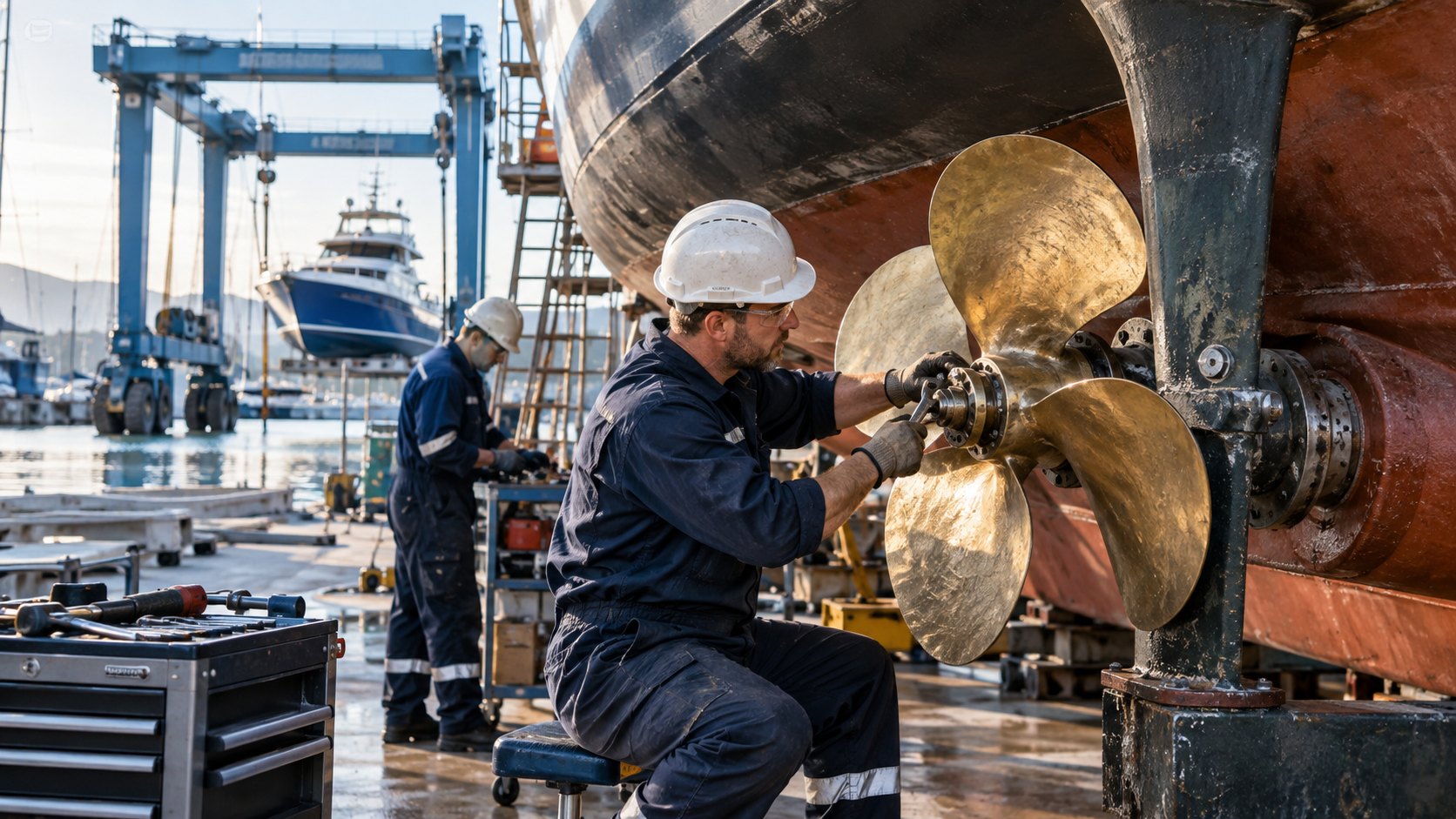
Activity CZ 42
How to Start a Marine Equipment Repair & Maintenance Business in Dubai
Most marine equipment is safety equipment, and safety equipment has service intervals. What this repair and maintenance line covers, who pays for it, and why the work returns whether anything has broken or not.
ConsultZone licensing desk
- Activity code
- CZ 42
- Category
- Manufacturing
- Reviewed
- Read
- 7 min
Listen instead
43 seconds
An audio summary of this guide.
Topic summary
How to Start a Marine Equipment Repair & Maintenance Business in Dubai
Take a working boat and list everything bolted to it. Liferafts, lifejackets, distress beacons, flares, extinguishers and fixed suppression systems, emergency steering, bilge pumps, navigation lights: a surprising share of a vessel's equipment is there in case something goes wrong. The rest is ordinary machinery worked hard in salt water — engines, gearboxes, shafts, winches, davits, cranes, hydraulics, deck gear, refrigeration.
This activity is the servicing of that equipment rather than of the vessel it is fitted to, and the distinction is the commercial point, not a technicality. A hull is repaired when it is damaged. Equipment carries service intervals, and a great deal of marine equipment cannot be left past its interval without the vessel's own paperwork falling out of date. The customer is therefore not deciding whether to spend; he is deciding who to spend it with. That is an unusually comfortable position for a workshop to occupy, and it is the reason this line is worth understanding properly before choosing between it and general mechanical repair.
What the activity covers
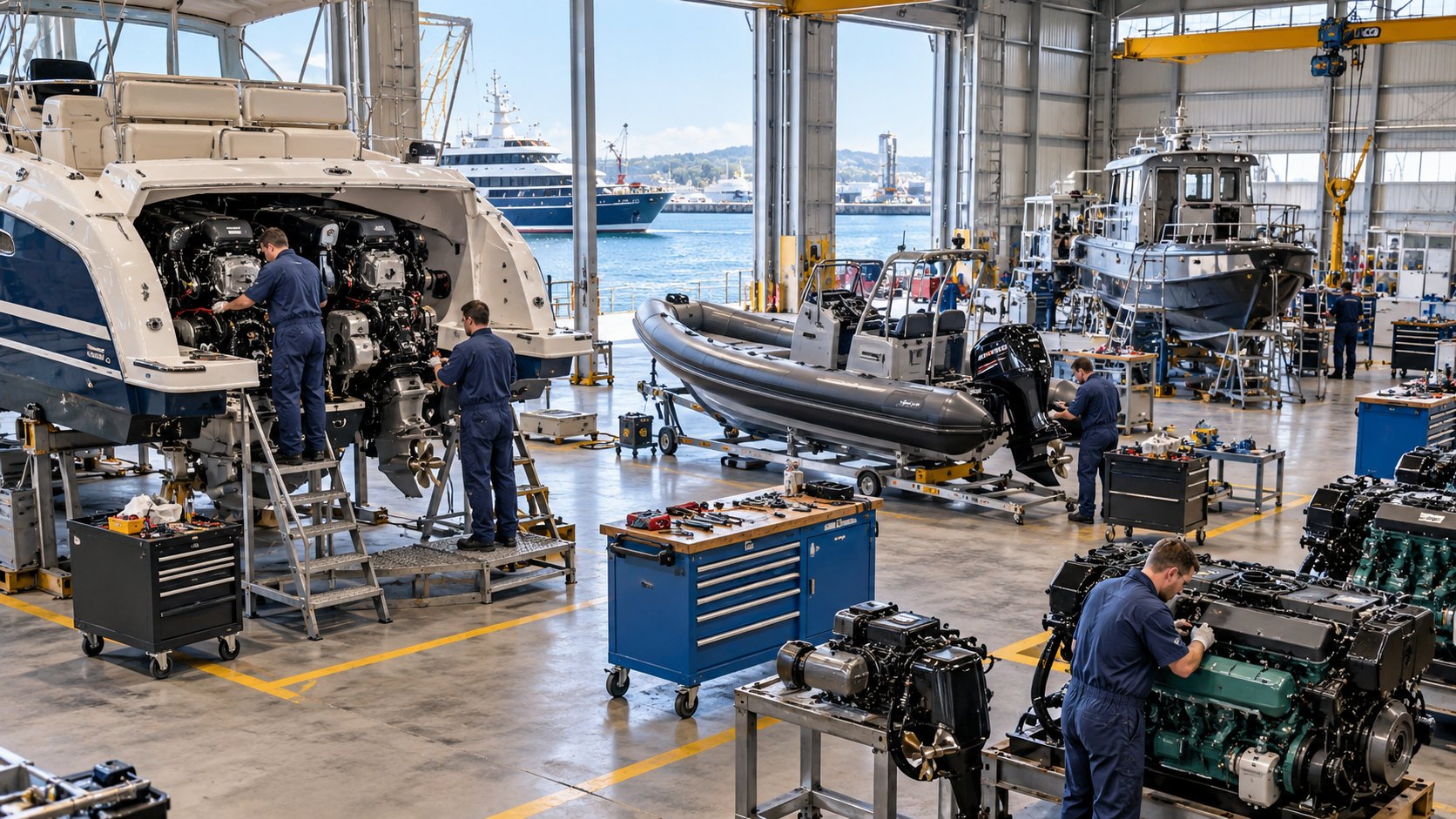
Three families of work sit under it, and they call for different people, different tooling and different levels of paperwork. A shop that starts in one of them and grows into the others is following the normal path; a shop that claims all three on day one is usually claiming the scope of approval rather than the capability.
Machinery and deck equipment
Inboard and outboard engines, gearboxes and drives, steering and hydraulics, winches, windlasses, capstans, davits and small deck cranes, pumps, compressors, generators and refrigeration. The skills here are mechanical and hydraulic, the tooling is conventional, and the competition is everybody else with a workshop and a van. What separates a marine shop from a general one is understanding what salt, heat and constant vibration do to a machine, and quoting for that rather than for the textbook failure.
Safety and lifesaving equipment
Inflatable liferafts and lifejackets, immersion suits, hydrostatic release units, portable and fixed firefighting equipment, emergency beacons, lifebuoys and line-throwing gear. This is the part of the trade that behaves like an annuity. Inflatable and pressurised equipment has to be opened, inspected, tested and repacked periodically; cylinders and cartridges have their own service lives; beacon batteries expire on a date printed on the unit. None of that depends on anything failing, which means the work is scheduled, repeatable and forecastable years out. It also demands a clean, controlled space and, for most equipment of any consequence, the manufacturer's own service authorisation and training — which is a real barrier and, once held, a real advantage.
Navigation and communication equipment
Radar, echo sounders, autopilots, chart plotters and satellite navigation, VHF and satellite communication sets, distress beacons and their antennas. Here the constraint is not mechanical at all. Radio and radio-emitting equipment in the UAE is subject to type approval by the Telecommunications and Digital Government Regulatory Authority, and equipment that has not been through that process is not equipment you should be fitting to a customer's boat.¹ A shop working on this family should know the approval status of what it installs, not just how to wire it.
The buyers, and the route to them
Four kinds of customer pay for this work, in descending order of how reliably they pay.
Commercial operators — workboats, crew and supply boats, tugs, barges, dive and tour boats, fishing vessels — are the core of the market, because their equipment schedules are not optional and their vessels earn money only while they are in service. Yards and marinas are the second route, and often the first one a new shop actually gets: refit and repair yards subcontract specialist equipment work rather than employing every trade, and getting onto that subcontract list is worth more than any advertising. Fleet and institutional owners — operators running many similar hulls — buy planned maintenance by contract, which is the most valuable revenue in this trade and the slowest to win. Private leisure owners are the most numerous and the least dependable: seasonal, price-led, and inclined to defer.
The route to all four is the same and it is not marketing. It is holding the maker's service authorisation for equipment that is already fitted to the boats in your area, being physically close enough to the water to get to a vessel in a morning, and holding the service history on hulls you have worked on before. The last of those is the quiet one. Once your name is on the service documentation for a fleet's rafts and extinguishers, the cost of moving that work to somebody else is not the price difference; it is the discontinuity in the paperwork.
Conditions that attach to the goods
The equipment itself brings obligations that a plain mechanical workshop never meets, and they land on the premises as much as on the work. Distress flares and line-throwing rockets are pyrotechnics, so storing them is storing explosives.² Servicing inflatables means compressed gas cylinders. Refinishing and antifouling means solvents and paints. Engine work means waste oil, coolant and filters that have to leave the site lawfully. Each of those is a separate condition applied by a separate body, and the order they arrive in is what decides whether a fit-out is done once or twice.
The emirate's economic department
- The trade licence carrying the repair activityFirst; nothing else can be applied for without it
The municipality
- A workshop unit the activity is permitted to run inWith the tenancy, before the fit-out, not after
- Disposal of waste oil, solvent and antifouling residueContinuously, for as long as the shop works
Dubai Civil Defence
- Storage of flares, gas cylinders, paints and solventsBefore anything flammable or explosive arrives
The federal telecommunications authority
- Type approval for radio and distress beacon equipmentBefore that equipment is fitted or sold
The drawing makes the practical point better than a list does. One body holds two of the five gates, and both of them are about the unit you have signed a lease on. A workshop taken on a standard commercial tenancy and then fitted out for solvent storage and cylinder handling is the most common and most expensive mistake on this line.³
Imported spare parts, cylinders, pyrotechnics and electronics also meet controls at the border, and some of those categories are restricted rather than simply dutiable, so the customs position belongs in the plan from the start rather than in the first shipment.⁴ What any of this costs, what documents each body asks for and how long each takes depend on the emirate, the unit and the exact scope applied for. Those are confirmed against the issuing authority for the specific case, and we would rather tell you the sequence accurately than quote you a timeline we cannot stand behind.
Where this is the wrong purchase. If the plan is to import and sell marine equipment, chandlery or spares rather than to service them, this is not the activity — a trading line fits the business and carries lighter premises conditions. If the plan is hull, structural or shipyard work on the vessel itself, that is a different line again, and the two are complementary rather than interchangeable: many shops on this activity earn their first years as a subcontractor to exactly those yards.
The mainland and free zone question resolves itself once the customers are named. Work performed on UAE-flagged and UAE-based vessels, for UAE operators, on UAE soil, points to a mainland licence. A shop whose business is servicing equipment that arrives, is worked on and leaves again without entering the local market has a genuine free zone case. Most shops on this line find they are the first kind.
References
- Telecommunications and Digital Government Regulatory Authority — type approval for radio, satellite communication and distress beacon equipment. Telecommunications and Digital Government Regulatory Authority
- Dubai Civil Defence — fire safety approvals for holding flares, compressed gas cylinders, paints and solvents on a workshop site. Dubai Civil Defence
- Dubai Municipality — premises suitability and the lawful handling of waste oil, solvent and antifouling residues. Dubai Municipality
- Dubai Customs — importing spare parts, cylinders, pyrotechnics and electronics, and goods subject to control at the border. Dubai Customs
Elsewhere in Manufacturing
Activities that sit beside this one
Most licences carry more than one activity. Adding a neighbouring line at the application stage costs a fraction of amending the licence afterwards.
Begin with a clear conversation
Tell us what you intend to build.
A consultant will map the structure, jurisdiction, approvals and likely cost against what you actually described — not against a package.
