

Activity CZ 41
How to Start a Light Aircraft Maintenance & Repair Business in Dubai
Light aircraft answer to an approval regime built for airliners. What the maintenance and repair line covers, which three fleets pay for it, and why a part is worth only what its paperwork says.
ConsultZone licensing desk
- Activity code
- CZ 41
- Category
- Manufacturing
- Reviewed
- Read
- 7 min
Listen instead
47 seconds
An audio summary of this guide.
Topic summary
How to Start a Light Aircraft Maintenance & Repair Business in Dubai
A four-seat trainer and a wide-body airliner have almost nothing in common that a mechanic would recognise, and they answer to almost the same framework of approvals. That is the shape of this business in one sentence. As the airframe gets smaller the customer gets poorer, the invoices get shorter, and the obligations barely move — which is why light aircraft work is a specialist trade with few serious entrants rather than the cheap way into aviation it looks like from outside.
Aircraft maintenance in the UAE is an approved-organisation activity. The shop holds an approval in its own name, the engineers hold their own qualifications, and every task is signed off against the aircraft manufacturer's published procedures rather than against the judgement of whoever is holding the spanner. The General Civil Aviation Authority is the federal body that operates that framework for UAE aircraft and aviation personnel, and its approvals are what decide whether a shop may release an aeroplane back to service at all.¹ A trade licence from an economic department makes you a company. It does not let you touch an aircraft. Both are needed, and they are nowhere near equally hard.
The planning consequence is worth stating plainly: build the file backwards from the technical approval rather than forwards from the licence. What the licence costs to hold, and what conditions attach to it, depend on the emirate, the premises and the scope of work applied for, and we confirm those for the specific case. The order in which the two are won does not vary.
The three fleets, and none of them wants the same thing
General aviation here is not one market. It is three, with genuinely different economics, and a shop that treats them as one subsidises the cheapest of them out of the profits of the dearest.
Flight schools and training fleets
Training aircraft are flown hard, by people who are learning, in heat and dust. Utilisation is high enough that inspections arrive on flight hours rather than on the calendar, so the work is frequent, repetitive and largely foreseeable. What a school buys is turnaround: an aeroplane in your hangar is a lesson schedule not being flown and a student not being billed. They are also the most price-sensitive of the three, because the aircraft are old, the fleet is standardised and a fixed-price inspection on a tired airframe is exactly where a shop's margin quietly disappears.
Private owners
One aircraft, flown occasionally, usually ageing, often loved. Here the driver is the calendar rather than the hour meter, and the spend is discretionary in a way the other two are not: an owner can defer, sell or move the aeroplane somewhere cheaper. They buy on trust and they argue about the bill, and they tend to authorise work late and in pieces, which is difficult to schedule around.
Small charter and corporate operators
The best payers and the hardest to win. Their maintenance is dictated by their own operating obligations rather than by preference, an aircraft on the ground is revenue lost, and the work is planned months ahead and contracted. In exchange they want records they can be audited against, and they will ask to see how you keep them before they give you an airframe.
| Flight schools | Private owners | Charter operators | |
|---|---|---|---|
| What brings the aircraft in | Flight hours, reached quickly | The calendar, reached slowly | Their own operating obligations |
| What they judge you on | Turnaround, above everything | Trust, and the size of the bill | Records, and whether you can be audited |
| How predictable the work is | Frequent and foreseeable | Occasional and deferrable | Planned months ahead |
| Where the margin goes thin | Fixed-price checks on tired airframes | Work authorised late and in pieces | Cover and availability you carry for them |
Read the middle row as the commercial answer. Predictability is what a hangar sells, because a hangar is a fixed cost whether an aeroplane is in it or not.
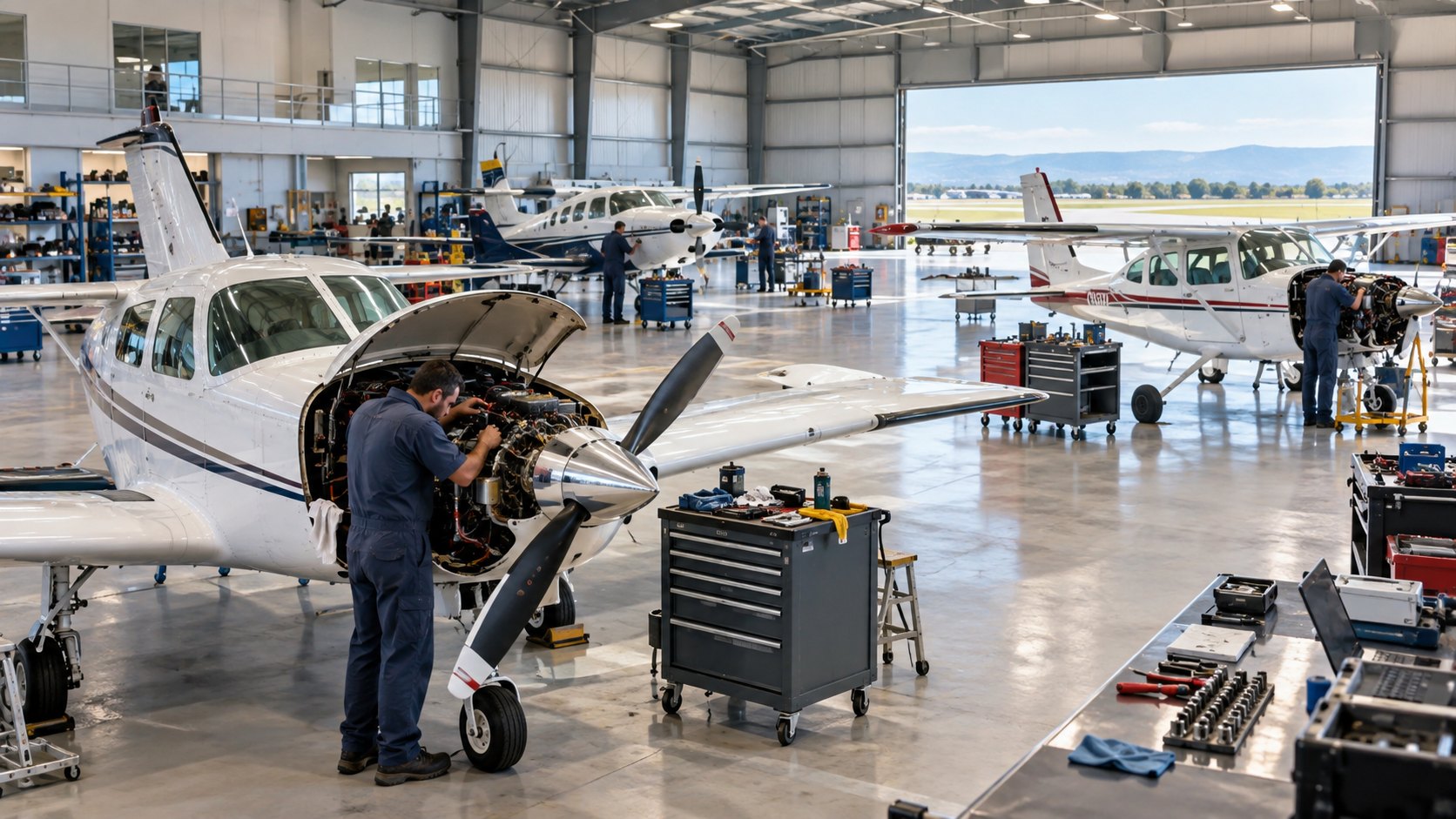
CZ 41 — Light Aircrafts Maintenance & Repair
Under this line sits the upkeep and repair of light and general-aviation aircraft: scheduled inspections at their published intervals, rectification of defects, removal and replacement of components, engine and propeller work within the shop's approved scope, avionics fitting and repair, sheet-metal and composite repair, weighing, and the technical records that accompany every one of those tasks.
The records are the product
This is the part that surprises people arriving from general engineering. The physical work on a light aircraft is often modest — a few hours with hand tools. What the customer is actually buying is a signed statement that the work was done to the manufacturer's procedure by a qualified person, and that statement is what returns the aeroplane to service. A job done perfectly and documented badly has not been done. Shops on this line live or die on their technical library, their task cards and their filing.
A part is worth what its paperwork says
A component with no traceable history is scrap, however good it looks and however well it tests. Serviceable parts arrive with documentation tying them to an approved source and, where the part is life-limited, to the hours and cycles already used. Break that trail and you have converted an asset into landfill. Two things follow. Your working capital sits in traceable inventory rather than in tools, and your buying discipline matters more than your buying price. Aircraft components are also imported goods with their own controls at the border, so the customs side of the trade is part of the operating plan rather than an afterthought.²
The engineers are the binding constraint
Not premises, not capital. Licensed engineers whose qualifications cover the aircraft types you intend to serve are a small population, and you cannot recruit scale into this business at short notice. Plan the aircraft types you will accept around the people you can actually employ, and resist the temptation to widen the scope of approval faster than the team can carry it.
The hangar decides the jurisdiction
The work has to happen where the aircraft is, which means the shop needs somewhere an aeroplane can lawfully be parked, opened up and worked on. That physical requirement — apron or hangar access at an aerodrome you can get into, with the storage, tooling and fire provisions the work implies — is what narrows the jurisdiction question. Choose the site first and let the site shorten the list of licensing authorities, rather than choosing a licence and then discovering there is no ramp attached to it.
What the licence does not cover
The boundaries on this line are hard ones, and each of these is somebody else's activity and somebody else's approval.
Flying the aircraft is not maintaining it, so flight training and charter or air-taxi operation both sit outside. Buying and selling aeroplanes, engines or components as a business is trading, not maintenance. Making parts is production. Ground handling, refuelling and letting hangar space are services to an aircraft rather than work on one. Designing or approving a modification is an engineering approval in its own right and is distinct from carrying the modification out. Unmanned aircraft answer to their own framework. And heavy base maintenance on airliners is a different scale of approval, different tooling and a different business, however similar the trade looks on paper.
Where this is the wrong purchase. If the intention is to supply parts, instruments or avionics to other shops and operators rather than to work on aircraft yourself, this activity is the wrong instrument and an aviation trading line will serve you better and cost less to hold. If the intention is to fly people or freight, the operating approval is the thing that matters and maintenance is something you will buy rather than sell.
The exact approvals, scope wording and conditions differ between emirates and between a mainland licence and a free zone one, and they change with the aircraft types and tasks applied for. Those are confirmed against the authority that will actually issue them before anything is committed, which is the one step on this line that is genuinely cheap to get right and expensive to get wrong.
References
- General Civil Aviation Authority — aircraft airworthiness, maintenance organisation approvals and aviation personnel licensing in the UAE. General Civil Aviation Authority
- Dubai Customs — importing aircraft components and consumables, and goods subject to control at the border. Dubai Customs
- UAE Government portal — the federal civil aviation framework and general government information. UAE Government portal
Elsewhere in Manufacturing
Activities that sit beside this one
Most licences carry more than one activity. Adding a neighbouring line at the application stage costs a fraction of amending the licence afterwards.
Begin with a clear conversation
Tell us what you intend to build.
A consultant will map the structure, jurisdiction, approvals and likely cost against what you actually described — not against a package.
