
Activity CZ 40
How to Start a Helicopter Repair & Maintenance Business in Dubai
Most helicopter maintenance is not repair at all. It is replacing parts that still work because their stated life has run out, and that is what makes the trade plannable.
ConsultZone licensing desk
- Activity code
- CZ 40
- Category
- Manufacturing
- Reviewed
- Read
- 7 min
Listen instead
51 seconds
An audio summary of this guide.
Topic summary
How to Start a Helicopter Repair & Maintenance Business in Dubai
The largest single category of work on a helicopter is removing components that are in perfect condition. Main and tail rotor blades, hubs, the main gearbox, the transmission and the control linkages are dynamic components, and dynamic components carry a stated life — measured in flying hours, in cycles, or simply on the calendar. When that life expires the part comes off, whether or not anything is wrong with it, and it comes off on a date that was known years in advance.
That is the fact to build a business plan on, because it makes the revenue legible. A shop that knows the fleet it serves, and the hours those aircraft actually fly, can see most of next year's work from here. It also fixes where the money is tied up. High-value rotables have to be on the shelf or on order before their due date, not ordered when the aircraft arrives, so the working capital in rotary-wing maintenance sits in parts and in exchange arrangements rather than in hangar steel. A shop with a full order book and no spare gearbox is a shop with a grounded customer.
The other half of the work is unscheduled — defects, damage, corrosion, a component that fails an inspection — and it behaves in the opposite way. It arrives without warning, cannot be forecast, and the aircraft waits on a diagnosis rather than on a delivery. A good shop is really two businesses running on one floor: a predictable one it plans around and an unpredictable one it keeps capacity for.
Rotary wing is a different trade, not a smaller version of the same one
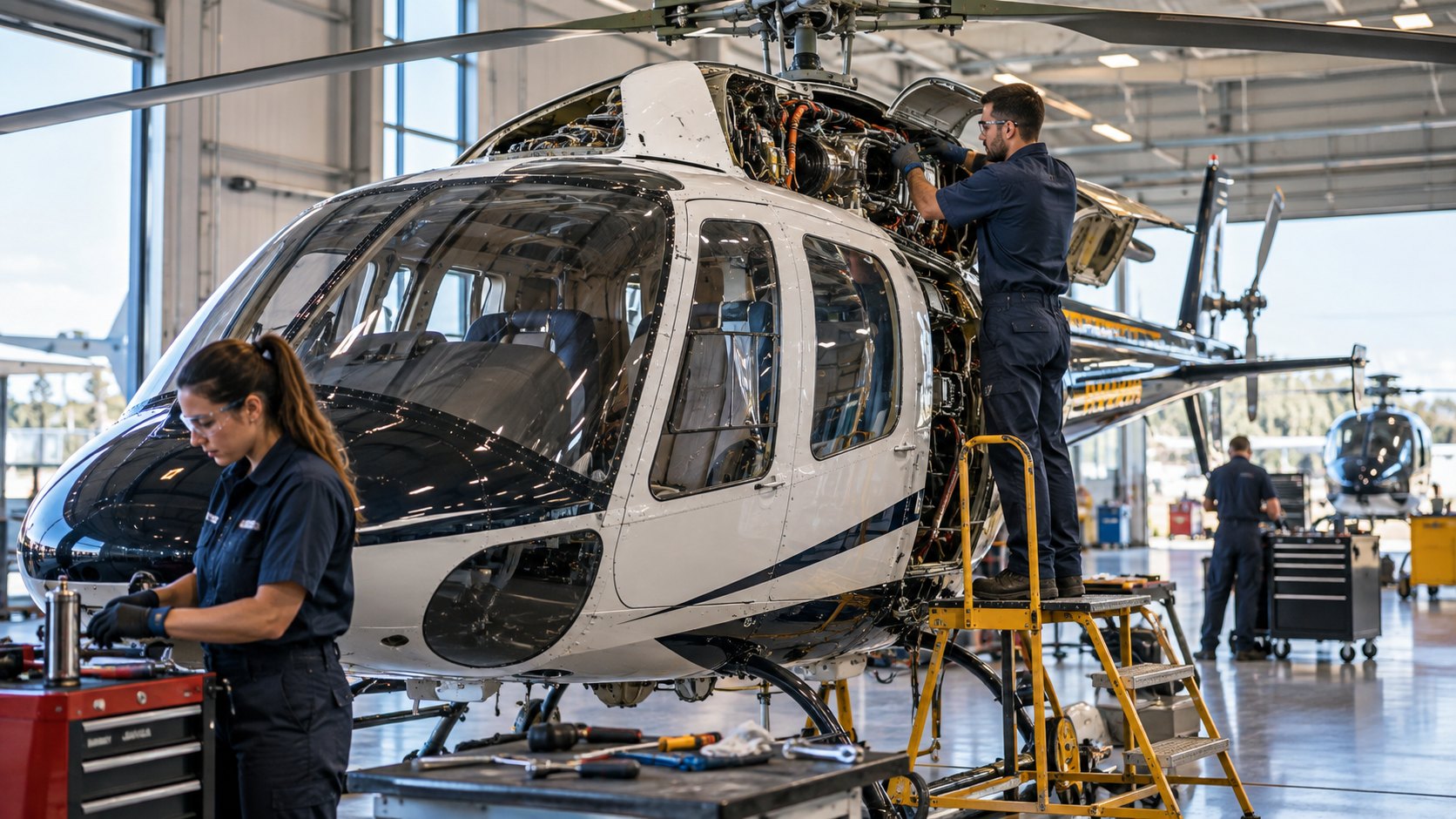
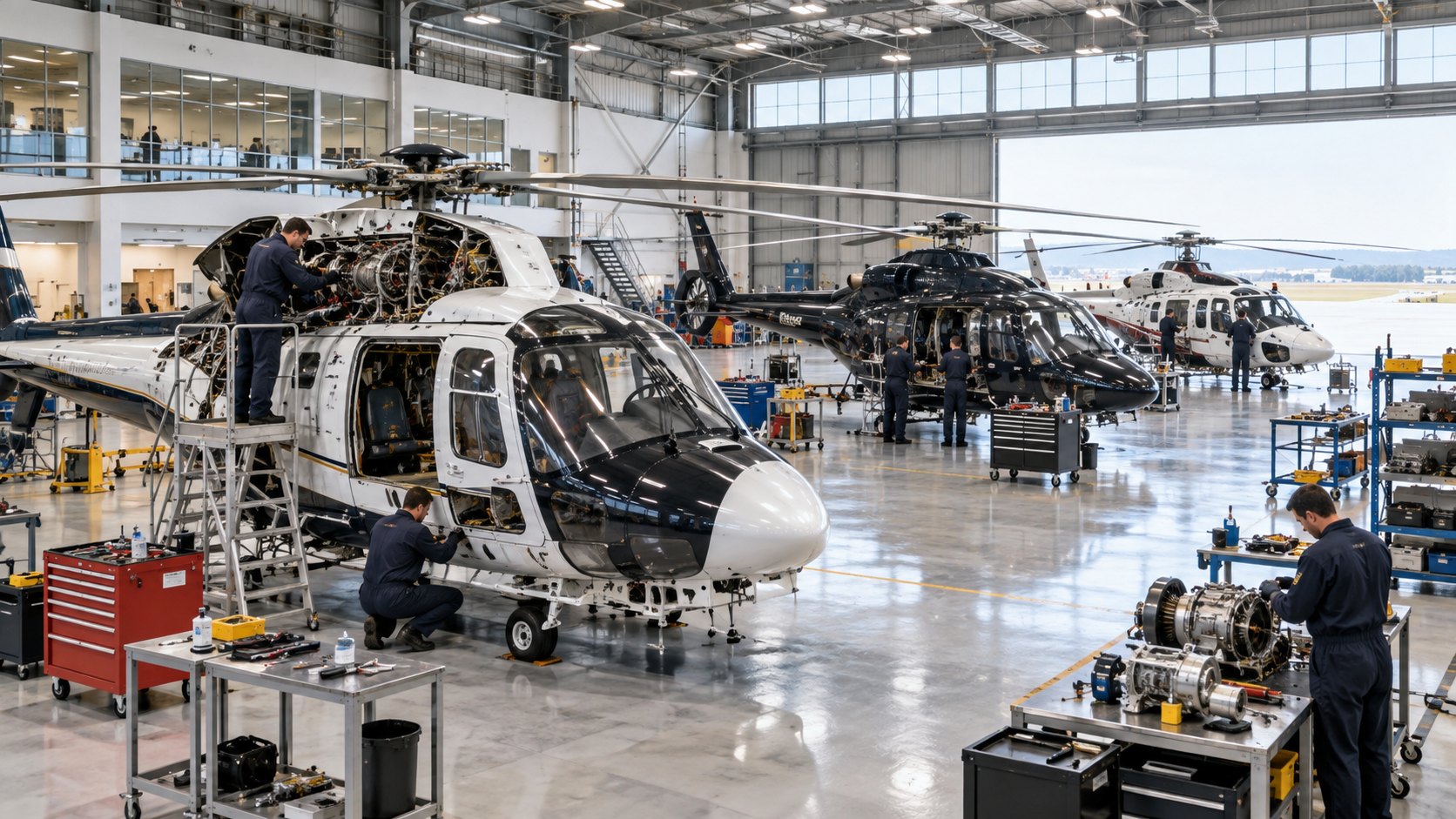
Under this activity you inspect, maintain and repair helicopters: scheduled inspections against the aircraft's maintenance programme, life-expired component replacement, defect rectification, structural and corrosion repair, engine removal and fitting, avionics and equipment fitted under approved data, and the record-keeping that lets the aircraft fly again. Rotor track and balance work belongs here too and is worth naming separately, because it needs specialist measuring equipment and a technician who can read it — a vibration signature is diagnostic on a helicopter in a way it never is on an aeroplane.
Two boundaries matter more than the rest. The first is with the line immediately before this one on the same sheet: CZ 39 covers passenger and cargo aircraft repair, and a capability built for transport aeroplanes does not reach helicopters. An approval's scope is written by aircraft type, so the two are separate capability lists, separate tooling, separate training and in practice separate businesses — which is why they are two activities and not one. Where a group wants both, it is holding two scopes, not a wider version of one.
The second boundary is with flying. Operating the aircraft — carrying passengers, flying tours, running an air ambulance or an offshore shuttle — is an operator's business and an entirely different approval. This line maintains aircraft; it does not fly them. Nor does it reach the overhaul of the components themselves, which is bench work usually done inside the manufacturer's own network, or the making of parts, which is manufacture.
- Establish which authority oversees the aircraftYour approval's scope has to reach that aircraft before anything else on this list matters
- Read the maintenance programme before the defect reportMost of the work on a rotary fleet is scheduled against calendar, hours and cycles
- Is the item now due a component with a stated life
- YesIt comes off on schedule whatever its condition, and the replacement must be on the shelf or on order before the date, not after the aircraft lands
- NoIt is defect rectification, and the aircraft waits on a diagnosis rather than on a delivery
- Carry out the work under approved data and the shop's own quality systemThe record is written as the work happens, because it cannot be reconstructed later
- The release that puts the aircraft back in serviceThe one document the owner is actually paying for
The buyer is closer than an airline procurement desk
Rotary-wing owners in this region are a small, identifiable group, and that changes how the business is sold. There is no tender portal to win; there are a few dozen relationships, and availability is usually a contractual promise the owner has made to somebody else.
Operators maintaining their own fleet
Offshore energy support, government and police aviation and air-ambulance work all run on availability commitments, so bringing maintenance in-house is a control decision rather than a cost one. The owner is buying certainty over its own schedule and is prepared to carry the overhead for it.
Independent shops serving mixed owners
The classic entrant, and the hardest position to hold, because every additional aircraft type widens the capability list, the tooling and the training bill. The discipline is choosing two or three types and being genuinely good on them rather than nominally capable on eight.
Manufacturer-authorised service centres
Here the type data, the technical support and the parts channel arrive with the appointment, which removes the two hardest problems at the price of the freedom to work on anything else.
Narrow specialists
Blades, avionics fit, interiors, paint and corrosion treatment sold into other shops rather than direct to owners. Low overhead, high skill, and a customer base of competitors.
Where it sits between the mainland and a free zone
The physical requirement settles this before the tax position gets a hearing. A helicopter maintenance base needs a hangar, ground handling space, somewhere to run engines, and a pad or apron access for the aircraft to reach it. Land of that description exists in a small number of places, and which of them has room is what narrows the jurisdiction — not ownership rules and not licence cost.
A mainland licence is the direct answer where the customers are UAE-based owners, where government and semi-government fleets are in scope, and where the facility sits inside a municipality's area. A free zone suits a shop whose aircraft are largely foreign-owned and whose parts are held and re-exported without clearing into the local market. What neither licence includes is the pad itself: airside access, a taxi route and a parking position are arranged with whoever runs the aerodrome or heliport, and an investor who secures the company first and the access afterwards can find the two do not meet.
Parts logistics deserve a line of their own, because on a grounded aircraft they are a customs problem before they are an engineering one. A component needed overnight has to clear the border, and how the company is licensed and where it sits changes how quickly that happens and who can sign for it.¹ The engineering side is governed throughout by the General Civil Aviation Authority, which approves maintenance organisations and sets the airworthiness framework here; what your organisation may sign for depends on the scope it holds, and the conditions attaching to that scope are the substance of the plan rather than an appendix to it.² A hangar also holds fuel, solvents and compressed gases, so fire safety is a premises matter,³ and licensed engineers and technicians need work permits through the Ministry of Human Resources and Emiratisation.⁴
Where this is the wrong purchase. If the plan is to fly people — sightseeing, charter, corporate transport, medical evacuation — this activity will not carry it, and an air operator's approval is a different and much heavier undertaking. If the plan is to trade in helicopter parts rather than fit them, a trading line is cheaper to hold and does not require an approved organisation behind it. ConsultZone confirms the licensing route, the emirate and the approval path against the fleet you actually intend to serve.
References
- Dubai Customs — importing aircraft components and spares, customs codes and clearance of urgent shipments. Dubai Customs
- General Civil Aviation Authority — approval of maintenance organisations, scope of approval and the airworthiness framework applying to helicopter maintenance in the UAE. General Civil Aviation Authority
- Dubai Civil Defence — fire-safety requirements for hangars and for storing fuel, solvents and compressed gases. Dubai Civil Defence
- Ministry of Human Resources and Emiratisation — work permits and labour contracts for licensed engineers and technicians. Ministry of Human Resources and Emiratisation
Elsewhere in Manufacturing
Activities that sit beside this one
Most licences carry more than one activity. Adding a neighbouring line at the application stage costs a fraction of amending the licence afterwards.
Begin with a clear conversation
Tell us what you intend to build.
A consultant will map the structure, jurisdiction, approvals and likely cost against what you actually described — not against a package.
