
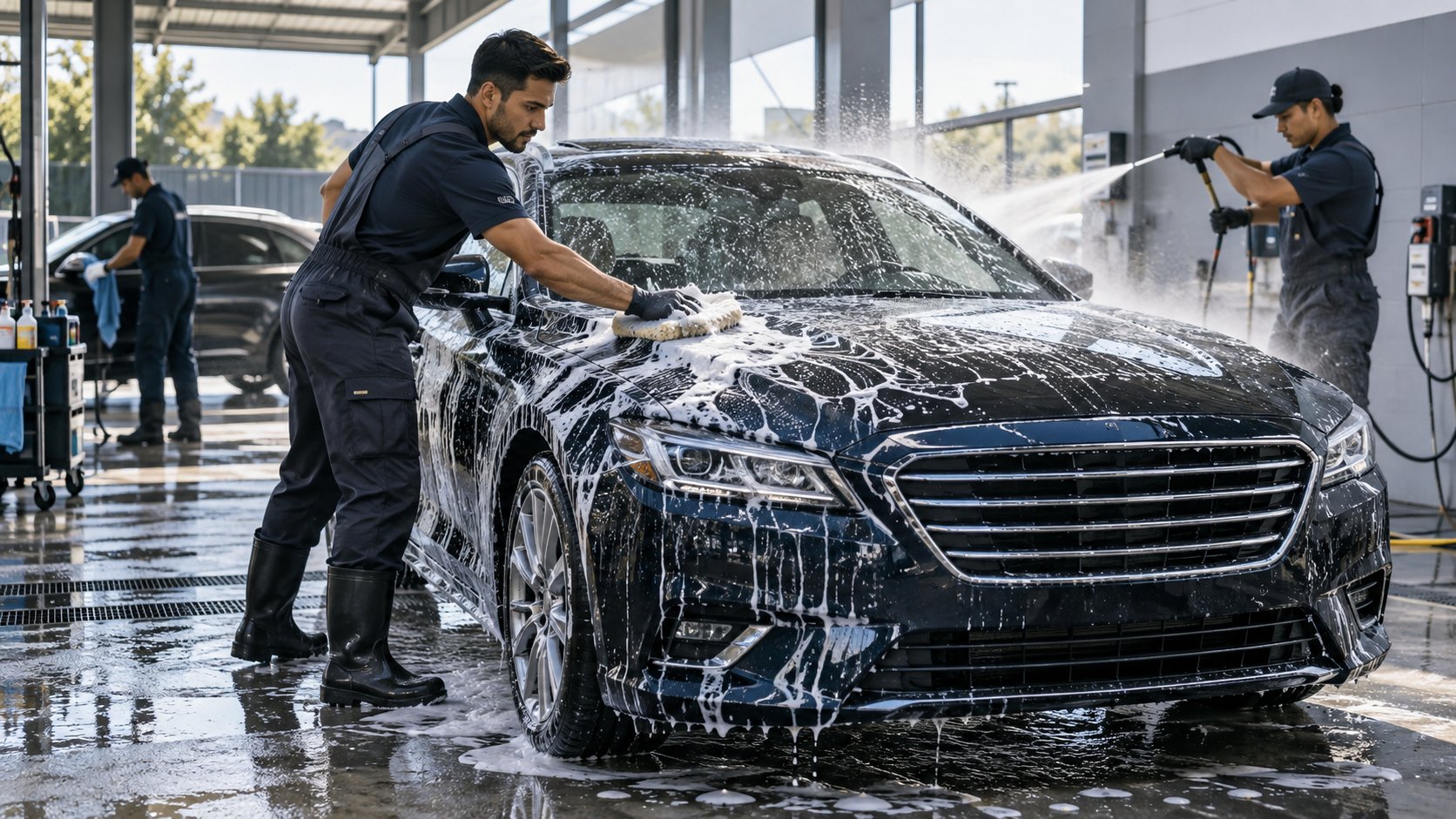
Activity CZ 86
How to Setup a Parking Car Washing Business in Dubai
Parking car washing is the line for washing vehicles on land you do not own. The permission is the asset, water is the constraint, and the deal with the building is the real business.
ConsultZone licensing desk
- Activity code
- CZ 86
- Category
- Trading
- Reviewed
- Read
- 7 min
Listen instead
43 seconds
An audio summary of this guide.
Topic summary
How to Setup a Parking Car Washing Business in Dubai
This is the only line in the vehicle-care family that is defined by what the operator does not have. There is no unit, no forecourt, no queue of cars waiting at a bay. The work happens where the cars already sleep — the basement levels of a residential tower, an office building's staff levels, a mall deck, a labour accommodation yard, a fleet compound — and every one of those places belongs to somebody else. Read that sentence twice, because it is the business.
The consequence is that the thing being bought and sold here is access. A fixed car wash competes on visibility and price: it needs traffic to drive past it and a reason to pull in. A parking operation has no traffic problem at all — the cars are parked in front of you, the owners live upstairs, and nobody has to be persuaded to make a journey. What it has instead is a landlord who can end the whole business with one letter to the building manager. Anyone entering this line is negotiating a concession as much as running a service, and the negotiation is the part that is usually underprepared.
The people this line suits are already talking to a building manager
The strongest entrant is somebody who holds the relationship before they hold the licence. A facilities management or cleaning contractor already working inside residential towers is the obvious case: the access, the trust and the building contacts exist, and washing cars is an added service sold to residents the contractor already sees every day. That is a far shorter route to revenue than starting cold.
Close behind is the fleet or property owner washing its own vehicles. A transport company, a rental operator, a school bus fleet or a hotel with a compound of its own has the vehicles, the space and the permission already settled, and the licence simply lets it stop paying somebody else — and then take neighbouring work in the spare hours.
Then there is the hands-on operator who wants a business without a lease. This line is genuinely attractive to that person, because the capital requirement is unusually low for a licensed activity: a trolley, consumables, a team, a way of taking payment. The trap is the mirror image of the attraction. Low entry cost means low barriers for everybody else, and the only durable advantage available is the agreement with the building. An operator who has not secured that in writing has not built anything a competitor cannot take next month.
The case that works least well is the investor expecting this to run itself. The work is distributed across places the owner does not control, performed by people nobody is standing over, on other people's expensive property. Supervision is the entire management problem, and it does not get easier with scale.
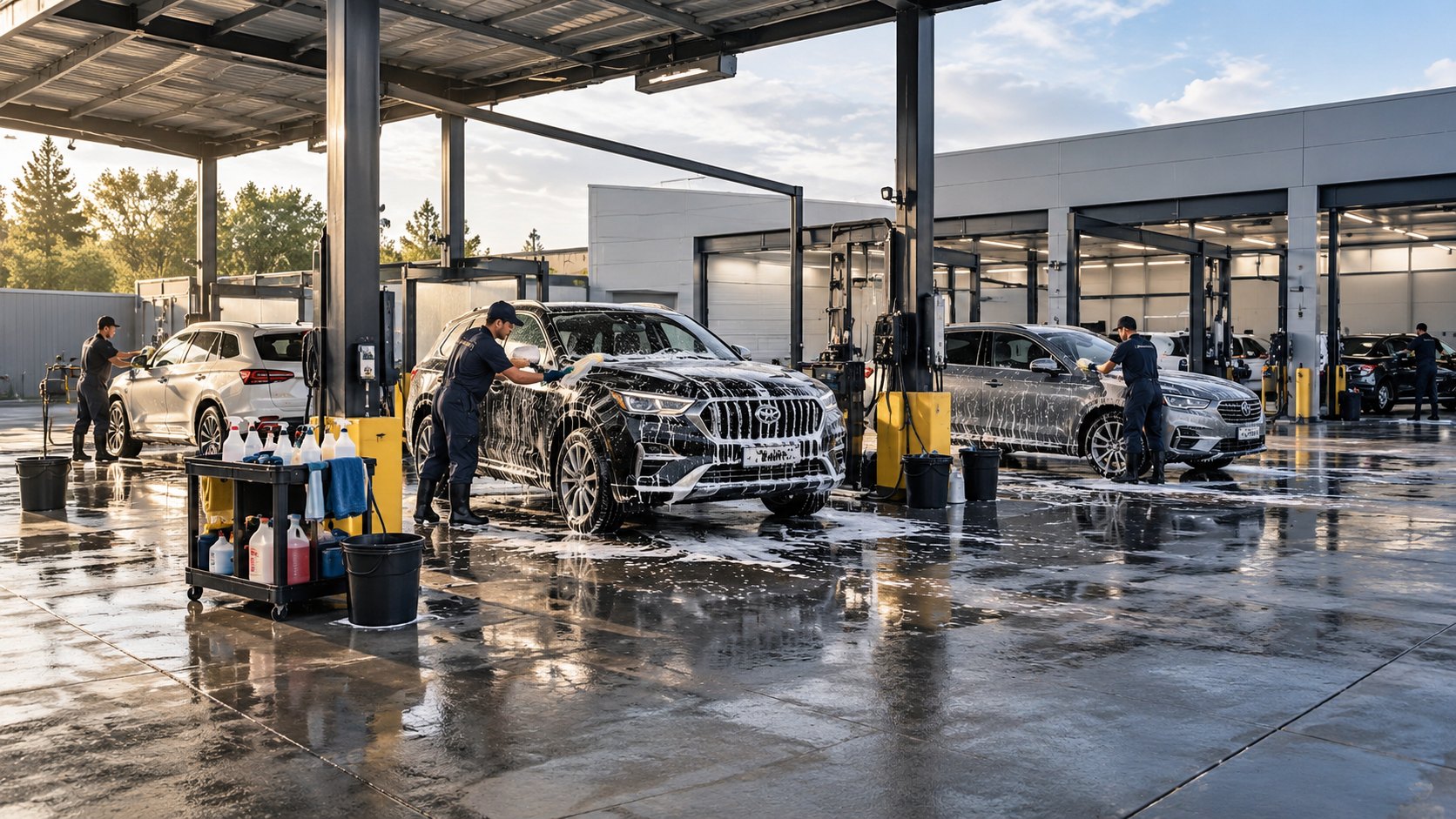
What the line lets you do, and the moment you have stepped outside it
It lets you wash and clean vehicles in a parking area. Exterior wash, interior vacuum and wipe-down, glass, wheels, the routine care a car needs between proper details. That is the honest centre of the activity.
It does not come with premises, and cannot manufacture them. Putting up a wash bay, a booth, a pressure-washer installation or a plumbed-in water point turns the operation into a fixed car wash, which is a different line in this catalogue with different premises conditions behind it. A structure you build in a car park is a structure, whoever owns the floor.
It does not cover mechanical or cosmetic repair. Paint correction is arguable at the edges; polishing and waxing are ordinary vehicle care, while machine paint correction, ceramic coating, scratch repair, dent removal, window tinting and upholstery work drift into detailing and bodywork trades that have their own activities. A team that starts offering to fix a kerbed alloy has moved off this licence.
It does not licence the car park. Operating the parking facility itself — managing spaces, charging for parking, valeting cars in the sense of moving them — is a separate business. The wash operator is a service provider inside somebody else's parking operation, not the operator of it.
It does not settle what the building will allow. The licence permits the activity; the property decides where and how. Those are two different permissions and only one of them comes from a government department.
Your premises belong to somebody else, and that is the operating problem
Three constraints decide whether a parking operation is profitable or merely busy, and all three point at the same thing.
Water and what happens to it afterwards. This is the binding constraint of the trade and it is not an administrative detail. Water is a scarce, charged resource in this country and a basement car park is drained for rain and fire water, not for a business discharging soapy run-off with road grime and oil in it every day. Whose water is being used, whose drain is receiving it, and whether the building's drainage may lawfully take it are questions for the municipality and for the property owner, and they are the reason so many operators work waterless or with a low-volume rinseless method from a trolley. The environmental logic and the commercial logic agree here, which is unusual and worth taking advantage of: less water means a lighter footprint, no drainage argument to lose, and access to levels a hose could never reach.
The agreement with the building. Access hours, which levels, where the trolley is stored, whether the team may use the service lift, what happens to a resident's complaint about a scratch, insurance, and the term. A verbal arrangement with a friendly building manager is not a term — it is a notice period of zero.
The team, and the fact that nobody can watch them. The work is unsupervised by nature, inside private property, around vehicles worth far more than the day's takings. Labour here is properly employed, properly permitted and properly trained, and the paperwork behind that is not the corner to cut: an informally engaged team is the quickest way to lose both the building and the licence. The routine and the finish have to be taught once and audited afterwards, because the customer's judgement is formed by the worst wash of the month, not the average one.
What it givesWhat it costs
- A concession over one large residential towerA closed book of cars that sleep where you workOne building manager who can end the business with a letter
- Spreading across several small car parksNo single landlord holds your entire revenueA team you cannot supervise, in places you do not control
- Washing with mains water and a hose on siteNothing to buy, and the fastest possible startA wet floor, a drain you do not own, and a manager who stops you
- Working waterless from a trolleyNo drainage argument to lose, and access to basement levelsConsumables on every car, and a technique that has to be taught
- Charging residents a monthly roundCash before the work, and a predictable weekYour price becomes a household line item, and household lines get cut
The marked row is the one worth arguing about, because it is where most operators are wrong in one direction or the other. A single tower is comfortable and fragile. A spread of small sites is resilient and hard to run well. The sensible shape is usually one anchor building that pays the fixed costs, plus smaller sites added only as fast as supervision can actually reach them.
As for what the licence costs to hold, there is no single figure and anyone quoting one has not asked the questions that determine it: the emirate, the jurisdiction, what the activity mix requires, whether an office address is needed at all for a service performed on other people's land, and the visa allocation the team will need. We establish the real position for the specific plan, including what the target buildings will and will not permit, before anything is filed.
References
- Dubai Municipality — waste water and drainage, public health, and premises conditions for washing vehicles in Dubai. Dubai Municipality
- Roads and Transport Authority — parking areas and vehicle-related permits in Dubai. Roads and Transport Authority
- Ministry of Human Resources and Emiratisation — work permits, labour contracts and wage protection for a mobile washing team. Ministry of Human Resources and Emiratisation
- UAE Government portal — water conservation and the general basis for commercial licensing. UAE Government portal
Elsewhere in Trading
Activities that sit beside this one
Most licences carry more than one activity. Adding a neighbouring line at the application stage costs a fraction of amending the licence afterwards.
Begin with a clear conversation
Tell us what you intend to build.
A consultant will map the structure, jurisdiction, approvals and likely cost against what you actually described — not against a package.
