
Activity CZ 87
How to Start a Mobile Auto Repair Business in Dubai
A mobile auto repair licence takes away the rent and the vehicle lift at the same time. Which jobs genuinely travel to the customer, which ones need a workshop bay, and what that boundary does to pricing.
ConsultZone licensing desk
- Activity code
- CZ 87
- Category
- Trading
- Reviewed
- Read
- 7 min
Listen instead
47 seconds
An audio summary of this guide.
Topic summary
How to Start a Mobile Auto Repair Business in Dubai
A mobile mechanic sells the same hour of labour as a workshop and can charge more for it, because the customer's alternative is a tow truck and half a day away from work. That is the entire commercial idea behind this activity, and it holds right up to the point where a job needs a two-post lift, a mains supply, an extraction hood or six uninterrupted hours with the vehicle standing still. Everything worth deciding about this licence sits on that line.
So the question this page answers is not how the licence is obtained. It is which repairs actually travel, which ones only appear to, and what the business looks like once it has been honest about the difference.
What you save in rent, you spend on the road
The saving is real, and it is what draws people to this line. There is no bay to lease, no compressor to install, no yard, and no fixed monthly cost that has to be covered before the first invoice is raised. A fitted-out van and a good tool inventory are the capital, and both are portable — which also means the business can be scaled down or moved without walking away from a lease.
The cost is utilisation, and it is easy to underestimate. A workshop with four bays has four vehicles in progress at once and a technician who never travels. A van has one vehicle in progress and a driver who spends a substantial part of the working day in traffic that nobody pays for. Two consequences follow. The labour rate has to carry the drive as well as the work, which is why undercutting a workshop on price is the fastest way to fail at this. And route density matters more than technical skill: four jobs inside one community pay far better than four jobs spread across the emirate, even when the second set are the more interesting repairs.
That is why operators who last in this line chase concentration rather than volume. A residential tower with two hundred parked cars, a delivery company with forty vans in one yard, a leasing fleet, a taxi operator, a bus depot, an office campus where staff leave their cars all day — each of these turns a day of driving into a day of billable hours. Domestic call-outs are the advertising; building and fleet agreements are the business.
The second discipline is parts. A van cannot carry a store, so a mobile operation either diagnoses before it travels and brings the component with it, or it arrives, quotes, leaves, and hopes to be invited back. The first version earns roughly twice the revenue per visit. In practice that means a phone conversation which is a genuine diagnostic interview rather than an appointment booking, and a supply relationship with a parts counter that will hold and hand over a component the same morning.
CZ 87 — Mobile Auto Repair Services
Under this line the business attends a vehicle where it stands and carries out repair and maintenance work there. The activity describes a method of delivery rather than a narrower kind of mechanical work, and it is the method that sets the limits.
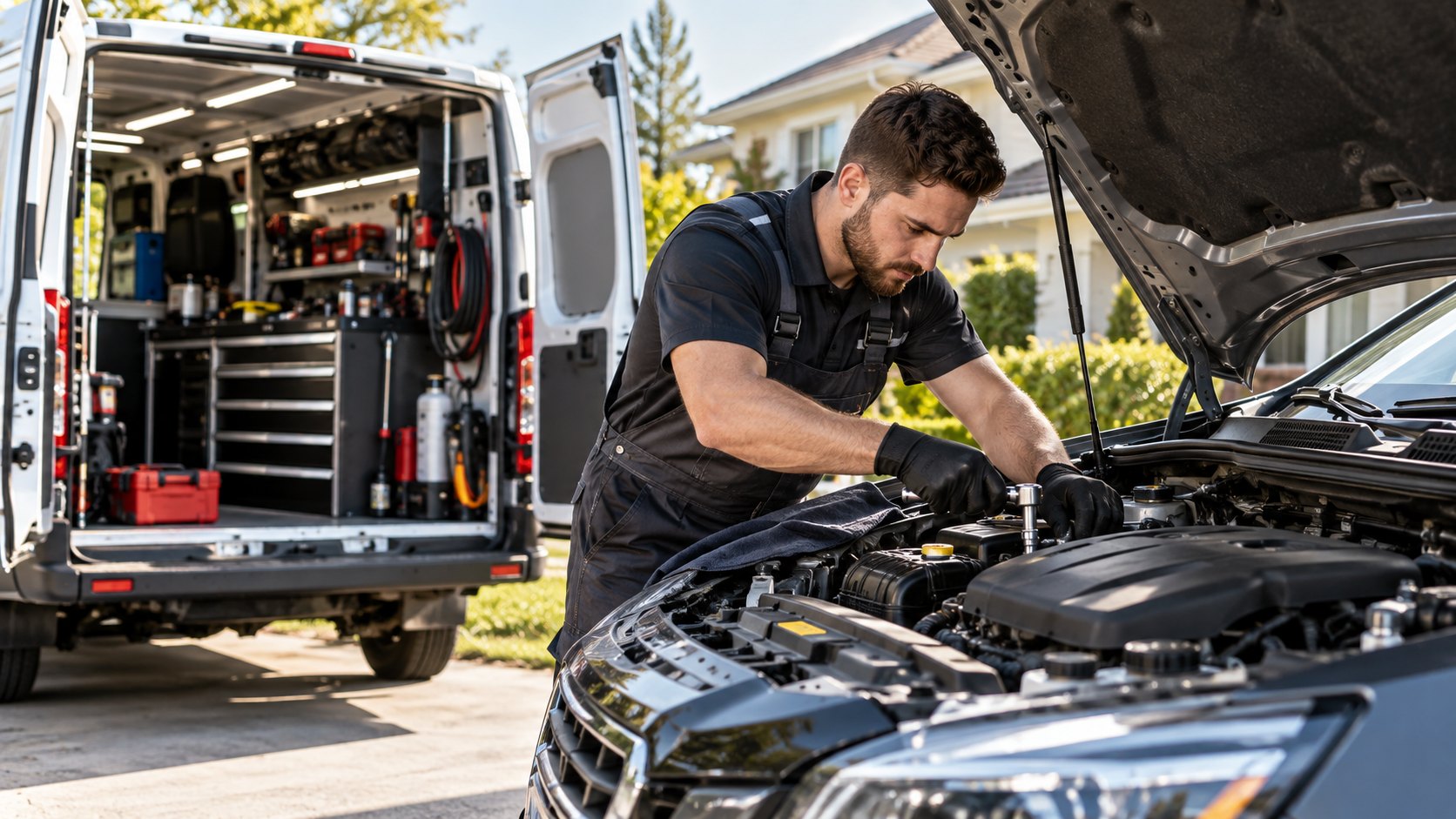
What travels well is anything that can be done with hand tools, a trolley jack on a level surface, a portable power source and a container to catch whatever comes out. Batteries and charging faults. Oil and filter changes. Brake pads, discs and fluid. Fault-code diagnosis and sensor replacement. Belts, hoses, coolant, plugs, wipers, bulbs and filters. Minor electrical work. Tyre changes, where the van carries the right equipment.
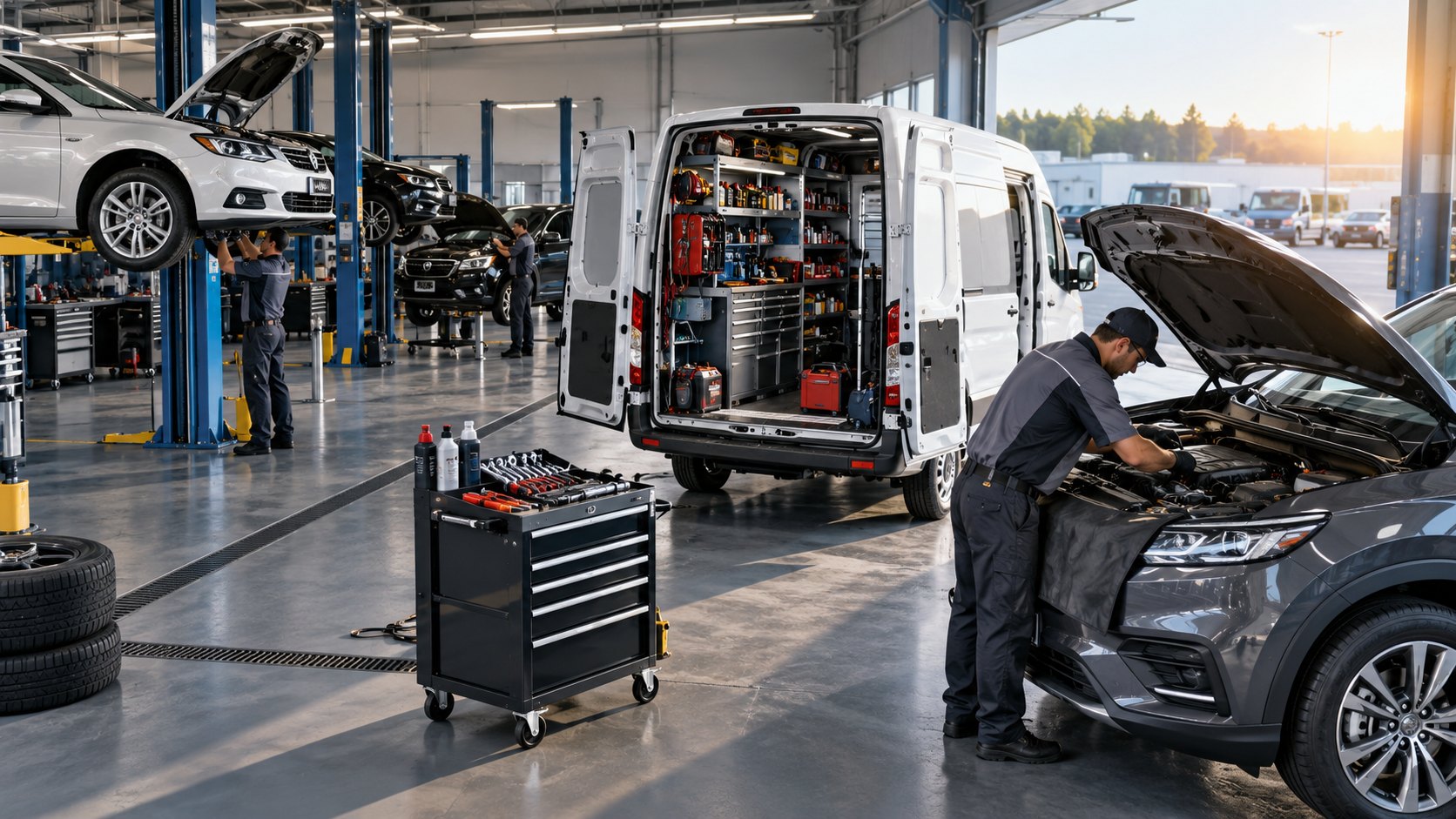
What does not travel is anything that needs the vehicle raised for hours, or needs a machine too heavy to ride in a van, or releases something that must be contained. Engine and gearbox internals. Clutch replacement. Air-conditioning work requiring refrigerant recovery. Bodywork, panel beating, paint and anything involving a spray booth. Welding and exhaust fabrication. Wheel alignment and balancing, which depend on fixed machinery. Recovery and towing, which is its own activity with its own vehicle permits.
seven kinds of job, three honest destinations
- Batteries, charging faults and starting problemsHand tools, a meter and fifteen minutes in a car park
- Oil, filters and fluid changesTravels only if the used oil leaves with you, sealed
- Brake pads, discs and fluidA jack, a level surface and a torque wrench are the whole requirement
- Fault-code diagnosis and sensor replacementThe job a customer most wants done without moving the car
At the vehicle
- Clutch, gearbox and engine internalsHours on a lift, and the car cannot be handed back part-finished
- Bodywork, paint and weldingContainment and extraction are the point, not the tools
In a workshop bay
- Tyre changes, alignment and balancingChanging a tyre rides in a van; the balancing machine does not
Either, with the right equipment
Read the shape of that rather than the rows. Four of the seven land at the vehicle, and they are the high-frequency, low-drama jobs every car needs several times a year — which is exactly the right foundation for a business built on repeat visits to the same buildings. The two that belong in a bay are the high-value repairs, and a mobile operator who wants that revenue holds a workshop or an arrangement with one rather than attempting them at a kerb. The last row is the trap: half the job is mobile and half of it is not, and quoting it as though all of it were is how a good visit becomes a complaint.
Working on ground you do not control is the condition that bites
The premises question does not disappear because the workshop does. A licence is issued to a company at an address, and the van is equipment rather than premises — so there is still a base to arrange, still a tenancy to record against the licence in most cases, and still a decision about how much space the tool inventory and parts holding actually need. What changes is the size of that space, not its existence.
The condition that catches operators out is the ground itself. Every place a vehicle is parked belongs to somebody: a building owner, a community management company, a mall operator, a landlord, or the authority responsible for the road. Permission to carry out mechanical work in that spot comes from whoever controls it, and it is entirely separate from anything written on your licence. Work carried out in public parking areas or at a road shoulder is a traffic and transport matter, and the authority that manages roads and vehicle permits in the emirate is the body with a view on it. The practical answer, and the one durable businesses reach, is written arrangements with building and fleet managers rather than treating every kerb as available.
Waste is the second condition and the one with real consequences. Used oil, oil filters, spent coolant, brake fluid and old batteries are controlled waste, not rubbish. A workshop has a collection contract and a storage point; a van has neither unless the business arranges both deliberately. What the municipality and the environmental authority in the emirate require of a mobile operator, and which licensed collector may take the material away, is worth settling before the first oil change rather than after a complaint.
Three further conditions apply as they would to any UAE company and are still worth naming. Liability cover, because a repair carried out at a roadside and the same repair carried out in a bay create the same exposure and only one of them happens under a roof you control. Work permits and labour contracts for the technicians, which sit with the federal labour ministry. And tax: the company falls inside the corporate tax net like every other UAE business, and enrolment for VAT becomes mandatory once taxable supplies pass the federal threshold the Federal Tax Authority publishes.
What the licence costs to hold, which approvals a particular emirate attaches to mobile mechanical work, and whether the intended activity mix needs one licence or two are all jurisdiction-specific. ConsultZone confirms them for the specific case before anything is filed.
References
- Roads and Transport Authority — vehicle and transport permits in Dubai, and the treatment of work carried out on roads and in public parking areas. Roads and Transport Authority
- Dubai Municipality — premises suitability and the handling of waste oil, filters and other controlled materials in Dubai. Dubai Municipality
- Ministry of Human Resources and Emiratisation — work permits and labour contracts for technicians. Ministry of Human Resources and Emiratisation
- Federal Tax Authority — VAT enrolment thresholds and corporate tax filing for a UAE services company. Federal Tax Authority
Elsewhere in Trading
Activities that sit beside this one
Most licences carry more than one activity. Adding a neighbouring line at the application stage costs a fraction of amending the licence afterwards.
Begin with a clear conversation
Tell us what you intend to build.
A consultant will map the structure, jurisdiction, approvals and likely cost against what you actually described — not against a package.
