
Activity CZ 68
How to Start a New Automobile Export Trading Business in Dubai
Trading new automobiles for export is a business built alongside the appointed-distributor system rather than inside it. What the export qualifier changes, and where the licence belongs.
ConsultZone licensing desk
- Activity code
- CZ 68
- Category
- Trading
- Reviewed
- Read
- 7 min
Listen instead
44 seconds
An audio summary of this guide.
Topic summary
How to Start a New Automobile Export Trading Business in Dubai
Every major carmaker sells into a country through an appointed distributor who holds the marque for that market, sets the price and carries the warranty. That arrangement is the reason this activity exists. A new-vehicle export trader buys unused stock outside, or at the edge of, that network and moves it to a market where a different distributor holds the same marque — and sells it there for less than the distributor does.
It is a long-established trade and Dubai is one of its centres, because the port, the free zone infrastructure and the concentration of buyers from three continents all sit in the same place. It is also a trade conducted permanently in tension with the makers, who would rather their pricing between markets were not arbitraged. Nothing about that is illegitimate. It does mean supply is the hardest part of the business and always will be, and that anyone entering it on the assumption that stock can simply be ordered has misread the activity.
The activity is unused stock, and the buyer is always somewhere else
Two words in the name do all the work. Unused means a vehicle that has never been in service — not merely a recent one, and not necessarily one bought from the local agent. For export means the vehicle is not being sold into the UAE market at all; it leaves.
That second qualifier changes what the company actually sells. A domestic dealer sells a car to a person who will drive it. An export trader sells a specification and a set of documents to a company abroad that will re-sell it, usually without either party seeing the other. So the product is three things, in this order:
- The right specification for the destination. Cooling, corrosion protection, lighting, instrumentation, equipment levels and the language of the software all differ between markets built for the Gulf, for Europe, for North America and for Africa. A car that is perfect here can be unsaleable or unusable there, and the buyer will have told you which build he wants in his first message.
- Documentation that survives a customs officer in another country. Invoice, ownership chain, chassis details and export paperwork have to agree with each other exactly. A single mismatch strands a container.
- A delivery date somebody can plan against. Export buyers are usually re-selling to a dated commitment of their own.
Where that stock comes from is the whole commercial question, and the three realistic answers behave very differently.
three sources, judged on the same five rows
| Judged on | The local agent | The parallel market | An overseas dealer |
|---|---|---|---|
| Choose the build specification car by car | Rarely | Yes | Yes |
| A buying price that still leaves an export margin | Seldom | Yes | Sometimes |
| The maker's warranty travels with the car | Yes | No | Depends on the market |
| You are inside the agency system rather than beside it | Yes | No | No |
| Supply you can plan a year of orders around | Yes | No | No |
Read the last two rows together, because they are the trade-off nobody warns new entrants about. The source that gives the best buying and the widest choice of specification is also the one that cannot promise you anything next month. Traders who grow in this line do so by holding several sources at once and by accepting that a proportion of enquiries will be declined rather than filled at a loss.
The trade suits people who already have somewhere to ship to
Founders with a buyer, not a plan to find one. This is the one that matters. A company with a standing relationship with two or three importers in a destination market has a business on day one. A company with stock and no buyer has a depreciating asset and a container booking.
People with a specification edge. Knowing which build satisfies which market, and being able to prove it before shipping, is a genuine and scarce skill. It is also what makes a buyer come back rather than shop the price.
Existing dealers with surplus. A distributor or large dealer whose allocation exceeds local demand is the natural seller into this channel, and the reason parallel stock exists at all.
Freight and logistics operators moving upstream. Companies already handling roll-on shipments and container loading who decide to take title to the goods instead of only carrying them. They start with the half of the business that is hardest to learn.
It suits nobody who expects the local agent to supply them. That is worth saying plainly because it is the most common misunderstanding: an export trader is not a sub-dealer, and no agency is granted by holding this activity.
Why the jurisdiction question answers itself more cleanly here
Most trading activities have a genuinely difficult mainland-or-free-zone decision. This one usually does not, and the reason is the definition of the activity rather than any rule about it: the goods are not intended for the UAE market and the customer is abroad.
A free zone is built for exactly that shape of business — holding goods, consolidating them and sending them out, with premises and warehousing designed around the port rather than around a showroom. A company that will never sell a car to a UAE buyer gains little from the ability to do so.
A mainland licence still makes sense in two situations. One is a company that wants the domestic market as well, in which case the export line sits alongside a domestic one rather than replacing it. The other is a company whose buyers want it to hold a wider set of activities in its own name locally.
What neither structure does is settle the specifics. Which authority, which premises, what the activity is permitted to be paired with, and what a vehicle has to satisfy if it is ever entered into the UAE market instead of shipped, all depend on the jurisdiction chosen and on the emirate. Those are the questions we answer against a real plan — the destination markets, the volume, the sourcing and whether a domestic channel is wanted — before a structure is chosen. A page that named a figure here would be guessing.
How the cars actually leave, and what that does to the business
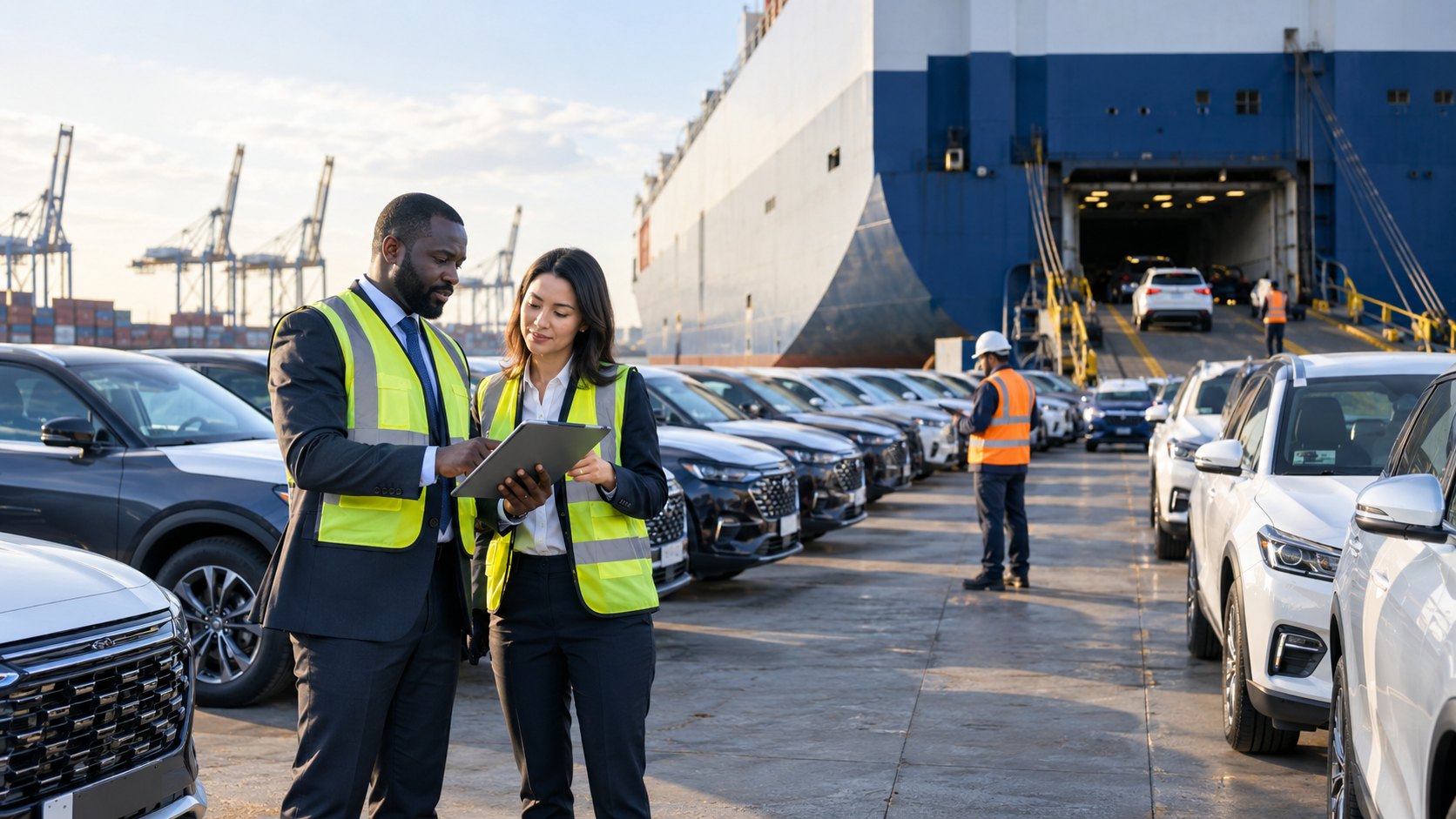
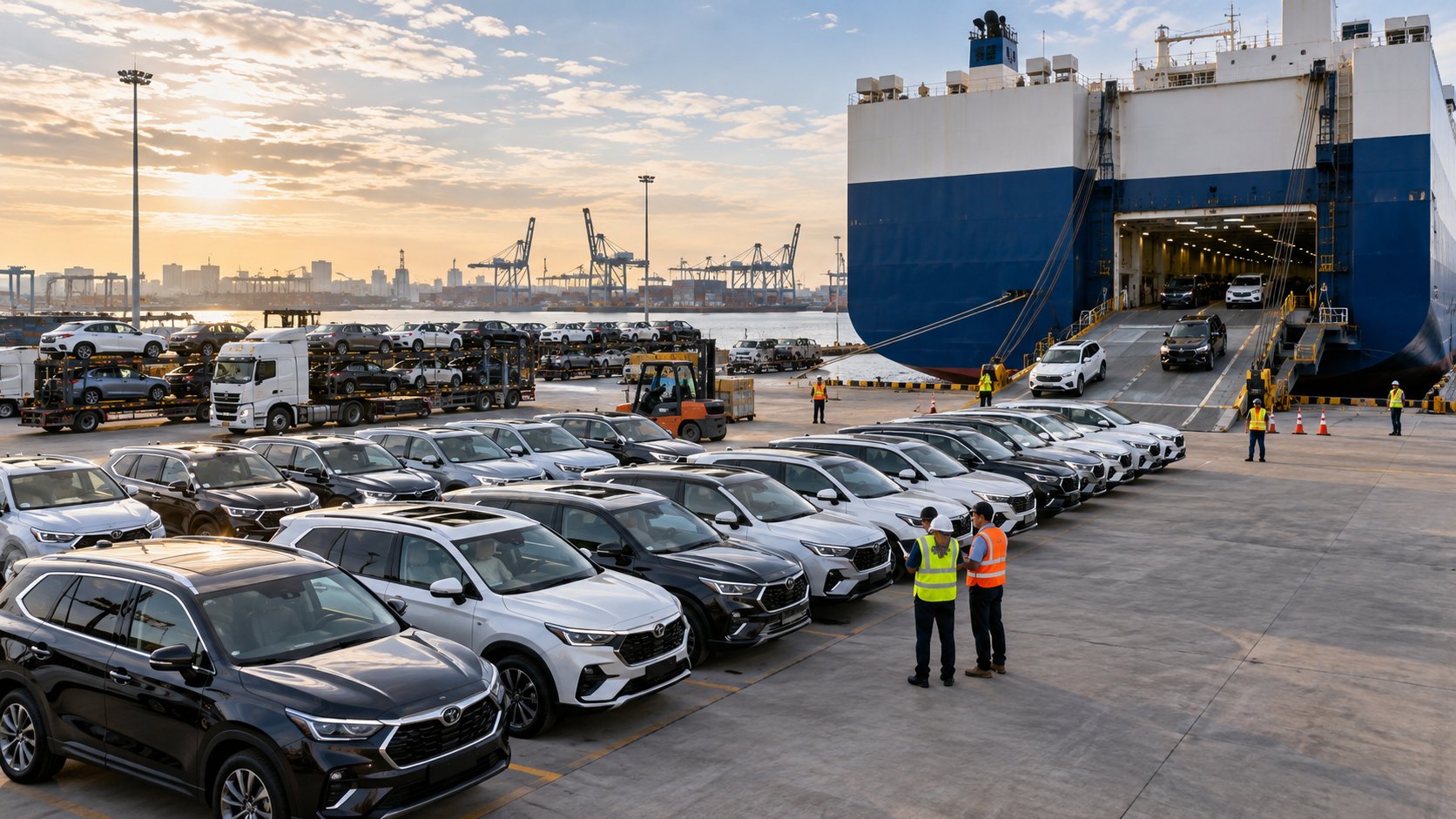
A vehicle leaves in one of two ways: driven aboard a vessel built to carry rolling stock, or loaded into a container and braced inside it. Which one is a commercial decision, and in this trade it is taken before the car is bought rather than after it is sold.
Containerised carriage changes the unit of sale. A part-filled container costs what a full one costs, so the arithmetic in this business runs per container and not per car. That is why so much of an export trader's week goes on consolidating — matching several vehicles bound for the same destination, waiting for another trader's cars to share a box, or buying a unit nobody especially wanted in order to finish a load. A buyer ordering one car and a buyer ordering a full load are not the same customer, and the second one is the business.
Rolling the cars aboard instead is simpler, suits volume on established routes, and needs every vehicle to drive. What it does not give you is the schedule. The sailing belongs to the vessel, so the delivery date promised to a buyer rests on a departure somebody else sets — which is why traders who keep their buyers quote against a sailing they have already booked rather than against an intention to book one.
Both methods make condition at handover the thing argued about afterwards. Vehicles get marked at loading and marked again at the far end, and weeks later the question is settled by what was photographed, by whom and when. Photographing every unit properly at the moment it leaves your control is the dullest habit in this line of work, and it is the one that decides who pays for a dented roof.
References
- Dubai Customs — export documentation, importer and exporter codes, and restricted goods procedure. Dubai Customs
- UAE Government portal — the commercial agency framework, which is what defines an appointed distributor and what an export trader is not. UAE Government portal
- Ministry of Industry and Advanced Technology — national standards and conformity marks, which apply to a vehicle entering the UAE market rather than transiting it. Ministry of Industry and Advanced Technology
- Federal Tax Authority — how an export sale is treated for value added tax compared with a domestic one. Federal Tax Authority
Elsewhere in Trading
Activities that sit beside this one
Most licences carry more than one activity. Adding a neighbouring line at the application stage costs a fraction of amending the licence afterwards.
Begin with a clear conversation
Tell us what you intend to build.
A consultant will map the structure, jurisdiction, approvals and likely cost against what you actually described — not against a package.
