

Activity CZ 67
How to Start a Used Luxury Automobile Trading Business in Dubai
A six-figure used car is bought on trust in the seller. Provenance work is what the luxury automobile trade actually sells, and this page sets out the order that work happens in.
ConsultZone licensing desk
- Activity code
- CZ 67
- Category
- Trading
- Reviewed
- Read
- 7 min
Listen instead
58 seconds
An audio summary of this guide.
Topic summary
How to Start a Used Luxury Automobile Trading Business in Dubai
What separates this line from ordinary used-car trading is not the number on the windscreen. It is that a buyer spending several hundred thousand dirhams on a car cannot personally verify most of what he is buying, and knows it. He is buying the seller's word, and the paper behind the word. Every trader who lasts in this segment is, underneath the forecourt, a documentation business.
That is why almost all of the work happens before a car is advertised rather than after a buyer starts asking. A car with a complete service file, a clean structural history and a specification suited to the market it is standing in sells at a real premium to a mechanically identical car without the paper. The gap between those two prices is the margin in this trade. It is not won by negotiating harder; it is won by knowing more about the car than the person selling it to you did.
Dubai is one of a small number of genuine world markets for cars of this kind, which cuts both ways. Supply is unusually deep and turnover is fast. It also means the person on the other side of your next purchase may be better informed than you are.
The commercial case is a small number of large mistakes
The arithmetic here is the opposite of volume used-car trading. A company might move a handful of cars a month rather than dozens, so each unit has to carry a great deal of overhead on its own. Capital per car is high, stock sits longer because the pool of buyers for any particular car is small, and the cost of getting one wrong is not proportionate — it is the whole quarter.
Where the money is
In the spread between a car bought as an unknown and sold as a known quantity. A trade seller discounting for uncertainty and a retail buyer paying for certainty are the two ends of the same transaction, and verification is the work that moves a car from one to the other. Sourcing matters as much: cars bought from an owner who kept records, or from a fleet that maintained on schedule, are cheaper to make saleable than cars bought on price alone.
Where it goes
Into the reconditioning bill, which on these cars is not a scaled-up version of a mainstream one. A single component, a set of tyres or a suspension repair can cost a multiple of the same item on an ordinary car, and a fault found after purchase is paid for out of margin already committed. It also goes into time. A car that has stood unsold for months has consumed floor space, insurance and depreciation, and the next buyer will have noticed how long it was advertised.
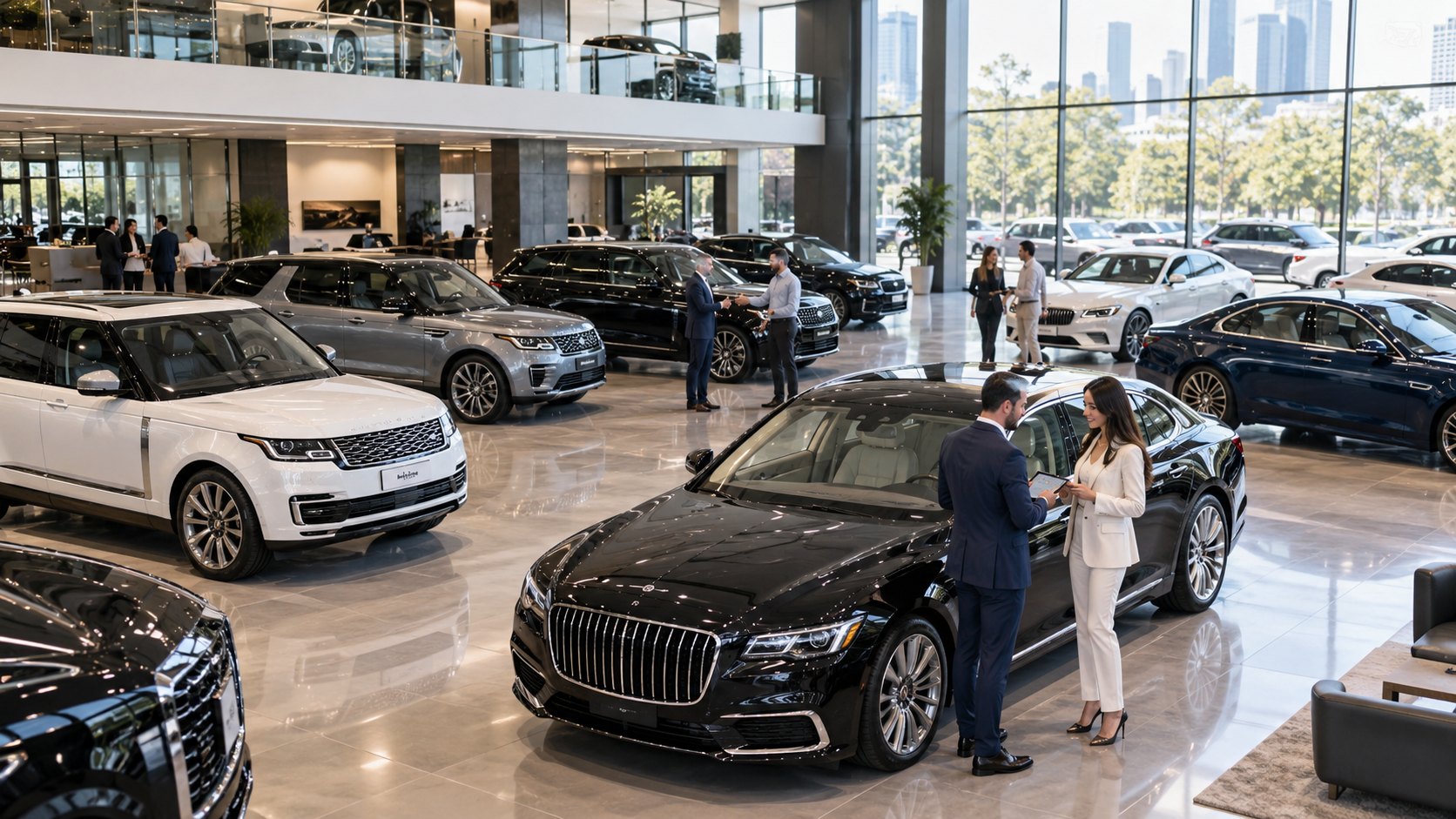
CZ 67 — Used Luxury Automobiles Trading
Under this line a company buys and sells used passenger cars at the top of the market, on its own account, wholesale or retail. Three boundaries are worth stating plainly.
It is not an agency. Holding this activity does not make a company the representative of any maker, entitle it to use a maker's marks, or let it offer a factory warranty. What an appointed agent is, and what protection it enjoys, is governed by the UAE's commercial agency framework and set out on the sale-of-motor-vehicles page beside this one.
It is not a workshop. Repair, bodywork, detailing and parts fitting are separate lines in this catalogue. A trader in this segment almost always needs a workshop relationship, and generally buys it rather than licenses it, because the equipment and the marque-specific diagnostic access are expensive to hold for a handful of cars a month.
It is not the plain used trade. The used-automobile-trading page covers the volume end of the same market, where the discipline is stock turn rather than provenance. Where the two overlap, the difference is that a mistake at this end is not recoverable from the next ten cars.
The order in which a car is examined is not a matter of taste. Each step either ends the purchase or changes the price, so working out of sequence means paying for checks on a car that was never going to be bought.
- Establish who owns it and what is still owed against itNothing else is worth doing until clean title can pass
- Read the service file against the odometer and the car itselfDecides whether the car is a specimen or a project
- Independent inspection for accident damage and structural repairIs the difference between the price you pay and the price you should have paid
- Confirm the specification the car was actually built toSets what the car is worth here, and what it is worth elsewhere
- Cost the reconditioning in writing before you make an offerStops the margin being spent after it has been counted
- Document the condition as received, in detailIs most of what a buyer who cannot attend is paying for
The third row decides whether the business is profitable. A car that has been straightened and repainted well is difficult to detect and easy to buy by accident, and it is worth materially less than an original one. Traders who skip an independent inspection on the grounds that they know what they are looking at eventually buy a car that was inspected properly by the person selling it.
What attaches to the car rather than to the dealer
Most of the obligations in this trade travel with the individual vehicle, not with the licence.
Title and any finance against it. A car with an unresolved lien cannot be passed on with clean title, whatever the licence says. That is settled with the seller's lender before money moves, not afterwards.
The vehicle's own record with the emirate's traffic and transport authority. Ownership transfer happens there, per car, every time, and that is where a sale actually completes.
Customs, if it crossed a border. A car arriving from abroad has to be entered before it can be dealt with locally; a car leaving has to be documented, and for a buyer overseas that documentation is a large part of what he is paying for.
Tax on the transaction. A domestic sale and an export sale are not treated the same way for value added tax, and a company doing both needs records that separate them from the outset rather than at the year end.
Two conditions in this segment are commercial rather than regulatory, and they are easy to mistake for rules. Covered or climate-controlled storage, and insurance written at the real value of the stock, are not imposed by any authority — they are imposed by the cars. A hail-dented or sun-faded car in this market has lost more value than the storage would have cost.
Why no honest page can quote you a figure
The licence fee, the premises the activity requires, how many cars that premises will hold and the approvals attaching to any particular vehicle category all turn on the emirate, the licensing authority and the rest of the activity mix. Two companies can hold identical words on a licence and have entirely different cost bases. We work the real numbers for a specific plan — the emirate, the premises, the stock level and the mix — before anything is filed, rather than publishing an average that fits nobody.
References
- Roads and Transport Authority — vehicle records and the transfer of ownership between parties in Dubai. Roads and Transport Authority
- Dubai Customs — entering an imported vehicle and documenting a vehicle leaving the country. Dubai Customs
- Federal Tax Authority — value added tax treatment of a domestic sale against an export, and corporate tax filing. Federal Tax Authority
- UAE Government portal — the commercial agency framework, which is what a trading licence does not confer. UAE Government portal
Elsewhere in Trading
Activities that sit beside this one
Most licences carry more than one activity. Adding a neighbouring line at the application stage costs a fraction of amending the licence afterwards.
Begin with a clear conversation
Tell us what you intend to build.
A consultant will map the structure, jurisdiction, approvals and likely cost against what you actually described — not against a package.
