
Activity CZ 05
How to Start a Men's Tailoring Business in Dubai
Men's tailoring makes two promises, and the one about the date is broken more often than the one about the fit. What this line carries, the trades it is confused with, and who walks in.
ConsultZone licensing desk
- Activity code
- CZ 05
- Category
- Manufacturing
- Reviewed
- Read
- 7 min
Listen instead
38 seconds
An audio summary of this guide.
Topic summary
How to Start a Men's Tailoring Business in Dubai
Every shop in this trade makes the same two promises: it will fit, and it will be ready when it was said it would be. The second is broken far more often than the first, and it is the one that loses the customer. A shop that fits beautifully and delivers a week late is remembered as unreliable; a shop that fits adequately and hands the garment over on the stated afternoon gets the next three orders. That is an unglamorous thing to build a business plan around, and it is the honest one.
The line covers making men's outerwear and shirting to the measurements of the man who will wear it — suits, jackets, trousers, waistcoats, shirts — together with the adjustment and remaking of garments he already owns. One wearer, one pattern, one set of measurements taken in the shop.
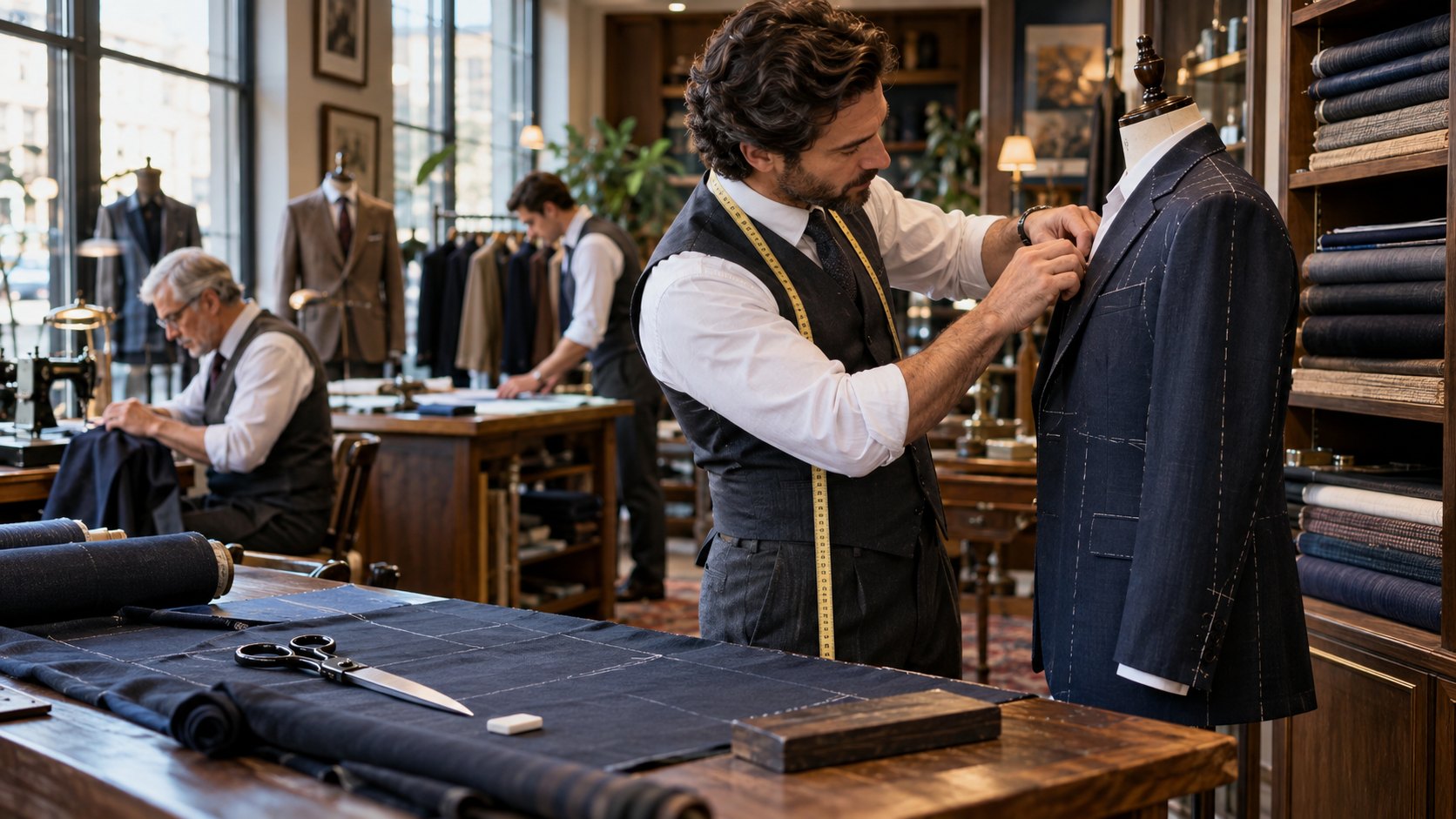
The work has a fixed shape. The customer is measured, a pattern or block is drawn or pulled and adjusted, the cloth is cut, the garment is part-made and tried on, the correction is marked in chalk on the customer's own body, and only then is it finished and pressed. The fitting is not a courtesy step before delivery. It is the product, and it is what separates this trade from buying something off a rail. A shop that quietly drops the fitting to save the customer a visit has changed what it is selling without telling him.
CZ 05 — Men Tailoring
One wearer, one pattern
The garment is built around a single body and no other. That is the whole economic difference from a factory: there is no size curve, no run length and no unit cost that falls with volume. A tailoring shop's output is measured in hours of skilled hands, and its price is set by how many of those hours a garment takes and how good the hands are.
Cloth comes out of a book, not off a shelf
Customers choose from swatch bunches and the cloth is ordered by the metre against a live order. That single habit keeps the stock risk in this line far lower than in a shop that must hold bolts on display for customers to feel — a real difference between this trade and the Arabic menswear workshops it sits beside. The cost of it is lead time: a cloth that has to be brought in is a date the shop has promised on somebody else's behalf.
Three pairs of hands, and each one is a different trade
A cutter who can read a body and put that reading on cloth. A machinist who can close a garment cleanly. A finisher and presser who can make flat cloth take a shape. The third is the one owners underrate and customers judge: pressing is most of what makes a jacket look made rather than assembled. All three need a work permit and a contract, and the wage payments behind those are a continuing obligation rather than a formality at the start.¹
Alterations are not a sideline
Taking in a waist, shortening a sleeve, letting out a jacket bought two sizes ago — this is the same craft worked backwards, it needs no cloth investment, it converts in a single visit, and it is what occupies the bench between suit orders. Shops that treat it as an interruption tend to have an empty workroom for three weeks in every eight.

The four trades this line is mistaken for
The commonest licensing trouble in tailoring is not a refusal. It is a shop discovering, after the licence is cut, that a large part of what it intended to do sits on a different line.
Arabic menswear tailoring is a different repertoire
CZ 04 covers national and regional men's dress — the kandura and the cloak worn over it — and it is made to measure exactly as a suit is. The two lines are neighbours and many shops hold both on purpose. What separates them is the pattern tradition and the cutter: a man who cuts a convincing Emirati neckline is not thereby a jacket cutter, and the reverse is just as true. A shop planning to serve both says so when the activities are chosen.
Apparel manufacturing is made to a specification
CZ 03 is a plant that takes cloth in and sends finished garments out against a drawing and a size curve, for a buyer who is not the wearer. The test is simple enough to apply at the counter: if nobody is going to be measured, it is manufacturing. Four hundred identical staff shirts for a hotel are a factory order even when a tailoring shop is perfectly capable of sewing them.
Selling cloth is trading, not making
A counter that sells cloth by the metre produces no garment, and the activity that carries it is a trading one. A tailoring shop that also wants to sell its bunches by the metre is asking for a second activity, not a broader reading of this one.
Laundry, pressing, embroidery and dry cleaning
Each of these is sold as a service in its own right and each is its own trade, even though a tailoring shop presses every garment it makes. Doing the work on your own output is not the same as selling it to the public.
six requests at the counter, three of them this licence
- A two-piece suit cut to one man's measurementsOne wearer, one pattern, measured in the shop
- Shirts and trousers made to a customer's own fitThe same bench and the same cutter, a smaller ticket
- Taking in a jacket he bought somewhere elseThe same craft in reverse, and it pays the rent between orders
Men's tailoring — this line
- A kandura with an Emirati neckline and a tasselA separate pattern tradition and a separate cutter
Arabic menswear tailoring
- Four hundred identical staff shirts to a buyer's specificationMade to a size curve, not to a person
Apparel manufacturing
- Cloth sold by the metre over the counterNo garment is produced, so nothing is manufactured
A trading line, not a making one
Who walks into a men's tailoring shop
The professional who has priced a brand suit
He wants the cloth and the fit a label charges a premium for and will accept a longer wait to get it. He is the best customer this trade has, because he understands what he is buying and he comes back when his shape or his job changes.
The groom, and the six men behind him
One order that arrives as seven, on a date that cannot move. Wedding work is the most profitable and the most dangerous thing on the bench: it fills a quiet month and it destroys a reputation if a single jacket is late.
The man whose size has changed
Alterations and remaking. He arrives with a wardrobe he already paid for and a specific problem, he decides in ten minutes, and he is the reason a shop with a good presser never has an idle week.
The small employer with eight people to dress
A showroom, a clinic, a restaurant — too few staff to interest a factory and too many to ignore. This is the order tailoring shops win because nobody else wants it, and the ceiling is real: past a certain headcount the buyer wants a size curve and a price per piece, and that is CZ 03's work rather than this line's.
Where this is the wrong purchase. If the intention is to import finished suits and sell them, or to open a menswear shop stocked from a wholesaler, this is not the line to hold. Nothing is being made, the workroom and its payroll are pure cost, and a retail or trading activity does the job. Take this line when a customer is going to be measured.
Premises settle more here than founders expect. The trade needs frontage a customer will stop at, a fitting room he is willing to undress in, and a workroom within reach of both, and the suitability of that unit is the municipality's ground.² Whether the company belongs on the mainland or in a free zone follows from that: a shop serving walk-in customers on UAE soil is a mainland proposition, and the structural alternatives are worth reading before a lease is signed rather than after.³ Corporate tax applies as it does to any UAE business, and enrolment and filing sit with the Federal Tax Authority.⁴
References
- Ministry of Human Resources and Emiratisation — work permits, labour contracts and wage protection for cutters, machinists and finishers. Ministry of Human Resources and Emiratisation
- Dubai Municipality — premises suitability and public health conditions for a retail unit with a workroom. Dubai Municipality
- UAE Government portal — the mainland and free zone licensing structure and general federal information. UAE Government portal
- Federal Tax Authority — corporate tax and VAT enrolment and filing. Federal Tax Authority
Elsewhere in Manufacturing
Activities that sit beside this one
Most licences carry more than one activity. Adding a neighbouring line at the application stage costs a fraction of amending the licence afterwards.
Begin with a clear conversation
Tell us what you intend to build.
A consultant will map the structure, jurisdiction, approvals and likely cost against what you actually described — not against a package.
