
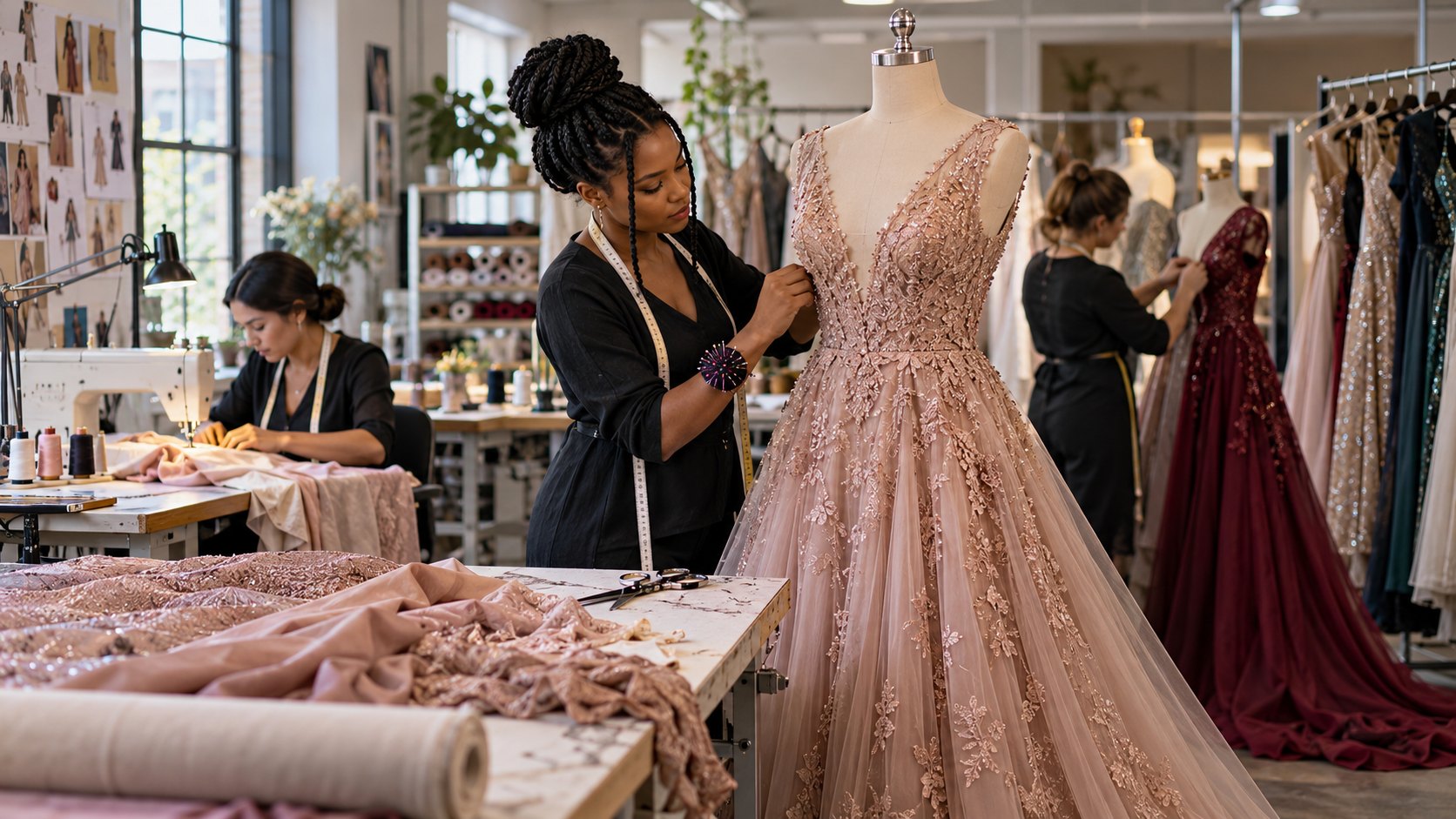
Activity CZ 07
How to Start a Ladies Gowns Tailoring Business in Dubai
A gown has a date on it. Ladies gowns tailoring is priced on fittings and pattern-cutting skill, and the cloth is bought for one customer who cannot be sold the same dress twice.
ConsultZone licensing desk
- Activity code
- CZ 07
- Category
- Manufacturing
- Reviewed
- Read
- 8 min
Listen instead
52 seconds
An audio summary of this guide.
Topic summary
How to Start a Ladies Gowns Tailoring Business in Dubai
A gown has a date on it. There is a wedding, a graduation, an awards evening or a National Day reception, and the garment either hangs correctly on that morning or the customer is standing in a room where everybody can see that it does not. That deadline is the whole character of this business. It sets the price, it caps the number of orders a workroom can honestly accept, and it is why a gown maker's name travels faster than any advertising she could buy.
The craft is fitted work, and that is the boundary between this activity and the everyday long garments it sits beside on the same shelf. An abaya hangs from the shoulder and forgives a few kilos either way. An evening gown is built on a bodice — bust, waist, hip, back length, the rise of the shoulder — and it is held in shape by boning, linings, interfacings and a closure that has to lie flat. It needs two or three fittings on the customer's own body, and the measurements go stale between them.
Everything downstream follows from that. Pattern-cutting for a fitted bodice is a distinct skill, and a machinist who runs straight garments quickly cannot necessarily cut one. The materials are silk, chiffon, satin, tulle, heavy crepe and beaded panels — expensive, slippery and unforgiving, so a cutting error writes off the cloth rather than an hour of labour. And that cloth is bought for one named customer, which puts the working capital and the cancellation risk in the same place at the same time.
The money is in the fitting, not in the fabric
The price of a gown is not the cost of its cloth with a multiple on top. It is the cutter's judgement, plus the fittings, plus the assurance that the date will be met — and customers who care about that will pay for it. Which is fortunate, because the economics are otherwise unattractive. The work is slow, every piece is unique, and capacity is limited by a small number of skilled hands rather than by the number of machines on the floor. Buying a second machine does not double a gown workroom's output. Finding a second cutter does, and that is a hiring and training problem rather than a capital one.
Four buyer groups behave quite differently, and most workrooms end up serving two of them well and the other two badly.
Private clients
The core of the trade: a woman with an event, a budget and a preference for something nobody else will be wearing. She arrives by recommendation, she expects to be measured in person, she pays a deposit before the cloth is cut, and she is worth several gowns over the years if the first one hangs correctly.
Brides and bridal parties
The highest value and the highest exposure. One booking can carry a month, because a bride rarely orders alone — mothers, sisters and bridesmaids come with her. The exposure is that the date cannot move, the alterations continue into the final week, and a bridal commission that goes wrong is discussed for years afterwards.
Boutiques and other labels
Small batches cut to another company's design and sold under another company's name. Steadier and duller: the same pattern earns more than once, the cloth is often the buyer's or paid for on the buyer's terms, a late delivery is a commercial inconvenience rather than somebody's wedding, and the workroom owns neither the label nor the customer.
Stylists, events and production wardrobe
Television, photography, pageants and corporate events, where the brief arrives late and the deadline is shorter than a private client would ever accept. Rush work pays a premium and eats the schedule that paying work was already occupying.
Two of those four are really two businesses, and a founder should choose deliberately rather than drift.
judged on the same five rows
| Judged on | Made to measure | Small batch for a boutique |
|---|---|---|
| Fittings happen on the customer's own body | Yes | No |
| A cutting error writes off the cloth, not an hour | Yes | Partial |
| The same pattern earns more than once | No | Yes |
| The workroom owns the label and the customer | Yes | No |
| A missed date is somebody's event, not a delivery note | Yes | No |
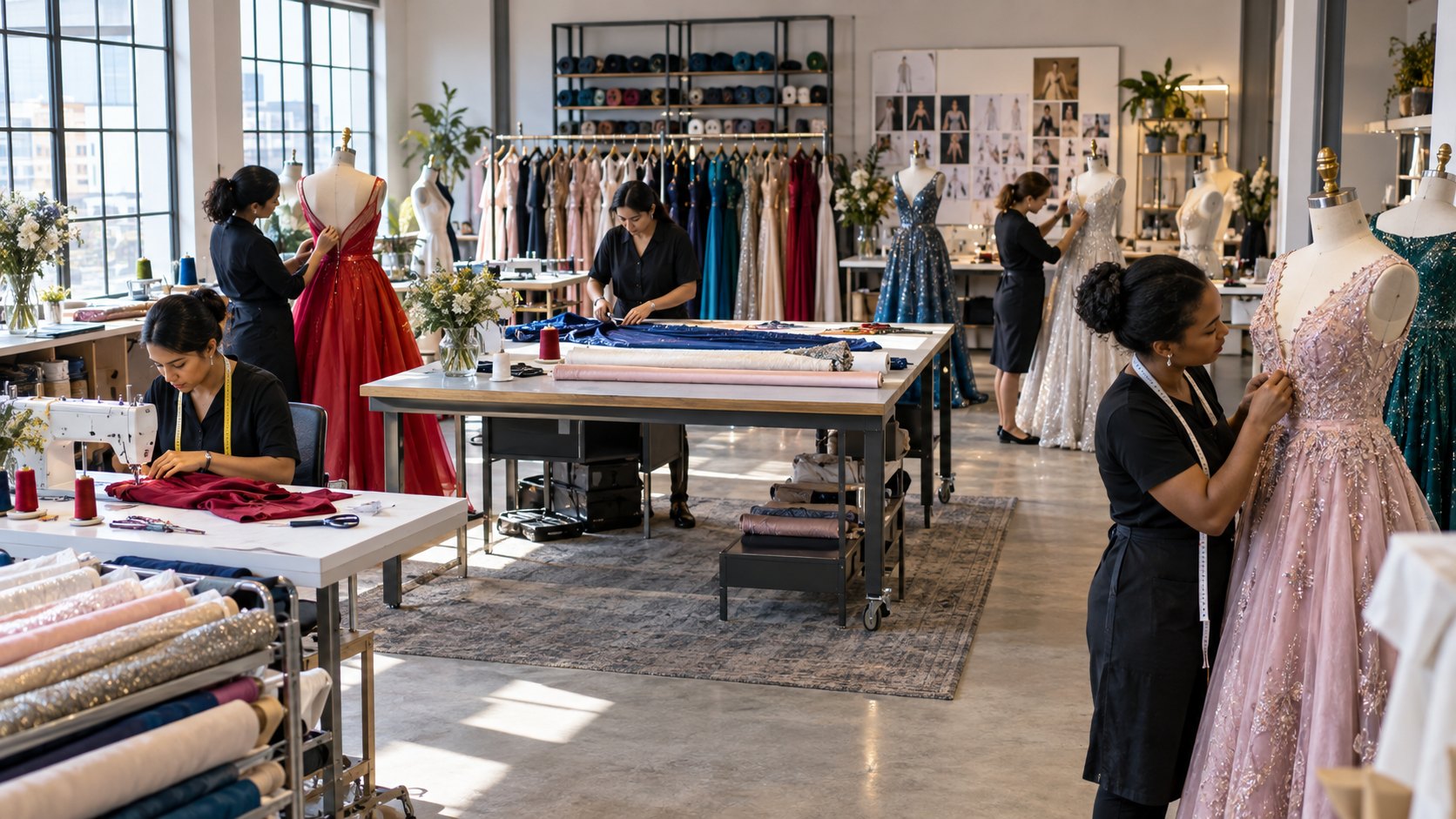
CZ 07 — Ladies Gowns Tailoring
The activity covers making and altering ladies' gowns: cutting, sewing, fitting and finishing occasion and evening wear, either to a customer's own measurements or as a small run for a shop. Alterations to gowns a customer already owns belong here too, and they are worth taking seriously rather than treating as a favour — a gown bought abroad and altered locally is how a great many workrooms acquire their first private client.
Three boundaries deserve stating plainly, because this is the line most often chosen by mistake.
Making is not selling stock: a rail of finished gowns bought in and sold on is trading, and the activity has to say so. Making is also not supplying materials — cloth, lace, beads and crystals sold by the metre or the packet are a separate trading line with entirely different stock economics. And dyeing, printing or beading cloth as an industrial process, before it becomes a garment, sits upstream of this licence rather than inside it.
The nearest relative is the wider ladies' wear line, which takes in everyday garments as well and adds embroidery as a trade that can be sold to other workshops. If the plan is occasion wear only, this narrower activity describes it exactly. If beadwork and embroidery are meant to become a revenue line in their own right, the wider one is the instrument to ask for. The everyday Arabic gown — the abaya and the jalabiya — has its own line again, and the reason the two are kept apart is the fitting: one is cut to hang, the other is cut to fit.
Where this is the wrong purchase. A shop selling finished evening wear with a tailor kept on hand for hems is a trading business with a workroom attached, not the other way about. Taking this licence as the main one inverts it.
What attaches to the work, and what does not
Gown making is not a controlled-product line. Nobody clears a dress before it may be sold, the way a medicine or a food product is cleared, and it is worth saying so, because founders arriving from other sectors often budget for an approval that does not exist. What does attach is a short list, and none of it is exotic.
The premises come first. A gown workroom needs good light, a long cutting table, hanging space that does not crush a finished garment, and at least one private fitting room — a thing an abaya workshop can do without and a gown maker cannot. Premises suitability is settled by the municipality against the specific unit, and a shop-fronted atelier is assessed differently from a back-of-house workroom on an industrial street.
Labour is the binding constraint and the largest running cost. Cutters and finishers work on written contracts with work permits, and wages are paid through the protected channel. The practical planning question is not the rate but the fact that a peak season cannot be answered by hiring for six weeks.
Imported cloth brings the border into it. Silk, tulle and beaded panels shipped in by the company itself need a customs code held in its own name, duty falls due when they land, and a few finishes and trimmings are inspected before release. Buying from local wholesalers removes that work altogether and charges for it in margin.
Where finished garments are sold at retail rather than made to order, what the label on the garment must say about fibre content and care is a standards question rather than a licensing one, and the national standards body is the authority behind it.
Tax obligations run as they do for any UAE business, on turnover and profit rather than on the craft: enrolment for value added tax once turnover crosses the published threshold, and corporate tax filings as a taxable person. Both should be confirmed against the Federal Tax Authority's own published thresholds rather than estimated, because the thresholds are the part that moves. Which approvals apply, what conditions come attached and what the licence costs to hold all depend on the emirate and the licensing authority, and ConsultZone confirms them for the actual case rather than quoting a neighbour's.
References
- Dubai Municipality — premises suitability for a workroom or a shop-fronted atelier. Dubai Municipality
- Ministry of Human Resources and Emiratisation — work permits, written contracts and wage payment for cutters and finishers. Ministry of Human Resources and Emiratisation
- Dubai Customs — importing cloth and trimmings under the company's own name, customs codes and restricted goods. Dubai Customs
- Ministry of Industry and Advanced Technology — national standards and conformity marks, including what a garment label must carry at retail. Ministry of Industry and Advanced Technology
- Federal Tax Authority — value added tax and corporate tax enrolment, thresholds and filing. Federal Tax Authority
Elsewhere in Manufacturing
Activities that sit beside this one
Most licences carry more than one activity. Adding a neighbouring line at the application stage costs a fraction of amending the licence afterwards.
Begin with a clear conversation
Tell us what you intend to build.
A consultant will map the structure, jurisdiction, approvals and likely cost against what you actually described — not against a package.
