
Activity CZ 04
How to Start an Arabic Menswear Tailoring Business in Dubai
Arabic menswear tailoring sells a fit, not a garment. What the kandura repertoire covers, why the cutter is scarcer than the customer, and what two short seasons do to the wage bill.
ConsultZone licensing desk
- Activity code
- CZ 04
- Category
- Manufacturing
- Reviewed
- Read
- 8 min
Listen instead
45 seconds
An audio summary of this guide.
Topic summary
How to Start an Arabic Menswear Tailoring Business in Dubai
A man who has found a tailor who cuts his kandura correctly stops shopping. He orders several at a time, he sends his brothers, and in time he brings his sons in to be measured. That habit is the commercial premise of this whole line, and it is also the warning attached to it: the trade is won slowly, over years of consistent work, and lost in a single badly set neckline.
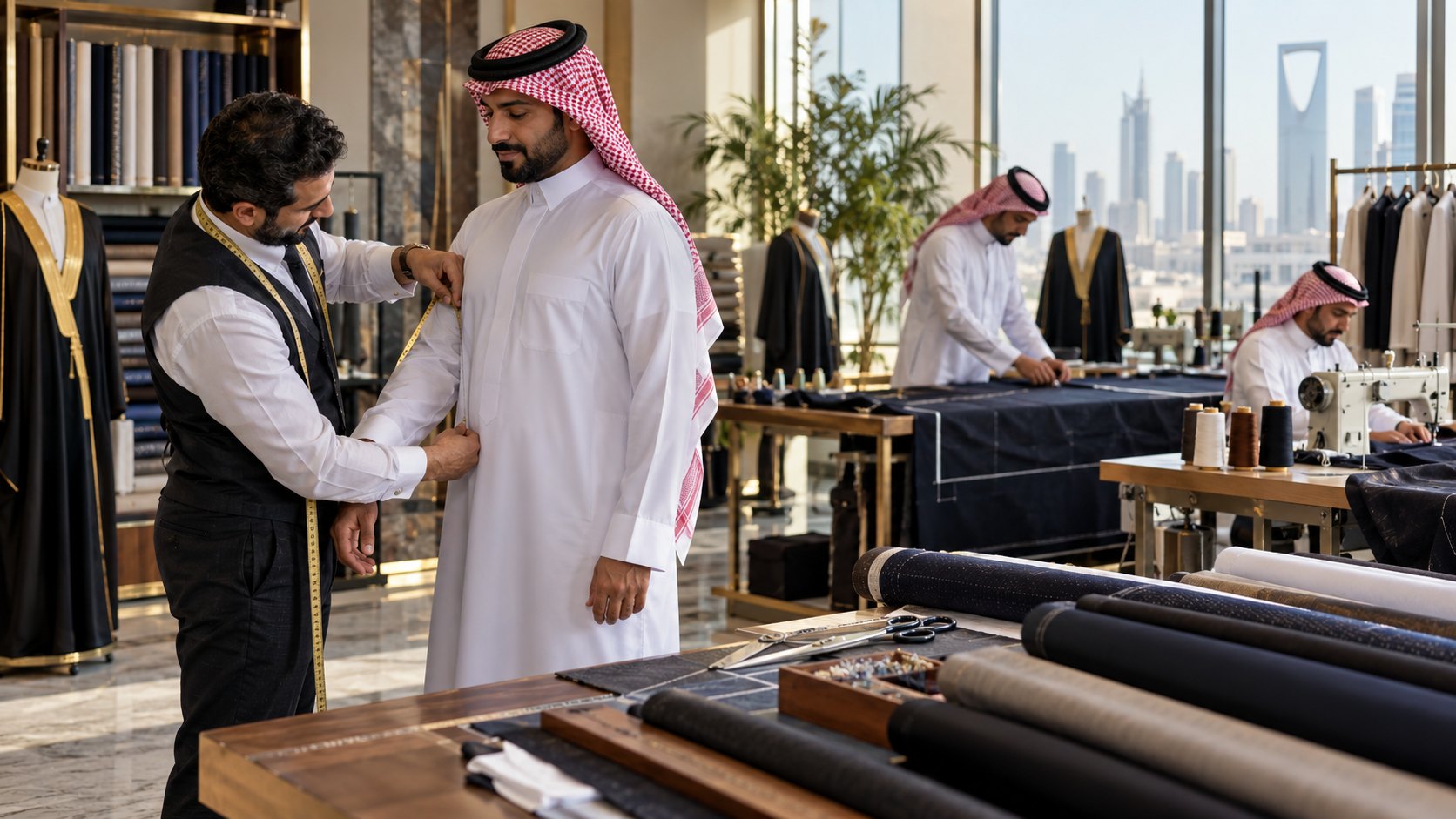
Arabic menswear tailoring is the making of national and regional men's dress to the measurements of the man who will wear it. The kandura — thobe or dishdasha, depending on where the customer is from — is the centre of it. Around that sit the bisht worn over it on formal occasions, boys' sizes, and the steady work of altering and remaking garments the customer already owns. Everything leaves the workroom as a single article for a single named person.
What makes this a craft rather than an assembly job is the neckline. It is the regional signature, and customers read it instantly. The Emirati cut is usually worn without a collar, with a long worked front opening and a tassel hanging at the throat; the Saudi cut takes a collar and buttoned cuffs and reads much closer to a shirt; Omani dress has its own throat tassel and its own proportions, and the Gulf states in between all carry small variations of stand, placket and cuff. A cutter who has spent a career on one of these does not automatically produce a convincing version of another. Hiring for this line means hiring for a specific repertoire, not for sewing in general.
Cloth is the other half of the conversation at the counter. Customers here ask for it by mill and by weight rather than by colour alone, because weight is what decides whether a garment is wearable in August or in January. The heavier, more opaque cloths belong to the cool months; the lighter and more open weaves to the rest of the year. White dominates the trade and does not exhaust it. Almost all of it is imported, arriving by the bolt.
What a kandura workshop actually makes
The kandura, and the neckline that identifies it
The core article and the reason the customer came. It is measured on the body, cut to a pattern held for that customer, and finished to the neckline style he wears. Length, sleeve width, shoulder slope and the set of the opening are the four things a regular will comment on, and they are why a kept pattern is worth more to this business than any machine in the room.
The bisht, and why it is a different sale
The fine cloak worn over the kandura for weddings, for the majlis and for formal occasions, often finished with metallic braid at the neckline. It is a separate skill, a separate cloth and a separate price bracket, bought rarely and kept for years. A workshop that can make one well is remembered for it.
Boys' sizes, and the school year
Children are fitted for Eid, for National Day and for school occasions, and they grow out of everything. It is the most reliably repeating part of the order book, it arrives in clusters, and it is usually the reason a family becomes a customer of the shop rather than of one tailor.
Taking in, letting out and rebuilding
Bodies change and cloth wears. Adjusting a garment, replacing a tired placket or cuff and remaking a favourite one to the same pattern is not a sideline — it is what keeps a bench occupied between order peaks, and it is the work that earns the next new order.
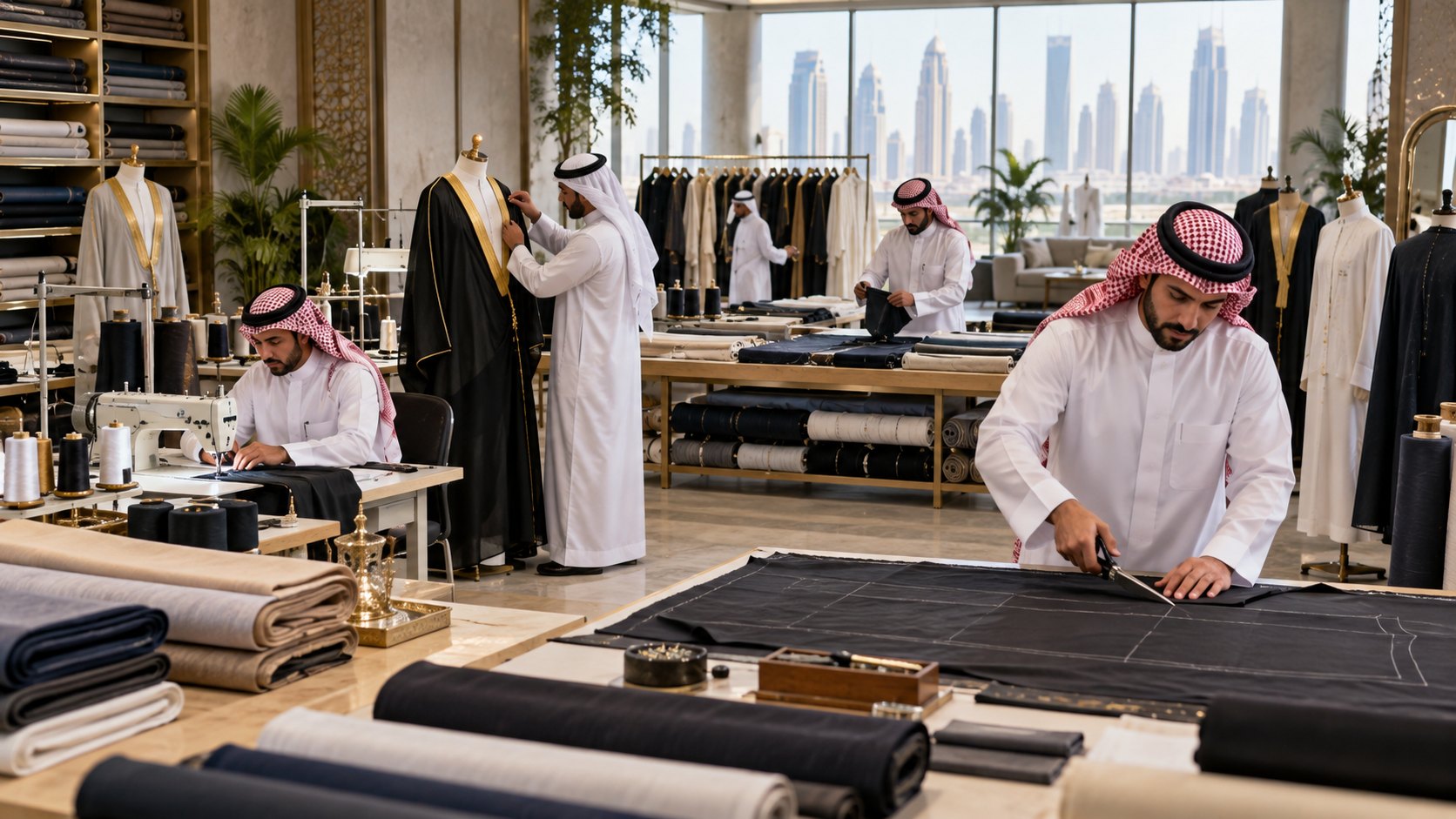
The customer returns for the fit, and brings his sons
The route to this customer is short and almost entirely local. He finds the shop because it is near where he lives, works or prays, or because somebody he trusts named it. There is no substitute for the first of those: a workshop in the wrong neighbourhood is a workshop with a marketing problem it cannot solve by advertising. Once he is a customer, the shop holds his pattern, and a phone message is enough to start the next order without him visiting at all.
Against that steadiness sits a calendar that is anything but steady. Demand concentrates hard before the two Eids, around National Day and through wedding season, and those weeks can carry a disproportionate share of the year. A workshop is therefore always deciding how much of its capacity to own outright and how much to rent for a few weeks, and each of those decisions buys something and costs something.
Five choices define how a workroom is run. Cutting and stitching everything in-house holds the fit inside the business but puts a master cutter on the payroll before the order book justifies him. Sending cut work out to a stitching unit flexes capacity with the season at the price of letting another workshop's hands finish garments carrying your name. Holding cloth on the shelf lets an order close at the counter on the first visit but leaves capital standing in weights that only move twice a year. Taking the customer's own cloth removes that risk entirely and reduces the shop to labour margin, along with the blame for a cloth it did not choose. And meeting the Eid peak with overtime serves the best weeks of the year at the cost of a wage bill that arrives whether the cloth did or not.
five choices, each weighed against the same rule
What it givesWhat it costs
- Cutting and stitching everything in-houseControl of the fit, which is the whole productA master cutter on the payroll before the order book pays for him
- Sending cut work out to a stitching unitCapacity that rises and falls with the seasonAnother workshop's hands on a finish your name carries
- Holding cloth on the shelf for customers to choose fromThe order closes at the counter, on the first visitCapital standing in weights that move twice a year
- Taking the customer's own clothNo stock risk at all, and a faster yesLabour margin only, and blame for cloth you did not pick
- Meeting the Eid peak with overtimeThe best weeks of the year fully servedA wage bill that arrives whether the cloth did or not
The conditions here attach to the premises and the payroll, not to the garment
Nothing this line produces is a controlled article. There is no product file to open, no clearance for a bolt of cloth on health grounds and no approval attached to a finished kandura, which puts this trade in a very different position from food, medicines or fuel. What does attach is everything around the garment.
The licence itself, with the tailoring activity on it, comes from the emirate's economic department, and the trade name is reserved through the same route. The unit is the next question: a shopfront workshop needs a frontage a customer will walk into and a working area behind it with room for cutting tables, machines, pressing and finished garments on rails, and the suitability of that unit and what it discards is the municipality's ground.¹ Then the people. Every cutter, machinist and presser needs a work permit and a contract, the wage payments behind them are a continuing obligation, and in this line the hiring decision is the product decision — the repertoire a cutter knows is what the shop can credibly sell.² Cloth arriving from abroad passes through the emirate's customs authority, which is also where the code the business imports under comes from.³ Which of these applies, and on what conditions, differs between the mainland and the free zones and between one emirate and the next, so it is confirmed for the specific case before a lease is signed.⁴
Where this is the wrong purchase. Two plans get mistaken for this one. Selling cloth by the metre over a counter, or importing ready-made kanduras to sell, is trading — no garment is produced, and a trading line carries it more cheaply. Making national dress in volume for a retailer's own label is the manufacturing line, CZ 03, because that work is cut to a size curve rather than to a person.
Where this line ends and men's tailoring begins
Plenty of shops hold both this line and CZ 05, men's tailoring, and there is a good reason for it: the bench, the presser and the fitting habit are shared. The boundary is the repertoire, not the customer. This line is national and regional dress and the cloak worn over it; CZ 05 is the Western wardrobe — suits, jackets, trousers, shirts — which is a different pattern tradition and usually a different cutter. A workshop that intends to serve both should say so when the activities are chosen, rather than discover the gap when a wedding party arrives asking for suits.
Corporate tax applies here as it does to any UAE business, and once takings pass the mandatory turnover threshold the shop is inside the VAT system as well; enrolment and filing for both sit with the Federal Tax Authority.⁵
References
- Dubai Municipality — premises suitability and trade waste conditions for a shopfront workshop. Dubai Municipality
- Ministry of Human Resources and Emiratisation — work permits, labour contracts and wage protection for cutters, machinists and pressers. Ministry of Human Resources and Emiratisation
- Dubai Customs — imported cloth and trims, and the customs code the importing business trades under. Dubai Customs
- UAE Government portal — the mainland and free zone licensing structure and general federal information. UAE Government portal
- Federal Tax Authority — VAT and corporate tax enrolment and filing. Federal Tax Authority
Elsewhere in Manufacturing
Activities that sit beside this one
Most licences carry more than one activity. Adding a neighbouring line at the application stage costs a fraction of amending the licence afterwards.
Begin with a clear conversation
Tell us what you intend to build.
A consultant will map the structure, jurisdiction, approvals and likely cost against what you actually described — not against a package.
