
Activity CZ 06
How to Start an Arabic Gowns Tailoring Business in Dubai
An abaya is worn most days of the year, not once. Arabic gowns tailoring is therefore a repeat-order trade, and the cloth and the delivery date decide it rather than the design.
ConsultZone licensing desk
- Activity code
- CZ 06
- Category
- Manufacturing
- Reviewed
- Read
- 8 min
Listen instead
42 seconds
An audio summary of this guide.
Topic summary
How to Start an Arabic Gowns Tailoring Business in Dubai
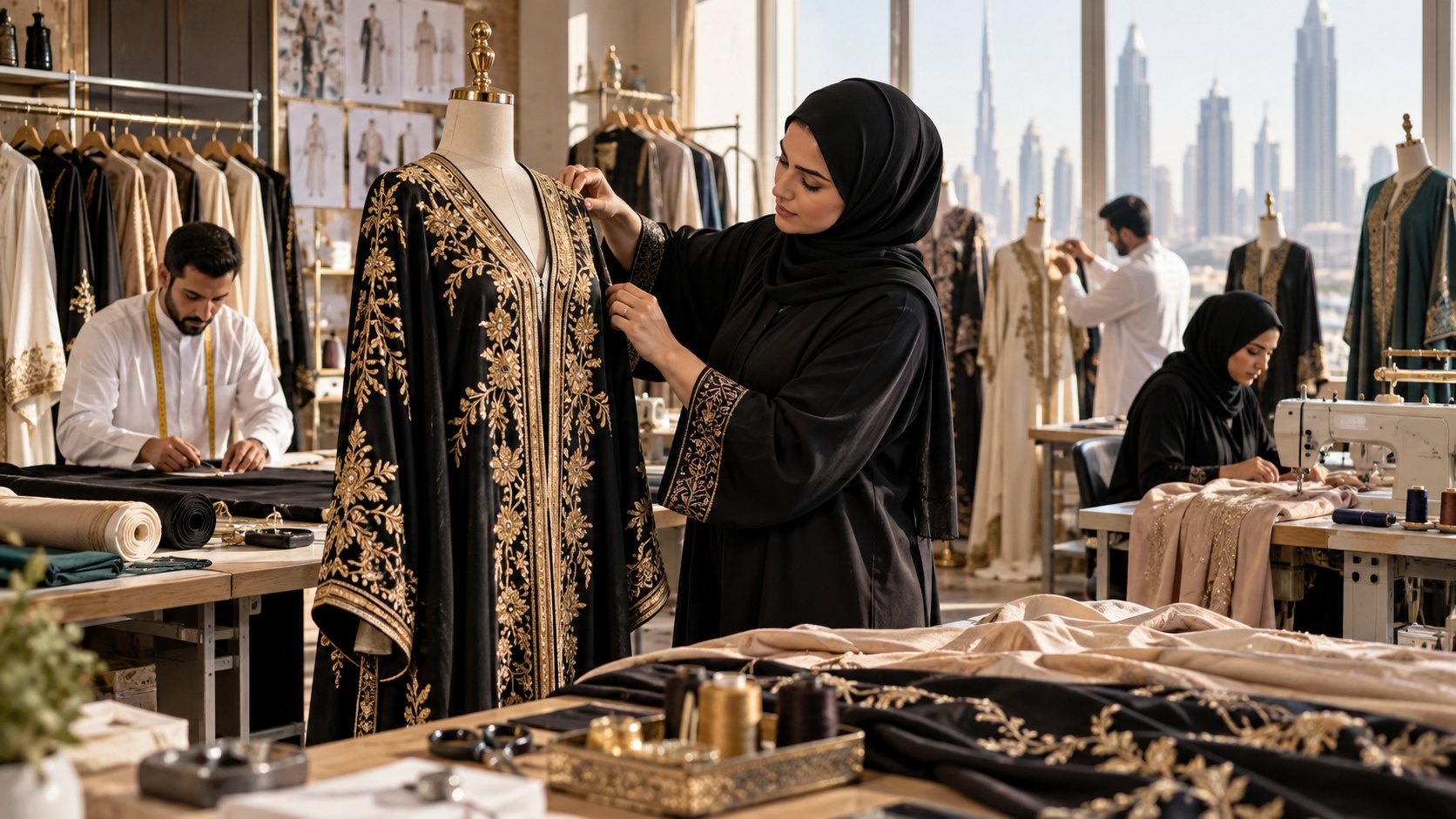
An abaya is not an occasion. It goes on for the school run, for the office, for the mall and for a funeral, and a woman who wears one owns several at a time and replaces them on a cycle. Almost everything commercially interesting about this activity follows from that single fact: the customer comes back, her measurements keep working, and the workroom that holds her cloth preference tends to hold her for years.
That makes Arabic gowns tailoring a different trade from the dressmaking it usually gets filed beside. An occasion-wear atelier sells one garment to one customer once and then starts the search again. An abaya workroom sells the same household three or four garments a year for as long as the drape stays right, and it competes on cloth, on cut and on a delivery date that holds — not on design novelty.
The cloth is the product
A customer judges an abaya before she looks at a seam. Weight, the way it falls, whether it creases in a car seat, whether the black is still black after a dozen washes — those are properties of the fabric, and a workroom with a dependable line on good crepe and nida has an advantage that a faster machinist cannot copy. Fabric is also the largest single cost in the finished piece and the item most exposed to shipping and duty, so where the cloth comes from is a strategic decision rather than a purchasing one.
A measurement, once taken, is an asset
An Arabic gown hangs from the shoulder. Fit is shoulder width, sleeve length, total length and the set of the neck; it does not turn on the waist, which is why a customer can reorder by telephone a year later and be pleased with what arrives. A fitted evening gown cannot be sold that way. The consequence for the business is that the customer file — names, measurements, cloth preferences, what she ordered last Eid — is the most valuable thing the workroom owns, and it accumulates instead of depreciating.
The year has one spike in it
Ramadan and Eid are the peak, and it is not a gentle one: households commission new gowns inside the same fortnight, and the wedding season behaves the same way. In those weeks capacity rather than demand sets the ceiling on the business. Accepting more orders than the machines can finish is how a workroom loses customers it spent three years earning, and there is no easy fix, because the staff who would absorb a seasonal peak need work permits that are not seasonal.
Three kinds of founder buy this licence, and only one starts from nothing
The machinist with a following
Someone who has cut abayas inside another person's workroom for a decade and already has customers asking for her privately. The craft risk is nil. The real risk is that a licence, a rent and a payroll convert a flexible side income into a fixed monthly cost that the quiet months have to carry.
The label
A founder who wants a name and a look rather than a workroom, and who will need making capacity behind it either way. The first decision is whether cutting and sewing happen in-house or are bought from another workshop, because that answer settles the premises, the headcount and most of the capital before anything else is chosen.
The trader moving upstream
An importer or shop owner who sells ready-made gowns, is tired of paying somebody else's production margin, and wants to make what he sells. It is worth being blunt that this is a different business as well as a different licence: buying well is a purchasing skill and making well is a production one, and the second does not arrive free with the first.
What the line permits, and five things people assume come with it
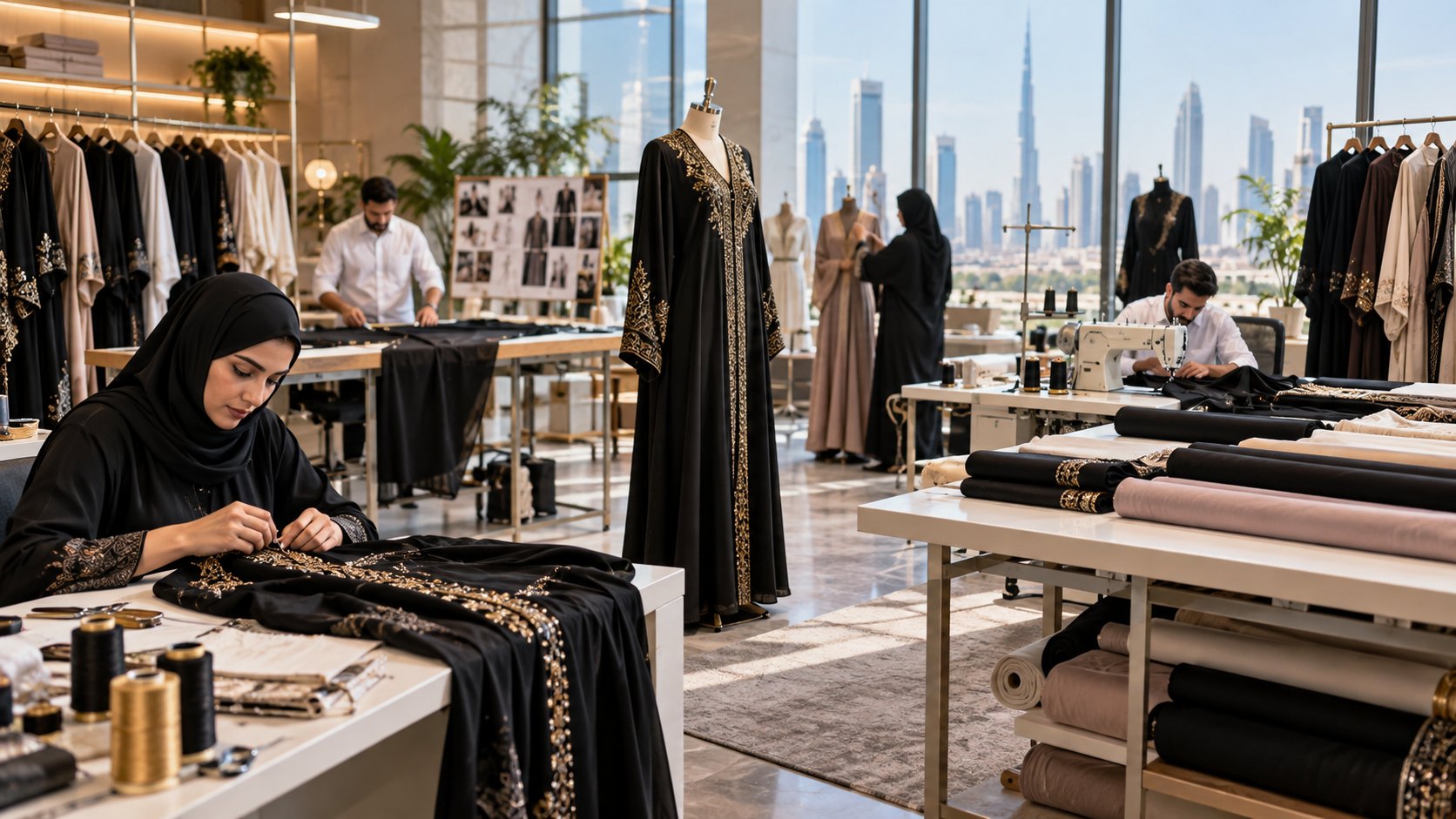
Under this activity you cut, sew, finish and alter Arabic gowns — abayas, jalabiyas, kaftans and the everyday long garments that sit with them — whether the work is made to a customer's own measurements or run as a small batch for a shop. Alterations to garments a customer already owns sit inside it comfortably, and in practice they are a useful counterweight to the seasonal peak, because hems and sleeve adjustments arrive all year round.
Five things founders expect to be included, and are not:
- Selling ready-made gowns bought in from a supplier. That is trading, and it is a separate line; a workroom that also wants a rail of bought-in stock needs the activity to say so.
- Selling fabric by the metre. Also trading, and a different one again — cloth sold on is a commodity business with its own margin and its own stock risk.
- Weaving, knitting or dyeing the cloth. That is textile production, several steps upstream, with plant and effluent questions this licence was never written for.
- Embroidery sold as a service to other workshops. Doing your own beadwork on your own garments is one thing; taking in panels from other tailors and stitching them for a fee is a trade in its own right, and it belongs to the wider line named below.
- Laundry, pressing and dry cleaning offered on their own. Pressing your own output is part of making a garment. Taking in a customer's wardrobe to clean is a separate service.
Two neighbours are worth naming, because a reader comparing three similar-sounding lines should know which one to ask for. Ladies gowns tailoring covers the fitted evening and occasion gown, which is a different craft with different patterns, different cloth and a different kind of risk. Ladies wears tailoring and embroidery is the widest of the three: it takes in everyday ladies' garments and adds embroidery as a trade that can be sold on its own. If the plan is abayas and nothing else, the narrow line here is the cleaner instrument, and it is easier to explain to a landlord and to a customer.
Where this is the wrong purchase. If the intention is to buy finished gowns and resell them — online, from a shop, or wholesale to other shops — this activity will cost more to hold than it returns, and a trading line answers the actual plan better.
The workshop decides the licence, not the other way round
This is the question asked last and worth asking first. A tailoring workroom is light manufacturing with a counter attached, and the premises carry real requirements: three-phase power for industrial machines, a cutting table long enough to lay out a full-length garment, storage that keeps bolts of cloth off the floor and out of direct sun, extraction and space for a pressing station that produces heat and steam all day, and a fitting area with a door if customers come in. Cloth, offcuts and thread are also a fire load, which is why a workroom is looked at differently from an office of the same size.
That physical specification, not the licence fee and not the tax position, is what narrows where the company should sit. A premises approval attaches to one specific unit, so the tenancy — Ejari-recorded in Dubai — is usually the thing the rest of the file waits on, and the order in which the signatures arrive is the part founders most often get wrong.
- Fix the activity wording and reserve the trade nameLets the constitutional documents be drawn
- Take the workshop unit and have the tenancy recorded against itSettles the licence, the staff allocation and the rent line
- Fire and safety clearance for machines, pressing and stored clothAllows the workroom to be fitted out and used
- Trade licence issued against the approved premisesAllows work to be taken in and invoiced
- Work permits and written contracts for the machinistsTurns a licence into delivered capacity
The sequence above is the shape of the file, not a promise about any particular emirate. Which body signs off on a workroom, in what order, and on what conditions differs between the emirates and between a shop unit and an industrial one, and those are exactly the points ConsultZone confirms with the licensing authority for the specific case before anything is committed. What the licence costs to hold likewise depends on the emirate, the unit, the staff allocation and the activity mix, and any figure quoted without those four is a guess.
Two ongoing conditions deserve planning rather than reacting to. Labour is the first: a workroom's output is machinist hours, so work permits, written contracts, wages paid through the protected channel and — above a certain size — accommodation are the running cost that actually determines whether the peak can be met. Imported cloth is the second: bringing fabric in under the company's own name calls for a customs code and attracts duty at the border, while a workshop that buys locally from a wholesaler trades that paperwork for a thinner margin.
References
- Ministry of Human Resources and Emiratisation — work permits, written labour contracts and payment of wages through the protected channel. Ministry of Human Resources and Emiratisation
- Dubai Municipality — premises suitability and public health conditions on a workshop unit. Dubai Municipality
- Dubai Civil Defence — fire safety approval for a workroom holding cloth, offcuts and pressing equipment. Dubai Civil Defence
- Dubai Customs — importing fabric under the company's own name, customs codes and duty at the border. Dubai Customs
Elsewhere in Manufacturing
Activities that sit beside this one
Most licences carry more than one activity. Adding a neighbouring line at the application stage costs a fraction of amending the licence afterwards.
Begin with a clear conversation
Tell us what you intend to build.
A consultant will map the structure, jurisdiction, approvals and likely cost against what you actually described — not against a package.
