
Activity CZ 08
How to Start a Ladies Wears Tailoring & Embroidery Business in Dubai
This line carries two crafts that share nothing but a licence. Tailoring is paid in machinist hours; embroidery is either rare skilled hands or a bought machine, and that choice shapes the whole workshop.
ConsultZone licensing desk
- Activity code
- CZ 08
- Category
- Manufacturing
- Reviewed
- Read
- 7 min
Listen instead
52 seconds
An audio summary of this guide.
Topic summary
How to Start a Ladies Wears Tailoring & Embroidery Business in Dubai
Two trades are sitting on this one licence, and they do not share an economics. Tailoring is paid for in machinist hours: add an order, add a person or add overtime. Embroidery is either a pair of very skilled hands, which cannot be hurried at any price, or a computerised multi-head machine, which is a capital purchase that afterwards produces at a marginal cost close to nothing. A founder who treats embroidery as a finishing touch on the sewing business will misjudge the equipment list, the hiring plan and the premises in one stroke.
That is why this activity deserves its own page rather than a paragraph on a tailoring one. Read properly, it is the broadest of the ladies' wear lines — and the only one of them that lets a workshop sell a process to other workshops rather than a garment to a customer.
One licence, two crafts, and the machine question decides both
The tailoring half
Everyday and occasion garments for women: long garments, kaftans, blouses, skirts, trousers, children's occasion wear and workwear cut for women's uniforms. Made to measure for private customers, altered for customers who bring garments in, or run in small batches for a shop. The breadth is the advantage — a workroom with a wide activity can move between private orders, boutique batches and alteration work as the seasons move, and a narrow line cannot.
The embroidery half, by hand
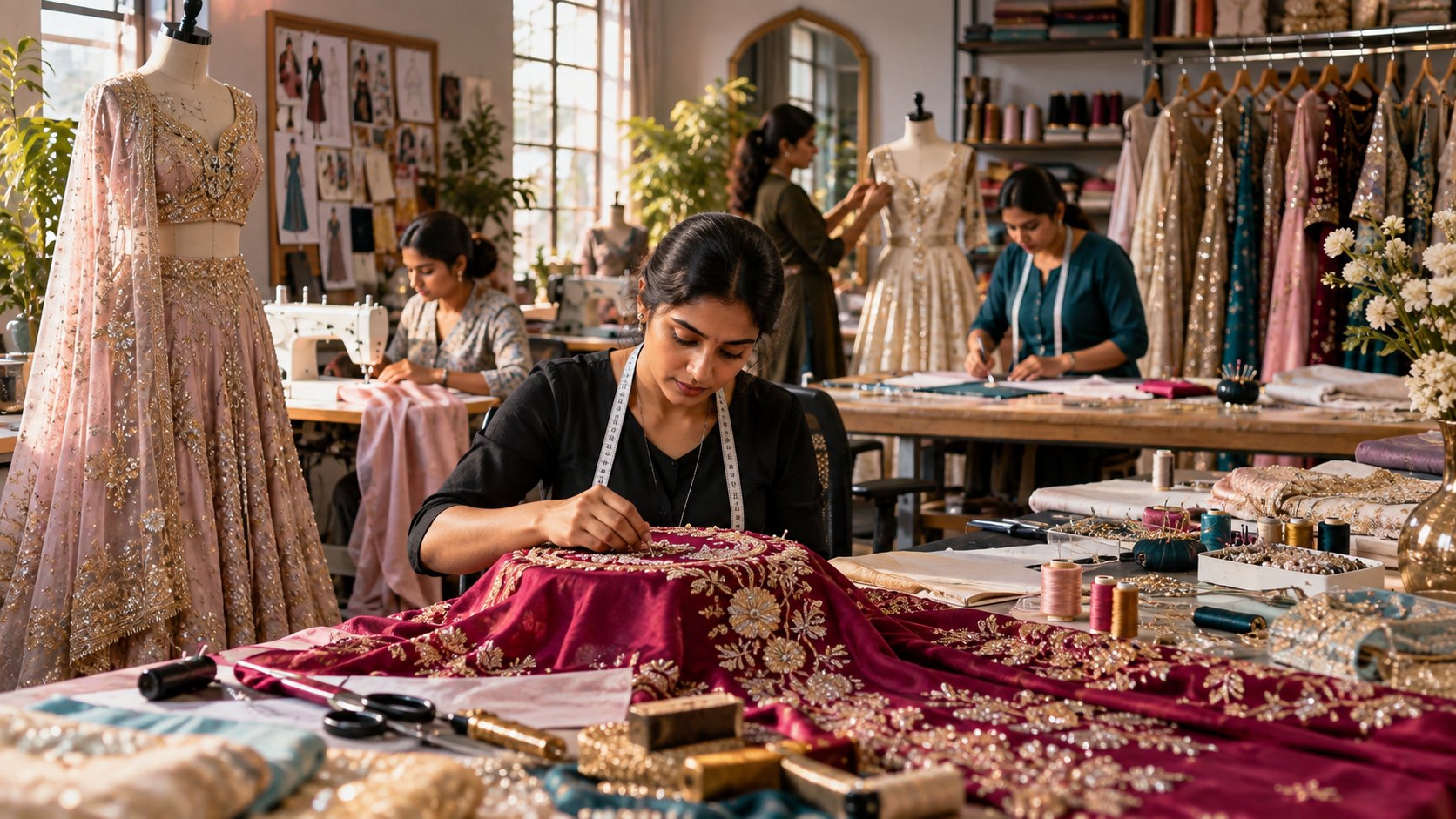
Zardozi and metal-thread work, beadwork, sequins, pearls, appliqué and hand-finished edges. This is where the price of a couture piece actually comes from, and it is piecework: the cost is hours, the hours belong to people whose skill took years to acquire, and no amount of investment compresses them. A workroom built on hand embroidery has a capacity equal to its roster of embroiderers, and its main business risk is that the best of them leave.
The embroidery half, by machine
A computerised multi-head embroidery machine, design software, and somebody who can turn a drawing into a stitch file that behaves on real cloth. The cost shape inverts: the money is paid once, the machine runs with one person watching several heads, and a design that took two hours to digitise then stitches a hundred times for thread and power. It rewards volume and repeat designs, punishes one-off bespoke work, and needs an industrial unit with the power supply and the floor to take it.
What the line does not stretch to
Cloth and trimming supply sold by the metre or the packet is a trading line. Weaving, knitting, dyeing and printing cloth are textile production, upstream of this activity. Selling finished garments bought in from elsewhere is trading, whatever the shop sign says. And printing on garments — screen printing, heat transfer, direct-to-garment — is a different process from stitching a design into cloth and should not be assumed to travel with an embroidery activity.
One asset here is easy to overlook: a library of digitised stitch files accumulates, costs nothing to reuse and is worth guarding. Protecting a design or a label name, though, is a separate exercise from holding the licence, and it does not happen on its own.
Who this suits, and who should ask for a narrower line
The workshop already sending its embroidery out
The clearest case of all. A tailoring business that pays another workshop to bead its panels knows exactly what that work costs, how much of it there is in a year and how often the outside supplier is late. That is enough to decide whether a machine pays for itself, and it is more than most equipment purchases are decided on.
The embroidery specialist selling to the trade
The genuinely distinctive move on this line, and the one that changes the sales cycle completely. Embroidery sold as a service to other tailors, boutiques, uniform suppliers and event companies is a business-to-business proposition: fewer customers, larger and more repeatable orders, quoted per panel or per thousand stitches rather than per dress. It is also the work that keeps an expensive machine busy between retail seasons, which is the difference between an asset and an ornament.
The label that wants everything under one roof
A founder building a women's wear brand who would rather cut, sew and embroider in one building than manage three suppliers. The broad activity suits that, and the honest warning is that three crafts under one roof mean three sets of skills to hire for and three separate ways for a deadline to slip.
Who should take a narrower line instead
If the plan is abayas and nothing else, or occasion gowns and nothing else, the narrower Arabic gowns and ladies gowns activities describe those businesses exactly, and a workshop is easier to explain to a landlord, a bank and a customer when the licence says what it does. Both of those lines already permit beadwork on the workroom's own garments. Take this wider line when embroidery is genuinely going to be sold as work in its own right — not when it is a possibility somebody wants to keep open.
- Fix which garments the workroom will actually cut
- Decide whether embroidery is sold to other workshops or only used on your own garments
- Will the embroidery be stitched by hand or by machine
- By handCapacity equals the roster of embroiderers, and the cost is hours that nothing compresses
- By machineAn industrial unit, a multi-head machine and a digitiser, paid for once and then fed with volume
- Take the unit that answer requires, and let the unit narrow the jurisdiction
Where this one sits between the mainland and a free zone
Both crafts pull in the same direction here, and it is worth following the logic rather than the licence fee.
A mainland licence lets the workshop sell directly to customers and to other UAE businesses on UAE soil. For the embroidery-to-the-trade model that is not a preference but the entire proposition: the customers are UAE tailors, boutiques, uniform suppliers and event companies, and invoicing them directly is the business. A mainland licence is also what puts a fitting room or a shop front on a street where private customers can walk in and be measured.
A free zone licence answers a different plan — a label that makes in the UAE and sells abroad, or sells online through a distributor, and is content to reach UAE customers through a mainland partner rather than directly. Goods that arrive and leave again without entering the UAE market are the case that route was built for, and a workshop cutting for export rather than for the street should look at it seriously.
What decides it in practice is usually physical rather than legal. A multi-head embroidery machine and a cutting floor need an industrial or workshop unit with the right power supply, ceiling height and loading access. The availability and the rent of that kind of unit vary more between jurisdictions — and between one industrial area and the next inside a single emirate — than the activity line does. Settle the unit, and the unit narrows the list of places the company can sensibly sit.
Which approvals attach, what conditions come with them and what the licence costs to hold all depend on the emirate, on the authority and on the specifics of the unit and the staff allocation, and those are confirmed with the licensing authority for the actual case rather than assumed from a neighbouring one. Two running obligations are worth building into the plan from the first month. The workforce is one: both halves of this activity are people-intensive, so work permits, written contracts and wages paid through the protected channel are the real recurring cost, and skilled embroiderers are harder to replace than machinists. The premises approval is the other: a machine-heavy workroom is assessed on its power draw, its fire load and its ventilation rather than on its floor area, and a unit that suits a sewing room may not suit an embroidery floor at all.
References
- Ministry of Industry and Advanced Technology — industrial and manufacturing activity, national standards and conformity marks. Ministry of Industry and Advanced Technology
- Ministry of Human Resources and Emiratisation — work permits, written contracts and wage payment for machinists and embroiderers. Ministry of Human Resources and Emiratisation
- Dubai Municipality — premises suitability for a workshop unit holding machines, stored cloth and a pressing station. Dubai Municipality
- UAE Government portal — the federal licensing framework and the difference between a mainland and a free zone establishment. UAE Government portal
Elsewhere in Manufacturing
Activities that sit beside this one
Most licences carry more than one activity. Adding a neighbouring line at the application stage costs a fraction of amending the licence afterwards.
Begin with a clear conversation
Tell us what you intend to build.
A consultant will map the structure, jurisdiction, approvals and likely cost against what you actually described — not against a package.
