
Activity CZ 09
How to Start a Ladies Wears Tailoring & Embroidery Workshop in Dubai
A ladies wears workshop sells production capacity to other businesses, not finished garments to the women who wear them. What the embroidery line covers, who buys it, and where the shopfront ends.
ConsultZone licensing desk
- Activity code
- CZ 09
- Category
- Manufacturing
- Reviewed
- Read
- 8 min
Listen instead
40 seconds
An audio summary of this guide.
Topic summary
How to Start a Ladies Wears Tailoring & Embroidery Workshop in Dubai
One word in this activity name does all the work, and it is not embroidery. It is workshop. The catalogue also carries a ladies wears tailoring and embroidery line without that word, and the two sit apart because they are two businesses. One takes the measurements of the woman who will wear the garment. This one takes a cutting order from whoever already took them. The sheet files this line under Manufacturing rather than under trading or services, and that single word is the most accurate short description of it available.
What follows from it is who pays you. A workshop's customer is a boutique with a waiting list and no machines; an abaya label that designs, photographs and sells but has never owned a bench; a bridal studio that keeps the fitting and sends the beadwork out; a uniform supplier that won a hotel's staff contract on price and now needs four hundred pieces cut to a size curve. None of them arrives off the street. All of them buy the same commodity — hours on a machine with a trained pair of hands attached — and they buy it again if the last batch came back right.
That matters because the three neighbouring lines in this family look interchangeable on paper and are priced, sited and staffed nothing alike.
| Wears workshop | Wears shopfront | Gowns tailoring | |
|---|---|---|---|
| Who places the order | A business with its own customer | The woman who will wear it | The woman, or her designer |
| What the premises is | A production unit | A retail bay on a street | A studio with a fitting room |
| What one order looks like | A size run, repeated | One garment, once | One garment, fitted twice |
| Where the money is made | Machine hours and finishing skill | The fitting, and the mark-up | Hand work, and the name on it |
| What empties the business | Idle benches between orders | Rent paid for footfall that stops | A sample rejected, with no volume behind it |
Read the marked row first, because it is the one that decides whether this is the right line to buy. A shopfront dies of rent. A gowns studio dies of a rejected sample. A workshop dies of silence — a fortnight with the machines switched off and the operators still on the payroll. Everything else on this page is really about keeping that from happening.
The people who actually need a bench of their own
The boutique that outgrew its back room
Two machines behind a curtain will carry alterations and the occasional made-to-measure piece. They will not carry a wholesale order, and the first time one arrives the owner discovers that the shop licence and the shop's floor area are both the wrong shape for the work. Separating production from the salon — a different unit, a different licence line, sometimes a different emirate — is what this activity exists for.
The label with a design and no factory
Abaya and modest-wear labels are frequently three people and a photographer. The design is theirs, the demand is real, and the production sits with a subcontractor whose quality they cannot control and whose other clients they are competing with for bench time. Bringing the bench in-house converts a variable cost into a fixed one, which is a good trade only if the order book is steady enough to keep it busy.
The embroiderer with a skill and no company
Hand beadwork, zari and zardozi, appliqué and heavy machine embroidery are genuinely scarce skills, and the people who hold them are often working informally for whoever calls. A licence turns that into a business that can invoice, hold a customs code, employ its own team and be paid on terms. It is also the point at which the work stops being paid in cash per piece and starts being quoted per hour of capacity.
CZ 09 — Ladies Wears Tailoring & Embroidery Workshop
Tailoring
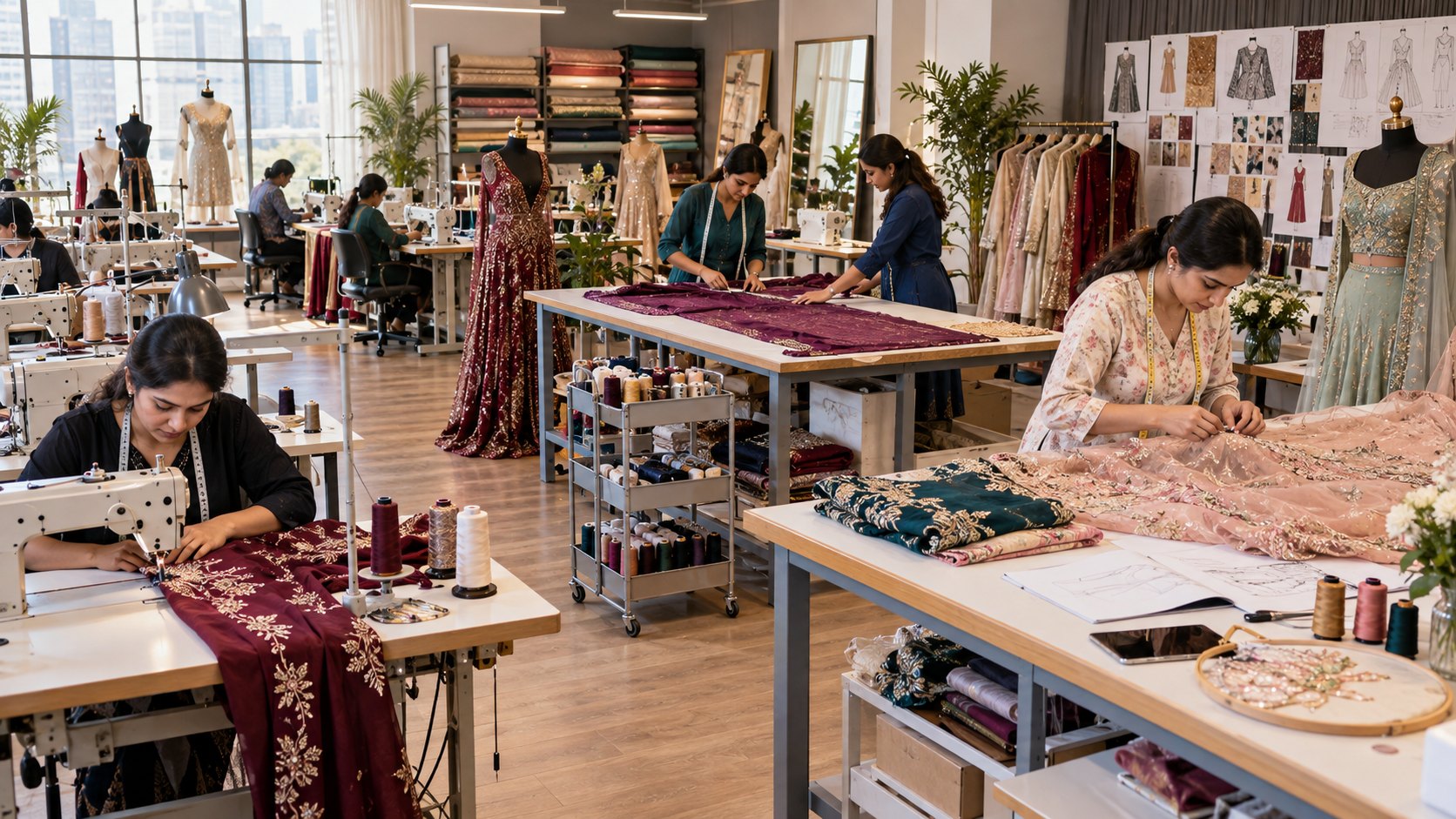
Cutting and sewing women's garments to a pattern the client supplies, or to a set of measurements somebody else took and passed on with the job. The output is a finished or part-finished garment; the input is cloth, a specification and a deadline. On a workshop floor the specification is the interesting part, because a boutique that cannot write one will send back garments made exactly as it asked.
Embroidery
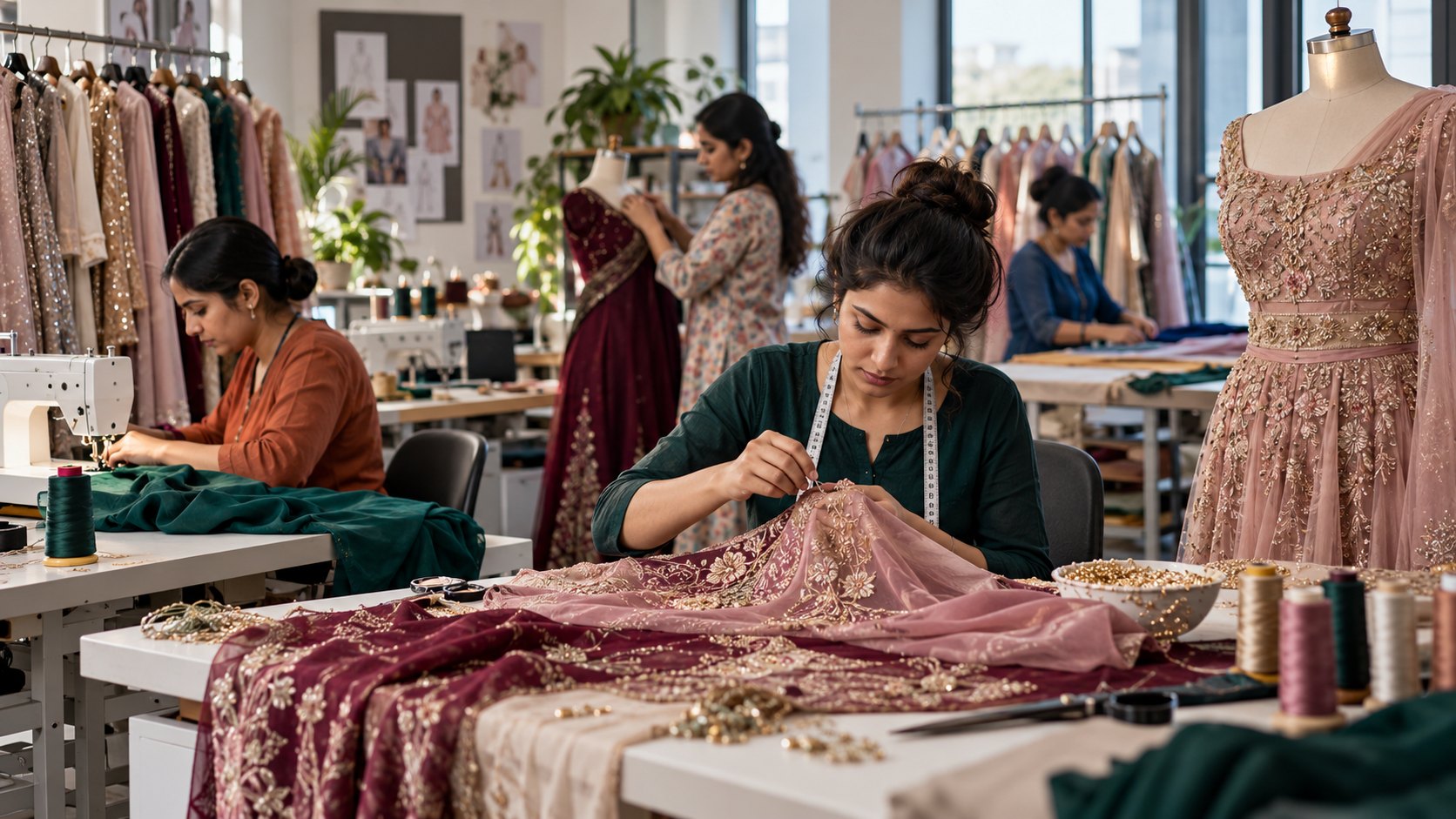
Decorative needlework applied to a panel before assembly or to a made-up garment afterwards — by hand, on a single-head machine, or on a multi-head that repeats one design across several garments at once. The choice between those three is a capital decision, not a craft one: hand work has no ceiling on intricacy and a very low ceiling on volume, and the machine is the reverse.
What "ladies wears" covers that "gowns" does not
Gowns are one garment type. Ladies wears is the wardrobe: abayas, kaftans, jalabiyas, kurtis and shalwar kameez, blouses, skirts, occasion and bridal wear, and women's uniforms for hotels, clinics and schools. The gowns line is a subset of this one, and that is the honest way to read the two entries side by side — anyone planning to make only evening and bridal wear should look at the narrower line before buying the broader one.
The calendar is most of the business plan
Demand for women's occasion and modest wear in this market is not flat across the year. It concentrates — Ramadan and the run-up to Eid, the wedding season, the return of the school and corporate year for uniform work. A workshop that plans for the average month will be short of operators in the peaks and carrying them through the troughs. Subcontracted overflow work, which is the least glamorous part of the order book, is what levels the line out.
What the work needs from the room
Benches, machines, cutting tables, a press, storage that keeps cloth clean and dry, and light good enough to set beads under. Industrial machines draw more power than a retail unit is wired for, and a floor stacked with fabric and thread is a fire-load question rather than a decorating one. The suitability of a given unit for light production, and the fire sign-off on it, are decided by the municipality and the civil defence authority for the emirate concerned — which is why the unit is chosen with those two in mind rather than on rent alone.¹ ²
Where this line stops, and what the next one costs
The line stops at the making. Everything on the far side of it is a different activity, and the cost of getting that wrong is an amendment to a live licence at the moment there is cloth on the floor and an invoice to raise.
Selling finished garments to the public from the unit is retail, not production. Importing made-up clothing and wholesaling it is a trading line with no bench in it at all. Dealing in fabric, thread and trims as goods is its own trade. Alterations, repairs and dry cleaning are services sold to the wearer. Design consultancy, pattern cutting sold on its own and styling are services too, and a workshop that wants to sell them alongside production needs them written into the activity line from the start. Tanning or finishing leather, fur and skins is a separate class of manufacturing entirely and should never be assumed to travel with a tailoring licence.
Two practical conditions sit underneath all of that. The team is the asset, and work permits, contracts and the standards that apply to housing production staff are matters for the federal labour ministry, whose conditions should be read before the first operator is hired rather than after.³ Fabric is where the working capital goes, and most of it comes from abroad. A bolt bought for an order that slips sits on the floor as money doing nothing, so the importer code belongs to the company rather than to an agent, and clearance is planned as part of the production calendar instead of being discovered at the end of it.⁴
Where this is the wrong purchase. A street-facing salon where women come in, are measured and collect a finished garment is not this activity. The shopfront tailoring entry is cheaper to hold and is what a licensing authority will assume such a trade runs under. Choose the workshop line when the order arrives from a company rather than from the wearer.
None of the numbers anybody will quote for this is the same in two emirates or for two activity mixes — what the licence costs to hold, how many visas the unit will carry, which of the approvals above actually bite. Those answers do exist. They belong to the authority issuing the licence where the company is being placed, and ConsultZone obtains them for the case in hand before anything is signed.
References
- Dubai Municipality — suitability of premises for light production, public health and waste conditions on a workshop unit. Dubai Municipality
- Dubai Civil Defence — fire safety approval on a unit storing cloth, thread and finished garments. Dubai Civil Defence
- Ministry of Human Resources and Emiratisation — work permits, labour contracts and the standards applying to production staff. Ministry of Human Resources and Emiratisation
- Dubai Customs — importer code and clearance of fabric, trims and machinery consignments. Dubai Customs
- Ministry of Industry and Advanced Technology — industrial licensing and the national standards regime a manufacturing line sits under. Ministry of Industry and Advanced Technology
Elsewhere in Manufacturing
Activities that sit beside this one
Most licences carry more than one activity. Adding a neighbouring line at the application stage costs a fraction of amending the licence afterwards.
Begin with a clear conversation
Tell us what you intend to build.
A consultant will map the structure, jurisdiction, approvals and likely cost against what you actually described — not against a package.
