
Activity CZ 75
How to Start a Vehicle Accessories Fitting Business in Dubai
Fitting accessories to a car that already has an owner is a different trade from fitting them on a production line. The fitter knows whether a modification survives the next vehicle test.
ConsultZone licensing desk
- Activity code
- CZ 75
- Category
- Trading
- Reviewed
- Read
- 7 min
Listen instead
57 seconds
An audio summary of this guide.
Topic summary
How to Start a Vehicle Accessories Fitting Business in Dubai
The clause that looks like clerical padding in this activity's name is the whole of it. Not as part of the manufacturing process means the car has already been built, sold, paid for and driven. It has an owner, a set of papers, an insurance policy and a history of passing a periodic test. Fitting a roof rack on a production line is factory work governed by the vehicle maker's own engineering. Fitting the same rack in a workshop bay is a service sold to a member of the public, and everything that makes it difficult follows from that one difference.
What the market asks for here is recognisable within a week of opening a bay. Recreational four-wheel-drive owners want suspension lifts, larger wheels, underbody protection, roof tents, auxiliary lighting, dual-battery and fridge systems, winches and recovery points. Fleet buyers want partitions, shelving, roof bars, load liners, reversing cameras and telematics units in vans and pickups. Ordinary drivers want window film against the heat, parking sensors, dash cameras, audio, trackers and alarms. The used-car trade wants cosmetic work that lifts a photograph: trim, wheels, lighting, interior consoles.
The money arrives twice, and only one half of it repeats
Two revenue lines run through a fitting bay and they behave nothing alike.
The part is a traded good. It is bought in, marked up and sold on, so it consumes working capital, it occupies shelf space, and it is priced against whatever a customer can find online in a minute. The margin on it is a trading margin and it moves with supply.
The hour is capacity. A bay holds one car at a time, the ceiling is the number of bays multiplied by the working day, and the price of an hour is set by the street rather than by ambition. Labour margin is thinner than it looks and does not grow without a second bay and a second competent fitter, who is harder to find than the second bay.
Which half a shop chooses to own decides what kind of company it is. A fitting-only operation takes the customer's own part, charges for labour, keeps no stock and carries almost no capital — and competes purely on price, because it is selling an interchangeable hour. A shop that supplies the part as well as the labour earns on both, controls what goes into the car, and can refuse a part it knows will fail. A shop working for dealers and fleets is selling neither a part nor an hour but an account: predictable volume, fixed rates, work delivered against a contract and paid well after it is done.
one bay, three ways to be paid, judged on the same five rows
| Judged on | Fit what the customer brings | Sell and fit your own stock | Subcontract to dealers and fleets |
|---|---|---|---|
| Who chooses the part | The customer | You do | The dealer's parts desk |
| Where the working capital sits | In nothing | On your own shelves | In unpaid invoices |
| Who answers when the part fails | Split, and argued | You, alone | You, under a contract |
| Can you refuse the job | Yes | Yes | Rarely |
| What brings the next car in | Price | The recommendation | The account |
The third column quietly changes the balance sheet. Account work smooths the week — a bay that lives on walk-ins is empty on Tuesday morning and three deep on Friday evening — but it is paid on somebody else's terms, and a small shop financing a fleet's accessories out of its own float is lending money at nothing per cent while paying its own suppliers on time.
CZ 75 — Installation of Parts and Accessories
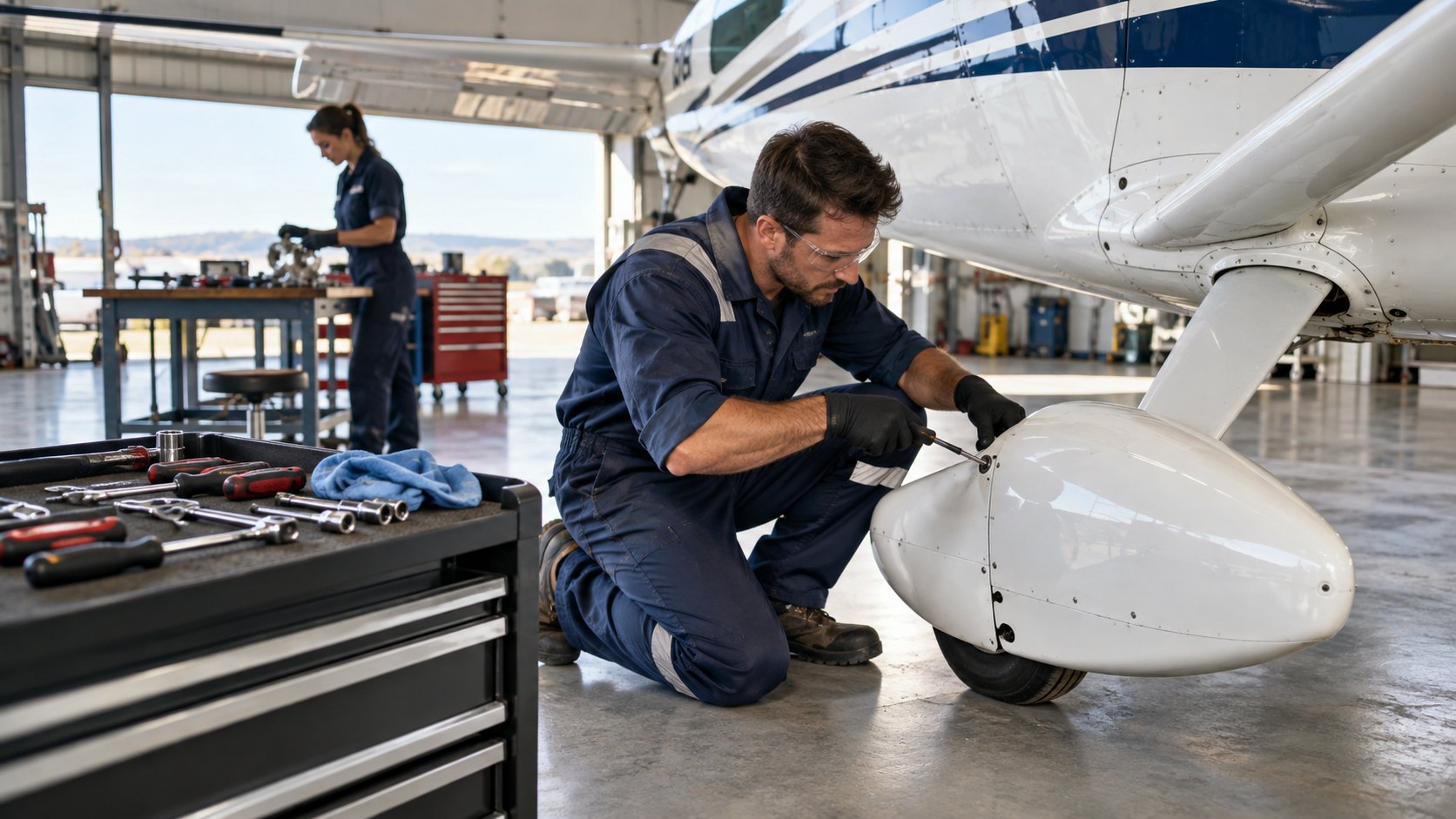
This line is the fitting itself: taking a manufactured part and attaching it to a finished vehicle so that the vehicle still works. In practice that is mechanical mounting, trim removal and refitting, drilling and sealing where the part demands it, electrical connection, and testing what has been connected.
The electrical half is where the trade has moved and where most of the damage is done. A modern vehicle runs its lighting, doors, seats and instruments over a data network rather than over individual wires, and the modules on it expect a known load. An accessory spliced into a convenient circuit because that circuit was easy to reach can wake a module that should be asleep, flatten a battery over a weekend, throw a fault the owner takes to a franchised dealer, and end with the dealer declining a warranty claim. The part cost a modest amount. The argument costs the fitter a customer and sometimes a repair bill.
What separates a fitter from a mechanic
Fitting is additive. Something that was not on the car goes onto it, and the car's original systems are supposed to be left exactly as they were found. Repair is corrective: something that has failed is put back to how it should be. The two use the same tools and much of the same knowledge, and they are separate entries in this catalogue — mechanical, electrical, bodywork and servicing work on motor vehicles is its own line, and a shop that does both holds both rather than one broadly worded one.
The other neighbours are worth naming for the same reason. Tyre and tube repair, fitting and replacement is its own entry, and tyre fixing with wheel alignment is another. Anti-rust treatment and rust-proofing are separate again. Vehicle upholstery — seats, headlining and trim recovered rather than bolted on — is its own line. A shop advertising all of them on a signboard while holding one of them on its licence has a problem that is entirely avoidable and entirely visible from the street.
What the vehicle has to survive after you hand back the keys
The licence lets the company trade. What governs any particular job attaches to the car, and this is the part of the work a customer almost never understands.
A modified vehicle still has to be roadworthy and still has to pass inspection. The customer arrives with a photograph from a forum and a fixed idea; the fitter is the one who knows which of those ideas will come back. Lighting that is the wrong colour or aimed in the wrong place, window film darker than is permitted, a bar or a rack that obscures a number plate or a lamp, a lift that changes headlight aim and steering geometry, wheels and spacers that put a tyre outside the arch — each of those works perfectly in the car park and fails when the vehicle is next presented for its test. Saying so before the work starts is the most valuable thing this trade sells, and the shop that says yes to everything spends its weekends undoing work it was paid for once.
Three kinds of control sit around the bay itself rather than around the car. Premises suitability, drainage and public-health conditions on a workshop are settled with the municipality for the emirate — Dubai Municipality in Dubai. Where solvents, paints, adhesives, compressed gas or quantities of batteries are held, fire safety is a civil-defence matter. Vehicle and transport permissions in Dubai sit with the Roads and Transport Authority, which is also the body concerned with what a modified vehicle is allowed to be. Separately, any accessory that transmits on a radio frequency — a tracker, a remote alarm, a two-way radio, a telematics unit with its own connection — falls under the type-approval control operated by the telecoms authority, so whether a particular unit may lawfully be sold and fitted here is a question answered before it is bought in bulk, not after. Accessories brought in from abroad are imported goods and clear customs like any other cargo.
None of that is a list that can be written once and reused. Which conditions apply depends on the emirate, the premises and the exact accessory mix, and the conditions attached to a workshop in one emirate are not the conditions attached to the same workshop in another. ConsultZone establishes the applicable approvals for the specific site and the specific activity mix before a lease is signed, because a bay with the wrong drainage or the wrong fire rating is a fit-out paid for twice.
References
- Roads and Transport Authority — vehicle and transport permits in Dubai, including what a modified vehicle is permitted to be. Roads and Transport Authority
- Dubai Municipality — premises suitability, drainage and public-health conditions for a workshop in Dubai. Dubai Municipality
- Dubai Civil Defence — fire safety where solvents, adhesives, compressed gas or batteries are held. Dubai Civil Defence
- Telecommunications and Digital Government Regulatory Authority — type approval for radio-transmitting equipment such as trackers, remote alarms and telematics units. TDRA
- Dubai Customs — import of accessories and parts, and restricted goods. Dubai Customs
Elsewhere in Trading
Activities that sit beside this one
Most licences carry more than one activity. Adding a neighbouring line at the application stage costs a fraction of amending the licence afterwards.
Begin with a clear conversation
Tell us what you intend to build.
A consultant will map the structure, jurisdiction, approvals and likely cost against what you actually described — not against a package.
