
Activity CZ 76
How to Start a Tyre Fixing and Wheel Alignment Business in Dubai
Fixing a tyre is work a customer can watch and verify. Wheel alignment is a measurement he has to take on trust, and that single asymmetry decides the equipment, the pricing and the reputation of the bay.
ConsultZone licensing desk
- Activity code
- CZ 76
- Category
- Trading
- Reviewed
- Read
- 7 min
Listen instead
43 seconds
An audio summary of this guide.
Topic summary
How to Start a Tyre Fixing and Wheel Alignment Business in Dubai
A customer can stand next to a punctured tyre, watch it come off the rim, see the plug go in, and watch it hold air in a water bath. He knows whether he got what he paid for. He cannot do any of that with an alignment. Toe, camber and caster are angles measured in fractions of a degree, they cannot be seen, and the car drives out of the bay feeling much as it drove in unless it was badly out to begin with.
That asymmetry is the business. One half of this activity sells visible labour into a commodity market, and the other sells a number that the buyer is not equipped to check. The first half brings the cars in. The second is where the margin is, and it is the only part of the automotive trade in this catalogue where the operator's honesty is a material asset rather than a virtue.
Fixing is labour; alignment is a measurement
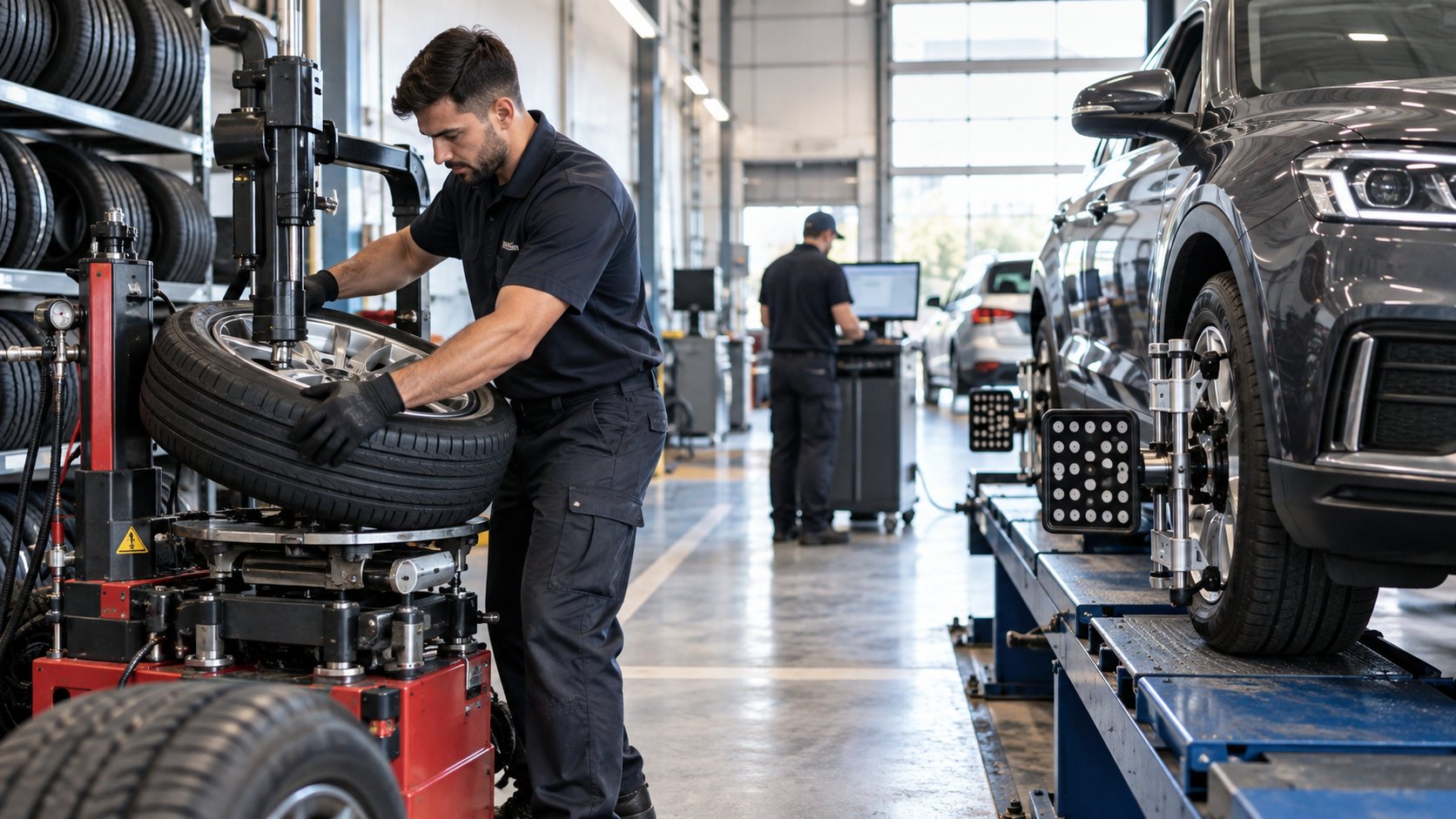
The fixing half is straightforward and relentless. Punctures are repaired or refused, tubes and valves are replaced, tyres are removed and remounted, wheels are balanced, beads are reseated, pressures are corrected and a road-damaged wheel is either straightened or condemned. It is quick, it is cheap, it repeats, and the only way to be better at it than the shop across the road is to be faster or open later.
Heat and load make it a bigger market here than it would be in a temperate country. Summer road surfaces are punishing, a tyre run soft in that heat fails rather than wears, and sand and construction debris on the approach roads to industrial areas puncture sidewalls that would survive anywhere else. Sidewall damage cannot be repaired, which means a share of the puncture work is actually tyre replacement — and a fixing bay that has no stock has to send that customer somewhere else.
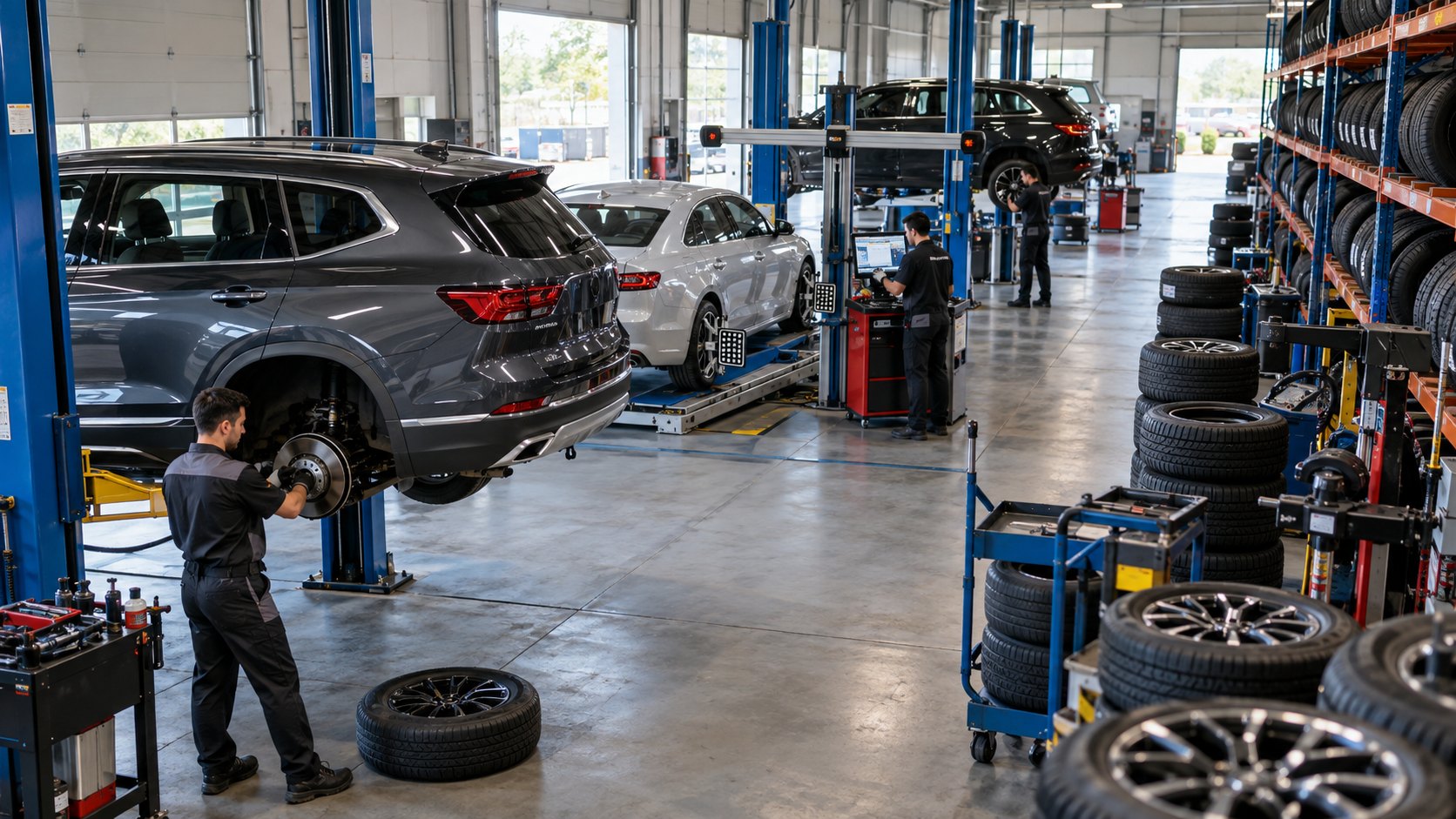
Alignment is a different discipline wearing the same overalls. The car is put on a level surface, targets are mounted to the wheels, the machine reads the geometry against the vehicle maker's own target values, and the adjustable angles are brought back within them. Three things have to be true before any of that means anything: the surface has to be genuinely flat, the equipment has to be in calibration, and the suspension and steering joints have to be tight.
The last of those is what separates a technician from an operator. Play in a ball joint, a worn track-rod end, a tired bush or a bent component produces a geometry reading that is real at the moment it is taken and meaningless five minutes later. Aligning a car in that condition is selling an adjustment that will not hold. The customer returns in a month with the same pull to the left and the same uneven wear, and he does not conclude that his bushes are worn — he concludes that the alignment was never done.
- Read the tyres before touching the machineWear across the tread says more than the customer's description of the problem
- Check the steering and suspension joints by handPlay in a joint makes every reading the machine takes meaningless
- Is the uneven wear coming from the geometry or from a worn part
- From the geometryAdjust to the maker's own target values and print the figures before and after
- From a worn partThe part is replaced first, or the alignment is sold twice and believed once
- Record the result and give the customer the printoutThe printout is the only evidence the work happened, and it is what he is paying for
- A bill the customer can check
That printout deserves more attention than most bays give it. It is not paperwork. It is the product, because it is the only part of an alignment a customer can hold, compare and show to the next shop. A bay that hands one over on every job has converted an unverifiable service into a verifiable one, and it can charge accordingly.
Who actually buys an alignment, and who never will
Three groups pay for geometry work, and they arrive for different reasons.
Owners who have hit something. A kerb, a pothole, a speed bump taken at the wrong angle. They know the car has changed and they want it put back. This is the easiest sale in the trade and the least frequent.
Owners who have just bought tyres. A new set of tyres on a misaligned car is scrubbed away early, and the owner blames the tyres. Any shop that sells tyres and does not offer alignment alongside them is handing away the more profitable half of the transaction and inheriting a warranty argument about tread wear.
Fleets. Taxis, delivery vans, rental fleets, buses and light trucks buy alignment as a cost-control measure rather than as a repair, because tyres are one of their largest running costs and a vehicle eating a set early is measurable on a spreadsheet. Fleet work is scheduled, priced by agreement, and it fills the days that walk-in trade does not.
And one group that will not buy it unless they are shown why: the owner with no symptoms. Nothing pulls, nothing vibrates, the car feels normal. Selling him an alignment requires showing him his own tread — inner shoulder worn, outer shoulder new — and that is a conversation, not a poster.
Where this line stops, and what sits beside it
Tyre and tube repair, fitting and replacement is a separate entry in this catalogue, and a shop whose business is buying and selling tyres as goods is trading rather than servicing. This line is the bay: the fixing, the balancing and the geometry. Suspension and steering repair — replacing the worn joints this work keeps finding — belongs with mechanical repair of motor vehicles, which is its own activity, and a bay that intends to replace the parts it condemns needs that line as well as this one. Washing the car afterwards is car washing and cleaning, another entry again.
This is a mainland trade, because the customer has to drive to you
The structural question of mainland against free zone answers itself here, and it answers itself on geography rather than on ownership rules.
A tyre and alignment bay earns its living from vehicles already on UAE roads, driven in by their owners or delivered by a fleet operator based in the emirate. A mainland licence issued by the emirate's economic department is the shape that matches that: the company trades with the local market directly, takes walk-in customers, invoices UAE fleets and sits on a commercial street where people can find it. A free zone licence is built for a company operating within its zone and trading outward, which is a good fit for importing and distributing tyres as goods and a poor one for a service bay whose customers are the general public.
What that licence costs to hold, and what conditions come attached, depends on the emirate, the premises and the activity mix, and the honest answer to a question about price is that it is established for the specific case rather than quoted from a table. What can be said without qualification is that the premises decide more than the licence does. A bay needs a hard, level floor over the area where geometry is measured, because a sloping or settled slab produces confidently wrong numbers; it needs drainage and waste handling that the municipality will accept, since tyre work produces water, rubber debris and used lubricant; it needs safe storage for the compressor and for whatever solvents and adhesives are held, which is a fire-safety matter for civil defence; and it needs enough frontage and turning room for cars to arrive and leave without blocking a road. Those conditions are agreed with the municipality and the landlord before the lease is signed, not discovered during a fit-out, and ConsultZone confirms the applicable requirements for the specific site.
References
- Dubai Municipality — premises suitability, drainage and waste handling conditions for a vehicle workshop in Dubai. Dubai Municipality
- Roads and Transport Authority — vehicle permits and roadworthiness requirements in Dubai. Roads and Transport Authority
- Dubai Civil Defence — fire safety for compressed air equipment and the storage of solvents and adhesives. Dubai Civil Defence
- Ministry of Industry and Advanced Technology — national standards and conformity marks applying to tyres and automotive products. MoIAT
Elsewhere in Trading
Activities that sit beside this one
Most licences carry more than one activity. Adding a neighbouring line at the application stage costs a fraction of amending the licence afterwards.
Begin with a clear conversation
Tell us what you intend to build.
A consultant will map the structure, jurisdiction, approvals and likely cost against what you actually described — not against a package.
