
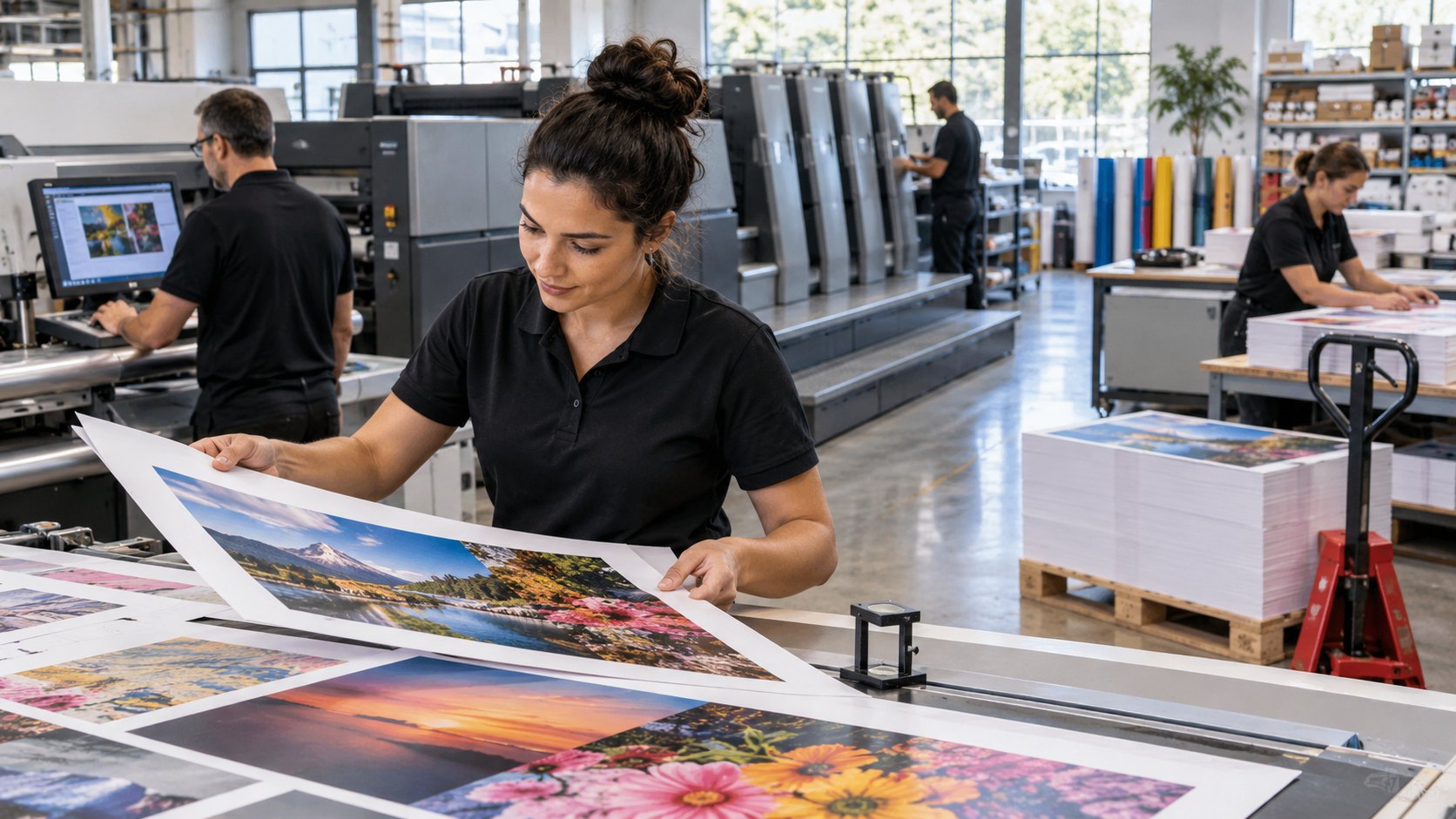
Activity CZ 11
How to Start a Printing and Print Services Business in Dubai
A print business is really two businesses — the press, and everything that happens on either side of it. This line covers both, and the case for holding it is where the deadlines sit.
ConsultZone licensing desk
- Activity code
- CZ 11
- Category
- Manufacturing
- Reviewed
- Read
- 7 min
Listen instead
53 seconds
An audio summary of this guide.
Topic summary
How to Start a Printing and Print Services Business in Dubai
A sheet coming off a press is not yet a product. It has to be trimmed square, folded, gathered, stitched or glued, sometimes laminated or foil-blocked, then counted and boxed — and none of that is printing. It is the work that turns an impression into something a customer can use, and it is where print jobs are lost. CZ 11 is the line that puts that work inside the same building as the press.
The distinction is commercial rather than administrative. A printer who sends every booklet out to a trade binder is quoting somebody else's lead time on his own delivery date, and paying away a slice of a margin that was never generous. Worse, a fault introduced at the folding stage is found after the ink has dried, when the only remedy is to print the job again — and a reprint is scrap, not a return. The firm that controls the whole sequence controls the date it promised, and print is bought on dates far more often than it is bought on price.
The front of the sequence is the other half of the argument. Preparing files, imposing them, proofing colour and making plates costs little to set up beside a press, and it is what keeps a customer: a client who has learned to trust your proof stops shopping the price on every job. A plant that only prints has no relationship with the file, and no relationship with the file means no relationship with the buyer.
Who this line is for
Print firms that already subcontract their finishing
The clearest case. The work exists, the customers exist, and the margin is leaving the building on somebody else's van. Bringing the steps in house is a licensing question before it is a capital one, because the activity wording on the licence is what decides whether those steps may be invoiced at all.
Design and pre-press studios adding production
A studio that has spent years specifying other people's print and watching what came back. The commercial upside is real. What surprises people is that the studio's profit per hour is usually the higher of the two, and a badly used machine can pull the whole business down with it.
Corporate and institutional print rooms going commercial
Hotel groups, hospitals, universities and large offices that already run a print room as a cost centre and want to sell its spare capacity. The internal demand makes the utilisation arithmetic work from the first month, which is the hardest part of this trade to solve from a standing start.
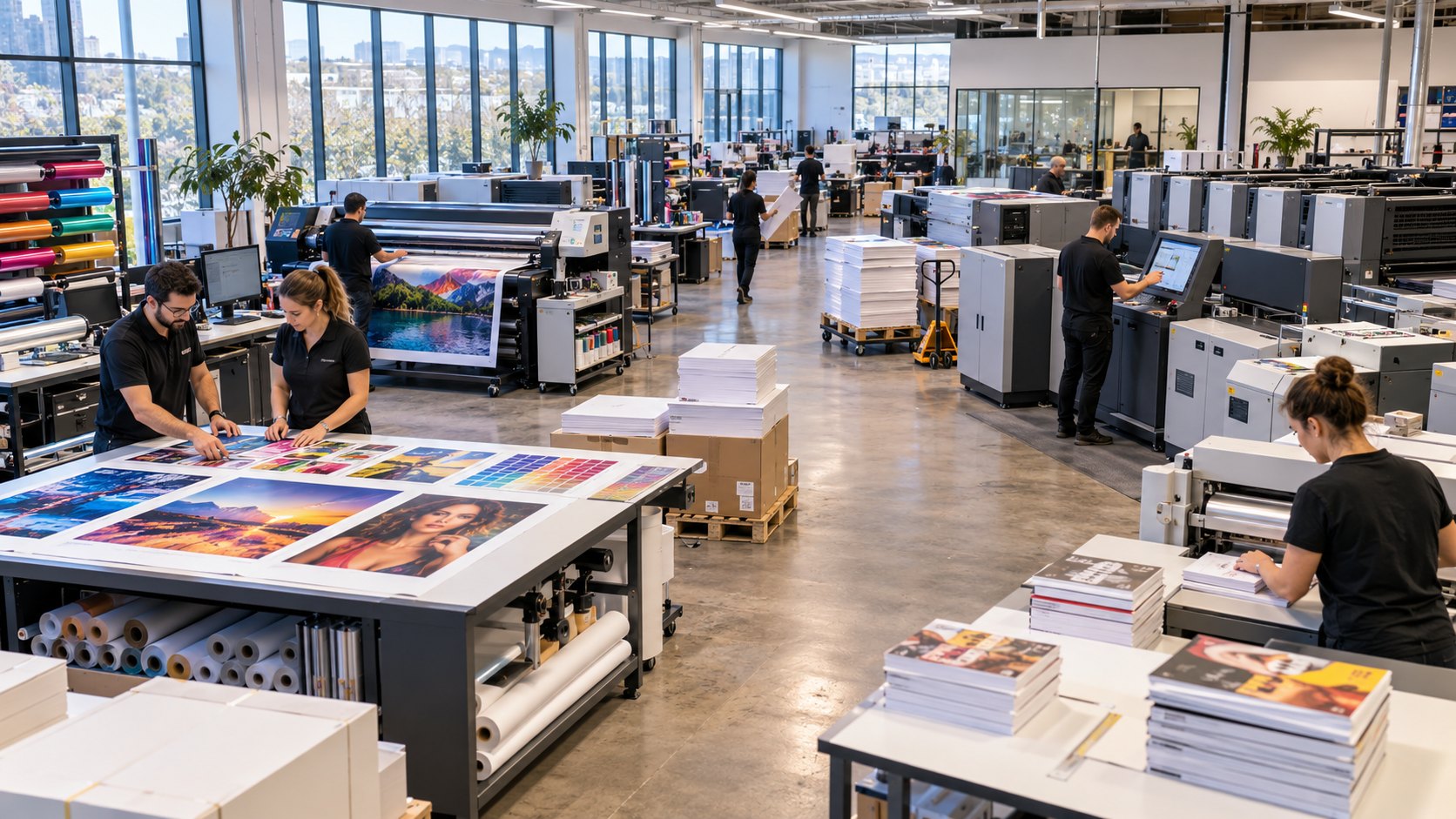
CZ 11 — Printing and service activities related to printing
The line is deliberately broad: the press, and the services that attach to printing on either side of it. In practice that is three stages the customer experiences as one job.
Before the press
Checking and correcting supplied artwork, imposition, colour proofing, and making the plates or screens the press will run. This is the low-capital, high-judgement end of the trade, and the stage at which a job is either going to work or already will not.
The press
Offset, digital, screen and pad printing, and flexography where the substrate suits it. What is sold at this stage is an impression on a sheet, to a specification.
After the press
Cutting and trimming, creasing and folding, gathering, saddle-stitching and perfect binding, laminating and varnishing, numbering, die-cutting, foiling, personalising, and preparing the result for despatch. Most of this equipment costs a fraction of a press and decides a larger share of what the customer actually notices.
There is a fourth thing the activity name never mentions and every plant learns. Paper takes up moisture and changes dimension with it, so a pallet that has stood in an uncontrolled warehouse through a Gulf summer will fight the press and lose its fit on a second pass. Storage is part of the plant, not an overhead attached to it.
Holding all three stages under one activity is also what lets a whole job be invoiced as one job. That sounds like bookkeeping and is not: a single invoice from a single supplier is the thing a procurement department is trying to buy, and it is the reason a combined plant wins work that a specialist press is never shown.
Because the three stages sit in different physical conditions, the permissions a plant needs are held by several different bodies rather than by one. The licence, and the activity wording carried on it, comes from the emirate's economic department — and so does any later change to that wording, every time the plant takes on a step it did not do before. Industrial use of the premises, trade effluent and waste belong to the municipality, and they are settled with the tenancy rather than after it. A store of inks, solvents and cleaning chemicals is a fire-safety matter for the civil defence authority, assessed at plant sign-off. The press, the paper and the plates arrive as imports and pass the emirate's customs authority once the licence is cut. The order those four counters are approached in is what turns a straightforward application into a slow one.
the five gates this page names, and who holds each one
The emirate's economic department
- The trade licence, and the activity wording on itFirst — the wording decides what may lawfully be invoiced
- Any later change to the activity mixEvery time the plant takes on a step it did not do before
The municipality
- Industrial premises use, trade effluent and wasteWith the tenancy, before a press is ordered
The civil defence authority
- Storage of inks, solvents and cleaning chemicalsAt plant sign-off, not afterwards
The emirate's customs authority
- The press, the paper and the plates arriving as importsOnce the licence is cut
What each of those conditions requires, and what satisfying it costs, depends on the emirate, the authority and the premises, and we confirm it against the specific plant before anything is signed. Staffing is a separate track again: press and finishing operators are a scarce skill in this market, and their permits and contracts run through the federal labour ministry rather than through the licensing authority.
Where this line stops
The activity sits in the manufacturing family of the client's own catalogue, and that classification carries an expectation of industrial premises rather than an office. Four boundaries are worth knowing before the application rather than after it.
It does not make you a publisher. Deciding what goes on the page, commissioning it, owning it and issuing it to the public is publishing; printing it to order for somebody who has already decided all of that is not. Where the printed matter is itself a publication — a newspaper, a magazine, a book — a media-content permission attaches to what is printed, separately from the trade licence that lets the press run. That territory belongs to CZ 13.
It does not cover security papers. Cheques, documents of title, postage stamps and taxation stamps are instruments rather than stationery, and they are not work a printer picks up by holding a wider licence. CZ 13 again, and the reasoning there is worth reading before anybody assumes otherwise.
It does not cover printing directly onto objects. The catalogue keeps printing onto textiles, plastic, glass, metal, wood and ceramics as its own line, CZ 14. A press that prints paper and a machine that prints a bottle are different activities in the client's sheet, whatever a supplier's brochure implies.
And it does not describe a studio that never prints. A firm that designs, specifies and places the work elsewhere is selling professional services, and the lighter licence that matches that is also the cheaper one to hold.
Where this is the wrong purchase. If the plan is to take print orders and place them with somebody else's plant, this is the wrong activity. A brokerage needs no press, no industrial floor and no chemical store, and a manufacturing licence bought to run one is a factory paid for and never used.
References
- Dubai Municipality — premises suitability, trade effluent and waste conditions for an industrial plant in Dubai. Dubai Municipality
- Dubai Civil Defence — fire safety approval, and the conditions attaching to a store of flammable inks and solvents. Dubai Civil Defence
- Dubai Customs — importing presses, paper, plates and inks, and the codes an importer holds in its own name. Dubai Customs
- Ministry of Human Resources and Emiratisation — work permits and labour contracts for press and finishing staff. Ministry of Human Resources and Emiratisation
- Ministry of Industry and Advanced Technology — industrial licensing, and the national standards that reach a plant doing manufacturing work. Ministry of Industry and Advanced Technology
Elsewhere in Manufacturing
Activities that sit beside this one
Most licences carry more than one activity. Adding a neighbouring line at the application stage costs a fraction of amending the licence afterwards.
Begin with a clear conversation
Tell us what you intend to build.
A consultant will map the structure, jurisdiction, approvals and likely cost against what you actually described — not against a package.
