
Activity CZ 10
How to Start a Gents Wears Tailoring & Embroidery Workshop in Dubai
Gents wears workshops earn on repetition, not on ornament — thobes, uniforms and crest embroidery to a specification. What the tailoring line covers, which buyers reorder, and who holds each gate.
ConsultZone licensing desk
- Activity code
- CZ 10
- Category
- Manufacturing
- Reviewed
- Read
- 8 min
Listen instead
43 seconds
An audio summary of this guide.
Topic summary
How to Start a Gents Wears Tailoring & Embroidery Workshop in Dubai
Measure the decorated area on a man's garment and the business model falls out of it. On a kandura the embroidery is the placket running down the chest, sometimes a cuff, occasionally a collar band — a few inches of thread on several square metres of cloth. On a woman's occasion gown the decoration can be the entire surface. That ratio is why the catalogue lists a gents wears workshop and a ladies wears workshop as two entries rather than one tailoring line with a footnote, and it is the first thing worth understanding about where the money sits.
Because ornament cannot carry the margin here, repetition has to. A gents workshop that lasts is one cutting the same shirt, the same thobe, the same trousers and the same security firm's tunic again next month, and the embroidery head standing on its floor is there to put a crest, a monogram or a company mark on them rather than to cover them. The sheet files this activity under Manufacturing, and on the gents side that word is nearer to literal than anywhere else in this family: a floor running size breakdowns against a written specification is a small factory with good lighting.
Cutting, sewing and an embroidery head, under one line
Two operations live inside this activity, usually performed by different people in different parts of the room, and a plan that budgets for one of them is short.
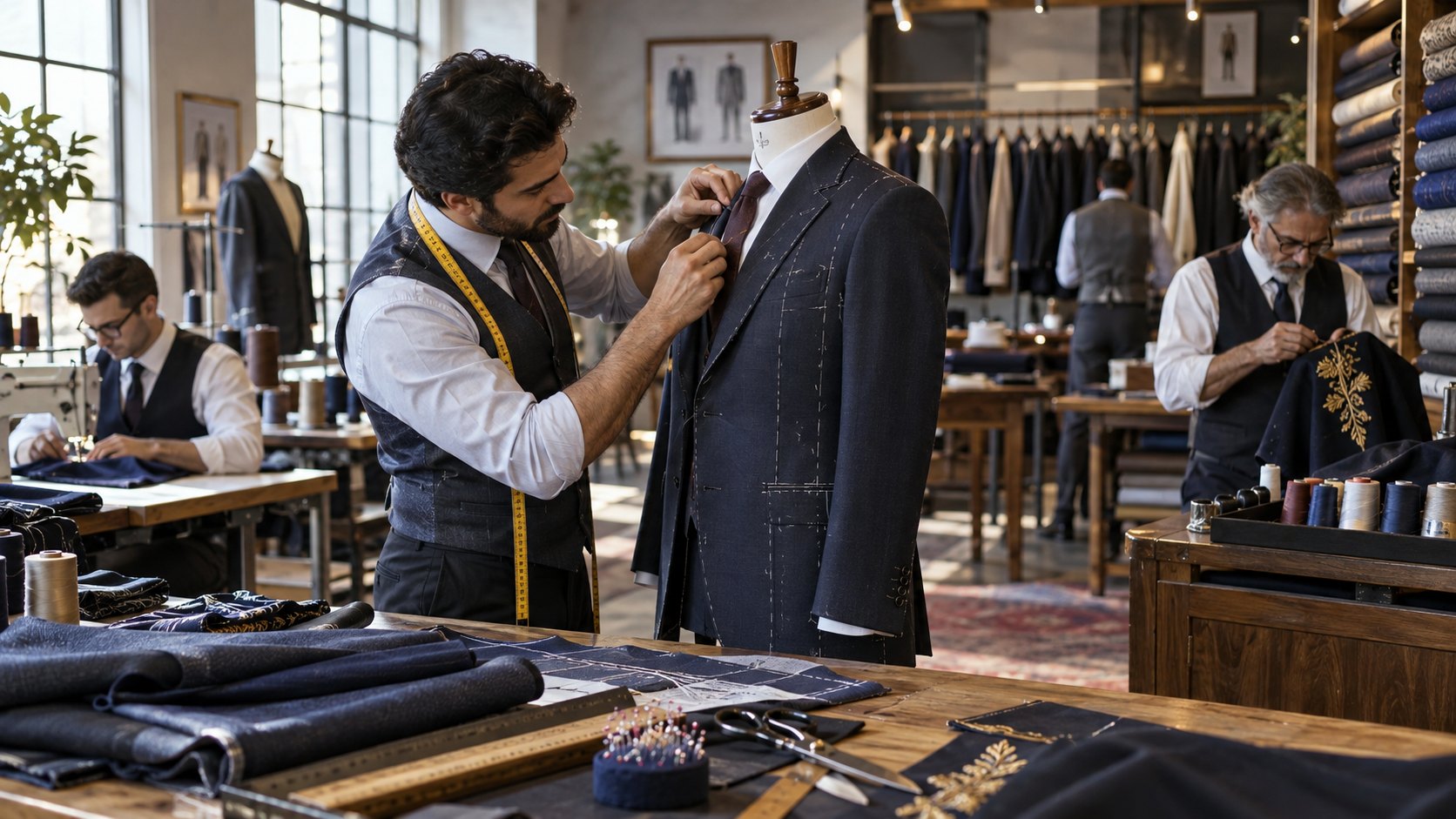
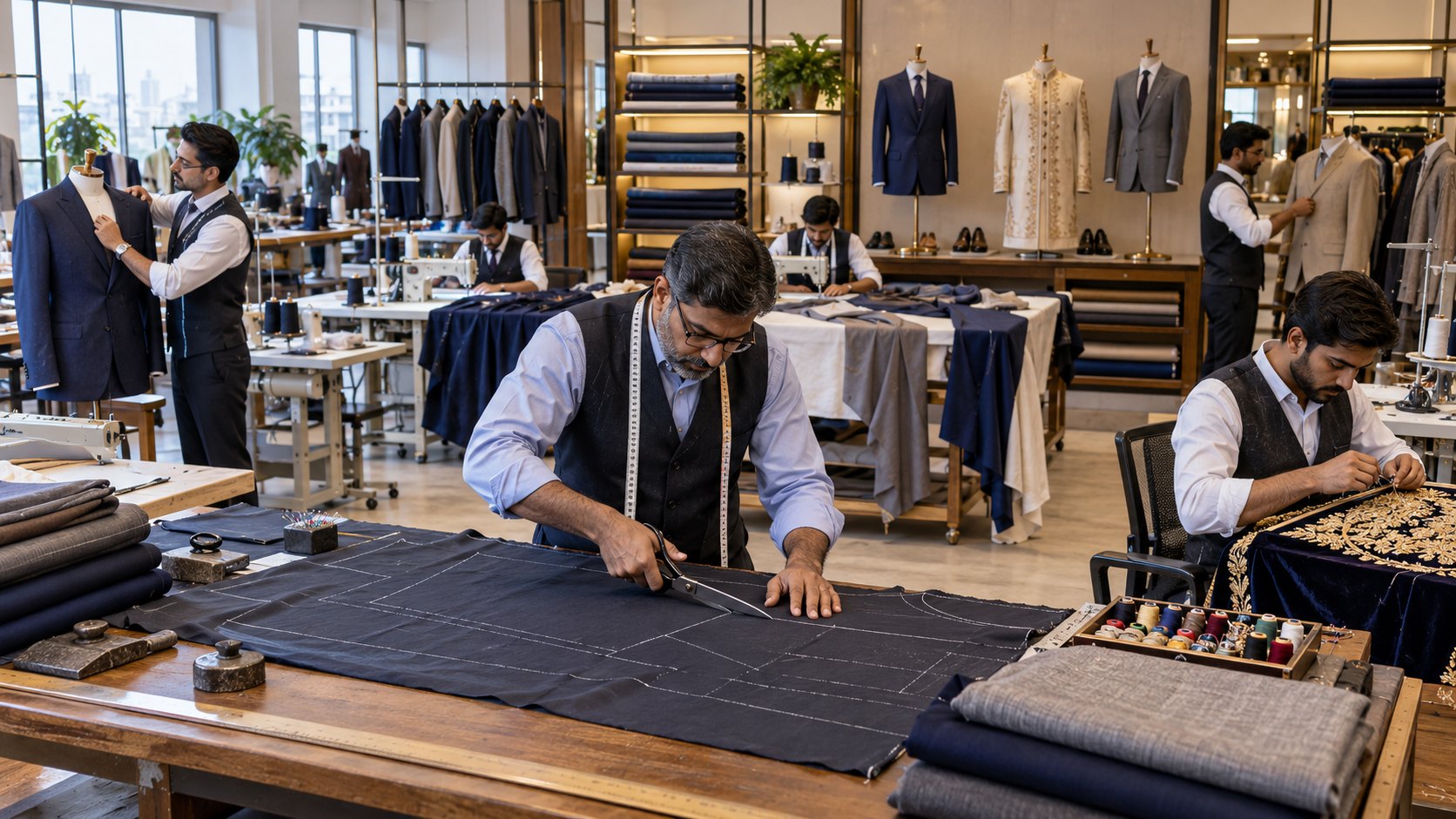
Tailoring is the cutting and making of men's garments — kanduras and thobes, shirts, trousers, suits and jackets, waistcoats, and the uniform and workwear that pays for the rest. Work arrives either as a measurement set handed over with the order or as a graded pattern with a size breakdown attached, and the second kind is what a workshop is built around. A bespoke jacket is four appointments and one sale. Two hundred shirts against a size breakdown is one specification and a delivery date, and only the second of those keeps a room full of machinists occupied.
Embroidery on this side is mostly identification rather than decoration. A hotel crest on a breast pocket, a school badge, a contractor's name across the shoulders of a coverall, initials inside a jacket, braid laid down the placket of a kandura. Machine work dominates, because the same design is repeated across a batch and a multi-head machine is what makes that arithmetic work — it stitches one design onto several garments in a single pass, which turns an embellishment into a unit cost somebody can be quoted. Hand work survives at the ceremonial end, on the gold couching of a formal thobe or a bisht, where intricacy is the point and volume is not.
Where this line and the ladies line genuinely overlap
They overlap on the machines and on the skills, and on very little else. The same multi-head will run a hotel crest in the morning and an abaya panel in the afternoon, and a cutter who can grade a shirt can grade a kurti. The order book is what differs. The ladies workshop is occasion-driven, decoration-heavy and short-run; this one is contract-driven, specification-heavy and long-run. Any floor intending to serve both should have both written onto the activity line from the beginning, rather than finding out on a purchase order that one of the two was never there.
The buyers who reorder, and how a workshop reaches them
There are four groups, and they are worth separating because the selling is different for each.
Uniform and workwear suppliers are the steadiest. They hold the contracts and the customer relationships and frequently own no production at all, which makes them the natural first customer for a new floor. They pay on terms, they reorder, and they are ruthless about a late delivery because their own penalty clauses run to the end client.
End buyers who consume uniforms directly — hotels, hospitals and clinics, schools, security and facilities firms, construction contractors, airlines and their ground handlers, restaurant groups. Reaching them means bidding: a sample against a specification, a price per piece, and a reference somebody can call. The award is slow and the reorder is almost automatic, which is the trade a workshop makes when it goes after this group instead of the suppliers who already serve it.
Kandura shops and gents' tailoring salons carry the walk-in trade and the fittings, and send out what their own back rooms cannot absorb — overflow at Eid and the National Day season, and the embroidery they have no machine for. This work is small, frequent and unglamorous, and it is what fills the gaps between contract batches.
Labels and online sellers are the newest group and the least predictable. The design and the marketing are theirs; the production is yours. Margins can be better than contract work and volumes are rarely committed, so this is a useful second income rather than a floor to build on.
None of these buyers ever visits a shop, which settles a question people usually get backwards. A gents wears workshop does not need an address anybody can find. It needs a sample box, a written price per piece, a stitch-out of the embroidery it claims it can do, and a delivery record — and once those exist the unit can sit wherever the rent and the power supply make sense.
The conditions attach to the premises, not to the cloth
This is the honest difference between a garment workshop and the licence lines people compare it to. Food, medicines and fuel are controlled as goods: the product itself carries a file. Woven cloth, thread and trims are not policed in that way. What is policed is the place the work happens and the people doing it, so almost every condition on this file lands on the unit rather than on the material.
the six gates named on this page
The emirate's economic department
- Reserving the trade nameFirst, before any document is drawn
- The activity line the licence actually carriesWith the initial approval, and awkward to change later
- The address the licence is issued againstAfter the tenancy, and it shapes the visa allocation
The municipality
- Whether the unit may be used for light productionAt the tenancy, not once the machines are in
Civil defence
- Fire safety on a floor holding cloth and threadWith the fit-out, before anything is commissioned
The federal labour ministry
- Work permits and contracts for the machinistsOnce the licence and the unit both exist
The shape of that is the finding. Three of the six sit at one counter, which is good news in that most of the file moves in one place, and bad news in that a wrong answer there — the wrong activity wording, an address the department will not accept — stalls everything downstream. The two gates on the unit are the ones that catch people out, because both are decided with the tenancy rather than after it, and a lease signed on a unit that turns out not to be usable for production is money already spent.
Three further conditions attach to the work itself, and none of them comes from a licensing authority.
Imported cloth, thread, trims and the machines themselves need a customs code held in the company's own name, and a consignment that clears before production is scheduled rather than on the morning it is needed.¹ A mark being embroidered belongs to whoever owns it: a hotel crest, a school badge or a brand logo is stitched on the written instruction of the party entitled to use it, and a workshop that takes that instruction verbally is carrying somebody else's risk. And what a finished garment must show on its label depends on the market it is being sold into, which in practice means the buyer's own specification settles it long before any authority asks.
For a floor that grows past a workbench operation, the federal industry ministry is the body that runs industrial licensing and the national standards and conformity regime, and it is worth knowing where that threshold sits before the second unit is taken rather than after.²
When this is the wrong line to buy. A street-facing salon where men are measured, fitted and handed a finished kandura is a different activity, and the men's tailoring entry in this same catalogue is the one the licensing authority expects for it. This line is for a floor whose invoices go to businesses.
Which of the approvals above apply, and what the licence costs to hold, turns on the emirate, the unit and the exact mix of activities written onto it. Those answers come from the licensing authority for the jurisdiction being chosen, and ConsultZone establishes them for the specific case rather than quoting an average.
References
- Dubai Customs — importer code, clearance and restricted-goods guidance for cloth, trims and machinery consignments. Dubai Customs
- Ministry of Industry and Advanced Technology — industrial licensing, national standards and conformity marking for a manufacturing line. Ministry of Industry and Advanced Technology
- Dubai Civil Defence — fire safety approval on a production unit storing fabric, thread and made-up garments. Dubai Civil Defence
- Ministry of Human Resources and Emiratisation — work permits, labour contracts and wage protection for a production team. Ministry of Human Resources and Emiratisation
- UAE Government portal — federal government information on company licensing and the authorities named above. UAE Government portal
Elsewhere in Manufacturing
Activities that sit beside this one
Most licences carry more than one activity. Adding a neighbouring line at the application stage costs a fraction of amending the licence afterwards.
Begin with a clear conversation
Tell us what you intend to build.
A consultant will map the structure, jurisdiction, approvals and likely cost against what you actually described — not against a package.
