
Activity CZ 120
How to Setup a Horns, Hooves and Animal Bones Trading Business in Dubai
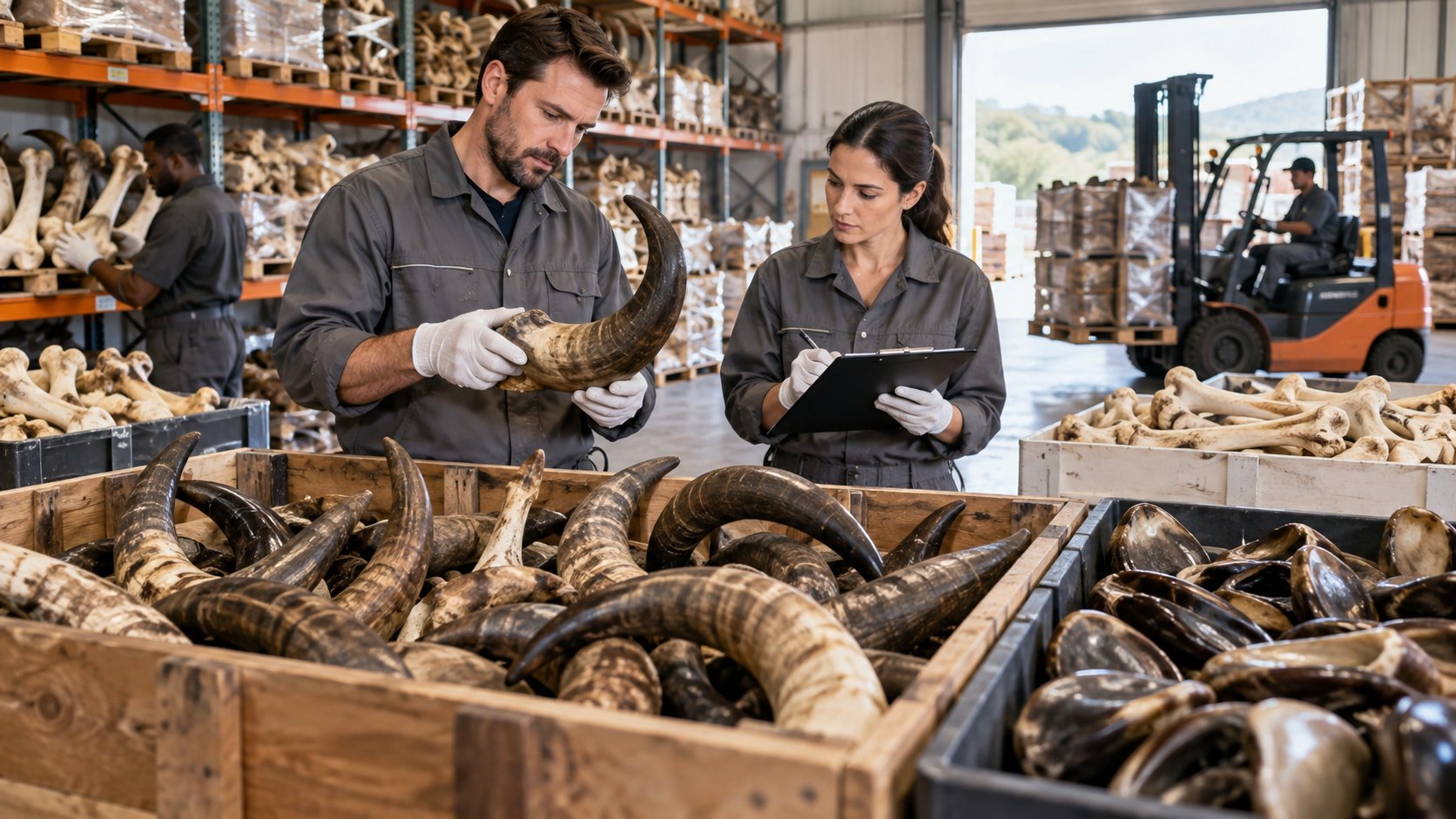
Horns, hooves and bones are an industrial raw material whose supply is somebody else's slaughter schedule. What the trade actually sells, who buys it, and the wildlife check that comes before any ornamental lot.
ConsultZone licensing desk
- Activity code
- CZ 120
- Category
- Trading
- Reviewed
- Read
- 7 min
Listen instead
46 seconds
An audio summary of this guide.
Topic summary
How to Setup a Horns, Hooves and Animal Bones Trading Business in Dubai
Nobody farms horns. That single fact shapes everything about this licence line, because the material only exists as a residue of an animal that was killed for something else — meat, hide, milk at the end of its working life. The volume available to you next quarter is set by the slaughter schedules of abattoirs you do not own, in quantities you cannot order more of.
A trader who understands that runs the business from the supply side. You are not taking orders and then sourcing; you are securing a stream and then finding it a home. The mills, renderers and craft workshops that buy this material are patient about price and impatient about consistency, which inverts the usual trading instinct.
Two threads run through the page. The first is that supply belongs to somebody else's business, and the second is that a small part of this trade touches protected species, where a buyer who checks nothing is exposed in a way a buyer of sheep bone never is.
What a horn, a hoof and a bone are actually sold as
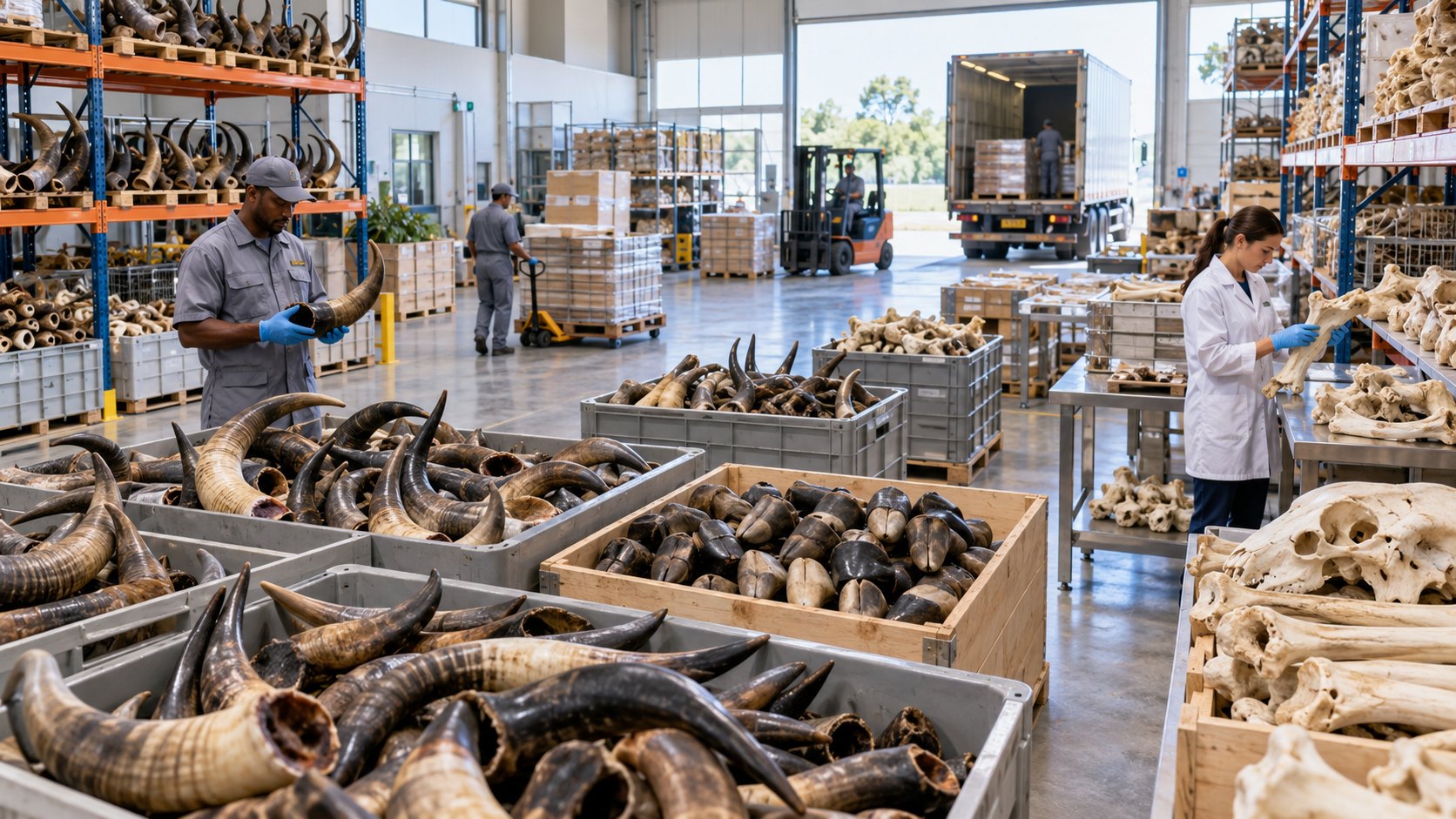
Four distinct material streams sit under one activity name, and they do not share a buyer, a price or a problem.
Bone for rendering and bone meal
The bulk stream by weight. Cattle, sheep, goat and camel bone goes to renderers who cook it down into tallow, bone meal and gelatine feedstock. The buyer is an industrial plant, the price is per tonne, and the material is judged on freshness, how much soft tissue is still attached and whether it arrived dry or wet. This is a logistics trade dressed as a commodity trade.
Horn and hoof for gelatine and keratin
Hoof and horn are keratin, which is why they feed the same gelatine and protein-meal chains as bone but at different yields. Buyers are a narrower set of processors, and they care about species, because the material behaves differently in the vat.
Craft and ornamental horn
The high-value corner. Buffalo, cattle and goat horn is worked into buttons, combs, knife and dagger handles, drinking vessels, inlay and furniture detail. Here the unit is a piece rather than a tonne, price depends on colour, curve, wall thickness and the absence of cracks, and a single good lot is worth more than a container of rendering-grade bone. It is also where the wildlife question lives.
Bone for carving and turning
Camel and cattle bone as a material for carving, beadwork, inlay and traditional craft. Small volumes, sold on whiteness and grain, and closer to a stone trade than to a rendering one.
Two boundaries are worth drawing now, because they run into neighbouring activities in this catalogue. Hides and skins are their own line — the moment you are trading the covering rather than the frame, you are on a different licence. And once the material has been cooked, milled or processed into bone meal, tallow or gelatine, the seller is an industrial producer rather than a trader of by-products.
Who buys into a by-product trade
The honest answer is people who already have one leg in the chain, and it is worth saying so rather than pretending this is an open opportunity.
Meat and abattoir operators. The strongest position in the line. If you already handle slaughter volume, the by-product stream is currently a cost or a giveaway, and turning it into a second revenue line uses material you are already paying to remove. The licence is the cheap part of that plan.
Rendering and feed-mill groups. A trading licence lets a processor buy raw material in its own name across several emirates and several suppliers instead of taking whatever arrives at the gate. Supply security, not margin, is the purchase.
Craft and furniture importers. Workshops and traders already moving horn buttons, handles or inlay who want to buy the raw material rather than the finished component. Small capital, real skill required, and the wildlife check is not optional.
Commodity traders with a destination. Exporters with a live relationship in a market that processes this material at scale. The relationship is the asset; the licence formalises it.
There is a fifth group that should be talked out of it, and we do. A trader with no supply relationship, no buyer and no processing knowledge is entering a market where the material is cheap, the handling is unpleasant, the freight is heavy relative to the value, and every established participant knows the abattoir manager. The margin is not thin because of competition. It is thin because the material is a residue.
The wildlife question, and it comes before the purchase
Ornamental horn and bone is the one part of this trade with a genuine legal trap in it. A number of species are protected under the international convention governing trade in endangered species, and the material derived from them — certain antelope horn, ivory, some big-cat and rhino products — is controlled or prohibited outright regardless of how it is described by the seller. A carved piece bought on the assumption that it is buffalo is a liability if it is not.
The practical discipline is short. Establish the species before money moves, not after. Treat any ornamental lot of unknown origin as unbuyable until it is identified. Assume that a decorative object crossing a border is examined on what it is made of rather than on what the invoice calls it. The Ministry of Climate Change and Environment is the federal authority on this ground,¹ Dubai Customs holds the restricted and prohibited goods position at the border,² and inside Abu Dhabi the Environment Agency has the environmental remit.³ What is permitted, what needs a clearance and what cannot be bought at all is confirmed for the specific species and the specific lot — never inferred from a previous shipment.
Where it sits between the mainland and a free zone
The structural choice here is unusually clean, because it follows the material rather than the tax position. Three supply routes exist and they load the company differently.
three supply routes, judged on the same five rows
| Judged on | From the abattoir | From a consolidator | Imported by container |
|---|---|---|---|
| You control the condition the material arrives in | Yes | Partial | No |
| Volume is predictable enough to promise a mill | No | Yes | Yes |
| Capital sits still before anything is sold | Little | Some | Most |
| A species check is needed before you buy | Rarely | Sometimes | Every ornamental lot |
| Who carries the drying, cleaning and odour problem | You | You | The shipper, then you |
Read the middle column as the working answer for most new entrants: a consolidator gives you enough predictability to sign a supply contract without tying up container-scale capital.
That table also settles the jurisdiction. A business buying from UAE abattoirs and selling to UAE renderers is trading inside the domestic market, and a mainland licence is the ordinary route for it — you are dealing with UAE-licensed counterparties on UAE soil. A business built on importing raw material and re-exporting it processed or unprocessed to another market never needs the goods to clear into the local market at all, and a free zone licence fits that shape better. The awkward case is the hybrid, where domestic collection feeds an export book, and that is a question to settle before incorporation rather than after, because the answer differs between zones and each zone states its own terms.
What does not change either way is the premises. This material is wet, heavy and it smells, and no jurisdiction will let you hold it in a general-purpose unit. Storage suitability, effluent, washdown and odour containment sit with the municipality,⁴ and the site is what caps how much material you can handle at once. Settle the yard first and let it narrow the list of jurisdictions — the reverse order is how files stall.
References
- Ministry of Climate Change and Environment — animal health and by-products, and the UAE's implementation of international controls on trade in protected species. Ministry of Climate Change and Environment
- Dubai Customs — import and export of animal by-products, customs codes, and the restricted and prohibited goods position at the border. Dubai Customs
- Environment Agency Abu Dhabi — environmental permits and protected-species matters inside Abu Dhabi. Environment Agency Abu Dhabi
- Dubai Municipality — premises suitability, storage conditions, effluent and public health for animal by-product handling in Dubai. Dubai Municipality
- UAE Government portal — federal law and strategy on environment, animal protection and trade in controlled goods. UAE Government portal
Elsewhere in Trading
Activities that sit beside this one
Most licences carry more than one activity. Adding a neighbouring line at the application stage costs a fraction of amending the licence afterwards.
Begin with a clear conversation
Tell us what you intend to build.
A consultant will map the structure, jurisdiction, approvals and likely cost against what you actually described — not against a package.
