
Activity CZ 123
How to Start a Bovine Semen Trading Business in Dubai
Bovine semen trading sells genetics, not livestock. The cold chain and the pedigree file are the whole product, and a straw that has thawed once is worth nothing at all.
ConsultZone licensing desk
- Activity code
- CZ 123
- Category
- Trading
- Reviewed
- Read
- 8 min
Listen instead
59 seconds
An audio summary of this guide.
Topic summary
How to Start a Bovine Semen Trading Business in Dubai
A straw of bovine semen is the smallest and most valuable thing in this catalogue. It holds a fraction of a millilitre. It lives under liquid nitrogen at close to two hundred degrees below zero. And what the buyer is paying for is not the fluid at all — it is the bull standing behind it, and the milk his daughters gave, and the shape of their udders, and how reliably they calved, measured across years and sold to a farmer as a set of numbers.
That is worth saying plainly at the top, because it sets this trade apart from every line next to it. A live animal is a single unit of production. A straw is a decision about the next generation of a herd, taken by a farm that will not see the result for the better part of three years. The trader who sells it is selling a promise with a delivery date that far out, and two things can break the promise: the temperature, and the paperwork.
The cold chain is not a condition of sale, it is the product
Genetic material survives because it never warms up. It is collected, extended, packed into straws, frozen in vapour and then held under liquid nitrogen for as long as anybody keeps paying to top the tank up. Handled that way it lasts a very long time. Allowed to warm once, even briefly, even in transit between two tanks, it is dead — and this is the part that catches new entrants out: it does not look dead. A thawed straw looks identical to a live one. The failure surfaces months later, on somebody else's farm, as a cow that did not hold to service. The farmer does not blame physics. He blames his supplier, and he tells the other farmers.
So the shipper's dewar, the nitrogen schedule, the transfer technique and the person who knows how to do it at speed are not overheads on this business. They are the business. Most trading lines let you store stock cheaply and badly; this one charges you a running cost every month for inventory that is sitting still, and punishes a single lapse with a loss you will not detect until the claim arrives.
CZ 123 — Bovine Semen Trading
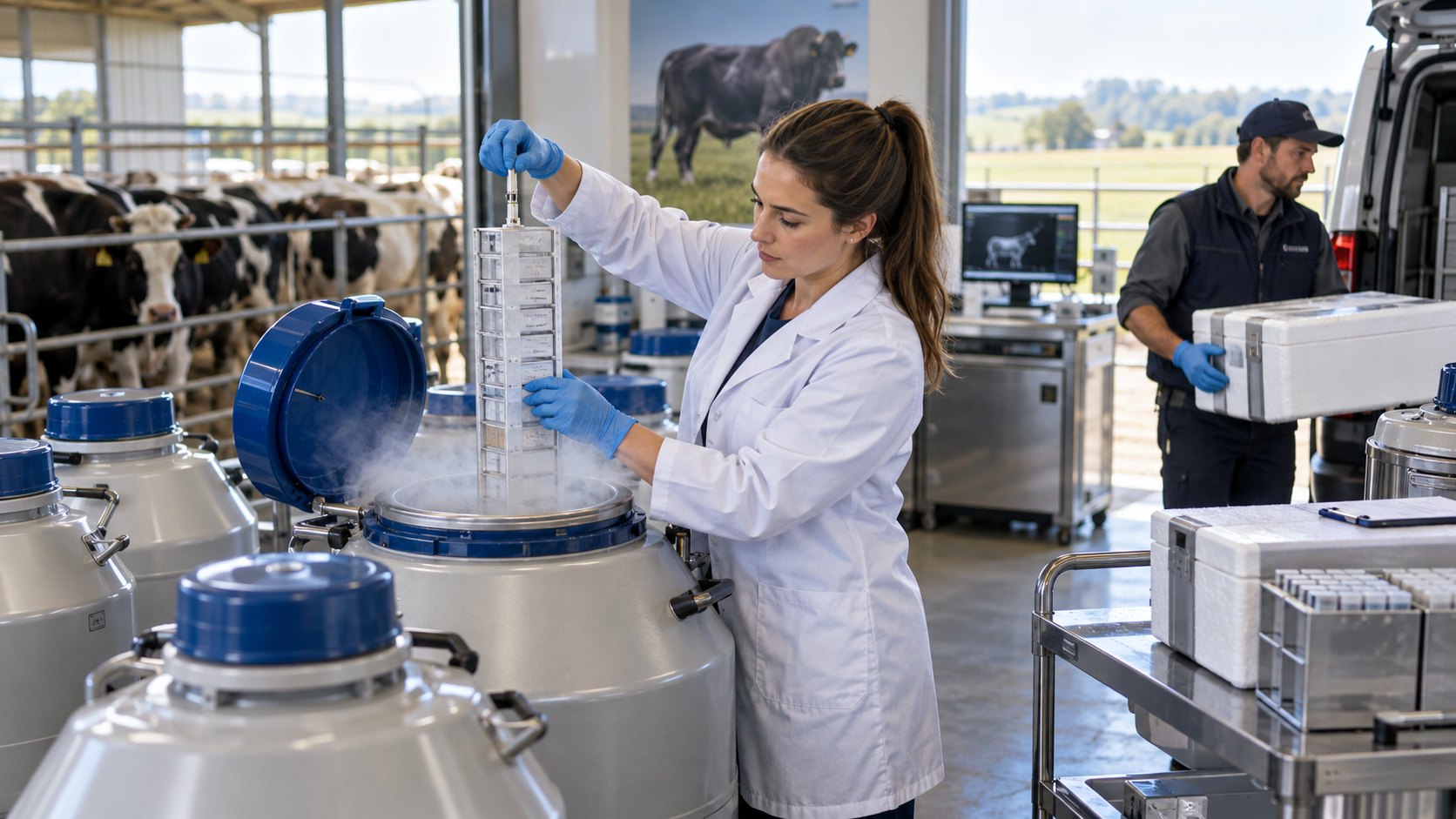
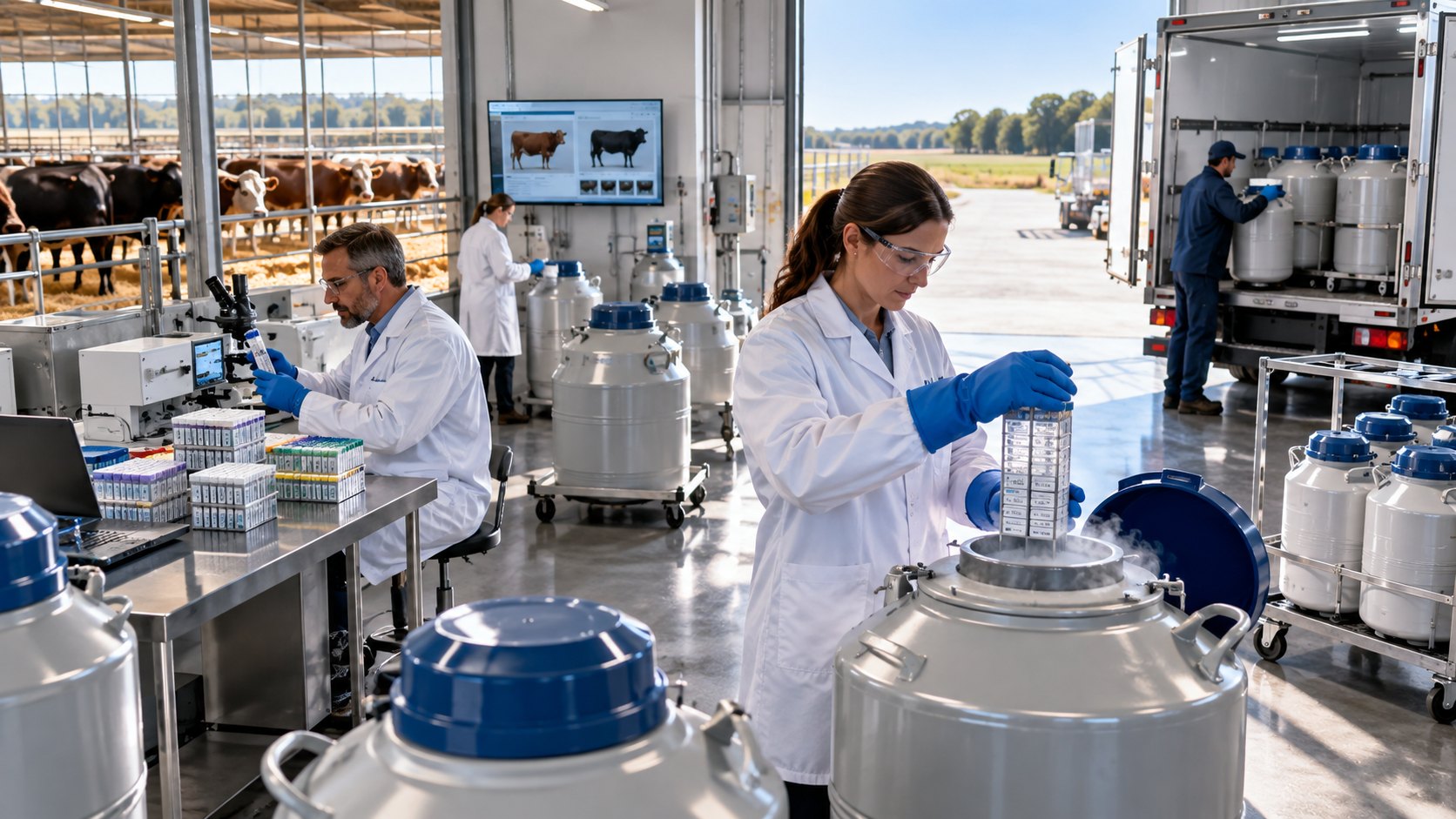
Under this line you buy, hold, import and sell frozen bovine genetic material as goods. The physical work is receiving consignments, holding them in vapour-phase or liquid storage, and releasing straws in small quantities against orders — usually far smaller quantities than the consignment came in.
What is actually on the price list
Conventional straws from proven sires are the volume product, sorted by the traits a buyer is chasing: yield and components for a dairy herd, growth and carcass shape for beef. Sexed straws are the premium product, sorted so that a dairy farm gets heifer calves rather than bull calves, which changes the economics of a whole replacement programme. Beef genetics sold into dairy herds is its own small and growing category, because a dairy cow that is not producing a replacement heifer may as well produce a calf somebody will buy for meat. Different sires, different price points, different buyers — and the same tank.
The pedigree file is half the goods
An undocumented straw is unsellable, and that is not a regulatory point but a commercial one. The buyer needs the bull's identity, his breed society record and his genetic evaluation, and he needs it to match the code printed on the straw itself. Without that, he has bought an unidentified fluid at a premium price. The trade therefore runs on two parallel inventories — the physical one in the tank and the documentary one in the file — and they have to agree straw by straw, batch by batch. A trader whose file does not reconcile with his tank has stock he cannot lawfully or commercially move.
Animal health certification sits alongside it. Bovine genetic material crossing a border travels with certification about the donor bull and the conditions of collection, and the importing side decides whether that certification satisfies it. The practical consequence for a trader is that the health file is assembled at the exporting end, before anything is shipped, and cannot be repaired afterwards. A consignment that arrives with a defective health file is not a delay; it is a consignment that may never be released.
The gates, and who holds them
Four bodies have a say, and they do not have an equal say. The licensing authority decides what the company may trade in and where it may trade from. The federal animal health side decides whether this class of goods may enter and on what certification. The municipality decides whether the unit you have taken is fit to hold cryogenic vessels. Customs decides whether a given consignment moves. The order matters more than the count, because each one waits on the one before it.
the six gates named on this page
The emirate's economic department
- The activity line the licence actually carriesWith the initial approval, and awkward to amend later
- The official office address the licence is issued againstAfter the tenancy, and it shapes the visa allocation
The federal animal health authority
- Health certification covering the donor bull and the collectionBefore the consignment leaves the exporting country
- Clearance of the consignment as animal genetic materialAt the border, on every shipment, not once
The municipality
- Whether the unit may hold cryogenic storage vesselsWith the tenancy, not once the tanks are standing
The emirate's customs authority
- A customs code in the trading company's own nameOnce the licence is cut
What the conditions are in detail, and what any of it costs to hold, depends on the emirate, the premises and the exact activity mix on the licence. Those are the things ConsultZone confirms for a specific case rather than quoting from a page, because the wording differs between authorities and the difference is the whole answer.
Live cattle, breeding services and straws are three different lines
This is where most of the trouble on this activity begins, so it is worth drawing the boundaries rather than assuming them.
Selling the animal itself is not this line. CZ 113, wholesale of live animals, and CZ 119, live stock trading, both move the beast. This one moves genetic material, and the health controls, the storage, the transport and the buyer's reason for buying are different in every respect.
Breeding your own cattle is not this line either. That is animal production, CZ 01 — you own the herd and the output is calves, milk or meat. Here you own no animals at all.
Performing insemination on somebody else's farm is a service sold, not goods traded. A technician who arrives with a flask and a catheter and charges per cow is running a different kind of company, and a trading licence does not authorise it. Many established operators do both, which is exactly why the distinction gets blurred at application stage and has to be settled in writing before the licence is cut.
Embryos are close cousins and not the same goods. So are the veterinary medicines and biologicals a farm uses, which sit under health-product controls rather than agricultural ones. And animal by-products — CZ 120 for horns, hooves and bones, CZ 114 for hides — are the end of an animal's life rather than the start of one.
Where this is the wrong purchase. If the plan is to build a herd, to run a stud, to offer insemination rounds to farms, or to import breeding cattle, this licence will not carry any of it. It carries goods in a tank.
Who this licence suits, and who should look at a neighbouring line
Established genetics distributors
Operators who already represent stud houses elsewhere and want a regional base. For them the UAE question is not whether the market exists but whether the storage and the onward logistics can be run to the standard their principal demands. The answer usually turns on premises, not on structure.
Veterinary practices and insemination technicians
The people already on farms are the natural sellers, because they are present at the moment the buying decision is made. The caution for them is scope: the practice and the trade are two companies doing two different things, and the trading activity has to sit somewhere that permits it.
Farm groups buying for their own use
A large dairy or beef operation importing for itself has a genuine choice between buying through a distributor and holding its own trading licence. Volume, the number of consignments a year and who carries the clearance exposure decide it.
Investors
The attraction here is not volume, which is small. It is that demand is tied to national herd improvement and food-security policy rather than to consumer fashion, and that the barrier to entry is competence rather than capital. The risk is the mirror image: one badly handled tank can end a reputation in a market where every serious buyer knows every other serious buyer.
References
- Ministry of Climate Change and Environment — the federal authority for agriculture, livestock and animal health, and the policy behind herd improvement. Ministry of Climate Change and Environment
- Abu Dhabi Agriculture and Food Safety Authority — agriculture and animal health matters within Abu Dhabi. Abu Dhabi Agriculture and Food Safety Authority
- Dubai Customs — import and export, customs codes, and goods subject to restriction on entry. Dubai Customs
- UAE Government portal — federal law, national food security strategy and general government information. UAE Government portal
Elsewhere in Trading
Activities that sit beside this one
Most licences carry more than one activity. Adding a neighbouring line at the application stage costs a fraction of amending the licence afterwards.
Begin with a clear conversation
Tell us what you intend to build.
A consultant will map the structure, jurisdiction, approvals and likely cost against what you actually described — not against a package.
