
Activity CZ 03
How to Start an Apparel Manufacturing Business in Dubai
Apparel manufacturing is sold as machinery and bought as labour. What this line covers, why the payroll rather than the plant sets the ceiling, and where manufacturing stops.
ConsultZone licensing desk
- Activity code
- CZ 03
- Category
- Manufacturing
- Reviewed
- Read
- 9 min
Listen instead
55 seconds
An audio summary of this guide.
Topic summary
How to Start an Apparel Manufacturing Business in Dubai
A garment plant is sold as machinery and bought as labour. The sewing heads, the cutting table and the steam press are the cheapest serious things in the building; the wage bill, the worker accommodation and the months of cloth standing in the store are what the business actually is. Read the line that way and most of the decisions below answer themselves.
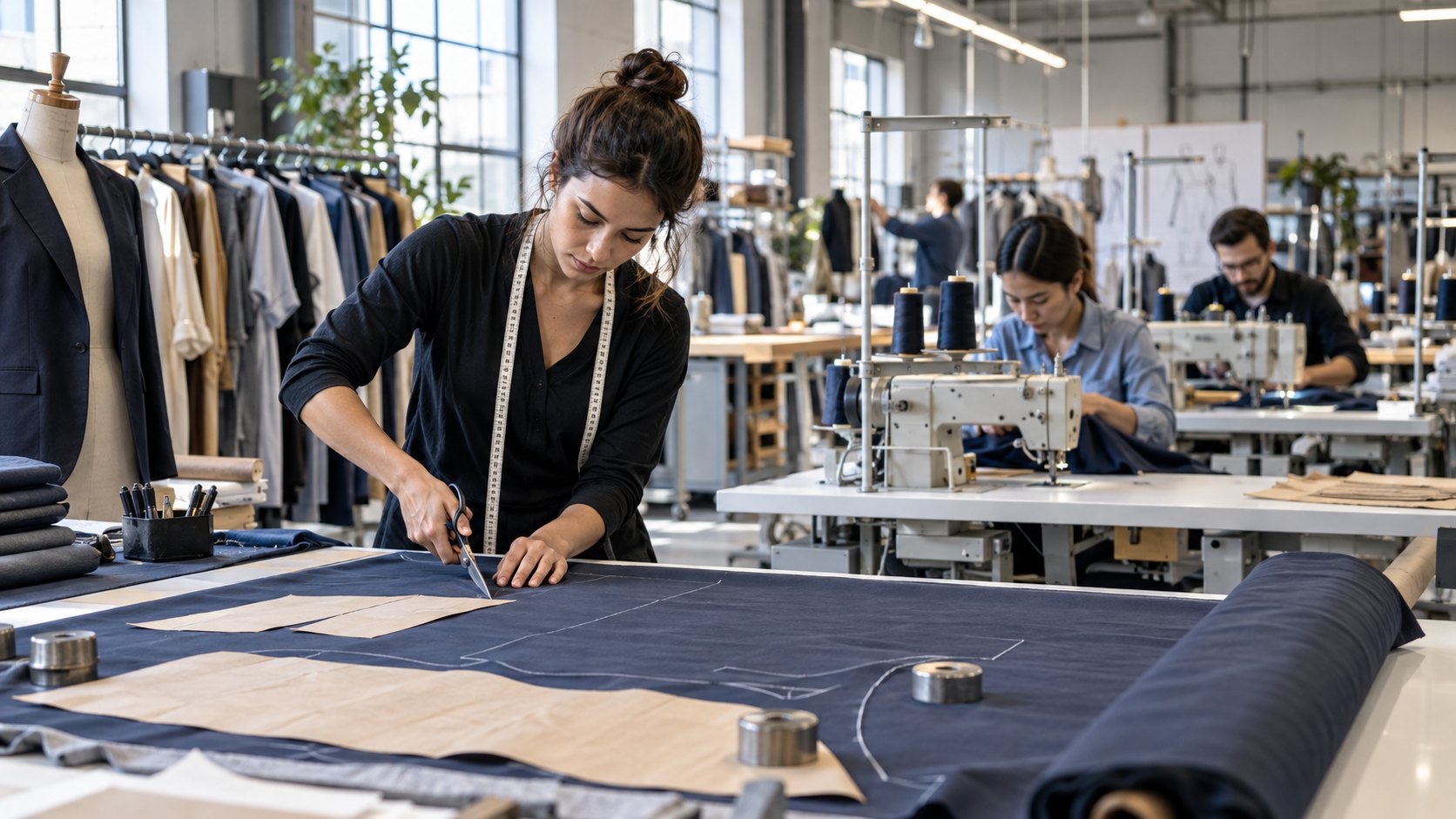
Manufacture of wearing apparel means cloth arrives finished and garments leave finished. The work between those two doors is cutting, sewing, trimming, pressing, labelling and packing, and all of it is done to somebody else's specification. That is the whole distinction from the two tailoring lines sitting beside this one in the same family: a plant makes to a drawing and a size curve, a tailor makes to one man's measurements. Same machines, different business, different licence.
The exception written into the name deserves to be read literally. Fur is treated as its own trade, with its own handling, its own supply questions and its own conditions, which is exactly why the line carves it out by name. A plant intending to work fur should settle that before it signs a lease rather than after.
The UAE particular here is supply. The country does not grow cotton or spin most of the cloth it sews, so fabric arrives by container, in rolls, ordered a season ahead against orders that can still move. A unit can be equipped for the price of a few months of the fabric it will consume, which is why an underfunded garment plant almost always fails on cloth and wages rather than on equipment.
The demand that is easiest to read in this market is not fashion. It is uniforms. Hotels, clinics, schools, security firms, facilities management, catering, transport and industrial employers all dress large numbers of people to a fixed specification, replace them on a cycle and buy again the following year. National dress made at retail volume is the other steady column. Fashion labels exist and some of them are excellent business, but they order late, order small and change their minds, and a plant built around them needs a different balance sheet from one built around a uniform contract.
The people who need this line already have an order book
Nobody buys a cut-and-sew plant speculatively and then finds work for it. All four buyers below arrive with demand already in hand.
Brand owners who want their label made near their market
They are paying for short lead times, small repeat runs and the ability to change a colour without a container's notice. Proximity is the product, not the lowest price per piece, and they will judge the plant on how quickly the second order comes back rather than on how cheaply the first one did.
Uniform and workwear contractors
The most legible order book in the trade: a specification, a size curve, a delivery date and an annual replacement cycle. It rewards consistency over flair, and it is won on the sample and on the ability to hold a colour and a fit across two years of production.
Traders moving up their own chain
Importers of finished clothing who want the margin the factory keeps. The caution is that importing and making are different businesses — one is bought and sold, the other is scheduled and staffed — and a trader's working-capital habits do not transfer to a floor with a fixed weekly wage bill.
Manufacturers positioning for the region
Operators who want cut-and-sew capacity whose output reaches buyers across the Gulf, or which never enters the UAE market at all. Their real question is the route the goods take, and it is settled before a jurisdiction is.
Where this is the wrong purchase. If the plan is to buy finished garments and resell them, to retailers or wholesalers or online, this is the expensive way to do it. A trading line carries that, needs no production floor and no machinists, and costs less to hold. Take a manufacturing line only when something is genuinely going to be made.
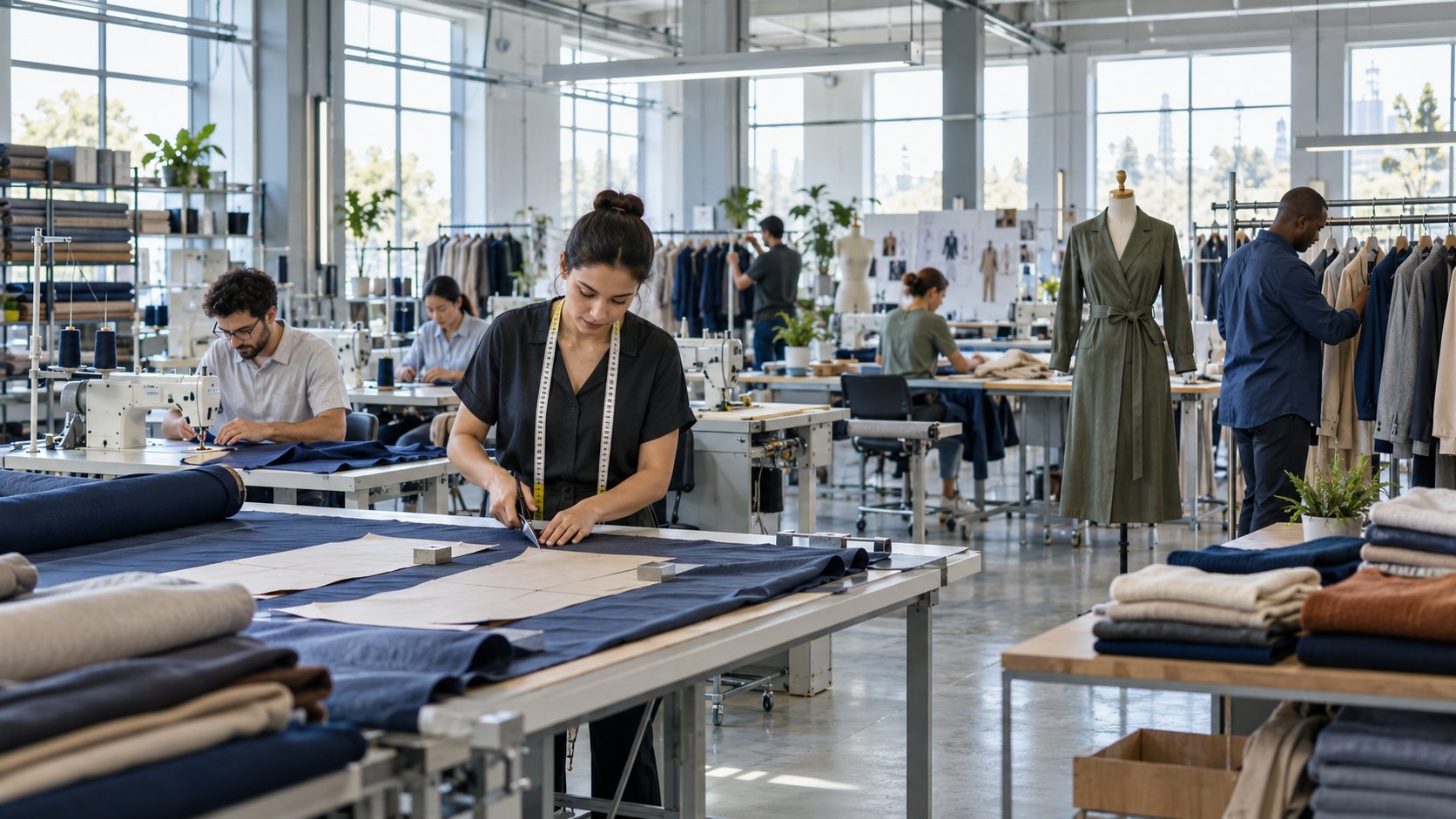
CZ 03 — Manufacture of wearing apparel, except fur apparel
Cut, make and trim is the whole of it
The sequence is fixed, and every improvement in this business happens inside it. A marker is laid over the cloth, the lay is cut, the pieces are bundled, the bundles move down a sewing line, and the garment is finished, pressed, labelled, checked and packed. The craft is line balance — matching the time each operation takes so that no machinist waits and no station piles up. That is where the margin is made or lost, and it appears on no equipment list.
Woven and knitted are two different factories
Shirts, trousers, jackets and abayas are cut from woven cloth and assembled largely on lockstitch machines. T-shirts, polos and jersey are knitted, run on overlock and coverstitch machines, and behave differently under the needle and under the iron. This line permits both. One floor rarely does both well, and a plant that promises both to its first two customers usually disappoints one of them.
Protective clothing is the one place the garment itself is examined
Most of what this line makes carries no product approval at all. Protective clothing is the exception a reader should know exists: once a garment is sold as protective, the question stops being only about the plant and becomes whether the article meets a standard. National standards and conformity marks are the federal industry ministry's ground, and whether a particular item falls inside that regime is worth settling before it is quoted, not after it is cut.¹
What has a say, and in what order
Several bodies hold something on a garment plant, and the order matters far more than the count. The licence with a manufacturing line on it comes from the emirate's economic department, and nothing is fitted out before it exists. Industrial classification, and the standards the output must meet, belong to the federal industry ministry.¹ A unit holding rolls of cloth, offcuts and lint is a fire load, so the fit-out drawings go past civil defence.² The municipality looks at the unit itself and at what leaves it as trade waste.³ A work permit and a contract for every machinist on the floor, and the wage payments behind them, sit with the federal labour ministry.⁴ Fabric arriving and finished garments leaving belong to the emirate's customs authority.⁵ Which of these applies in your emirate or your zone, and on what conditions, is confirmed for the specific case before anything is committed.
six gates, five bodies, and the labour ministry holds two of them
The emirate's economic department
- The licence, with a manufacturing line on itFirst; nothing is fitted out before it
The federal industry ministry
- Industrial classification and the standards the output must meetAlongside the licence, not after it
Civil defence
- Fire load of cloth, offcuts and lint inside the unitWith the fit-out drawings
The federal labour ministry
- A work permit and a contract for every machinistContinuously, and it is what caps capacity
- The wage payments behind those permitsEvery month the floor runs
The emirate's customs authority
- Fabric arriving and finished garments leavingOnce the licence is cut
The payroll is the capacity
Output here is a function of hands, hours and skill, and nothing else scales it. Each additional machinist is a permit, a contract, a wage and somewhere to live, which means capacity is bought in a form that cannot be switched off between seasons. That is why the deciding bodies above concentrate where they do, and it is the commonest miscalculation on a first plant: the machines were budgeted and the people were assumed.
Where this line stops: the production floor, not the shop
The licence covers making. It does not cover the neighbouring things people expect it to, and amending an activity afterwards is slower and dearer than choosing it correctly.
Selling the garments over a counter is retail and is its own line. Making to one customer's measurements is tailoring — CZ 04 for Arabic menswear, CZ 05 for men's suits and shirts — and the difference is not the garment but the order: if the article exists before a body is measured, you are manufacturing. Producing the cloth itself, by weaving, knitting, dyeing or printing fabric, is upstream and separate. Fur apparel is excluded by name. Embroidery, garment printing, laundry, pressing and alterations sold as services in their own right are separate trades, even where a plant performs all of them on its own output. Importing finished clothing to wholesale is a trading line.
Mainland or a free zone is settled by the buyer, not by the tax rate
The honest general rule is that a plant selling into the UAE market — retailers here, uniform contracts here, anything won on a local tender — belongs on the mainland, while a plant whose output goes out again, or which serves a parent company abroad, is the case for a free zone unit. Both need an industrial unit with power, floor loading, cloth storage and somewhere for the finished-goods check, and no company structure supplies that. Find the unit that suits the line you intend to run and let it narrow the jurisdictions, rather than the reverse.
Labour and tax, briefly
Contracts, permits and wage protection for the floor are a continuing obligation to the federal labour ministry rather than a one-off step.⁴ Corporate tax applies as it does to any UAE business, and enrolment and filing sit with the Federal Tax Authority whatever rate ends up applying.⁶
References
- Ministry of Industry and Advanced Technology — industrial licensing, national standards and conformity marks for manufactured goods. Ministry of Industry and Advanced Technology
- Dubai Civil Defence — fire safety approvals for a unit storing cloth, offcuts and finished goods. Dubai Civil Defence
- Dubai Municipality — premises suitability and trade waste conditions. Dubai Municipality
- Ministry of Human Resources and Emiratisation — work permits, labour contracts and wage protection for a production payroll. Ministry of Human Resources and Emiratisation
- Dubai Customs — import of fabric and trims, export of finished garments, and the customs code behind both. Dubai Customs
- Federal Tax Authority — corporate tax and VAT enrolment and filing. Federal Tax Authority
Elsewhere in Manufacturing
Activities that sit beside this one
Most licences carry more than one activity. Adding a neighbouring line at the application stage costs a fraction of amending the licence afterwards.
Begin with a clear conversation
Tell us what you intend to build.
A consultant will map the structure, jurisdiction, approvals and likely cost against what you actually described — not against a package.
