

Activity CZ 37
How to Start an Aircraft Engine & Parts Repair & Overhaul Business in Dubai
In aircraft overhaul the product is not the repaired part. It is the airworthiness release that lets the part fly again, and only an approved organisation can issue one.
ConsultZone licensing desk
- Activity code
- CZ 37
- Category
- Manufacturing
- Reviewed
- Read
- 8 min
Listen instead
43 seconds
An audio summary of this guide.
Topic summary
How to Start an Aircraft Engine & Parts Repair & Overhaul Business in Dubai
A shop can strip an engine module, clean it, inspect every surface, replace what is out of limits and build it back to a standard better than the one it arrived in — and the part is still worth nothing. What restores its value is the release: the signed statement, issued under an approval the organisation itself holds, that the work was done inside an approved scope, by qualified people, using controlled processes and traceable material. Remove that and a perfectly overhauled engine is an expensive paperweight.
Everything else on this page follows from that single fact, and it is why aircraft work does not behave like the rest of the repair economy. A trade licence lets a company exist, hire, take a unit, import tooling and issue invoices. It does not make aircraft work saleable. Airworthiness is a civil aviation matter, and the General Civil Aviation Authority — not the authority that cuts the licence — is the body whose approval decides whether what leaves the shop may be fitted to a flying aircraft. That approval is granted to an organisation: its premises, its quality system, its written procedures, its calibrated equipment and its named qualified staff. It is not granted to an engineer who happens to be excellent. A founder who treats it as a formality to be arranged once the unit is fitted out has the sequence backwards, and the sequence is the entire risk on this activity.
What the UAE brings to it is proximity to the customer. Major long-haul fleets are based here, the country is one of the larger transit points in world aviation, and lessors, cargo operators and other maintenance organisations sit within an hour of most industrial addresses. The number an airline actually cares about is turnaround — how long the part is off the aircraft — and every day saved in freight comes straight off that figure. That is a genuine structural advantage. It is also why the customer will audit you: being close to the fleet gets you onto the list only if you survive the inspection that follows.
CZ 37 — Aircraft Engine & Parts Repair & Overhaul
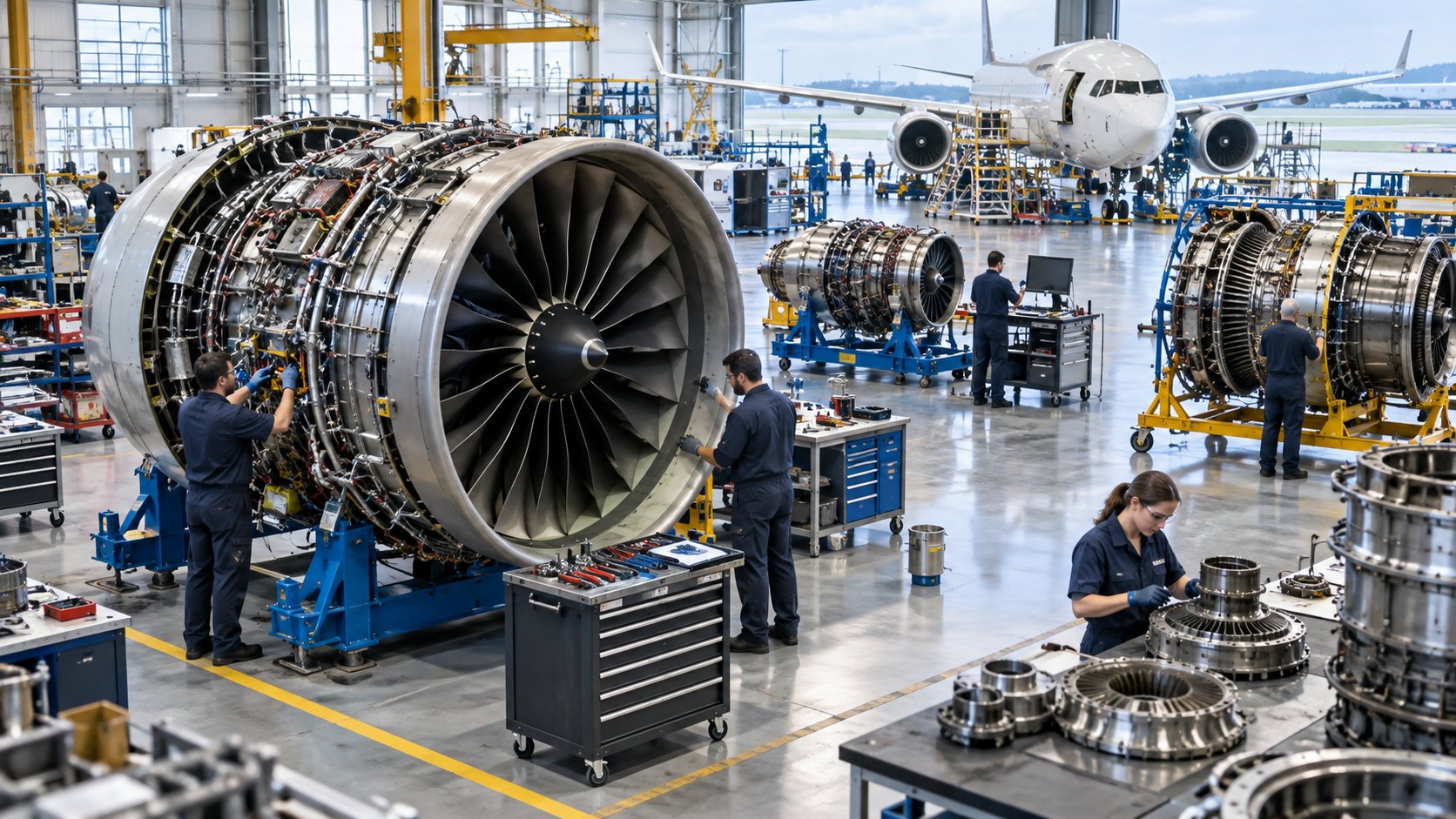
The line covers work performed on engines, engine modules, components and parts that have come off an aircraft, in a shop rather than on the aircraft itself. It splits into four blocks, and they are not the same business in capital terms.
Engines and modules
Strip, clean, inspect, repair and rebuild of engines and their modules, hot-section work, blade and vane repair, balancing, and test running where the shop is equipped for it. The heaviest end of the line in tooling, floor loading, test capability and working capital — and the end that almost nobody enters first.
Components and accessories
Fuel and hydraulic units, pneumatics, actuators, valves, pumps, heat exchangers, wheels and brakes, landing gear, avionics units, instruments and electrical machines. Most shops in the world live here rather than on engines, because a narrow capability done properly is a business and a broad one done thinly is not. A single deep scope — wheels and brakes, or one family of accessories — is the realistic way in.
Controlled processes
Non-destructive testing, plating and surface treatment, painting, heat treatment, machining and welding of aircraft parts, calibration and test. These are the processes an approval is written around, and each is separately demonstrated rather than assumed from the fact that the shop owns the machine.
The history that travels with the part
Every part carries a record: where it came from, what has been done to it, by whom and under what approval. A part with no history is scrap whatever its condition, and unapproved parts finding their way into a supply chain is the standing safety problem of the industry. Traceability on this activity is not paperwork sitting beside the inventory — it is most of what the inventory is worth.
Which is why the first question to answer about any proposed piece of work is not whether the shop can physically do it, but what makes it saleable once done. Three different answers, and the difference between them is the business plan.
six kinds of work, three different answers
- Overhauling an engine or one of its modulesNothing leaves the shop as a serviceable unit without one
- Repairing, testing or inspecting a flight componentThe document on the part is the product being sold
- Non-destructive testing of a structural partThe inspection is itself a controlled process
An airworthiness approval the organisation holds
- Working inside another organisation's approved systemTheir quality system covers your hands and their release signs the part
An approval somebody else holds
- Buying and selling serviceable or new partsTrading a part is not working on one
A different licence line altogether
- Making tooling, stands and ground equipmentNothing produced is fitted to a flying aircraft
The trade licence on its own
The fourth row is the one worth dwelling on, because it is how a great many capabilities are built. Working under an approval that somebody else holds lets a shop prove its people and its processes on real work before carrying its own approval, and it is an ordinary commercial arrangement rather than a loophole. What it is not is a permanent position: the customer relationship, the pricing and the release all belong to the organisation whose approval it is.
The physical side deserves the same care. A unit of the right height and floor strength, controlled stores, clean areas where the work demands them, calibrated test benches and quarantine for unserviceable material are requirements of the operation rather than fit-out preferences, and together they narrow the choice of address far more than the tax position does. Which approvals attach, on what conditions, and what it all costs to hold differ by emirate and by jurisdiction — items to confirm for the specific case before a lease is signed.
Four lines this one is mistaken for
Maintenance carried out on the aircraft
Line and base maintenance — work done on an aircraft at a gate or in a hangar — is a different business under a different approval. It needs apron or hangar access, aircraft-rated staff and a response capability tied to a flight schedule. A component shop never touches an aircraft, and the two capabilities are rarely built by the same team at the same time.
Trading in aircraft parts
A parts distributor buys, holds, documents and resells new and serviceable material. It is a stock-and-documentation business with no workshop and it sits on a trading line. The two are complementary — a shop buys material from distributors and sells repaired units back into the same chain — but the licence, the skills and the shape of the working capital have almost nothing in common.
Engine and aircraft leasing
A lessor owns assets and manages their residual value over time. Overhaul appears on its accounts as a cost and a scheduling problem, not as its trade. Lessors are customers on this activity, and often demanding ones, because the condition of a returned asset is the whole of their argument with an operator.
Manufacture of new parts
Making a new part is production under a design approval, with its own conformity and quality regime. Repairing a part restores an existing one to a condition already approved for it. The distinction sounds academic until a shop starts fabricating a replacement piece rather than repairing the original, at which point it has crossed into a different activity.
This is a second business, not a first one
Established maintenance groups opening a Gulf shop
The natural entrant. The approval, the quality system and the customer list already exist somewhere else, and what is being bought is distance to the fleet. The work is largely one of extension rather than creation.
Component specialists with one deep capability
Engineers and managers out of an existing shop who know a single product family thoroughly. The narrower the declared scope, the faster it can be proved and the more defensible the business is afterwards.
Operators and lessors bringing work in-house
An airline, a cargo operator or a lessor sending work abroad reaches a point where the freight, the turnaround and the margin paid to somebody else stop making sense. The honest test is volume: an in-house shop below a certain throughput is a cost centre with a capital budget.
What none of those three groups can avoid is the shape of the money. Tooling, test equipment and a pool of rotable spares are the working capital, and they are committed before the first unit is invoiced. The customers are airlines, lessors and other maintenance organisations, which means audits before the work and long payment terms after it. Corporate tax applies as it does to any UAE business, and enrolment and filing with the Federal Tax Authority follow from whatever structure is chosen — a point worth reading alongside the capital plan rather than after it.
References
- General Civil Aviation Authority — airworthiness approvals for organisations working on aircraft engines, components and parts, and the framework that makes such work saleable. General Civil Aviation Authority
- Ministry of Industry and Advanced Technology — industrial licensing, national standards and in-country value for an engineering operation. Ministry of Industry and Advanced Technology
- Dubai Customs — import and export of engines, components, material and tooling, and the treatment of restricted goods. Dubai Customs
- Ministry of Human Resources and Emiratisation — work permits and labour contracts for qualified engineering and inspection staff. Ministry of Human Resources and Emiratisation
- Federal Tax Authority — corporate tax enrolment and filing obligations. Federal Tax Authority
Elsewhere in Manufacturing
Activities that sit beside this one
Most licences carry more than one activity. Adding a neighbouring line at the application stage costs a fraction of amending the licence afterwards.
Begin with a clear conversation
Tell us what you intend to build.
A consultant will map the structure, jurisdiction, approvals and likely cost against what you actually described — not against a package.
