
Activity CZ 36
How to Start a Ships & Boats Repairing Business in Dubai
Repairing boats and ships is event-driven work — a casualty, a breakdown, a refit — and the customer pays for the date the vessel goes back to work, not the weld. Who buys it, and on whose terms.
ConsultZone licensing desk
- Activity code
- CZ 36
- Category
- Manufacturing
- Reviewed
- Read
- 8 min
Listen instead
44 seconds
An audio summary of this guide.
Topic summary
How to Start a Ships & Boats Repairing Business in Dubai
Nobody schedules a repair. A shaft goes out of line on a crew boat forty miles offshore. A gearbox lets go on a tour boat in the middle of the season. A dhow takes a knock alongside and opens a plate. An engine-room fire writes off a wiring loom and half a bulkhead. A fibreglass hull finds a sandbar at low water. From that moment the vessel earns nothing, and somebody is counting the cost of every day it sits.
That is the whole commercial logic of this line, and it is worth stating plainly because it changes how the work is priced. A repair yard's product is not the weld or the laminate or the rebuilt gearbox. It is the date the vessel goes back to work. A customer who has lost the use of an asset will pay for speed in a way that no customer on a routine job ever will, and a yard that prices repair work as though it were servicing has misread what it is selling.
It also separates this activity from marine maintenance, which sits immediately beside it on the same sheet and uses many of the same hands. Maintenance is sold against a calendar and paid for before anything has gone wrong. Repair is sold against an event that has already happened. Same trades, opposite order books — one predictable and thin, the other better paid and impossible to plan. Most yards end up holding both lines, and the ones that last know which of the two is paying the rent.
The UAE gives repair work an unusually broad base to draw on. There is an offshore and port fleet of crew boats, supply vessels, tugs and barges whose downtime is measured against day rates. There is a dhow, fishing and trading fleet along the Dubai Creek and the Sharjah and Ajman creeks, working in timber and steel and often on very tight money. There is a leisure fleet with high expectations and low tolerance for a job that looks repaired. And there are tour, dive and ferry operators whose season punishes any delay at all. Four customers, four tolerances for downtime, four different prices for the same week of labour. A yard that cannot tell them apart quotes everybody the same and loses money on two of the four.
Repair work arrives on the casualty's timetable
The line covers putting a damaged, worn out or failed vessel and its machinery back into service, and it reaches across more trades than any other activity on the waterfront.
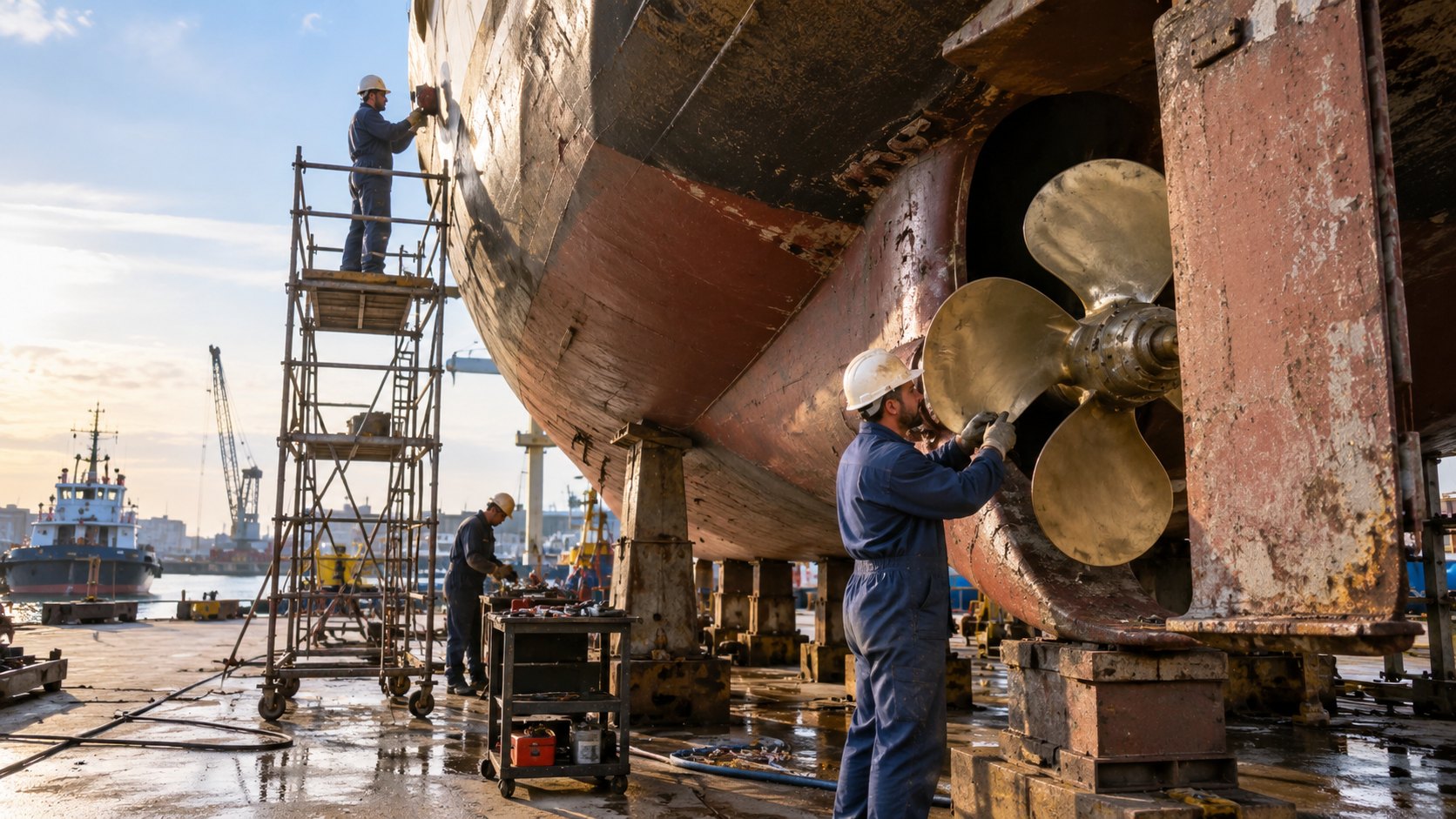
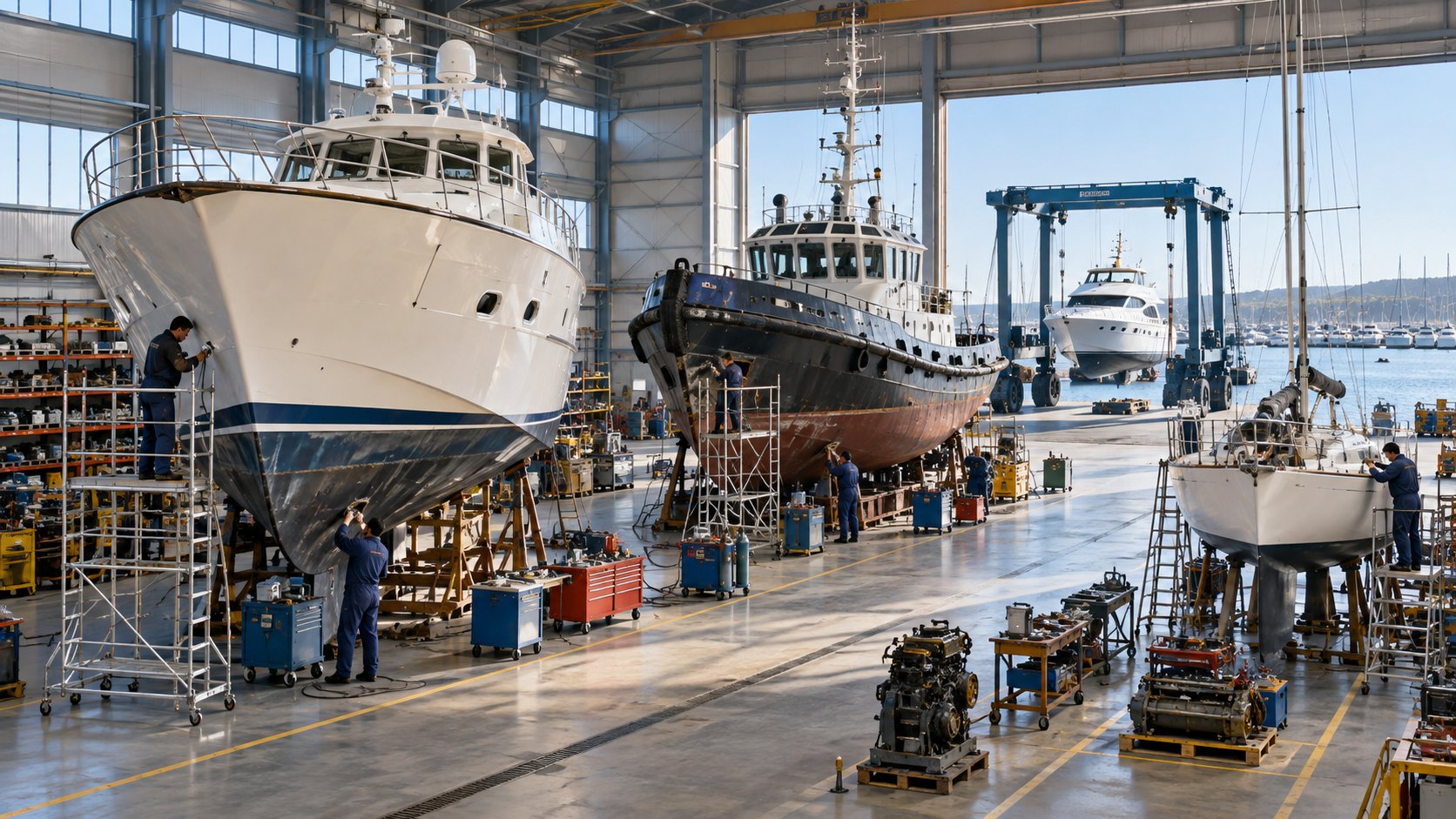
Structural and hull work runs in four materials, and each one is a different shop: steel plating and welding, aluminium fabrication, fibreglass laminating and fairing, and shipwrighting in timber for the dhow trade. Propulsion covers engine strip and rebuild, repowering, gearbox and drive overhaul, shafting and alignment, propeller and sterngear work, and thrusters. Around that sit steering and hydraulics, piping, tanks and valves, electrical rewiring and switchboards, electronics replacement, and the reinstatement of interiors after fire or flooding. Paint and gelcoat work follows nearly every structural repair, because the repair is not finished until it stops being visible.
The planned end of the same trade is refit and conversion — a hull taken back to bare metal or bare laminate and rebuilt, or a vessel changed from one use to another. Same skills, sold on a schedule instead of in an emergency, and it is how a yard keeps its people between casualties.
Which leads to the decision that actually shapes a repair business, and it is not the licence. It is what mix of work the yard chases, because the two halves of a repair order book reward and punish completely differently.
five ways into the same trade
What it givesWhat it costs
- Scheduled refits booked months aheadA yard plan you can staff, buy and borrow againstRates argued down by a buyer holding three other quotes
- Breakdown and casualty workThe best day rate in the trade, from someone who cannot waitA schedule wrecked whenever it lands, and overtime nobody budgeted
- Claim work routed through an insurer's surveyorRepeat volume, and a payer who settles in fullA scope of work you did not write, and paper on every line of it
- Your own yard, lift and hardstandingControl of the schedule, and the haul-out revenue as wellRent on waterfront space whether it is full or empty
- A mobile crew working inside other people's yardsAlmost no fixed cost, and reach along the whole coastSomebody else decides when your job is allowed to start
The mobile route deserves more credit than it gets. A small team with a van, a welding set, hand tools and a trailer can work the whole coast without paying waterfront rent, taking jobs inside marinas that have more boats than capacity. It is the most common honest starting shape on this activity, and what it lacks is control: the lift is not yours, and the day your customer's boat comes out of the water is decided by whoever owns the slipway.
The payer is often not the owner
This is the part newcomers get wrong, because the person whose boat it is and the person who signs the cheque are frequently two different people with two different interests.
A private owner pays from his own pocket, decides quickly and argues about the invoice afterwards. A fleet operator sends a technical superintendent who knows the machinery better than you do, wants the vessel back on station and will hold you to the estimate. An insurer pays against a scope written by its own surveyor, which is the single most important sentence on this page: on a claim job the extent of the repair is not yours to define, and the margin is won or lost on how variations are raised and agreed rather than on the original quote. A charter or management company sits somewhere in between and cares most about the finish, because its customer will be standing on it next week.
The route to all of them is narrower than it looks. Marine repair is a small trade with a long memory, and work comes from three places: being physically close to where casualties happen, being known to the surveyors and superintendents who decide where a vessel goes, and being reachable when something fails at an inconvenient hour. Standing on an insurer's or a manager's list of acceptable yards is what turns a single job into repeat volume. None of that is bought with advertising; it is accumulated one clean job at a time, and it is why a repair business without a yard relationship is a phone number rather than a company.
What the vessel drags into the yard with it
Repair work brings hazards onto the premises that a clean industrial unit never has to think about, and the conditions attaching to the site follow from the materials rather than from the trade name on the licence.
Paints, solvents, resins, catalysts, thinners, gas cylinders and fuel are flammable, and how much may be held on the premises and how it must be stored is a fire safety matter to be settled before the first delivery arrives, not after an inspection. Hot work is the other half of that problem: welding, cutting and grinding near tanks that have held fuel, and entry into confined and unventilated spaces, are the two activities that account for most serious injuries in this trade anywhere in the world.
What leaves the site is controlled as closely as what comes in. Waste oil, oily bilge water, blasting grit, antifouling scrapings, paint residue and washdown water all have to go somewhere lawful, and on a waterfront site the receiving water is a few metres away — which is why municipal conditions on a marine yard are tighter than on a dry industrial plot, and why the drainage arrangement is worth designing before the tenancy is signed.
Then there is the equipment. Engines, gearboxes, electronics and spares are largely imported, so the customs treatment of parts and the handling of anything restricted becomes part of the job's timeline. Marine radio and communication equipment carries a type approval requirement before it may be put into service in the UAE, so a radio, a distress beacon or a satellite terminal fitted during a refit is not simply a part swap. And a vessel under a foreign flag brings its own survey regime into your yard: the certification is the owner's responsibility rather than yours, but your work is what the surveyor examines afterwards, so the record of what was done is part of what you are selling.
The precise conditions, approvals and costs differ between emirates and between a mainland plot and a zone. They are worth confirming for the specific site rather than assumed from another yard's experience.
References
- Dubai Civil Defence — fire safety, hot work, and the storage of paints, solvents, resins, gas and fuel on a working yard. Dubai Civil Defence
- Dubai Municipality — premises conditions, drainage, and the disposal of waste oil, blasting residue and washdown water on a waterfront site. Dubai Municipality
- Dubai Customs — importing engines, gearboxes, spares and consumables, and the treatment of restricted goods. Dubai Customs
- Telecommunications and Digital Government Regulatory Authority — type approval for marine radio and communication equipment before it is put into service. TDRA
- Ministry of Human Resources and Emiratisation — work permits, labour contracts and wage protection for a shift-working yard crew. Ministry of Human Resources and Emiratisation
Elsewhere in Manufacturing
Activities that sit beside this one
Most licences carry more than one activity. Adding a neighbouring line at the application stage costs a fraction of amending the licence afterwards.
Begin with a clear conversation
Tell us what you intend to build.
A consultant will map the structure, jurisdiction, approvals and likely cost against what you actually described — not against a package.
