

Activity CZ 160
How to Start a Stationery and Books Wholesale Business in Dubai
Stationery and printed publications sit on one licence line and are two different businesses. One is won on price and availability; the other turns on what may lawfully be read here.
ConsultZone licensing desk
- Activity code
- CZ 160
- Category
- Trading
- Reviewed
- Read
- 7 min
Listen instead
52 seconds
An audio summary of this guide.
Topic summary
How to Start a Stationery and Books Wholesale Business in Dubai
Two trades share this activity and only one of them is about paper.
The first is consumables. Pens, files, toner, envelopes, whiteboard markers, exercise books and the hundred small things an office or a school gets through without noticing — bought on price, availability and the reliability of a delivery van, never on brand loyalty. It is a margin-thin, turnover-heavy business in which the winner is whoever is in stock on the morning the buyer runs out.
The second is publications. A book, a magazine or a newspaper is a physical object carrying content, and content is the thing that makes this half of the line behave differently from every other wholesale activity in the catalogue. What is inside an imported title is subject to review before it may be sold here. That is not a tax on the trade or a surprise buried in the paperwork; it is the defining feature of the business, and a wholesaler who plans the publications side without it has planned the wrong business.
Most companies holding this line end up leaning heavily on one half. The ones that do both well are usually school suppliers, because a school orders exercise books and set texts on the same requisition and would rather have one supplier than two.
Who should actually take this line
The office-supplies dealer with a delivery round
The natural entrant, and the one who can start smallest. The asset is not the warehouse, it is the route: a standing list of offices, clinics, schools and building managements that order weekly and pay monthly. Stock follows the round rather than the other way about, and the business grows one customer at a time.
The bookseller or importer going upstream
Somebody who already sells titles retail, understands what moves in this market and can see the trade discount above them. The step up is a step into forecasting: a retailer orders what it can sell, while a distributor takes a position on what other people will sell, and unsold books come back.
The school and institutional supplier
The biggest orders in the line and the least flexible. Purchasing runs on a term calendar, specifications are fixed by the curriculum rather than by the buyer's preference, and everything is decided months ahead. Working capital peaks alarmingly before the academic year and then unwinds; a supplier who misreads that cycle has a solvency problem rather than a sales problem.
The newspaper and periodical distributor
A logistics business dressed as a media one. Dailies and weeklies are perishable, returns are part of the model rather than a failure of it, and the whole thing is judged on whether the delivery arrives before the reader wants it. Print circulation is not what it was, which makes route density the entire economics.
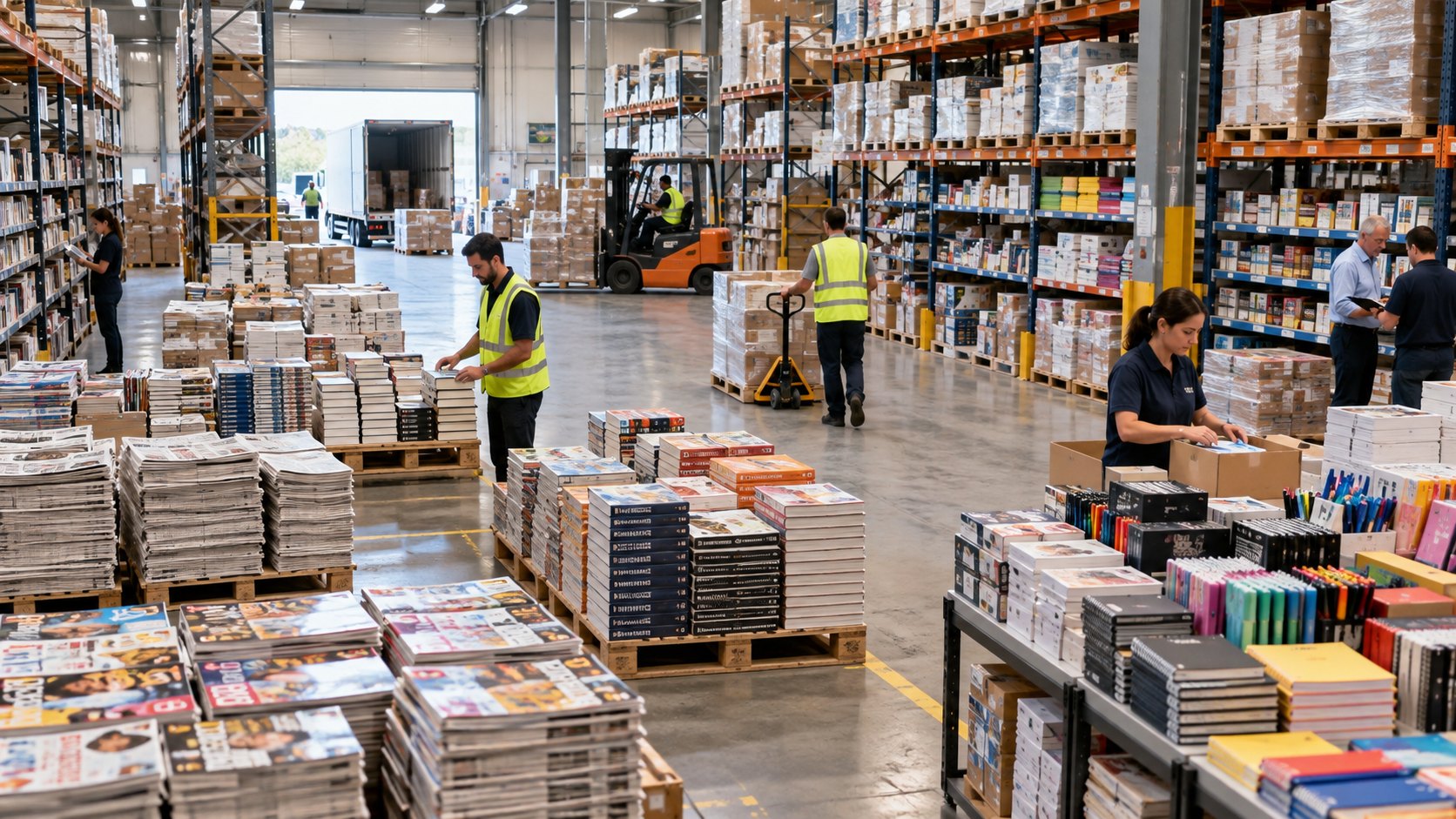
What this line lets you do, and where it stops
The activity covers buying and selling stationery, office consumables, books, magazines and newspapers in trade quantities to other businesses. It does not let you print them, publish them or sell them retail over a counter — printing is a production activity, publishing is a separate line with its own rights obligations, and a shop selling to consumers needs a shop licence at a shop address.
Three boundaries are worth stating plainly, because each one has caught somebody.
Stationery is not equipment. Selling toner, paper and folders is consumables trade. Selling the printer itself, the shredder, the binding machine and the office furniture is a different set of lines with different suppliers and a service obligation attached. Several wholesalers carry both by holding both activities, which is the correct way to do it rather than the convenient one.
A book is not the same object as the rights to it. A wholesaler buys finished copies from publishers or their appointed distributors and sells them on. It does not acquire the right to reprint, translate, adapt or supply a title digitally, and it takes on real exposure if the copies it bought were not lawfully made. That exposure is the same one described on the recorded media line, CZ 162, and the boundary between the two pages is simply the format: print here, discs and tapes there.
The content of an imported publication is somebody else's decision. A distributor may hold a perfectly good licence, a proper warehouse and a paid invoice, and still find that a particular imported title may not be offered for sale. Which titles, on what grounds and by what route is a matter for the authority that reviews imported printed material, and it is decided per consignment rather than once for the company. The commercial consequence is that stock arriving from abroad carries a risk no amount of margin removes, which is why experienced importers order conservatively on unfamiliar titles.
The order those things happen in matters more than the list of them.
- Settle whether the company sells paper, publications or bothDecides which of the two businesses is being built, and which gates apply
- Reserving a trade name and taking initial approvalLets the constitutional documents be drawn up
- Trade licence carrying the wholesale lineAllows buying and selling in the company's own name
- Premises that keep paper dry, off the floor and away from a loading bayFixes the licence address and what may be stored there
- A customs code in the importer's own nameLets consignments clear without paying a third party to do it
- Content clearance for imported books and periodicalsDecides whether a title may be offered for sale here at all
The marked step is the one people leave until last and should not. What the licence costs to hold, which approvals attach to the publications half and how long any of it takes depend on the emirate, the premises and the activity mix — items ConsultZone confirms for the specific case rather than figures anybody should be quoting in advance.
Premises decide this business more than the licence does
Paper is heavy, it is bulky in proportion to its value, and it is ruined by water. Those three facts govern the warehouse.
Weight comes first. A pallet of copier paper is dense, and a mezzanine or an upper floor rated for light storage is not rated for this. Floor loading is a question to ask the landlord before the tenancy is Ejari-recorded, not after the first delivery arrives.
Then water. A single roof leak, a burst pipe or a wet loading bay writes off stock outright — damp paper is not discounted stock, it is refuse. So racking off the floor, a dry bay and a roof somebody has actually looked at are the real specification, and they are worth more than a cheaper square metre rate.
Then handling. Stationery is small-item, high-line-count order picking: a school order might carry sixty lines of which fifty are worth a few dirhams each. Books are heavier, more fragile at the corners and unforgiving of being stacked wrong. Newspapers move on a schedule that starts before dawn. Those are three different picking operations in one unit, and the businesses that struggle are usually the ones that laid the unit out for one of them and then added the others.
Two practical points close the picture. Fire load in a paper warehouse is high by nature, so how the stock is racked and where the aisles run is a fire-safety matter and the fire authority's view of the layout is worth having early rather than at inspection. And returns are structural on the publications side — unsold magazines and newspapers come back by design — so a business that has no quarantined space and no process for credit notes will lose the margin it thought it had made.
References
- UAE Government portal — federal law, government information and the framework covering media and printed content. UAE Government portal
- Dubai Customs — import and export, customs codes, and the treatment of restricted goods including imported publications. Dubai Customs
- Dubai Municipality — premises suitability and storage conditions for a warehouse in Dubai. Dubai Municipality
- Dubai Civil Defence — fire safety approvals for the layout and racking of a high fire-load warehouse. Dubai Civil Defence
- Federal Tax Authority — VAT and corporate tax enrolment and filing obligations. Federal Tax Authority
Elsewhere in Trading
Activities that sit beside this one
Most licences carry more than one activity. Adding a neighbouring line at the application stage costs a fraction of amending the licence afterwards.
Begin with a clear conversation
Tell us what you intend to build.
A consultant will map the structure, jurisdiction, approvals and likely cost against what you actually described — not against a package.
