

Activity CZ 161
How to Start a Sunglasses and Optical Goods Wholesale Business in Dubai
Sunglasses are eye protection that happens to be fashion. Prescription lenses are a health matter and sit outside this line entirely, and an optical goods wholesaler earns by knowing where that boundary runs.
ConsultZone licensing desk
- Activity code
- CZ 161
- Category
- Trading
- Reviewed
- Read
- 8 min
Listen instead
45 seconds
An audio summary of this guide.
Topic summary
How to Start a Sunglasses and Optical Goods Wholesale Business in Dubai
Read the catalogue entry carefully and it tells you what this activity is really about. The examples given are sunglasses, binoculars and magnifying glasses — not cameras, not studio lighting, not tripods. This is a line about lenses and the things built around them, and the photographic half is the smaller part of it.
That matters because the trade divides on a line most people do not see until they are standing on the wrong side of it. A pair of sunglasses is a consumer product bought for shade and for how it looks, and what controls it is conformity as eye protection. A prescription lens is a corrective medical appliance, dispensed to an individual against an examination, and it belongs to the health side of the economy rather than the trading side. Both arrive in a box of eyewear. Only one of them can be sold under this activity.
A wholesaler who understands that boundary has a business. One who does not will at some point accept an order for corrective lenses from an optical shop, fulfil it, and discover that the easiest part of the transaction was the invoice.
The margin is in the brand and the return rate, not in the glass
The economics of this line are unlike most trading activities, and the reason is that the cost of the object has almost nothing to do with its price.
Eyewear is a branded accessory sold through other people's shops. The frame costs what a frame costs. What a buyer pays for is a name, a season and a display stand, and what a distributor actually supplies is the apparatus around the product: the stands, the testers, the display cards, the staff who tell a retail assistant which model is selling, and a replacement for the one a customer dropped. Lose that and you are selling a commodity with a logo on it.
Fashion means obsolescence, and obsolescence is the risk. Collections turn over. Last season's model does not become cheaper to hold, it becomes harder to move, and a distributor holding depth on a style that did not catch is holding it until it is cleared at a loss. Breadth beats depth in this trade for exactly that reason, and the suppliers who survive are the ones who reorder quickly rather than the ones who buy big.
Optical instruments behave in the opposite way. Binoculars, spotting scopes, monoculars, magnifiers and loupes sell slowly, hold their price, are bought by people who research before they buy, and have almost no fashion cycle at all. Marine users, hunters and birders, security operators, surveyors, jewellers, watchmakers and laboratories buy on specification, and the specification is stable for years. A business that carries both halves is deliberately running one fast line against one slow one, which is a sound hedge if the stockholding is planned that way and an accident if it is not.
The counterfeit problem is real and it is the distributor's problem. Sunglasses are among the most heavily copied consumer goods in the world. A wholesaler who cannot show where its stock came from is exposed on two sides at once: to the brand owner whose mark is being used, and to the retailer who finds its own shelves full of goods it cannot sell. Parallel and grey imports sit in the same territory. Documented supply from an authorised source is not administrative tidiness here, it is the asset.
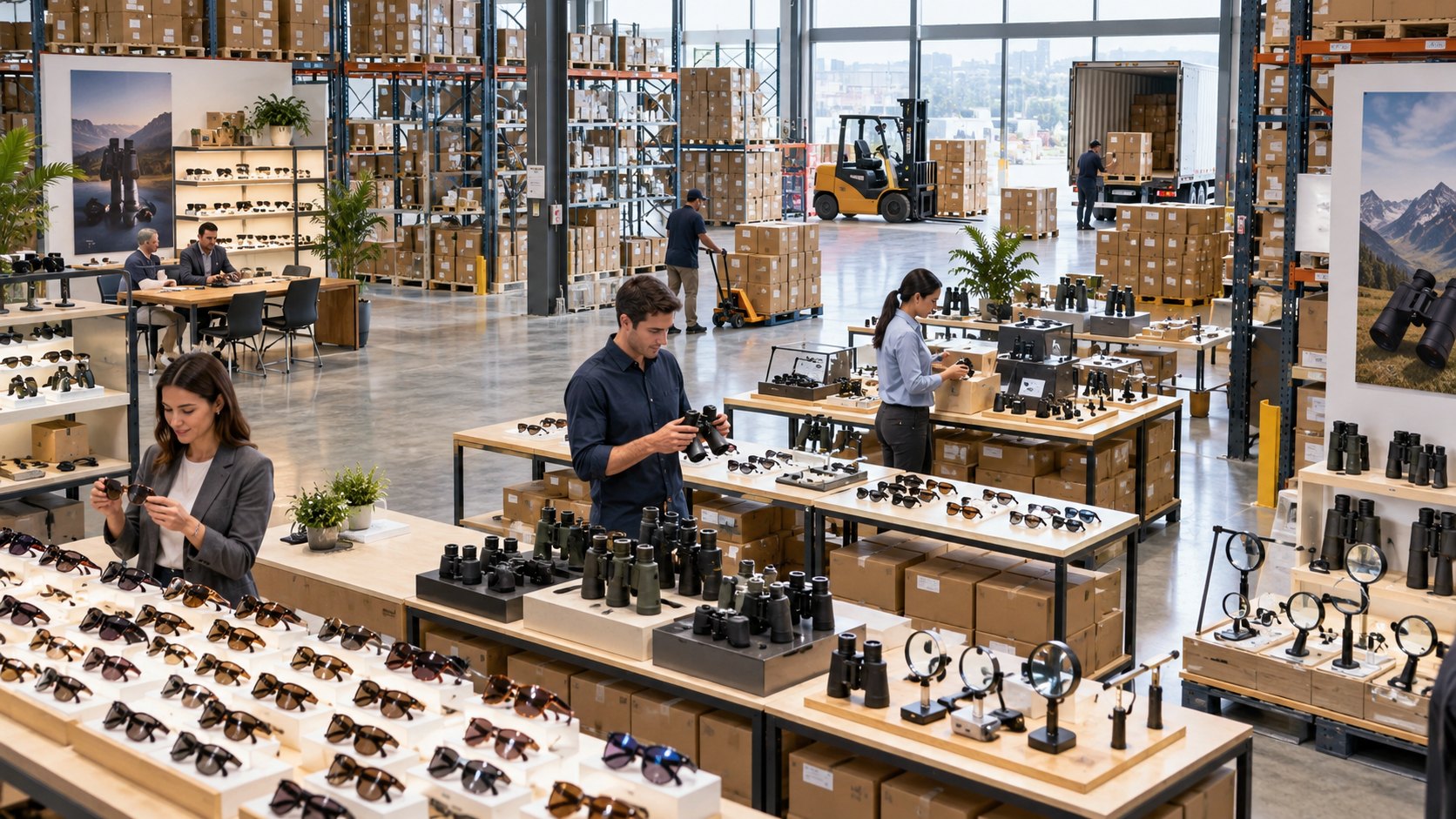
CZ 161 — Wholesale of photographic and optical goods
The line covers trade supply of optical goods and photographic goods: eyewear that does not correct vision, hand and instrument optics, and photographic equipment and its accessories. It splits into three families, and they are not equally governed.
Non-corrective eyewear
Sunglasses, sports and cycling eyewear, swimming goggles, safety glasses, fashion frames supplied without lenses, and the cases, cords and cloths sold with them. Tinted lenses are doing a job — reducing glare and blocking ultraviolet — and that job is what brings them under conformity requirements as protective equipment. The practical consequence for a wholesaler is that the manufacturer's test evidence belongs on its own file. Cycling and sports eyewear also appears on the bicycle parts line, CZ 159, and the sensible division is by customer: a cycle distributor sells it as part of a rider's kit, an optical wholesaler sells it as eyewear.
Instrument and hand optics
Binoculars, telescopes, spotting scopes, monoculars, magnifying glasses, loupes, reading magnifiers and the mounts and cases that go with them. Straightforward traded goods for the most part. The exception is at the technical end, where an instrument carries a rangefinder, a thermal sensor, image intensification or a wireless link — at that point it may stop being a simple optic and start attracting equipment controls, and a device that transmits needs type approval before it is supplied.
Photographic goods
Cameras, lenses, filters, bags, tripods, lighting and studio accessories. A declining consumer market and a durable professional one, now largely a specialist trade serving photographers, production companies and institutions rather than a general public that photographs on a phone. Almost everything modern in this category contains a radio, which is where the type approval point above becomes routine rather than exceptional.
What this line does not reach
Prescription spectacles, corrective lenses, contact lenses and the solutions that go with them. Also the act of examining eyes, taking measurements and dispensing against them. These are health matters carried out by qualified people in licensed facilities, and no trading licence substitutes for either the qualification or the facility.
Those three families, and the fourth thing that is not one of them, are best read against each other.
judged on the same five rows
| Judged on | Sunglasses and non-corrective eyewear | Instrument and photographic optics | Prescription eyewear and lenses |
|---|---|---|---|
| Sits inside this activity line | Yes | Yes | No |
| What governs the goods | Conformity as eye protection | Product controls, plus type approval where a device carries a radio | A health-regulated matter |
| Who the buyer is | Fashion retail, opticians, pharmacies, sports shops | Marine, security, hobby, trade and laboratory users | Licensed optical practices and clinics |
| How fast the stock turns | Fast, and obsolete within a season | Slowly, and stable for years | Made to order, so it never sits |
| Needs a qualified person to supply it | No | No | Yes |
The highlighted column is the one that is not available to you, and it is highlighted for that reason. It is also the most common misunderstanding on this activity, because the same optical shop buys from all three columns and sees no reason why its supplier should not.
What attaches to the goods, and what does not
A useful way to hold this is that the licence governs the company and conformity governs the product. They are separate questions and they are answered by different bodies.
The trade licence lets the company exist, hire, lease a unit, open a bank account, import and invoice. It says nothing about whether a particular pair of sunglasses may be placed on the market. That second question is answered by standards and conformity: whether the product meets the requirements that apply to eye protection, and whether the evidence exists to show it. For a distributor the practical form of this is a file per supplier and per model, holding the maker's declarations and test reports, kept current as models change. It is unglamorous and it is the single most useful thing a new entrant can set up properly from the start, because retrieving it after a question has been asked is far harder than keeping it.
Three further conditions attach in practice rather than on paper.
Supply provenance. Authorised-distributor paperwork from the brand owner, or a clean chain of invoices from one. On a heavily counterfeited product this is what protects both the stock and the customer relationship.
Import documentation. A customs code in the company's own name, correct classification of the goods, and an understanding that eyewear and optical instruments can attract scrutiny at the border precisely because of the counterfeit trade. Dubai Customs is the authority on what is restricted and how consignments are treated.
Radio equipment, where it applies. Any device that transmits — a wireless camera, a connected scope, a rangefinder with a link — falls to the telecommunications regulator for type approval before it is supplied into the market. It is worth checking the specification sheet rather than assuming an optic is passive.
What none of that answers is cost or duration, and no honest page will tell you. What a licence costs to hold, which approvals attach to a particular product and how long each takes depend on the emirate, the licensing authority, the premises and the exact product mix. Those are confirmed for the specific case, against the specific supplier list, before stock is ordered.
References
- Ministry of Industry and Advanced Technology — national standards and conformity marks for consumer products, including eye protection and tinted lenses. Ministry of Industry and Advanced Technology
- Ministry of Health and Prevention — medical devices and health products, which is where corrective lenses and contact lenses sit rather than on a trading line. Ministry of Health and Prevention
- Dubai Health Authority — health facilities and health-product trade in Dubai, including licensed optical practice. Dubai Health Authority
- Telecommunications and Digital Government Regulatory Authority — type approval for devices carrying a radio, such as connected cameras and rangefinding optics. Telecommunications and Digital Government Regulatory Authority
- Dubai Customs — import and export, customs codes, and the treatment of restricted and counterfeit goods. Dubai Customs
Elsewhere in Trading
Activities that sit beside this one
Most licences carry more than one activity. Adding a neighbouring line at the application stage costs a fraction of amending the licence afterwards.
Begin with a clear conversation
Tell us what you intend to build.
A consultant will map the structure, jurisdiction, approvals and likely cost against what you actually described — not against a package.
