

Activity CZ 162
How to Start a Recorded Music and Video Wholesale Business in Dubai
Physical recorded media is a small, specialised trade now — vinyl, back catalogue, regional-language titles and institutional buyers. What still decides it is whether the copy in the box is a licensed one.
ConsultZone licensing desk
- Activity code
- CZ 162
- Category
- Trading
- Reviewed
- Read
- 7 min
Listen instead
39 seconds
An audio summary of this guide.
Topic summary
How to Start a Recorded Music and Video Wholesale Business in Dubai
Begin with the honest version, because a plan built on the flattering one will fail.
Streaming took the mass market for recorded media and is not giving it back. Nobody is going to build a large distribution business here on new-release discs sold to a general public, and anybody who says otherwise is selling something. What is left is smaller, slower and genuinely durable: a specialist trade with identifiable customers who want a physical object for reasons a subscription does not satisfy.
Those reasons are worth naming, because they are the whole business case. Vinyl came back and stayed back, bought by people who want the sleeve, the pressing and the ritual as much as the music, and who pay accordingly. Back catalogue in regional languages serves communities that streaming platforms cover thinly or not at all — and the UAE, with its resident population drawn from dozens of countries, is an unusually good place to sell it. Collectors pay premiums for pressings, editions and condition, which is a trade in scarcity rather than in volume. Institutions still buy physical copies because a library, a school or an archive needs something it owns and can lend. And a long tail of vehicles, hotel rooms and older equipment still has a disc player in it.
That is a real set of customers. It is not a growth market, and a wholesale operation sized for one will drown in stock.
What is actually in the boxes, and what is not
The line covers trade supply of recorded audio and video on physical carriers: vinyl records, compact discs, DVDs and Blu-ray, audio and video tape, and the cases, sleeves and inserts that come with them. It is a goods business. Four distinctions do most of the work.
Recorded is not blank. A blank disc or a blank tape is a consumable, sold on price per unit to anybody. The moment something is recorded on it, the object carries content that belongs to somebody, and that ownership is what this page is really about.
Wholesale is not retail. Trade quantities to shops, chains, libraries, schools, hotels, tour operators and online sellers. A counter where a customer walks in and buys one album is a retail activity at a retail address.
Distribution is not publishing. A label commissions, records, manufactures and owns a recording. A distributor moves finished copies of it. The two are often confused because small labels do both, and holding both means holding both activities.
A physical copy is not a licence to transmit. Buying a thousand discs gives you a thousand discs. It gives no right to stream the recording, to supply it digitally, to use it for public performance in a venue, or to copy it. Those are separate rights held by separate people, and a wholesaler who starts offering digital supply alongside the physical has moved into a different business with different obligations.
Two threads then run through everything above, and they are the only two that genuinely decide whether a consignment is worth buying.
The first is the chain of title. A legitimate copy was manufactured by, or under licence from, whoever owns the recording, and the paperwork behind it says so. An infringing copy looks identical on a pallet, costs less, and is worthless the moment anybody asks — it cannot lawfully be sold, it exposes the buyer to the rights holder, and it cannot be returned to a supplier who was never traceable in the first place. Copied discs were a visible problem in this region for years and the trade's reputation still carries it, which means a new entrant is checked more carefully rather than less.
The second is content. Recorded audio and video arriving from abroad carries material that is reviewed before it may be offered for sale here, in the same way that imported books and periodicals are on the stationery and publications line, CZ 160. The division between those two pages is only the format — print there, discs and tapes here — and the practical consequence is identical: a consignment can be fully paid for, properly licensed and still not clear for sale. Order conservatively on unfamiliar titles.
- Decide which catalogue you are in — vinyl, regional back catalogue, collectable or institutional
- Establish who owns the recording and who is licensed to reproduce itNot who is selling you the box, which is a different question
- Can the seller show the right to produce and distribute this copy
- YesContent review of the imported material is the next gate, and the stock is worth buying
- NoThe consignment is unsaleable whatever it cost, and it cannot be returned
- Price for turnover rather than for the shelfA disc that does not move in a year will not move in two
- Stock with a title behind every sleeveThe only inventory in this trade that is worth what the ledger says
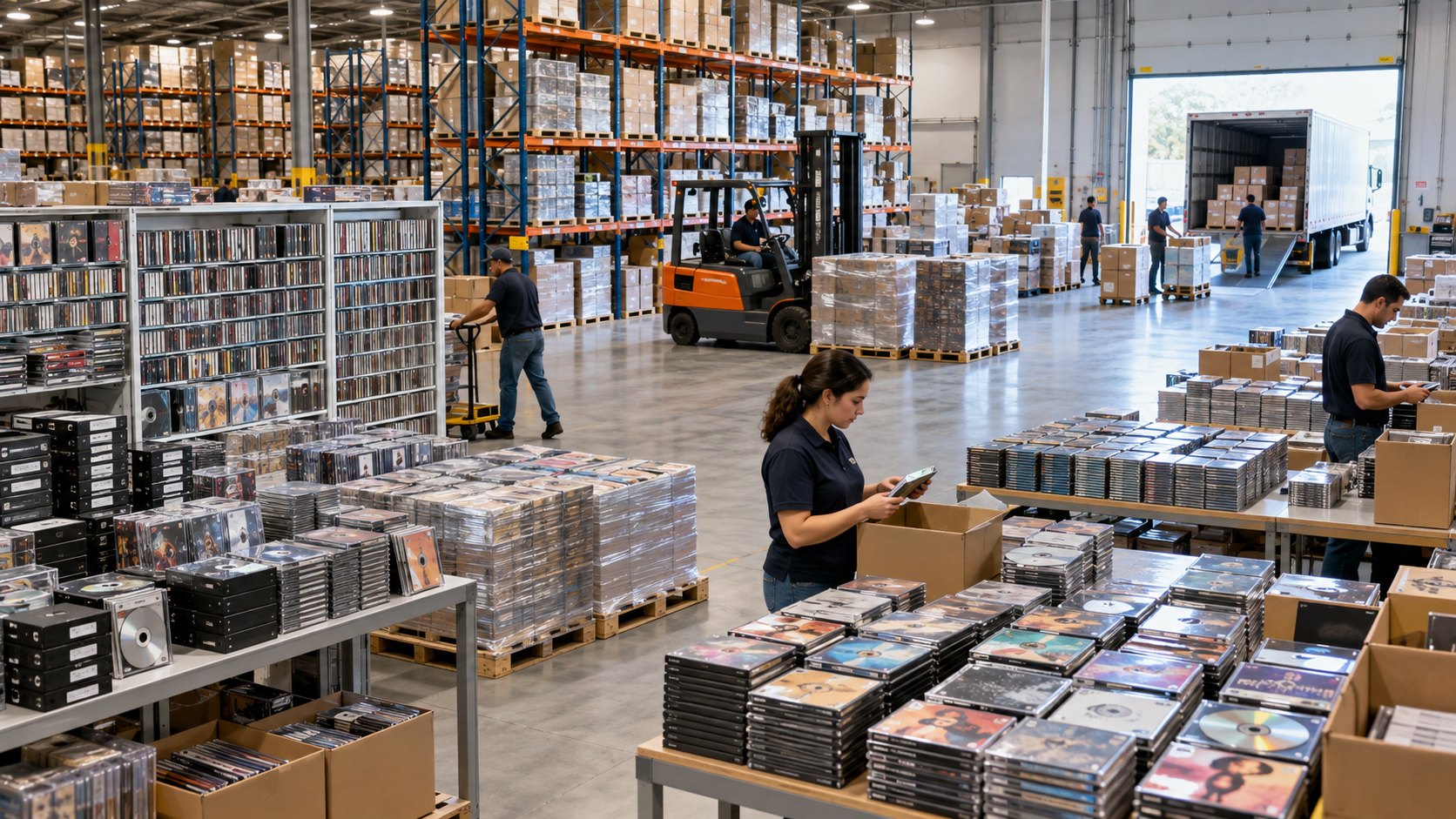
This is a specialist's trade, not a first business
The collector who already knows the market
The most credible entrant by a distance. Somebody who has spent years buying and selling pressings knows what is scarce, what is merely old, what condition is worth and which supplier is honest. That knowledge is the margin, and it cannot be bought in.
The label or studio adding distribution
A small label that already owns recordings and wants to move its own and other people's finished copies. The rights position is understood from the start, which removes the single biggest risk on the activity, and the question becomes whether it wants to run a stockholding business at all.
The community and language specialist
A supplier serving one language community thoroughly — its films, its music, its devotional and spoken-word catalogue. Narrow, defensible and unglamorous, and it works precisely because a global platform has no reason to serve that catalogue well.
The institutional supplier
Whoever sells to libraries, schools, universities, hotels and transport operators. Orders are specified, tendered and repeatable, payment terms are long, and the buyer wants documentation and a reliable reorder far more than it wants a discount.
What all four have in common is that they are built on knowledge rather than on volume, which is also why the capital requirement is modest by wholesale standards and the stock risk is high. A disc costs little and occupies shelf space indefinitely. The discipline is refusing cheap stock, not finding it.
Where it sits between the mainland and a free zone
The structural choice follows the customer, and on this activity it divides unusually cleanly.
A mainland licence is what lets a company sell directly to UAE businesses on UAE soil — the record shop, the hotel group, the school, the local online seller. If the plan is to supply buyers inside the country, that is the straightforward route, and it also means the company deals with the emirate's own licensing authority and municipality for everything from the activity line to the warehouse.
A free zone licence suits the opposite plan: goods brought in, held, consolidated and sent out again to other markets without entering the UAE market at all. For a regional distributor serving several countries from one warehouse, that is an efficient way to hold stock. The limitation is the domestic market, which is reached through a distributor or an appropriately licensed arrangement rather than directly, and for a business whose customers are mostly local that limitation is the whole argument against it.
There is a specific wrinkle on this activity worth raising before the structure is chosen. Content review applies to material that enters the market here; goods that are held and re-exported are a different proposition in practice. That distinction sounds like a reason to prefer one route, and it is not a decision to take from a web page — it depends on the exact flow of goods, the emirate and the jurisdiction, and it is exactly the kind of thing ConsultZone confirms for a specific case before a lease is signed or a licence is applied for.
The tax position is the same question every UAE business answers. Corporate tax applies, enrolment and filing run through the Federal Tax Authority, and VAT treatment follows from where the goods go and who buys them — all of which should be read alongside the choice of structure rather than after it.
References
- UAE Government portal — federal law and government information, including the framework covering intellectual property and media content. UAE Government portal
- Dubai Customs — import and export, customs codes, and the treatment of restricted goods and counterfeit material. Dubai Customs
- Ministry of Industry and Advanced Technology — national standards and in-country value for a goods-handling operation. Ministry of Industry and Advanced Technology
- Federal Tax Authority — VAT and corporate tax enrolment and filing obligations. Federal Tax Authority
- Ministry of Human Resources and Emiratisation — work permits and labour contracts for warehouse and sales staff. Ministry of Human Resources and Emiratisation
Elsewhere in Trading
Activities that sit beside this one
Most licences carry more than one activity. Adding a neighbouring line at the application stage costs a fraction of amending the licence afterwards.
Begin with a clear conversation
Tell us what you intend to build.
A consultant will map the structure, jurisdiction, approvals and likely cost against what you actually described — not against a package.
