
Activity CZ 163
How to Start a Leather Goods and Travel Accessories Wholesale Business in Dubai
A container of suitcases is mostly air, and the most desirable handbag in the world is also the most copied. Freight per cubic metre and provenance decide whether a leather goods line earns.
ConsultZone licensing desk
- Activity code
- CZ 163
- Category
- Trading
- Reviewed
- Read
- 7 min
Listen instead
52 seconds
An audio summary of this guide.
Topic summary
How to Start a Leather Goods and Travel Accessories Wholesale Business in Dubai
A container of hard-shell suitcases is mostly air. That one fact sits behind more disappointing first years in this trade than any licensing question, because freight is charged on the space a consignment occupies and luggage occupies a great deal of it for very little weight. A wholesaler who prices a range off the factory invoice and adds a rule of thumb for shipping usually finds that the rule of thumb was written for something denser. On this line, cubic metres are the unit of account.
The second fact is that the most desirable goods here are among the most counterfeited goods in world trade. A handbag carrying a famous mark is a target in a way that a laptop sleeve or a luggage strap is not, and that pushes the commercial question away from price and onto provenance: who you bought from, what they were entitled to sell you, and whether you can show it on demand. In most wholesale lines the paperwork is administration. In this one it is the asset, and a consignment that cannot explain itself at the border is a total loss rather than a delay.
The buyer is a retailer with shelf space and a season to fill
Independent luggage and bag shops are the backbone of the trade. They buy small quantities, reorder on what actually sold, and want a supplier who will break a carton rather than insist on a pallet. Serving them well is a picking-and-packing discipline, not a container discipline.
Department stores and larger retail groups buy volume and set the terms. Getting on their assortment is a genuine commercial win, and financing the gap between their delivery date and their payment date is the price of it.
Hotels, airlines and travel retail buy differently again. Amenity cases, branded gifts and duty-free assortments are specified rather than browsed, the quantities repeat, and the buying is often a formal tender against a written specification. A wholesaler who can hold a consistent article for years is worth more to this buyer than one with a new range every season.
Corporate gifting buyers want wallets, portfolios, document cases and luggage tags with a mark applied to them, and they want it in weeks rather than months. The margin is good, the demand is lumpy, and applying the mark is a finishing operation somebody has to own.
Online sellers and marketplace traders are the fastest-growing customer on this line. They will take a single carton, they need photographs and product data more than they need a showroom, and they churn.
Re-exporters serving neighbouring markets buy out of Dubai precisely because the assortment is here rather than in their own market. This buyer is the reason free zone stock on this line exists at all, and a plan aimed at that buyer is a different plan from one aimed at a shop on a high street here.
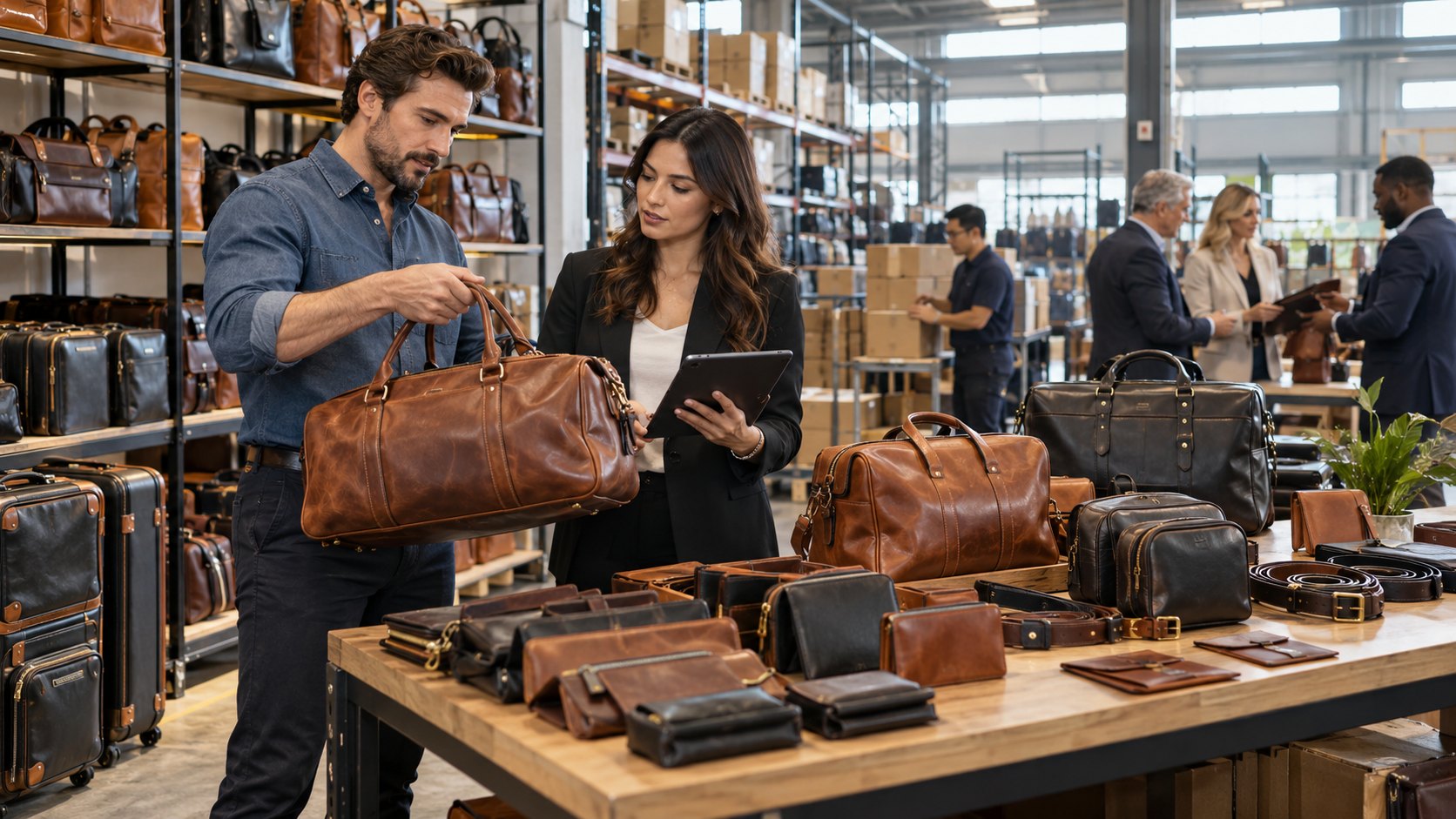
CZ 163 — Wholesale Of Leather Goods And Travel Accessories
The line covers finished articles: buying, importing, holding and selling them on to somebody who will sell them again. Raw hides and skins, and tanned leather sold as a material to manufacturers, are separate wholesale lines with separate buyers and a completely different set of problems — if the plan is to sell leather rather than things made of leather, that is the line to look at, and this page is about the other side of the tannery. Stated plainly, this activity begins where the material stops being a material.
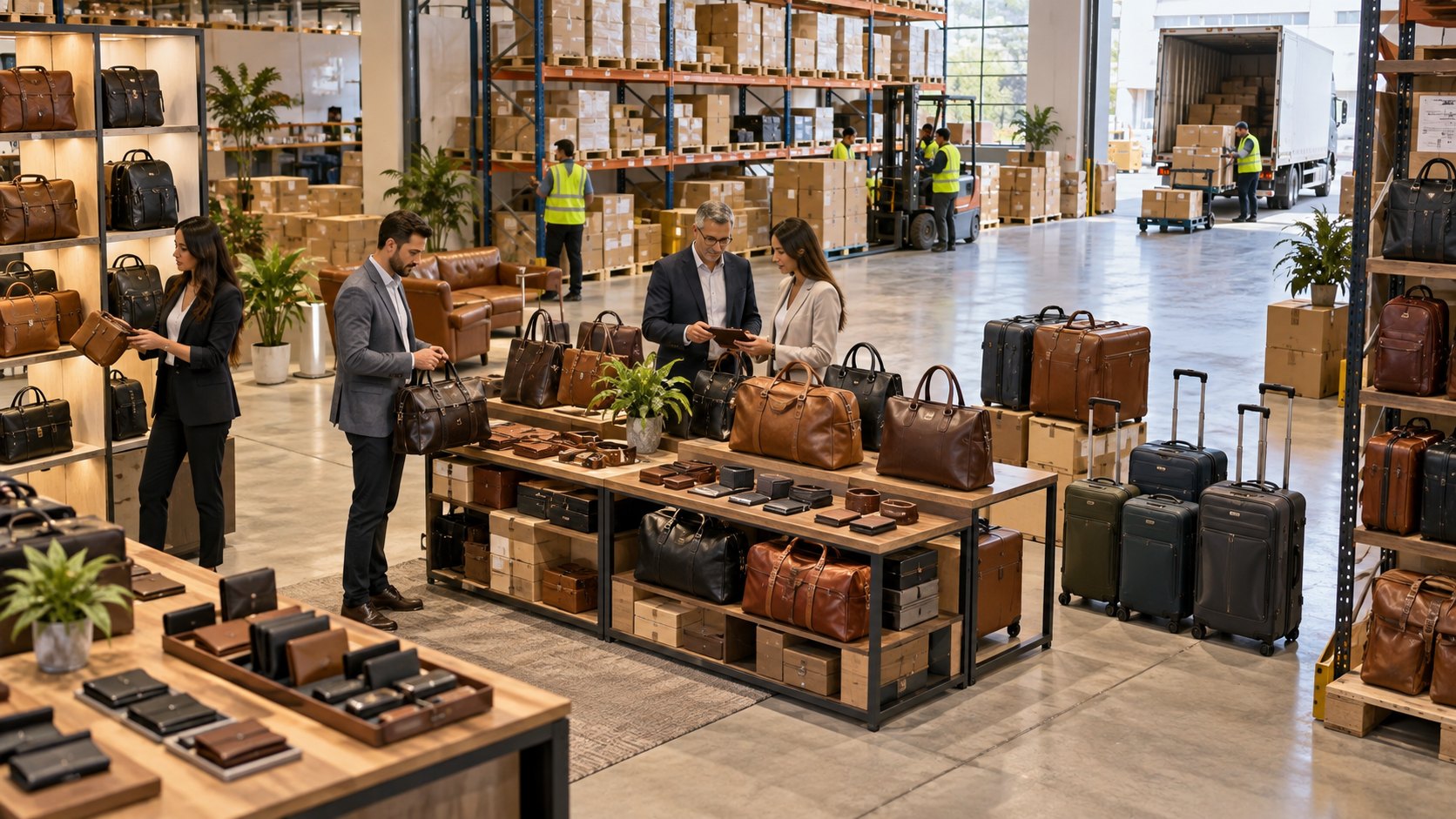
Within that, three families of stock behave so differently that a single stock plan struggles to hold all three.
Cases and luggage, where the carrier decides your margin
Hard-shell and soft trolley cases, holdalls, duffels, garment carriers and their wheels, handles and straps. The buyer is choosing capacity, weight and whether the thing survives a baggage belt. Price competition is brutal, brand matters less than warranty in the middle of the market, and the landed cost is dominated by volume rather than by weight. Stock stays current for years, which is a relief, and it needs racking height and a tolerance for storing empty space.
Handbags and small leather goods, where the mark is the product
Handbags, purses, clutches and shoulder bags. Here the customer is buying a brand and a season, not a capacity. Margin per piece is the best on the line and so is the risk: ranges date, and the counterfeit exposure is the highest in the trade because the pieces worth copying are exactly the pieces worth stocking. Anything carrying somebody else's mark needs an authority from the mark's owner or a supply chain you can trace to one, and it needs storage that is secure and reasonably stable in temperature, because leather marks and moulds.
Belts, wallets and carried accessories, where volume is the whole argument
Belts, wallets, card holders, key cases, passport covers, travel organisers, umbrellas and the small articles people buy alongside a bag. Low unit price, high pick rate, very little warehouse space, and demand that barely moves with the season. This is the family that keeps a warehouse busy between the luggage containers, and it is where a gifting order lands.
| Cases and luggage | Handbags and small leather goods | Belts, wallets and carried accessories | |
|---|---|---|---|
| What the buyer is choosing | Capacity and durability | A mark and a season | A price point and a gift box |
| What drives the landed cost | Cubic metres, not kilos | The authority behind the mark | Unit price, bought in volume |
| Where the counterfeit exposure sits | Low, hard to copy profitably | Highest in the trade | High, and hard to police |
| How long the stock stays current | Years | A season or two | Years |
| What the warehouse has to give | Height, and room for air | Secure, temperature-steady shelving | Little space, fast picking |
Read down the counterfeit row rather than across the page: it is the row that decides how much of the business is buying and how much of it is proving what you bought. A wholesaler who takes the first two families seriously has to be able to hand a customs officer a chain of supply, and that capability is built when the supplier is chosen, not when the container arrives.
What this line does not let you do
It does not let you make the goods. Cutting, stitching or assembling bags, cases or belts is manufacturing. That is an industrial activity with industrial premises and its own approvals, and it answers to the ministry responsible for industry rather than to a trade licence.
It does not let you tan or finish leather. Turning a hide into leather is a wet, chemical, effluent-producing process that sits a long way from a wholesale warehouse in every sense, including where the municipality will let it happen.
It does not let you repair or restore. Re-stitching a handle, replacing a lining, refinishing a scuffed bag or fitting a new wheel to a case is a repair activity with its own line. Wholesalers who take warranty returns and put them right are running a small workshop, and it belongs in the licence wording rather than in a conversation with an inspector.
It does not let you retail. Selling to the public from the premises is a different activity from selling to somebody who will sell it again, and a warehouse in an industrial area is generally not permitted to do it whatever the licence says.
It does not confer any right to a brand. A trade licence is permission to trade; it says nothing about whose marks you may put on goods or on a catalogue. Authority to deal in a branded article comes from the owner of the mark, in writing, and a wholesaler who cannot produce it is exposed at the border, in a retailer's audit and in a court.
What each of those additional lines requires, which approvals attach to a specific warehouse, and what a licence costs to hold all depend on the emirate, the premises and the activity mix. Those are points we confirm against the actual plan rather than quote in general — and on this line the first question is usually not the licence at all. It is whether the supply chain can prove itself.
References
- Dubai Customs — import and export, customs codes, and the treatment of restricted, prohibited and infringing goods at the border. Dubai Customs
- Ministry of Industry and Advanced Technology — industrial licensing, national standards and conformity marks on consumer articles. Ministry of Industry and Advanced Technology
- Dubai Municipality — premises suitability, warehouse conditions and public health requirements in Dubai. Dubai Municipality
- UAE Government portal — federal law on trade marks, commercial fraud and consumer protection, and general government information. UAE Government portal
Elsewhere in Trading
Activities that sit beside this one
Most licences carry more than one activity. Adding a neighbouring line at the application stage costs a fraction of amending the licence afterwards.
Begin with a clear conversation
Tell us what you intend to build.
A consultant will map the structure, jurisdiction, approvals and likely cost against what you actually described — not against a package.
