

Activity CZ 178
How to Start a Printed Circuit Board Trading Business in Dubai
A printed circuit is made to one customer's drawing and is worthless to anyone else. What the activity covers, the lines people confuse it with, and who the trade suits.
ConsultZone licensing desk
- Activity code
- CZ 178
- Category
- Trading
- Reviewed
- Read
- 7 min
Listen instead
45 seconds
An audio summary of this guide.
Topic summary
How to Start a Printed Circuit Board Trading Business in Dubai
Every other product in the wholesale part of this catalogue has one thing in common: if the customer who ordered it walks away, somebody else will buy it. A printed circuit board will not. It is manufactured to one company's drawing, with that company's track layout and that company's part footprints, and to anyone else on earth it is a piece of laminated glass fibre.
That single fact reorganises the whole business. There is no speculative stock, no shelf, no clearance line. What a board supplier actually sells is access to fabrication capacity, managed — the tooling, the quoting, the engineering queries, the lead time and the quality on arrival. The boards are almost incidental; the service is the product.
It is a genuinely good business in the UAE for an unobvious reason. The region has a growing population of electronics developers — product companies, instrumentation makers, industrial automation houses, universities and a real hardware start-up scene — and almost none of them want to deal directly with a fabricator eight time zones away in a language and a technical idiom they do not share. The supplier who absorbs that friction has a defensible position.
CZ 178 — Printed circuits
Under this line you supply bare printed circuit boards. Four things define the scope.
The board is bare
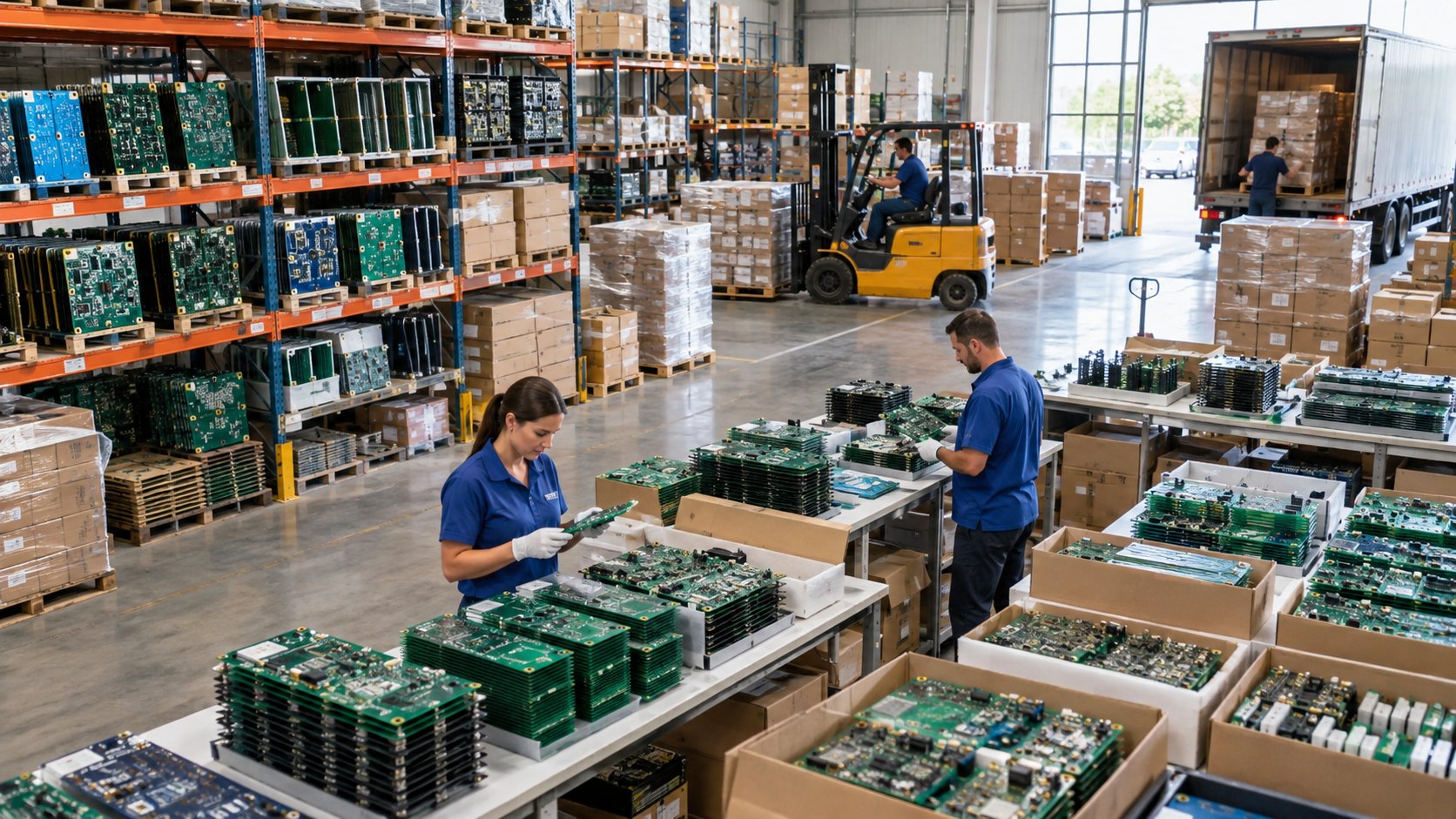
Unpopulated: copper, laminate, plating, finish and legend, with no components fitted. The moment parts are soldered on, it is an assembly rather than a circuit board, and that is a different product and a different activity.
Tooling dominates the first order and vanishes from the hundredth
Setting up a new board costs real money — drill programmes, test fixtures, films — and that cost is the same whether the customer orders five boards or five thousand. So the price per board on a prototype is startling and on a production run is trivial, and explaining that honestly to a first-time buyer is most of the sales conversation.
The specification is unforgiving and entirely the customer's
Layer count, material, copper weight, minimum track and gap, via structure, surface finish, impedance control, thickness, finished dimensions. The supplier does not choose any of it. What the supplier does is catch the things the customer got wrong before a fabricator builds them.
Lead time is the product's other half
Standard, expedited and emergency are three different prices for the same board, and a developer with a demonstration next week will pay the third without blinking.
What it givesWhat it costs
- Prototype and development boardsHigh margin per board, constant new customers, and the relationship that leads to productionEndless small orders, heavy engineering time, and customers who may never scale
- Production runs for an established productPredictable repeat volume and almost no engineering effort once qualifiedThin margin, a customer who will test the market against you, and real working capital
- Quick-turn and expedited workThe best margin in the trade, and a reason customers remember youCapacity you must hold or beg for, and a promise that is expensive to break
- Obsolete and long-life board supplyLoyal industrial customers with nowhere else to goOld material specifications and fabricators who no longer want the work
The marked row is where most suppliers think the business is, and the row above it is where the business actually starts. A supplier who only wants production runs never meets the customer early enough to win them.
Adjacent lines people confuse with it
Assembly is not board supply. Fitting components to a board is electronics assembly — a manufacturing activity with its own licence, premises and process controls. Many customers want one company to do both, and a supplier that takes that on has stepped out of trading and into manufacturing.
Components are a different trade. Semiconductors, integrated circuits and passives each have their own line in this catalogue. A board supplier who starts sourcing the parts to go on the board is holding two activities, and should do so deliberately rather than by drift.
Design is not supply. Producing the layout — schematic capture, routing, design for manufacture — is an engineering service. Reviewing a customer's files for manufacturability is a normal part of board supply; drawing them is not, and the liability is different.
Board fabrication is manufacturing. Etching, drilling, plating and lamination is an industrial activity with chemical handling, effluent treatment and environmental permitting. Nothing about this trading line permits it, and the distinction matters enormously, because board making is one of the more environmentally regulated processes there is.
Membrane keypads, flexible circuits and backplanes sit close enough to cause confusion. Flexible and rigid-flex circuits are still printed circuits; a finished keypad assembly is not.
Who is this for?
Representatives of overseas fabricators
The most common and the most natural: a company holding the regional relationship for one or several board makers, carrying the quoting, the engineering interface and the local accountability. The fabricator gets a market it cannot service directly; the customer gets somebody in the same time zone.
Electronics developers supplying their peers
Engineers who solved their own board-sourcing problem and discovered everybody around them had the same one. They start with credibility no salesperson can buy, and the thing they usually underestimate is how much working capital sits between paying a fabricator and being paid.
Distributors widening the offer
Component distributors whose customers keep asking who supplies their boards. Adding the line keeps a conversation that would otherwise go elsewhere, and the two trades share a customer and a buying cycle.
Assemblers buying for their own builds
Contract assemblers who would rather control the bare board than wait on a client's supplier. For them the activity is defensive, and it shortens their own programme.
What it costs to hold
The licence fee depends on the emirate, on the jurisdiction and on the activity mix, and it is not the number that decides this business. What decides it is working capital: fabricators want paying on despatch and customers pay on terms, and the gap between the two is the real cost of entry. We confirm the licensing position for the specific case.
The files are the contract
Earlier this page said that what a board supplier actually does is catch the things the customer got wrong before a fabricator builds them. That is the whole liability of the trade, and it is settled by a set of files.
A board order arrives as copper and drill data, a stack-up, a finish, a quantity — and a page of fabrication notes written in prose. The data is unambiguous. The notes are English. When the two disagree, and they disagree constantly, the fabricator builds the data and the customer meant the note.
The same disagreements recur. A note calls for controlled impedance that the stated stack-up cannot physically produce. A finished thickness is specified that the layer count and copper weights do not add up to. The drawing names a minimum gap the artwork does not hold. Legend ink lands on pads that have to stay solderable. There is no panel edge or tooling allowance, so the boards cannot be carried through an assembly line. And often no acceptability standard is named at all, which does not mean none applies — it means the customer will apply their own once the boards exist.
The discipline that follows is unglamorous: review before quoting, raise every query in writing, make the customer answer in writing, build against the answered file set and keep it. That answered set is the only thing that later decides whose cost a remake is.
It matters more than the sums suggest, because a wrong board is not found by the person who ordered it. It is found at the assembler, after components have been fitted, so the cost of a bad board is never the price of the board. The queries that irritate a customer at the quote are the ones that save them at the build.
References
- Dubai Customs — classification, duty treatment and clearance of printed circuit boards and electronic materials. Dubai Customs
- Ministry of Industry and Advanced Technology — national standards and conformity requirements, and the industrial licensing boundary that board fabrication sits behind. Ministry of Industry and Advanced Technology
- Federal Tax Authority — the differing treatment of domestic supply and export of goods. Federal Tax Authority
- UAE Government portal — the general framework for commercial licensing in the UAE. UAE Government portal
Elsewhere in Trading
Activities that sit beside this one
Most licences carry more than one activity. Adding a neighbouring line at the application stage costs a fraction of amending the licence afterwards.
Begin with a clear conversation
Tell us what you intend to build.
A consultant will map the structure, jurisdiction, approvals and likely cost against what you actually described — not against a package.
