

Activity CZ 177
How to Start a Microchip and Integrated Circuit Trading Business in Dubai
In integrated circuits the scarce thing is not the part but the certainty that it is genuine. What the activity covers, who the buyers are, and the conditions that travel with the goods.
ConsultZone licensing desk
- Activity code
- CZ 177
- Category
- Trading
- Reviewed
- Read
- 7 min
Listen instead
44 seconds
An audio summary of this guide.
Topic summary
How to Start a Microchip and Integrated Circuit Trading Business in Dubai
Two things make integrated circuits unlike any other component trade. The first is that a chip can be faked convincingly: a device can be recovered from scrap, cleaned, re-marked with a higher specification and sold as new, and it will often work on a bench and fail in a product. The second is that supply is rationed rather than sold — when a part is on allocation, the manufacturer decides who gets it, and no amount of money moves a date.
Put together, those two facts say what a chip trader actually sells. It is not the silicon, which anyone can quote. It is the certainty that the part is what it claims to be and that it will arrive. Every serious buyer in this market is paying for exactly that, and every disaster in it comes from somebody who was not.
That makes the UAE a sensible base — regional manufacturers and assemblers nearby, fast logistics, and a long trading culture — and it makes the reputational bar higher here than in almost any other line in this catalogue.
What the activity covers
Standard and logic devices
Microcontrollers, memory, logic families, interface and analogue parts. The workhorse categories, bought against a bill of materials by purchasing departments who want the exact part and nothing adjacent.
Application-specific and programmable devices
Field-programmable gate arrays, application-specific parts and system-on-chip devices. Higher value, longer lead times, and often tied to a design the customer cannot change without re-engineering a product.
Power management and interface circuits
Regulators, drivers, converters and the parts that sit between a processor and the world. Specified by engineers against a thermal and electrical budget.
Obsolete and end-of-life parts
A real and respectable trade. Industrial, medical, aerospace and defence equipment outlives the chips inside it, so somebody has to supply a part the manufacturer stopped making a decade ago. This is where the independent market earns its existence — and where the counterfeit risk is at its highest, because scarcity creates the incentive.
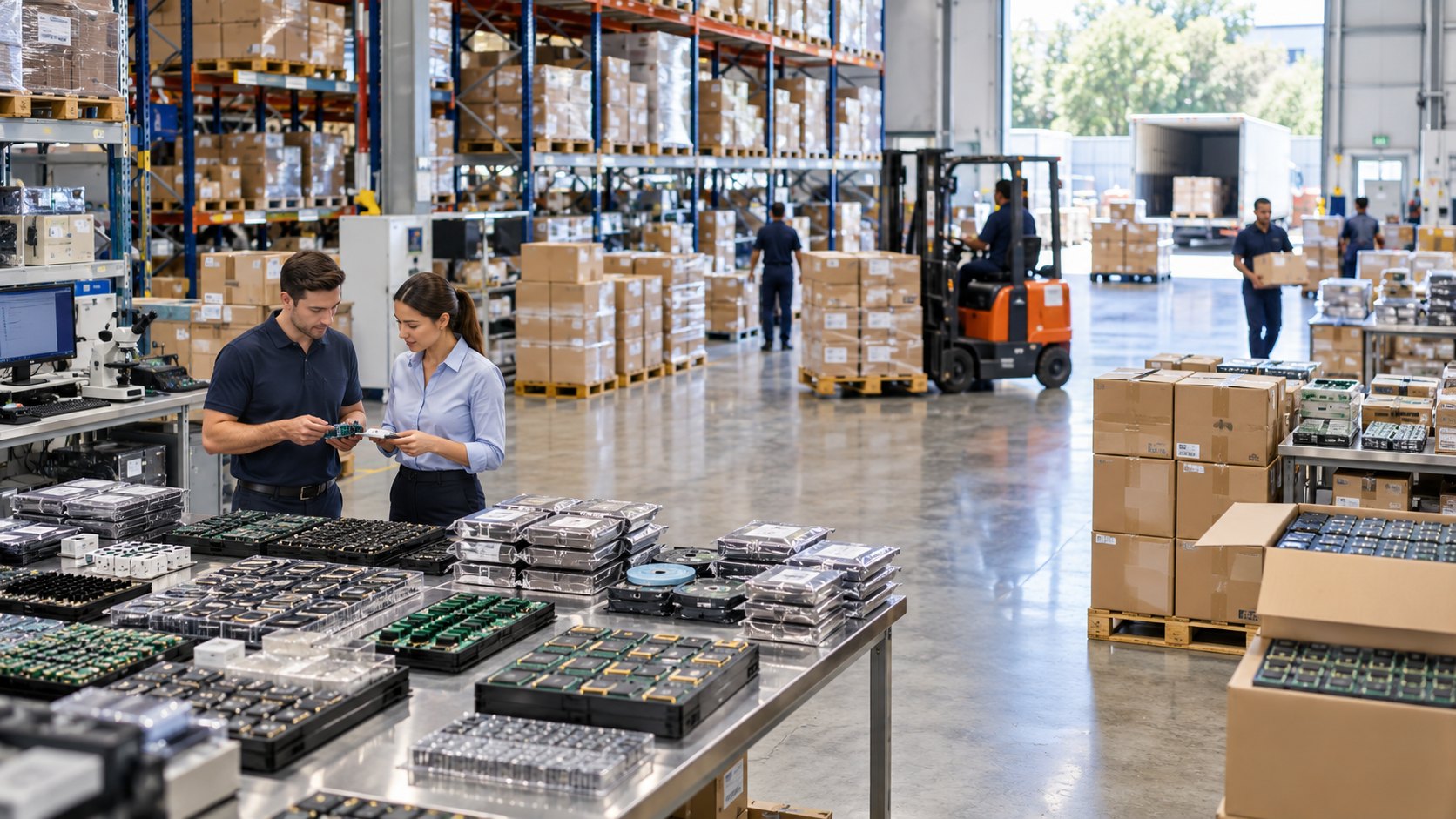
The buyers, and the route to them
Electronics manufacturers and contract assemblers buy against a build schedule and will pay a premium to protect it. Industrial and medical equipment makers buy obsolete parts to keep long-life products supportable. Repair and maintenance organisations buy small quantities at short notice. Other traders buy surplus to break into smaller lots.
The route to all of them runs through one question the buyer asks first: where did this come from? A trader who can answer it with a name, a document and an unbroken chain gets the order. A trader who answers "stock" does not get it twice.
the six gates named on this page
The authorised distribution chain and your own testing
- Whether the part is genuineBefore it is offered, not after it is shipped
Your own testing and the source's traceability
- Whether obsolete stock can be trustedEvery time, because nobody else will vouch for it
The manufacturer, through allocation
- Whether you can get the part at allContinuously, and it is the one gate money does not open
The emirate's customs authority and national controls
- Whether this part may go to that destinationBefore shipping, because some advanced devices are controlled
The emirate's customs authority
- Classification, duty and documentation on arrivalPer consignment
The federal standards authority
- Conformity, once the part is inside finished equipmentAt the point the equipment is supplied, not the component
The concentration in that drawing is the lesson. Two gates belong to customs, two belong to your own diligence, and the single most consequential one belongs to a manufacturer on another continent who has never heard of you. A business built on the assumption that supply can be bought is a business that stops when allocation tightens.
Conditions that attach to the goods
Traceability is the product. Documentation showing the chain from manufacturer to you is what a quality department audits, and in the obsolete market it is often the only thing distinguishing a legitimate part from a re-marked one. Keep it; a part without it is worth a fraction of the same part with it.
Testing is not optional on independent stock. Visual inspection, marking permanency, decapsulation and electrical test exist because counterfeits exist. A trader handling obsolete and surplus parts without a testing arrangement is selling risk and calling it inventory.
Some advanced devices are controlled for where they can go. Export and dual-use controls apply in the jurisdictions that produce many of these parts, and that travels with the goods rather than stopping at the factory gate. The practical consequence is that the destination matters as much as the part, and the question belongs before the purchase order rather than after it. Customs is the right place to settle it for a specific item.
Classification decides the duty and the documentation. Integrated circuits are not a single customs category, and getting the classification wrong is a delay rather than a saving.
Handling matters physically. These are static-sensitive devices with moisture-sensitive packaging and, for some parts, a shelf life on the dry pack. Storage conditions are part of what a customer is buying.
And a component carries no conformity mark on the customer's behalf. Standards obligations attach to finished equipment. Selling parts does not transfer them to you, and claiming otherwise misleads a buyer.
What it costs to hold
The licence fee turns on the emirate, the jurisdiction and the activity mix in the ordinary way, and it is small beside the working capital and the testing arrangements this trade needs to be done honestly. Whether a free zone's bonded holding suits better than a mainland licence depends on whether the buyers are local manufacturers or regional ones. We confirm the position for the specific case.
Why a shortage is not a market
This page has said that allocation is the one gate money does not open. The corollary is the part nobody plans for: money cannot move the date, but it moves the price, and in a squeeze it moves it a long way.
When a part goes short, the independent market stops pricing on cost and prices on scarcity instead. A buyer with a line stopped and a build schedule to protect will pay well above catalogue, and will pay it the same day. That is when a trader with cash and the right stock earns more in a month than in the year around it — and it is also the moment this trade quietly destroys companies, because the price was never a property of the part. It was a property of the shortage, and shortages end.
They end faster than they built. Allocation eases, the manufacturers' own lead times come back, and buyers stop paying scarcity prices because they no longer have to. Whoever bought at the top is left holding something worth roughly what the catalogue always said, which was the floor the whole time.
So stock bought into a shortage is a position rather than an inventory, and it should be sized as one. The useful question is not whether the parts will sell. It is what the holding is a bet on — that the squeeze outlasts your money — and whether being wrong is survivable. The operations that last in this line buy against an order wherever they can, go back to back where the margin allows it, and when they do take a position, take one they can afford to be wrong about.
There is a second cost, and it is the one the trade actually punishes. Buyers remember what you charged them when they had no choice. A customer who paid a scarcity price from somebody who explained the market plainly treats it as the market. A customer who concludes they were held up treats it as a reason, and the reason outlives the shortage. The margin available in a squeeze is real; the standing you spend to take all of it cannot be bought back.
References
- Dubai Customs — classification, duty, restricted and controlled goods, and export documentation for electronic components. Dubai Customs
- Ministry of Industry and Advanced Technology — national standards and conformity requirements, which attach to finished equipment rather than to components. Ministry of Industry and Advanced Technology
- Federal Tax Authority — the differing treatment of domestic supply and export. Federal Tax Authority
- UAE Government portal — the general framework for commercial licensing in the UAE. UAE Government portal
Elsewhere in Trading
Activities that sit beside this one
Most licences carry more than one activity. Adding a neighbouring line at the application stage costs a fraction of amending the licence afterwards.
Begin with a clear conversation
Tell us what you intend to build.
A consultant will map the structure, jurisdiction, approvals and likely cost against what you actually described — not against a package.
