
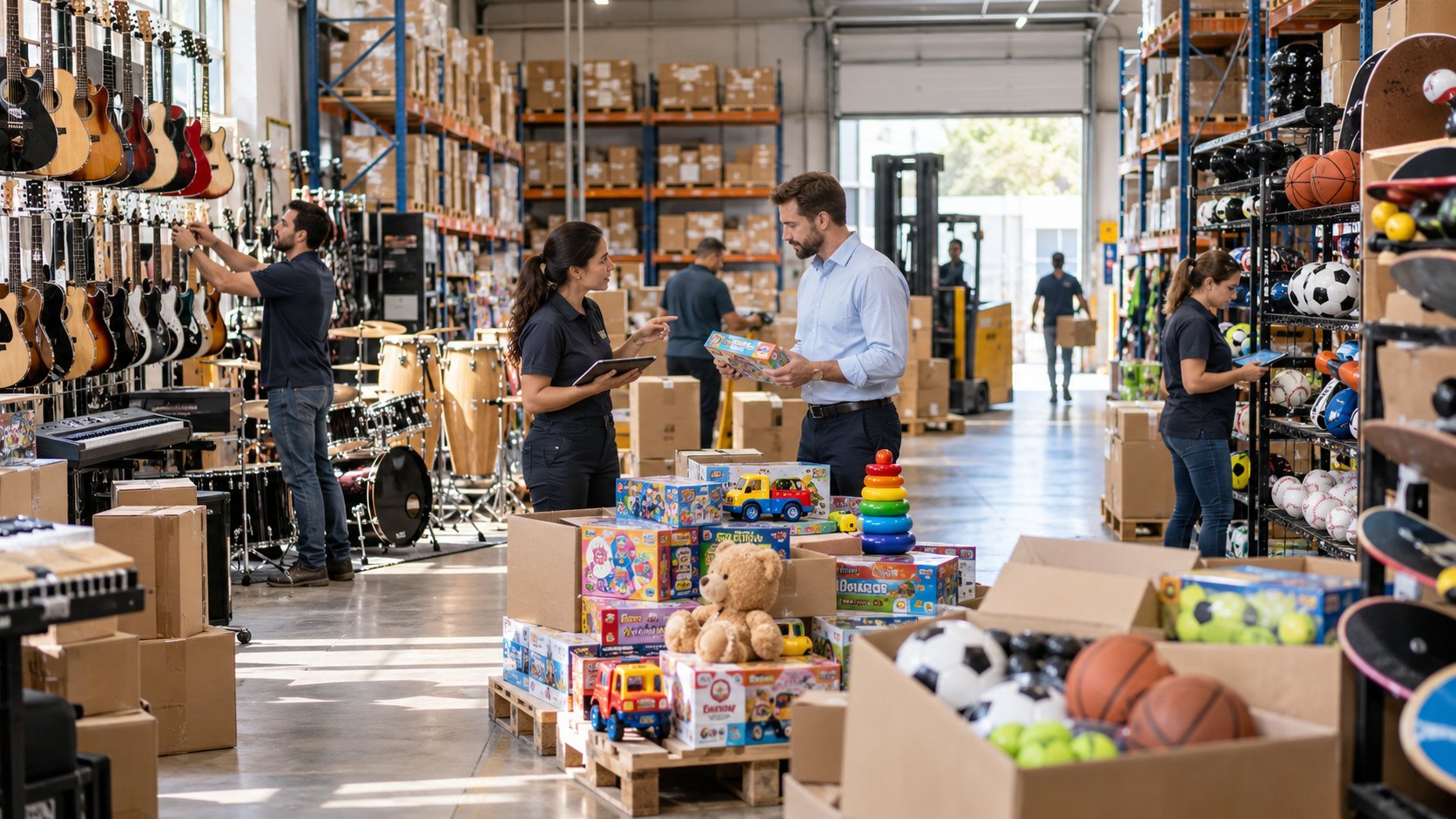
Activity CZ 165
How to Start a Musical Instruments, Games, Toys and Sports Goods Wholesale Business in Dubai
One activity line puts a grand piano, a jigsaw, a football and a treadmill in the same box. Toys carry the heaviest conformity file of any consumer good, and instruments behave nothing like them.
ConsultZone licensing desk
- Activity code
- CZ 165
- Category
- Trading
- Reviewed
- Read
- 8 min
Listen instead
39 seconds
An audio summary of this guide.
Topic summary
How to Start a Musical Instruments, Games, Toys and Sports Goods Wholesale Business in Dubai
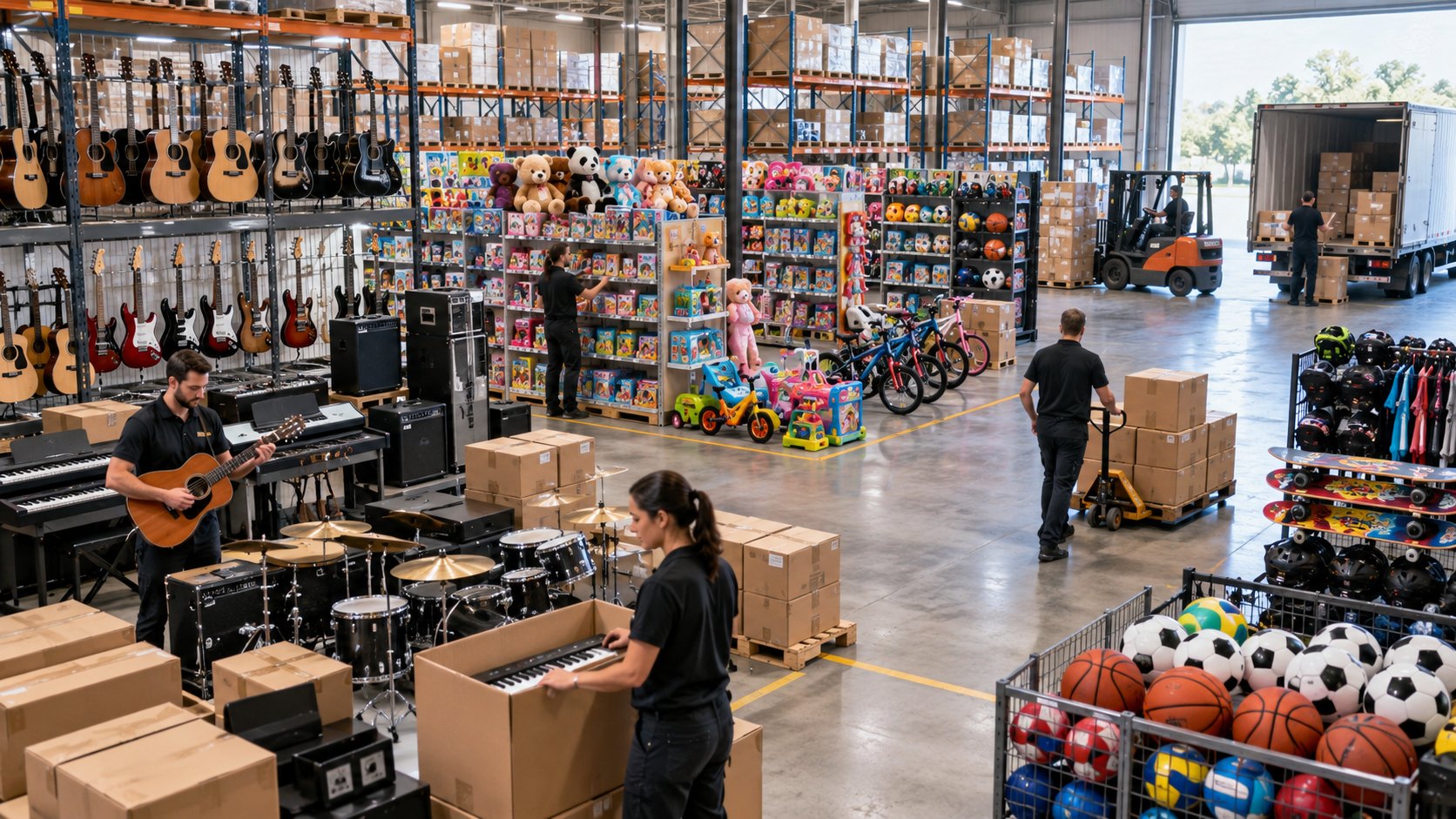
Four trades with almost nothing in common share this line. A grand piano, a thousand-piece jigsaw, a match football and a commercial treadmill are one activity on a licence and four different businesses in a warehouse: different buyers, different freight, different seasons, different failure modes. Anyone reading this line as a single opportunity is reading a filing convention, not a market.
There is one thing that genuinely unifies it, and it is worth stating first because it dominates the risk. Toys are among the most tightly controlled consumer goods in the world, and they are controlled for a reason that has nothing to do with trade policy: the user is a child who will put the product in his mouth, pull it apart and use it wrongly. Physical and mechanical safety, small parts that can be swallowed, cords and strangulation, flammability, limits on chemicals in the materials, and marking that states the age the item is meant for — these apply to the cheapest plastic novelty exactly as much as to the branded one. A wholesaler who understands that file is running a defensible business. One who buys on landed cost alone has bought a liability and does not yet know it.
CZ 165 — Wholesale Of Musical Instruments, Games And Toys, Sports Goods
The line covers buying, importing, holding and selling on to somebody who will sell again: instruments and their parts, strings, reeds, cases and stands; toys, games, puzzles, models and hobby kits; and sports, outdoor and fitness goods with their accessories. Four families sit inside it and each one earns and costs differently.
Toys and games are the volume. Demand repeats, it is broad, and it peaks hard around holidays and the start of a school year. It is also the family carrying the conformity file described above, which means the real work happens when a supplier is chosen — conformity documentation for a model is far easier to obtain before a container is loaded than to reconstruct after it has landed.
Musical instruments behave least like the rest. Volumes are small, stock moves slowly, the pieces are awkward and often fragile, and the buyer usually wants advice before he wants a price. The compensation is that the sale does not end at the sale: strings, reeds, pads, cases, stands, tuning and servicing follow it for years, and a supplier who can hold parts for an instrument nobody else stocks becomes hard to replace. The cost is that this family needs somebody on the team who can actually play, and dry, stable storage — humidity is unkind to wood and to glue joints.
Sports and outdoor goods run on brand and on season. A brand a club or a school already specifies sells itself; an unknown one does not sell at any price. And the season is real: stock bought for a season that ends unsold does not become next year's stock at the same value, because next year has a new colourway.
Fitness and gym equipment is the high-ticket end. One order can be worth a month of toys, and the buyers — gyms, hotels, developers, building management — order in bursts against a project rather than continuously. The cost is physical: the goods are heavy and bulky, somebody has to deliver and assemble them, and a warranty claim on a machine is not a returns label.
Two smaller families deserve a line each. Board games, puzzles and hobby kits are small, dense, cheap to ship and steady all year, which makes them unusually easy to hold — and the margins are thin and the shelf is crowded. And anything battery-powered or connected, from a remote-control car to a wireless controller, is the part of the toy shelf still growing; it also adds radio type approval on top of the safety file, because the item contains a transmitter.
six families, weighed on the same two questions
What it givesWhat it costs
- Toys and gamesThe broadest, most repeatable volume on the lineThe heaviest conformity file of any consumer good
- Musical instrumentsParts, servicing and accessories that outlive the saleSlow stock, dry storage, and staff who can play
- Sports and outdoor goodsBrand pull, and a season that can pay for the yearA season that ends whether the stock sold or not
- Fitness and gym equipmentOne order worth a month of toysFreight, delivery, and somebody to assemble it
- Board games, puzzles and hobby kitsSmall, dense, cheap to ship, steady all yearThin margins on a crowded shelf
- Battery-powered and connected play itemsThe part of the toy shelf still growingRadio type approval on top of the safety file
The focus row is the odd one out on purpose. Every other family on this line is a stock business judged on turns; instruments are a relationship business judged on whether you still have the part in three years. A plan that treats them as one warehouse problem will under-serve the instruments and over-order the toys.
Four neighbouring lines that look like this one and are not
A football shirt is clothing, and trainers are footwear
The most common mistake on this line is assuming that sports goods means everything sold in a sports shop. It does not. Clothing, including sports clothing, is its own wholesale line and so is footwear. A wholesaler intending to supply a club with balls, nets, cones, kit bags and shirts and boots is looking at more than one activity, and finding that out at the first order is expensive.
Recorded music is not a musical instrument
Wholesale of recorded audio and video is a separate line. Selling a guitar and selling an album are unrelated trades that share a word, and the same applies to sheet music, which is printed matter.
Arcade and entertainment-hall equipment is its own thing
Coin-operated machines, arcade cabinets, simulators and the fit-out of entertainment halls sit on a different line from a box of board games, and they bring premises and public-safety questions a toy warehouse never meets.
Anything that projects, cuts or resembles a weapon stops being a sports good
Air rifles and air pistols, crossbows and archery equipment, paintball and airsoft markers, hunting and diving knives, and imitation firearms sold as toys all leave the ordinary sports-and-toys conversation and enter the controlled-goods one. Whether a given item may be imported at all, and on what authority, is settled before an order is placed rather than at the border, and it is decided by the authorities responsible for the goods rather than by the trade licence. The same caution applies to dietary supplements sold alongside gym equipment: those are health products with their own line and their own product files, not sports goods.
Repair and tuning is also separate. Restringing and voicing instruments, or servicing gym machines under contract, is a maintenance activity — legitimate, and not covered by a licence that says wholesale.
The buyer is usually a retailer, a school or a facility
Toy, gift and department-store buyers are the core of the toy and games half. They buy assortments, they reorder against what sold, and they place their largest orders months before the season they are buying for.
Sports retailers, pro shops and club shops buy on brand and on the fixture calendar. Schools, nurseries and sports clubs are the quietly valuable customer on this line: their demand is budgeted, specified, repeating and tied to terms rather than to fashion, and once a supplier is on the list he tends to stay. The trade-off is procurement terms and payment on an institution's timetable, not yours.
Gyms, hotels, residential developers and building-management companies buy fitness equipment against fit-outs and refurbishments. Music schools, teachers, studios, houses of worship and working performers buy instruments and then keep buying parts. Online sellers and marketplace traders will take a single carton and need photographs and product data more than a showroom. And re-exporters serving neighbouring markets buy out of Dubai because the assortment is here, which is the demand a free zone address is built for.
Which conformity documents a specific model needs, what a licence costs to hold, whether an item is admissible at all, and which approvals attach to a given warehouse all depend on the emirate, the premises and the product. Those are confirmed against the actual range rather than quoted in general — and on this line the first question is nearly always which of the four families the business is really in.
References
- Ministry of Industry and Advanced Technology — national standards, conformity assessment and conformity marks on toys and consumer products. Ministry of Industry and Advanced Technology
- Telecommunications and Digital Government Regulatory Authority — type approval for radio and connected equipment, including remote-control and wireless play items. Telecommunications and Digital Government Regulatory Authority
- Dubai Customs — import and export, customs codes, and restricted and prohibited goods including imitation weapons. Dubai Customs
- UAE Government portal — federal law on consumer protection and product safety, and general government information. UAE Government portal
- Dubai Municipality — premises suitability, warehouse conditions and public health requirements in Dubai. Dubai Municipality
Elsewhere in Trading
Activities that sit beside this one
Most licences carry more than one activity. Adding a neighbouring line at the application stage costs a fraction of amending the licence afterwards.
Begin with a clear conversation
Tell us what you intend to build.
A consultant will map the structure, jurisdiction, approvals and likely cost against what you actually described — not against a package.
