
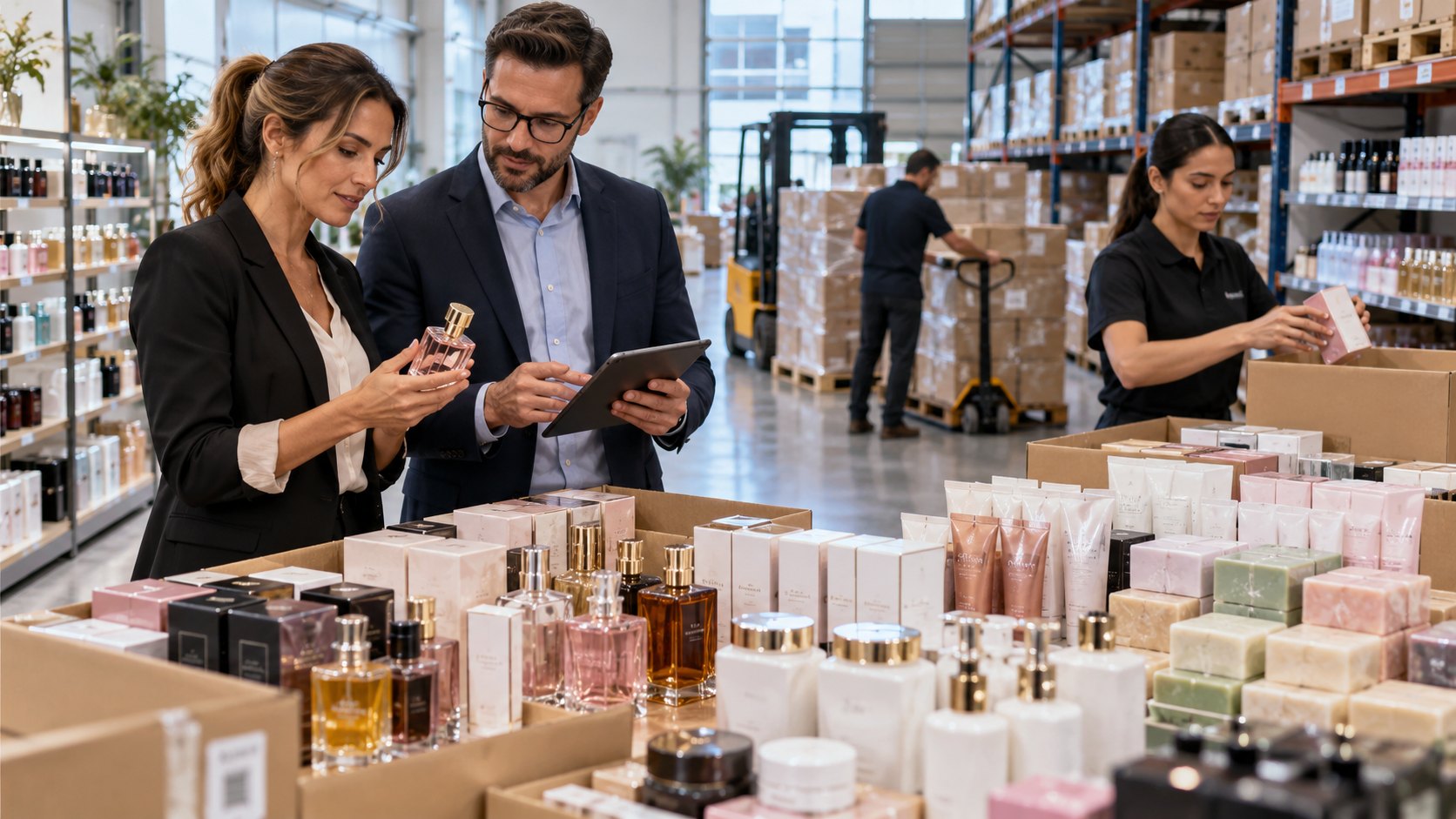
Activity CZ 158
How to Start a Perfumery and Cosmetics Wholesale Business in Dubai
Fragrance is a staple in this market, not a luxury. Perfumery and cosmetics wholesale is controlled on composition, claims and labelling — and heat is the quiet enemy of the stock.
ConsultZone licensing desk
- Activity code
- CZ 158
- Category
- Trading
- Reviewed
- Read
- 8 min
Listen instead
43 seconds
An audio summary of this guide.
Topic summary
How to Start a Perfumery and Cosmetics Wholesale Business in Dubai
Fragrance behaves differently here than almost anywhere else in the world. Oud, attar, mukhallat and bakhoor are daily household consumption in the Gulf rather than an occasional indulgence, worn and burned as a matter of routine and given as a matter of courtesy. On the same street, an international house sells an eau de parfum to a customer who owns twelve others. A wholesaler supplying this category is not selling into a luxury niche with a thin ceiling; the category is a staple with repeat purchase built into the habit, and that is the commercial fact the whole business rests on.
It also means the competition is unusually good. Traditional perfumery here is generations deep, the buyers are knowledgeable, and a retailer can tell a well-composed mukhallat from a cheap one across a counter. Anyone entering as a distributor is entering a sophisticated market rather than an underserved one, and the operators who do well tend to win on range, availability and condition of stock rather than on being first with something.
What the activity covers
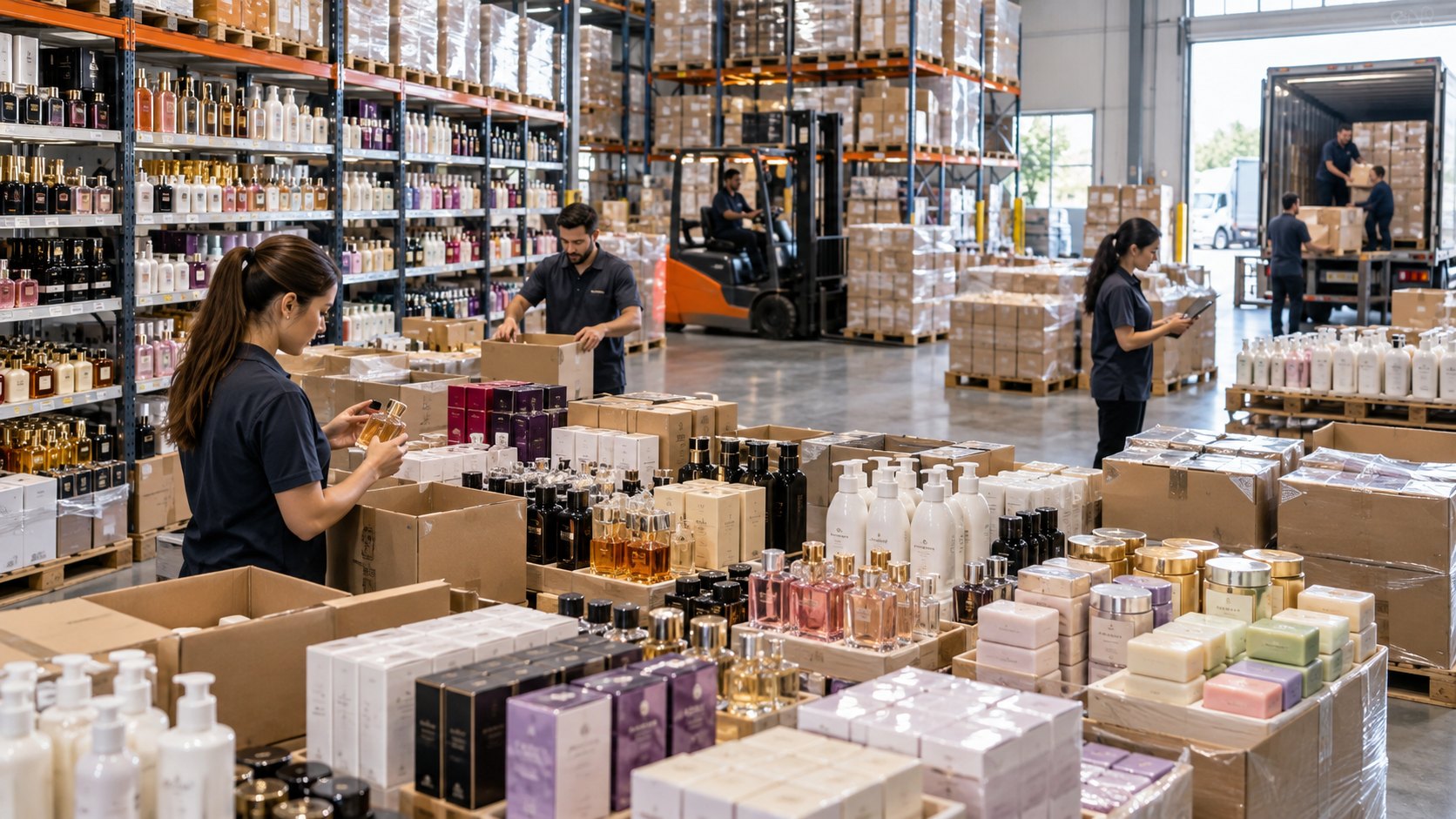
The line is the wholesale trade in fragrance, cosmetics, beauty preparations and soap. In practice that is five groups of goods that behave quite differently in a warehouse.
Fine fragrance — eau de parfum, eau de toilette, cologne — and the traditional Arabian side of it: oud oil, attar, mukhallat, bakhoor, incense and the burners and accessories sold alongside them. Colour cosmetics: foundation, lip, eye and nail products, with short trend cycles and a shade-matching problem that makes returns a permanent feature. Skincare and haircare, from mass-market to clinic-adjacent ranges, where the claim on the pack matters more than in any other group. Bath and body: bar and liquid soap, handwash, shower products, deodorants and body sprays, which move in volume at low margin. And the professional end: salon, spa and barber products in sizes no consumer buys, plus hotel amenity lines.
What sits just outside the line
Making the product is not trading it — a soap kettle, a filling line or a blending room is manufacturing, with its own licence wording and its own conditions. Applying the product to a customer is a service, not a trade, and a salon or spa needs its own activity. Household detergents, disinfectants and cleaning chemicals belong to an entirely different family of goods despite looking adjacent on a shelf. And medicated or prescription-strength preparations cross out of cosmetics altogether into pharmaceutical and medical goods at CZ 157, which is the boundary this page returns to below because it is the one that costs people money.
The buyers, and the route to them
Five buyers take this category, and each one buys on a different basis. Perfume houses and brand owners need distribution and will hand it to whoever can reach the shelves they care about. The traditional oud and attar retailers buy on composition and on the depth of a supplier's range, and they are the most demanding judges of quality in the market. Pharmacies and supermarket chains buy retail packs against a planogram, which means listing conversations, agreed promotions, and slow lines coming back at you. Salons, spas, clinics and hotel groups buy professional sizes on contract, so the offtake is forecastable and the credit terms are the negotiation. And online sellers and re-exporters buy for onward movement into the wider Gulf, East Africa and the CIS, where Dubai's role as a redistribution point for this category is long established and genuinely valuable.
The route to those buyers is where the business model is actually chosen, and there are six recognisable ways in. They are not mutually exclusive and most established houses run two or three, but each one buys a specific advantage with a specific cost.
six routes, weighed against the same two questions
What it givesWhat it costs
- Carrying an international brand under an agencyDemand that exists before the doors openA territory, a target and a price list somebody else sets
- Building your own oud and attar houseA maker's margin, and a product nobody can undercut like for likeEvery composition, claim and label becomes your responsibility
- Private-label runs for salons, spas and hotelsContracted repeat volume instead of a guessA minimum production run you own whether it sells or not
- Distributing retail packs to pharmacies and supermarketsVolume, and shelf visibility that pulls the next line throughSlow lines come back, and the shelf is rented rather than owned
- Supplying salons and clinics on accountMonthly offtake you can forecastCredit you extend, and the collection that follows it
- Holding depth through a Gulf summerFilling a large order the same day it landsHeat and light degrade whatever sits too long in the wrong store
The marked row is where the real businesses in this market have ended up. An agency gives a young distributor a trading income and teaches it the shelves; an own-brand oud house is what turns that into an asset, because the formulation, the name and the customer relationship all belong to it. The cost written beside it is not a formality — once the product is yours, every question about what is in it and what the pack says it does comes to you.
Conditions that attach to the goods, and the line against medicines
Cosmetics are product-controlled. That is the single sentence to hold on to, and it puts this line in a middle position: considerably more supervised than a household-goods trade, and very much less than the medicines file next door.
The control operates in three places. Composition — what may be present in a product applied to skin, hair or nails, and in what form. Claims — what the pack and the marketing are permitted to say the product does. Labelling — what information must appear on the pack, including ingredient information, and in which language, which is a compliance matter rather than a design decision. Which authority applies that control, and what it asks for, varies by emirate and by product class, so it is confirmed for the specific range rather than generalised from another trader's experience.
The boundary with CZ 157 is a sentence on a label
This is the most useful thing on the page. A cosmetic acts on the surface and makes an appearance claim. The moment a product claims to treat a condition, cure something, or change how the body works, it stops being a cosmetic and becomes a health product — which drops it onto the pharmaceutical and medical goods file at CZ 157, with everything that implies about the product being permitted before it can be sold. The line is not drawn by chemistry; it is drawn by what you say. A copywriter who upgrades "reduces the appearance of blemishes" to "clears acne" has moved a product across a regulatory boundary without touching the formulation. Ranges that straddle the two — cosmeceuticals, clinic skincare, anything sold on an active ingredient — need each product placed on one side or the other before the first order is raised.
Alcohol makes a perfume store a fire question
A bottle of fine fragrance is mostly ethanol. In retail quantities that is unremarkable; in a wholesale store it is a volume of flammable liquid sitting on racking, and it changes what the premises have to be. Fire-safety conditions on the store, how it is racked, separated and ventilated, and what quantity may be held are settled by the civil defence authority for the emirate, and they are conditions on the unit rather than on the licence. Taking a warehouse first and asking afterwards is the expensive order to do this in.
Heat is the loss nobody invoices for
The climate is a genuine operating constraint in this category, not a caveat. Heat and ultraviolet light degrade fragrance — the top notes go first, so a bottle can smell wrong while looking perfect. Emulsions separate. Lipstick blooms and sweats. Pressed powder cracks. None of it is visible through a sealed carton, and all of it is discovered by the customer. A conditioned store is a cost of doing business here, and so is thinking about the delivery vehicle standing in the sun on a long round, which does the same damage faster.
The last discipline is dating. Buyers in this category ask how much shelf life remains, and a short-dated pallet is worth materially less than a long-dated one, so batch coding and stock rotation are part of the margin rather than part of the paperwork. What approvals attach to the goods and to the premises, and what the licence costs to hold, depends on the emirate, the site and the product mix — ConsultZone confirms those with the relevant authorities for the specific case.
References
- Ministry of Health and Prevention — health products, and the boundary between a cosmetic and a medicinal product. Ministry of Health and Prevention
- Dubai Municipality — public health and premises suitability in Dubai. Dubai Municipality
- Dubai Civil Defence — fire safety and the storage of flammable goods, including alcohol-based fragrance held in quantity. Dubai Civil Defence
- Dubai Customs — import and export, customs codes, and goods subject to restriction on entry. Dubai Customs
- UAE Government portal — federal law and general government information on consumer goods and trade. UAE Government portal
Elsewhere in Trading
Activities that sit beside this one
Most licences carry more than one activity. Adding a neighbouring line at the application stage costs a fraction of amending the licence afterwards.
Begin with a clear conversation
Tell us what you intend to build.
A consultant will map the structure, jurisdiction, approvals and likely cost against what you actually described — not against a package.
