

Activity CZ 195
How to Start a Measuring Instruments Wholesale Business in Dubai
Measuring instruments that are not calibrated are not measurements, so this line sells an ongoing relationship rather than a product. Where an instrument sets what a customer pays, control tightens.
ConsultZone licensing desk
- Activity code
- CZ 195
- Category
- Trading
- Reviewed
- Read
- 7 min
Listen instead
1 min 2 sec
An audio summary of this guide.
Topic summary
How to Start a Measuring Instruments Wholesale Business in Dubai
A caliper that reads 20.00 millimetres is not telling you the part is twenty millimetres. It is telling you what it reads. Whether that is a measurement depends on something outside the instrument entirely: whether it has been compared against a better standard recently enough, by somebody competent, with the result written down and traceable upward to a national or international reference. Strip that away and the number is an opinion with a decimal point on it.
That single idea is the whole commercial logic of this activity, and it is what separates it from every other trading line in the catalogue. A trader in fabrics or cutlery delivers goods and the transaction is finished. Here the goods begin a clock. Every instrument sold has a calibration interval, and when that interval expires the customer either comes back or goes elsewhere. The supplier is not selling a device; he is selling a position in a cycle that repeats for as long as the instrument is in service.
What counts as an instrument in this line
The wording is broad and the market inside it splits into families that barely meet.
Dimensional and mechanical metrology is the workshop end: calipers, micrometers, bore gauges, height gauges, gauge blocks and reference standards, dial indicators, surface roughness and hardness testers, and coordinate measuring machines. The buyer is a machine shop or a quality department.
Electrical and electronic test equipment covers multimeters, clamp meters, insulation and earth testers, oscilloscopes, power quality analysers, signal sources and the calibrators that check them. Contractors, panel builders, utilities and maintenance teams buy here.
Process instrumentation is the industrial plant end: pressure gauges and transmitters, temperature sensors and thermometers, flow meters, level instruments, analytical sensors and fixed or portable gas detection. These are often specified by an engineering consultant rather than chosen by the user.
Weighing equipment runs from laboratory balances through bench and platform scales to weighbridges, and it is the family most closely tied to the next section of this page.
Survey, geomatics and construction testing covers total stations, optical and laser levels, laser distance meters, satellite positioning receivers, and the concrete, soil and compaction testing equipment that a site laboratory runs on.
Laboratory and environmental instruments include balances, pH and conductivity meters, sound level meters, light meters, air quality monitors and data loggers.
Those families share a licence wording and almost nothing else. A supplier who is strong in survey equipment has no credibility in process instrumentation, and the engineering consultant who specifies a flow meter has never heard of the brands that dominate a machine shop. Deciding which two or three families the business will actually be known for is the first commercial decision, and it matters more here than in a trade where one catalogue serves everybody.
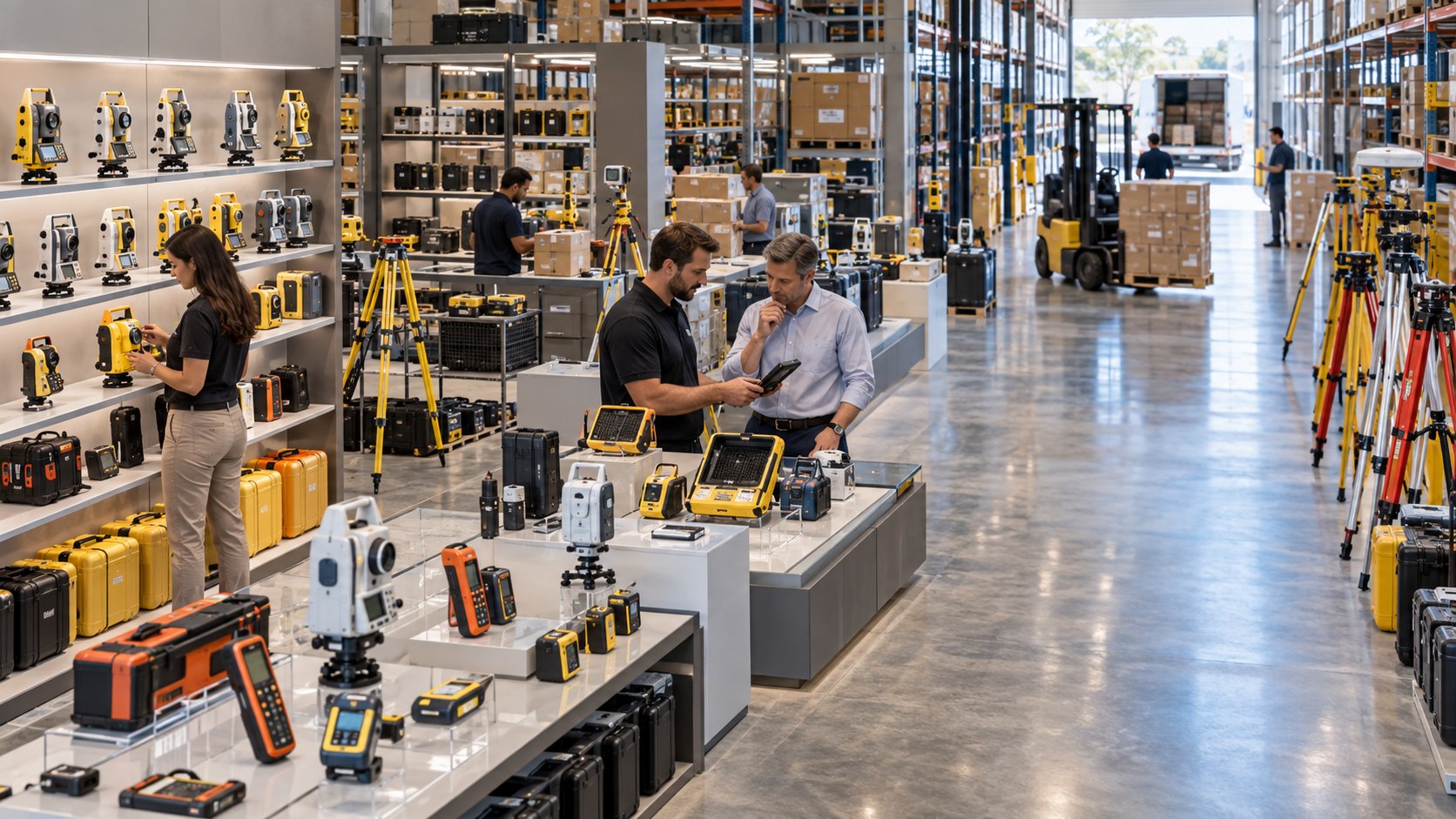
Four buyers who want different things from the same instrument
Laboratories and testing houses are the most demanding customers and the best ones. They buy against their own accreditation, which means the calibration certificate and its traceability are not an extra — they are part of what is being purchased, because the laboratory has to show them to its own assessor.
Industry and maintenance departments buy for production and for uptime. They want the instrument that their plant's procedures already name, delivered quickly, and they want it serviced without the asset leaving the site for a month.
Construction, survey and site laboratories buy ruggedness and project-length availability. An instrument on a site gets dropped, and a project that stops because a level went in for calibration is an expensive day.
Trade users are the fourth group, and they are different in kind rather than in degree, because their instrument decides what somebody pays.
judged on the same six rows
| Judged on | Catalogue supply | Supply plus own calibration | Appointed agency |
|---|---|---|---|
| Capital needed before the first sale | Light | Heavy | Moderate |
| Where recurring income comes from | Repeat orders, if they come | The calibration interval | Spares, service and consumables |
| Who the buyer trusts on a disputed reading | Nobody in particular | You | The maker, through you |
| What happens when the interval expires | The customer finds somebody else | The customer comes back | You manage it for them |
| Defensibility against a cheaper quote | None, it is a price list | Real, the service is the moat | Real, the appointment is the moat |
| How quickly it can be started | Immediately | Premises and standards first | After an appointment is won |
The middle route is picked because it is the only one of the three that owns its customers. Catalogue supply is a price list, and a price list is matched by the next trader with an internet connection. An agency is a genuine moat but it is somebody else's to grant and somebody else's to withdraw. Building a calibration capability is slow and capital-hungry — it needs premises with controlled conditions, reference standards that are themselves traceable, and competent people — and once it exists, every instrument sold books an appointment to come back.
Many businesses in this line start on the first route and move toward the second as cash allows, using the service relationship to decide which families to deepen. That order works. The reverse, building a laboratory before there is a customer base to feed it, is how the capital gets stranded.
Calibration is the condition that never finishes
Two conditions attach to these goods, and both follow the instrument rather than the licence.
The first is traceability, and it is contractual rather than regulatory for most customers. A plant working under a quality management standard, a laboratory under accreditation, an oilfield supplier under client audit — each has to show that the instruments behind its results were calibrated against traceable references at stated intervals. For those buyers the certificate is the deliverable and the instrument is merely the thing the certificate is about. A supplier who cannot produce certificates in a form the customer's auditor accepts is not in the running, however good the price.
The second is legal metrology, and it is where the control genuinely tightens. An instrument used inside a workshop affects only the workshop. An instrument that determines what a customer pays — a weighbridge, a shop scale, a fuel dispenser, a taxi meter, a utility meter — affects the public, and that class of equipment is treated differently everywhere in the world for the obvious reason. The national standards and metrology function sits with the federal ministry responsible for industry and advanced technology, and the municipality has an interest wherever the instrument sits in a trading premises. What applies to a particular instrument, in a particular emirate, in a particular use, is not something to read off a page: it depends on the instrument and on what it is used to decide, and it is confirmed with the competent authority before a supply contract is signed.
Three smaller conditions are worth knowing before the first order is placed. Gas detection and safety instruments consume calibration gas and want routine bump testing, so they bring a consumables stream and a duty of care with them. Instruments containing a radio — satellite positioning receivers, wireless sensors, telemetry data loggers — are radio equipment before they are instruments, and the federal type-approval gate for telecommunications and radio equipment attaches to the device model rather than to the company holding the licence. And everything in the catalogue crosses a border, which means a correct customs classification and a clearance on every consignment.
Where this is the wrong purchase: if the plan is to run a calibration or testing laboratory as a service to others, that is a service activity rather than a wholesale one, and it should be on the licence as such from the start. If the plan is to sell to the public from a shop, the retail wording is the one to ask for. What the licence costs to hold, which emirate suits the plan and what any specific instrument needs on entry all depend on the product list and the licensing authority, and those are settled case by case against the real catalogue.
References
- Ministry of Industry and Advanced Technology — national standards, metrology, conformity assessment and conformity marks. Ministry of Industry and Advanced Technology
- Telecommunications and Digital Government Regulatory Authority — type approval for instruments containing telecommunications or radio equipment. Telecommunications and Digital Government Regulatory Authority
- Dubai Municipality — public health and trading premises conditions, including instruments used in trade in Dubai. Dubai Municipality
- Dubai Customs — customs classification and clearance of instruments and reference standards. Dubai Customs
- UAE Government portal — federal law, consumer protection and general government information. UAE Government portal
Elsewhere in Trading
Activities that sit beside this one
Most licences carry more than one activity. Adding a neighbouring line at the application stage costs a fraction of amending the licence afterwards.
Begin with a clear conversation
Tell us what you intend to build.
A consultant will map the structure, jurisdiction, approvals and likely cost against what you actually described — not against a package.
