

Activity CZ 176
How to Start a Semiconductor Devices Trading Business in Dubai
Discrete semiconductor devices are an availability trade rather than a selling one. Who it suits, what the activity covers, and what the licence does not stretch to.
ConsultZone licensing desk
- Activity code
- CZ 176
- Category
- Trading
- Reviewed
- Read
- 7 min
Listen instead
52 seconds
An audio summary of this guide.
Topic summary
How to Start a Semiconductor Devices Trading Business in Dubai
A discrete semiconductor costs very little and stops a production line when it is missing. That asymmetry is the whole business. Nobody chooses a diode supplier on price once a board is designed around a part number; they choose whoever has it, in the quantity needed, with paperwork that proves it is what the label says.
So this is not really a selling business. It is an availability business: buying ahead of demand, holding breadth rather than depth, and being reachable when a production planner discovers a shortfall. The UAE suits it because the region's manufacturers and assemblers are close, the ports and airport are fast, and stock can sit here instead of in a factory's working capital.
Who is this for?
Component distributors and brokers
Companies whose competence is sourcing: knowing which franchised distributor has allocation, which independent has surplus, and which offer is too good to be true. The UAE gives them a location between Asian production and regional demand, and the trade runs on a reputation built one honest transaction at a time.
Manufacturers and contract assemblers buying for themselves
Electronics manufacturers who buy enough to want the margin and, more importantly, the control. For them this activity is added to an industrial licence, and the purpose is supply security rather than resale profit.
Repair and service businesses
Firms maintaining industrial electronics, power equipment or appliances, for whom discrete parts are a consumable. Holding the trading line lets them stock properly and sell parts to others.
Engineers and buyers going out on their own
The most common founder: someone who spent years inside a purchasing or applications function and knows both the parts and the people. The plan usually works. What breaks it is buying the wrong stock, because a line that does not move is dead money rather than slow money.
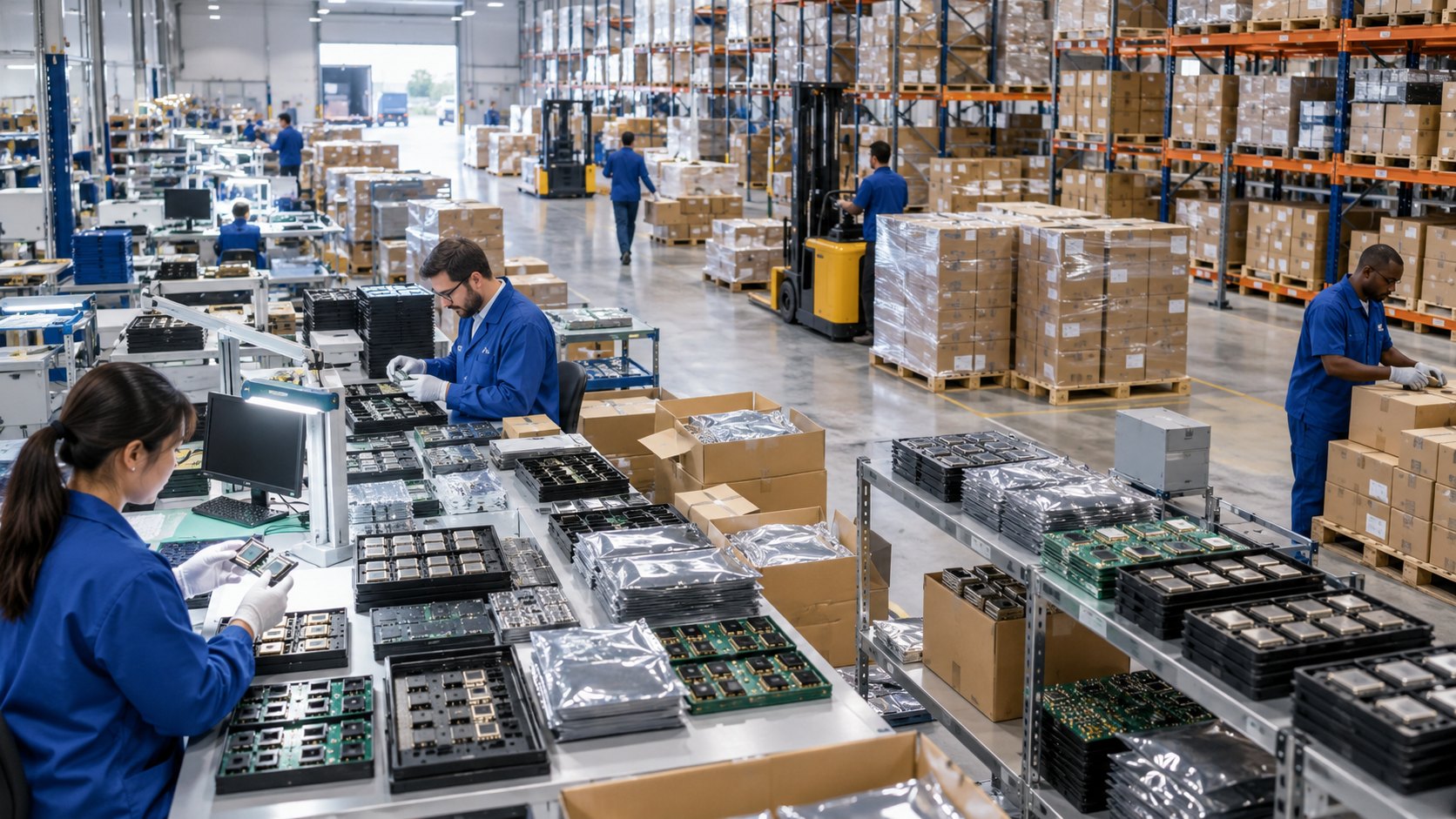
CZ 176 — Semiconductor devices
Under this line you trade discrete semiconductor devices — single-function parts rather than the integrated circuits that another activity covers. In practice that is four families.
Diodes and rectifiers
Signal diodes, rectifier diodes, bridges, Schottky and Zener parts. The highest-volume, lowest-value end: sold by the thousand, specified by voltage, current and package.
Transistors
Bipolar and field-effect devices for switching and amplification. The category where a substitution looks harmless and is not, because gain, capacitance and thermal behaviour differ between parts that share a pinout.
Power semiconductors
Power MOSFETs, insulated-gate bipolar transistors, thyristors and modules. The commercially interesting end: high unit values, long lead times, and customers in motor drives, power conversion, renewables and electric vehicle charging whose whole product depends on the part.
Optoelectronic and sensing devices
Light-emitting diodes, photodiodes, optocouplers and discrete sensors. Sold increasingly into lighting and instrumentation rather than into general electronics.
| Diodes and small transistors | Power semiconductors | Optoelectronic devices | |
|---|---|---|---|
| Who orders them | Purchasing, against a bill of materials | Engineering, against a design | Both, depending on the product |
| What decides the order | Availability and price per thousand | Specification and thermal data | Optical performance and binning |
| Lead time exposure | Short, and widely stocked | Long, and allocation-prone | Moderate, with batch variation |
| What a wrong substitution costs | A reworked board | A failed product in the field | A visible mismatch in the finished item |
| Where the margin sits | Volume and breadth of stock | Scarcity and technical support | Matching and consistency |
Read the marked row. It is the reason this trade is about trust rather than price: the cost of being wrong lands on the customer's product, not on your invoice.
What the licence does not cover
It does not cover integrated circuits. Microchips and integrated circuits are their own activity in this catalogue, and the distinction is real rather than clerical: the counterfeiting problem, the export-control exposure and the allocation dynamics around advanced chips are materially different from those around a rectifier diode.
It does not cover printed circuits or assemblies. Bare boards are their own line. A populated assembly — a board with components fitted — is a different product again, and selling it is not the same as selling the parts on it.
It does not cover manufacturing. Assembling, testing or packaging devices is industrial activity with its own licence, premises and approvals.
It does not cover finished equipment. The moment a device is inside something a customer switches on, you are selling the equipment, and that equipment carries conformity requirements the component never did — and type approval too if it transmits.
And it does not relieve you of knowing what you bought. A component trade's one unforgivable failure is passing on a part that is not what its marking claims. Traceability to a source you can name is the protection, and it is an operating discipline rather than a licensing condition.
What it costs to hold
The licence fee depends on the emirate, the jurisdiction and the activity mix in the ordinary way. What determines the cost of this business is stock breadth and the working capital behind it, and whether a free zone's bonded holding suits the customer base better than a mainland licence does. We confirm the position for the specific case.
One part number is not one product
This page opened by calling it an availability business and said breadth matters more than depth. That is easy to assert and expensive to get wrong, because a part number in this trade is not something you either have or do not have. It is a family of orderable items, and the differences between them decide whether stock is useful or merely present.
The same device ships in several packages. A transistor carrying one part number exists as a through-hole part for a hand-built or high-current board and as one or more surface-mount versions for a machine-placed one. The electrical specification is identical; the footprint is not. A customer running a placement line cannot use the through-hole part at any price, and a repair shop replacing a device on a twenty-year-old board cannot use the surface-mount one. "I have that part" is frequently not an answer to the question that was asked.
Each package then ships in several carriers. Tape and reel, cut tape, tubes, ammo packs, loose bulk. An assembler's feeder wants a sealed reel and will refuse loose parts because the machine refuses them. A development customer wants twenty pieces and nowhere to put a reel of several thousand. Same device, same package, two transactions that cannot be served out of one holding.
Minimum packaging quantity is where the money dies. The trap is not the line that never sells. It is the full reel bought to fill an order for forty pieces: the remainder is loose stock worth less than the share of the reel it represents, and you have quietly taken on the counting, bagging and handling that made bulk cheap in the first place.
So the buying decision is about the shape of the customer base rather than the breadth of the catalogue. A business serving repair and maintenance needs singles and tens across thousands of part numbers, and its real overhead is handling cost per line. A business serving assemblers needs reels across a far shorter list, and its real overhead is working capital. Those are two different companies, and attempting both out of one stockholding is the most reliable way to immobilise money in a trade where the individual items are worth almost nothing.
What makes a holding durable is what it refuses to carry. Breadth earns its keep where the alternative is waiting weeks — in practice the cross-referenced second sources nobody else bothered with, and the packages the mainstream distributors dropped years ago. It earns nothing against a franchised distributor shipping the same day for less than you paid. The operators who last decide in advance which reels they will break, what breaking one costs and who pays for it, and they charge for breadth rather than offering it as a courtesy.
References
- Dubai Customs — classification, duty treatment and clearance of electronic components, including restricted and controlled items. Dubai Customs
- Ministry of Industry and Advanced Technology — national standards and conformity requirements for electrical and electronic goods. Ministry of Industry and Advanced Technology
- Federal Tax Authority — the differing treatment of domestic supply and export of goods. Federal Tax Authority
- UAE Government portal — the general framework for commercial licensing in the UAE. UAE Government portal
Elsewhere in Trading
Activities that sit beside this one
Most licences carry more than one activity. Adding a neighbouring line at the application stage costs a fraction of amending the licence afterwards.
Begin with a clear conversation
Tell us what you intend to build.
A consultant will map the structure, jurisdiction, approvals and likely cost against what you actually described — not against a package.
