

Activity CZ 199
How to Start a Refined Oil Products Trading Business in Dubai
Refined oil products trading is a storage and credit business as much as a commodity one. Who it suits, what the licence permits, and the premises conditions that decide whether it works.
ConsultZone licensing desk
- Activity code
- CZ 199
- Category
- Trading
- Reviewed
- Read
- 7 min
Listen instead
56 seconds
An audio summary of this guide.
Topic summary
How to Start a Refined Oil Products Trading Business in Dubai
Two companies can hold this licence and never meet. One has an office, a screen, a credit line and no fuel: it buys cargoes and sells them on, and the product never touches anything it owns. The other has tanks, a jetty connection, trucks and an operations team, and its business is moving physical litres. Both are refined oil products traders. The first needs banking relationships and nerve; the second needs land, permits and a safety culture.
The UAE is one of the two or three best places in the world to do either. Fujairah sits on the open ocean outside the Strait of Hormuz and is a major bunkering and storage centre; Dubai and Abu Dhabi add refining, petrochemicals and a deep concentration of trading houses. Product, storage and counterparties are all here, which is rare.
Who is this for?
Trading houses and desks
Companies whose competence is price, freight and credit rather than pumps. For them the UAE offers counterparties, storage that can be leased rather than built, and time zones that overlap both Asia and Europe. The licence is straightforward; the bank account and the credit lines are the real work.
Physical suppliers and distributors
Companies selling diesel to contractors, generators, marine users and fleets. This is a logistics business with a fuel product: trucks, tanks, metering and collections. It lives or dies on delivery reliability and on getting paid.
Bunker suppliers
A distinct trade serving ships rather than land customers, where the transaction happens alongside or at anchorage and the quality of what is delivered is contested more often than in any other fuel market. Worth entering only with the operational discipline to document everything.
Lubricants and specialities businesses
Base oils, blended lubricants, greases and additives. Technically the least like the others: smaller volumes, branded product, conformity and labelling requirements, and a route to market through workshops and retailers rather than through terminals.
Industrial buyers integrating backwards
A contractor, a shipping company or a manufacturer that buys enough fuel to want the margin. Usually the soundest version of the plan, because the demand already exists inside the group.
- Trade licence with the refined products activityLets the company contract and invoice
- Storage — owned, or capacity leased in a terminalDecides how much product can be held, and therefore the size of the business
- Hazardous handling and firefighting provision for the siteThe gate that turns approved land into usable tankage
- Environmental permitting for the installationVapour, containment, interceptors and contaminated water
- Customs standing for import, storage and movementLets product cross the border and move under control
- Transport arrangements for road deliveryPuts a tanker legally on the road
- Tax position for domestic against export supplyDecides what the margin actually is
Read the sequence rather than the rows. The licence is step one and the cheapest; the two steps that actually determine whether the business exists are storage and the hazard approval on that storage, and both belong to somebody else. A paper trading operation skips the middle of this list entirely — which is precisely why most new entrants start there.
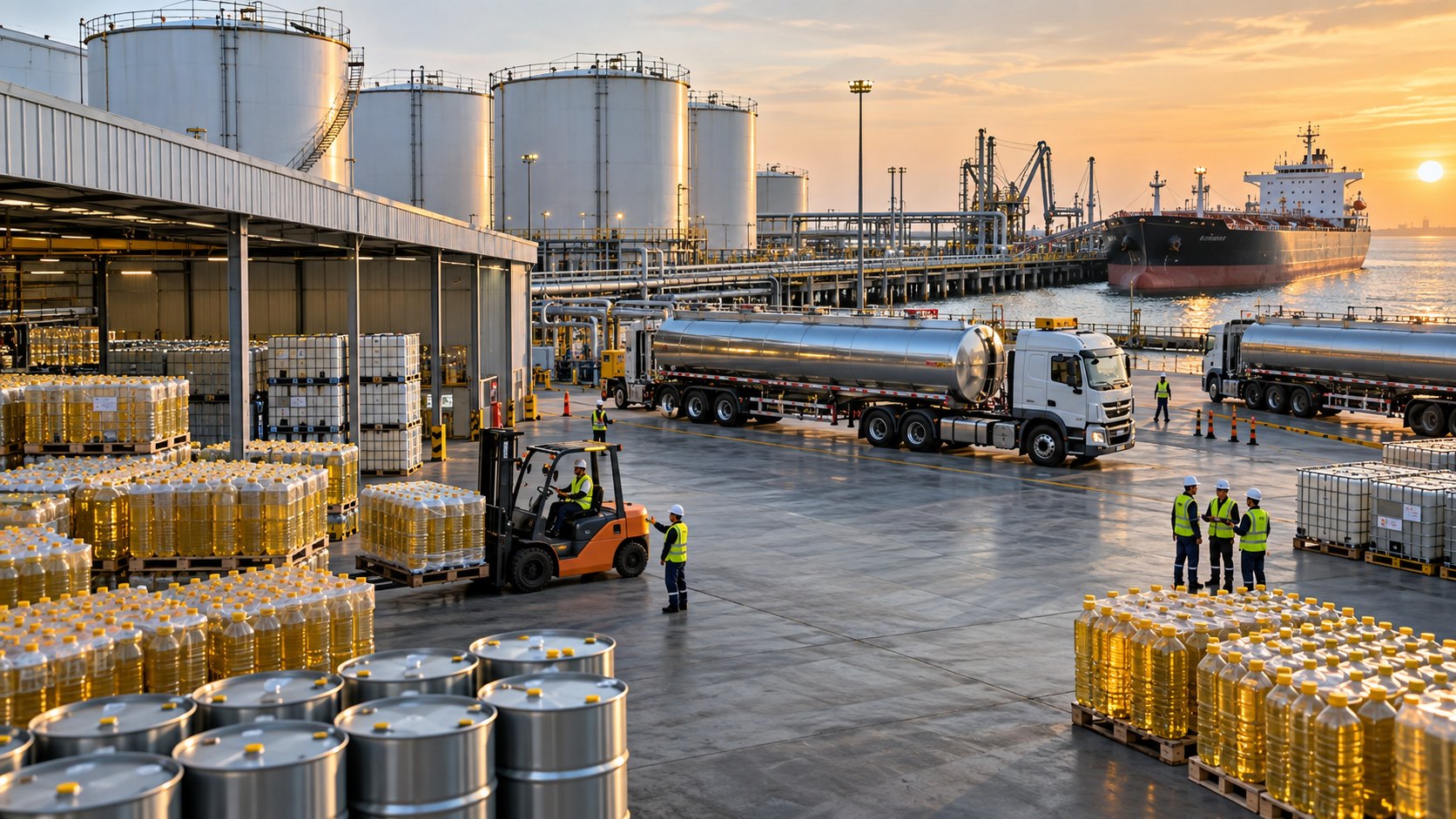
What you can and cannot do under this line
You can trade, store and supply refined products. Diesel and gasoil, gasoline, fuel oil, kerosene, bitumen, base oils and lubricants all sit inside the ordinary reading of this activity, subject to the conditions on the goods.
You cannot refine. Processing crude or intermediate streams into products is industrial manufacturing with its own licence, its own land and an entirely different approval regime.
You cannot retail motor fuel on the strength of it. A forecourt selling to the public is its own controlled activity, tied to the site and to the fuel retail framework, and it is not an extension of a wholesale licence.
You cannot treat fuel as ordinary cargo. Refined products are dangerous goods. Classification, packaging where applicable, documentation and the competence of the people handling them are prescribed, and customs, the port and the transport authority each apply that in their own domain.
You cannot assume the tax treatment. Product sold domestically, product exported and product supplied for international transport are treated differently. A company running more than one of those needs records that separate them from the first invoice, not from the first audit.
Premises and practical conditions
For a paper trader the premises question is trivial — an office. For anyone touching physical product it is the whole plan.
Tankage is either built or leased, and leasing is how sensible companies start. Independent terminals sell capacity, which converts an enormous capital project into a contract and lets a company find out whether it has customers before it buys steel.
The site is a major hazard installation, not a warehouse. Separation distances, bunding, foam and water provision, vapour control and an emergency plan are conditions imposed by civil defence and the environmental authority, and they attach to the land rather than to the company.
Metering and quality documentation are commercial instruments. Fuel is bought and sold on measured quantity and tested quality, and both are audited by counterparties who assume nothing.
Credit is the binding constraint more often than storage. A single cargo is a large number, payment terms are long, and a trader's capacity is set by what a bank will support rather than by what a tank will hold.
What it costs to hold
The licence fee depends on the emirate, the jurisdiction and the activity mix in the ordinary way, and it is not the number that matters here. What determines the cost of entering this line is whether the plan is paper or physical, and physical is decided by land, hazard approvals and credit rather than by the licensing authority. We confirm the licensing position and are straightforward about which parts sit elsewhere.
The cargo moves faster than its documents
For most of a physical transaction a trader is not holding fuel. It is holding paper that says who holds the fuel — and title, payment and possession move at three different speeds. Newcomers lose money assuming they move together.
A cargo can change hands several times before it discharges. The ship is at sea for days while the original shipping documents travel through a chain of banks at their own pace. Discharge is therefore routinely performed against an undertaking from the seller rather than the original documents, and whoever stands in the middle of that chain has accepted a promise in place of a document. That is ordinary practice here, and it is also the precise point at which an unexamined counterparty becomes an unsecured loss.
The waiting is on the trader's account. A chartered vessel earns money while it sits, and it sits because a berth is occupied, a tank is not ready, a clearance is outstanding or a document has not arrived — none of which the trader controls and all of which the trader pays for. How much waiting is allowed, and what happens once it is used up, are terms of the contract rather than details of it, and a margin priced on the product alone disappears into one slow discharge.
A bank checks the documents, not the cargo. Where a purchase is financed, the security is the cargo and the only thing that reaches the cargo is the document set. Payment turns on whether what is presented matches what was agreed, exactly: a name, a date or a missing copy is enough for a bank to decline while the goods sit perfectly sound on the water. Companies new to this prepare for the commercial negotiation and are caught out by the clerical one, which is the one that stops the money.
Four questions settle most of it before signature. When does title pass, what triggers payment, who carries the waiting, and what happens if the documents are late. A paper trader needs those answers at least as badly as a tank owner does, because paper is the only thing a paper trader owns.
References
- Dubai Civil Defence — hazardous and flammable storage, firefighting provision and emergency planning for fuel installations. Dubai Civil Defence
- Dubai Customs — import, storage and movement of petroleum products under customs control. Dubai Customs
- Environment Agency Abu Dhabi — environmental permitting for fuel storage and handling installations in Abu Dhabi. Environment Agency Abu Dhabi
- Federal Tax Authority — the differing treatment of domestic supply, export and supply for international transport. Federal Tax Authority
- Ministry of Industry and Advanced Technology — national standards and conformity requirements applying to lubricants and packaged products. Ministry of Industry and Advanced Technology
Elsewhere in Trading
Activities that sit beside this one
Most licences carry more than one activity. Adding a neighbouring line at the application stage costs a fraction of amending the licence afterwards.
Begin with a clear conversation
Tell us what you intend to build.
A consultant will map the structure, jurisdiction, approvals and likely cost against what you actually described — not against a package.
