

Activity CZ 154
How to Setup a Cutlery Wholesale Business in Dubai
A hotel that buys four thousand forks will want four hundred more in eighteen months, in the same pattern. Cutlery wholesale is won on pattern continuity and on the grade of the steel.
ConsultZone licensing desk
- Activity code
- CZ 154
- Category
- Trading
- Reviewed
- Read
- 7 min
Listen instead
43 seconds
An audio summary of this guide.
Topic summary
How to Setup a Cutlery Wholesale Business in Dubai
A hotel opening two hundred covers buys four thousand pieces at once. Eighteen months later it needs four hundred more, and they have to be the same fork — same pattern, same weight in the hand, same finish — because a table set with two patterns is a table the food and beverage manager will not let out. The supplier who can produce those four hundred keeps the account for a decade. The one who discontinued the range loses it in a single phone call.
That is the whole commercial architecture of this trade, and it is unusual. Most wholesalers compete on price and availability. A cutlery wholesaler competes on the promise that what he sold you will still exist when you need more of it, which is a stock commitment rather than a sales skill and is the reason this business rewards patience over turnover.
The money is in the reorder, not in the first order
Hospitality cutlery disappears continuously. It leaves with waste, it goes out in laundry, it is bent by dishwashers, it is taken by guests, and it is dulled and pitted by the chemicals a commercial kitchen washes with. Attrition is a permanent operating fact rather than an accident, which means a hotel that has chosen a pattern is a buyer for as long as it runs that pattern. The opening order is the advertisement; the replacement orders are the business.
That changes what the wholesaler should be good at. Holding depth in a small number of patterns beats holding breadth across many. Carrying a range that a factory will still be producing in five years beats carrying whatever was cheapest at the last trade fair. And being able to say honestly how long a pattern will be available is worth more to a purchasing manager than a discount, because he is the one who will have to explain a mismatched table.
The retail and gifting side of the trade behaves in the opposite way. Boxed sets sell into weddings, into corporate gifting and around the seasons, presentation and packaging carry as much of the decision as the steel does, and margin per set is better than anything the hospitality contract market will pay. But the demand is lumpy and fashion-sensitive, and a set that did not sell this season is not obviously easier to sell next one. Wholesalers who serve both sides are running a steady business and a seasonal one side by side.
The material itself is where an experienced buyer separates suppliers. Stainless cutlery is described by two numbers — chromium and nickel content — and the nickel is what resists corrosion and holds the lustre. The grades with nickel in them survive a commercial dishwasher for years; the cheapest grade is duller, magnetic and pits far sooner, which is fine for a canteen and visibly wrong on a restaurant table. Weight per piece, the join between blade and handle, and whether a knife handle is hollow or solid are the other things a professional buyer checks in the first thirty seconds. Silver plate exists at the top of the market and brings its own problem, because plating wears and a worn piece cannot be quietly mixed back in.
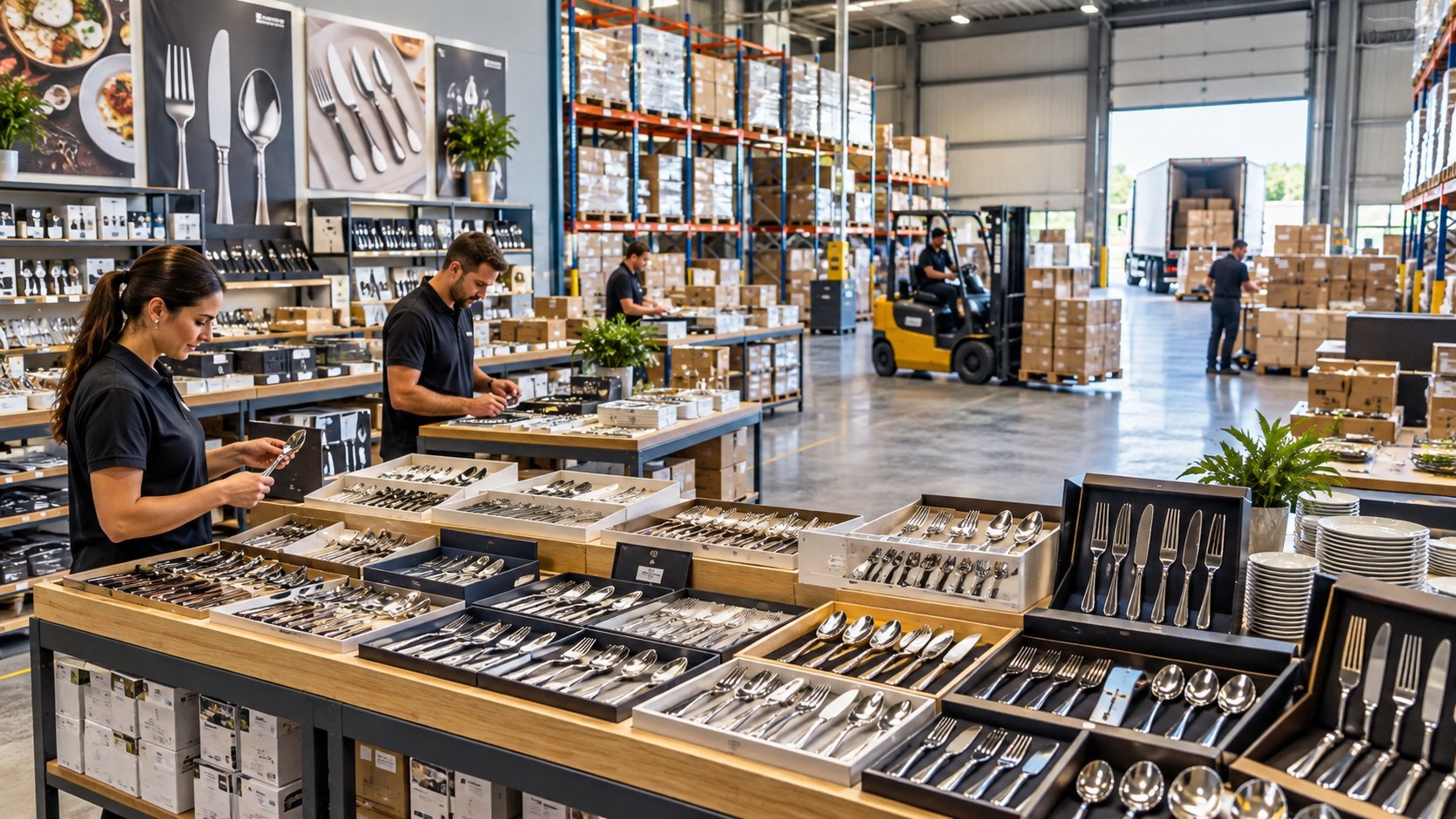
CZ 154 — Wholesale Of Cutlery
The line covers buying, importing, holding and selling eating and serving implements: knives, forks and spoons in all their table sizes, teaspoons and coffee spoons, serving pieces, carving sets, children's cutlery, and the canteens and cases they are presented in. Both stainless and plated, both open stock and boxed.
Three neighbours are close enough to be worth naming. Professional kitchen knives and cutting tools are a different trade with a different buyer — a chef choosing a knife is buying a tool, not a table setting. Hollowware, crockery, glassware and the rest of a hotel's operating equipment sit in their own lines, even though the same purchasing manager buys all of it on the same day. And the general kitchenware and household goods umbrella overlaps at the retail end, so a licence intended to carry a full houseware range needs wording wider than cutlery alone.
The buyers themselves sort the licensing question more cleanly than the goods do.
five kinds of buyer, two destinations
- Hotels, restaurants and catering companiesThe buyer is a UAE business and the goods land on UAE soil
- Retail chains and department storesConsumer supply chains expect a supplier inside the local market
- Corporate gifting buyers and hospitality fit-out contractorsBoth ends of the contract sit in the local market
Mainland licence
- Container volume moving on to other GCC and African marketsNothing clears into the UAE market, so the zone's limits do not bite
- Stock held in the UAE for an overseas manufacturerA warehouse arrangement, and the buyer is abroad
Free zone licence
The concentration in that drawing is the point. Almost every buyer worth building this business around is inside the UAE, which pushes the licence towards the mainland; the free zone answer is for the re-export and warehousing trade, where the UAE is the desk rather than the market. Fit-out contractors deserve their own mention, because hotel and restaurant openings are often procured through a fit-out or operating-equipment package rather than by the operator directly, and the wholesaler who is not on that contractor's list never sees the opening order at all.
One thing the line does not carry: making or plating. Stamping, polishing, grinding and electroplating are manufacturing, they need industrial premises and they generate effluent that has to be dealt with, so they answer to an industrial licence and to environmental control rather than to a trade licence.
What attaches to metal that goes into a mouth
Cutlery is a food-contact material, and that is the one genuine technical thread running through the whole activity. Material intended to touch food carries suitability requirements of its own — the question is whether the metal or the plating can transfer anything into food in use — and the evidence for it comes from the manufacturer, in the form of documentation about the material and its intended use. Food-contact goods also fall within municipal food-control interest at the point they reach a kitchen or a shelf, which is why this is a question worth settling with a factory before a container is ordered rather than after it arrives.
Alongside that sit the ordinary obligations on any consumer product sold here: conformity with national standards and the marking that evidences it, administered federally by the ministry responsible for industry and standards, and Arabic labelling on consumer packaging. Boxed retail sets meet those requirements more visibly than open stock does, because the packaging is where the labelling lives.
The knives are the one place to be careful at the border. Bladed goods are a category customs authorities look at, and whether a particular item is treated as restricted on entry depends on what it is rather than on what it is called in a catalogue. A table knife and a long-bladed carving or specialist knife are not the same question. The time to ask it is before the purchase order, because a consignment held at the border is a cost that compounds daily and the answer does not change once the goods have arrived.
What the licence costs to hold, which conformity route a specific product takes, what a warehouse in a given emirate has to satisfy, and how a particular bladed item is treated on entry all depend on the emirate, the premises and the product list. Those are confirmed case by case rather than quoted, because the answer moves between authorities and between product categories — and on this line it is the product list that decides it.
References
- Ministry of Industry and Advanced Technology — national standards, conformity assessment and the marking of consumer products. Ministry of Industry and Advanced Technology
- Dubai Municipality — food control and the suitability of food-contact goods and premises in Dubai. Dubai Municipality
- Dubai Customs — import and export, customs codes, and goods subject to restriction or prohibition on entry. Dubai Customs
- Abu Dhabi Agriculture and Food Safety Authority — food safety oversight within Abu Dhabi. Abu Dhabi Agriculture and Food Safety Authority
- UAE Government portal — federal law, consumer protection and general government information. UAE Government portal
Elsewhere in Trading
Activities that sit beside this one
Most licences carry more than one activity. Adding a neighbouring line at the application stage costs a fraction of amending the licence afterwards.
Begin with a clear conversation
Tell us what you intend to build.
A consultant will map the structure, jurisdiction, approvals and likely cost against what you actually described — not against a package.
