

Activity CZ 155
How to Start a China and Glassware Wholesale Business in Dubai
China and glassware wholesale is priced around breakage. Why a hotel that reorders one pattern for years buys nothing like a gift shop, and where the loss is actually decided.
ConsultZone licensing desk
- Activity code
- CZ 155
- Category
- Trading
- Reviewed
- Read
- 8 min
Listen instead
56 seconds
An audio summary of this guide.
Topic summary
How to Start a China and Glassware Wholesale Business in Dubai
A share of every container of plates and glasses that lands in this market arrives broken. Not through carelessness, and not as the exception — as a property of the goods. Fired clay and glass do not bend, so the knock a carton of towels would absorb becomes a hairline crack, and a hairline crack becomes a write-off the moment a buyer turns the piece over under a light. Operators who have been in this trade a while carry that loss as a line in the cost of goods. The ones who have not carry it as a surprise, and they are the ones who quote a price on the first order that they cannot honour on the second.
That one fact shapes everything downstream. It decides how much you are willing to pay a factory for packaging you will immediately throw away, how the pallet is built and how high it is stacked, whether a faster freight route is worth its premium, how the racking is laid out, how the warehouse crew are taught to lift, and how much margin has to be held back before a single piece is sold. A wholesaler of china and glass is running a handling operation with a sales desk attached to it.
What the activity actually covers
The line is the trade in tableware and decorative ware made of ceramic and glass, bought in quantity and sold on to businesses that either resell it or put it to work. Porcelain, bone china, stoneware and earthenware on one side: plates, bowls, cups and saucers, mugs, platters, serving dishes, teapots. Pressed, blown and toughened glass on the other: tumblers, stemware, jugs, carafes, bowls, ovenware, heat-resistant coffee glass, and the decorative crystal that sits closer to gifting than to catering.
What it does not carry is worth being precise about, because three neighbouring lines in this same catalogue are routinely confused with it. A glass lampshade is not glassware in this sense — it is part of a light fitting, and lighting equipment is CZ 153. A steel fork is cutlery, CZ 154, and so is a knife with a porcelain handle. Breakable household items that are not tableware fall under the wider household umbrella at CZ 149. And laboratory or pharmacy glassware belongs with scientific and medical supply rather than with anything used at table, because the buyer, the specification and the controls on it are all different.
Two phrases that sound decorative and are not
The first is food contact. Anything used to serve or eat from is a material that touches food, and materials that touch food are controlled for what they can transfer into it. That question lands hardest exactly where the design value is — on coloured glazes, decorated rims, metallic banding and hand-painted ware. A pattern that sells because of its finish is a pattern whose finish somebody will eventually ask about. Dubai Municipality is the food-control authority in the emirate, and conformity marking on consumer goods sits with the Ministry of Industry and Advanced Technology, so this is a question to settle before a container is ordered rather than after it is unpacked.
The second is thermal shock. Glass that is perfectly sound on a shelf fails when hot liquid hits it, and a hospitality buyer will put your tumbler under a coffee machine on the first morning. Ovenware, hot-drink glass and anything a caterer will run through a commercial dishwasher have to be specified for that duty. A buyer who breaks a case in week one does not conclude that he chose the wrong glass. He concludes that he chose the wrong supplier.
Who is this for?
Two buyers sit behind this line and they behave nothing alike. Most of the avoidable mistakes in this trade come from treating them as one market.
Retail and gifting
Gift shops, homeware retailers, department store buyers, online sellers and the wedding-list trade. Small lots, design-led, seasonal, and a good margin on each piece. The buying decision is made on how the thing looks, so the range has to keep moving and a pattern's commercial life may be a single season. The risk sits on the other side of that margin: slow lines that never clear, returns, and stock that was fashionable when it was ordered and is not by the time it lands.
Hospitality contract supply
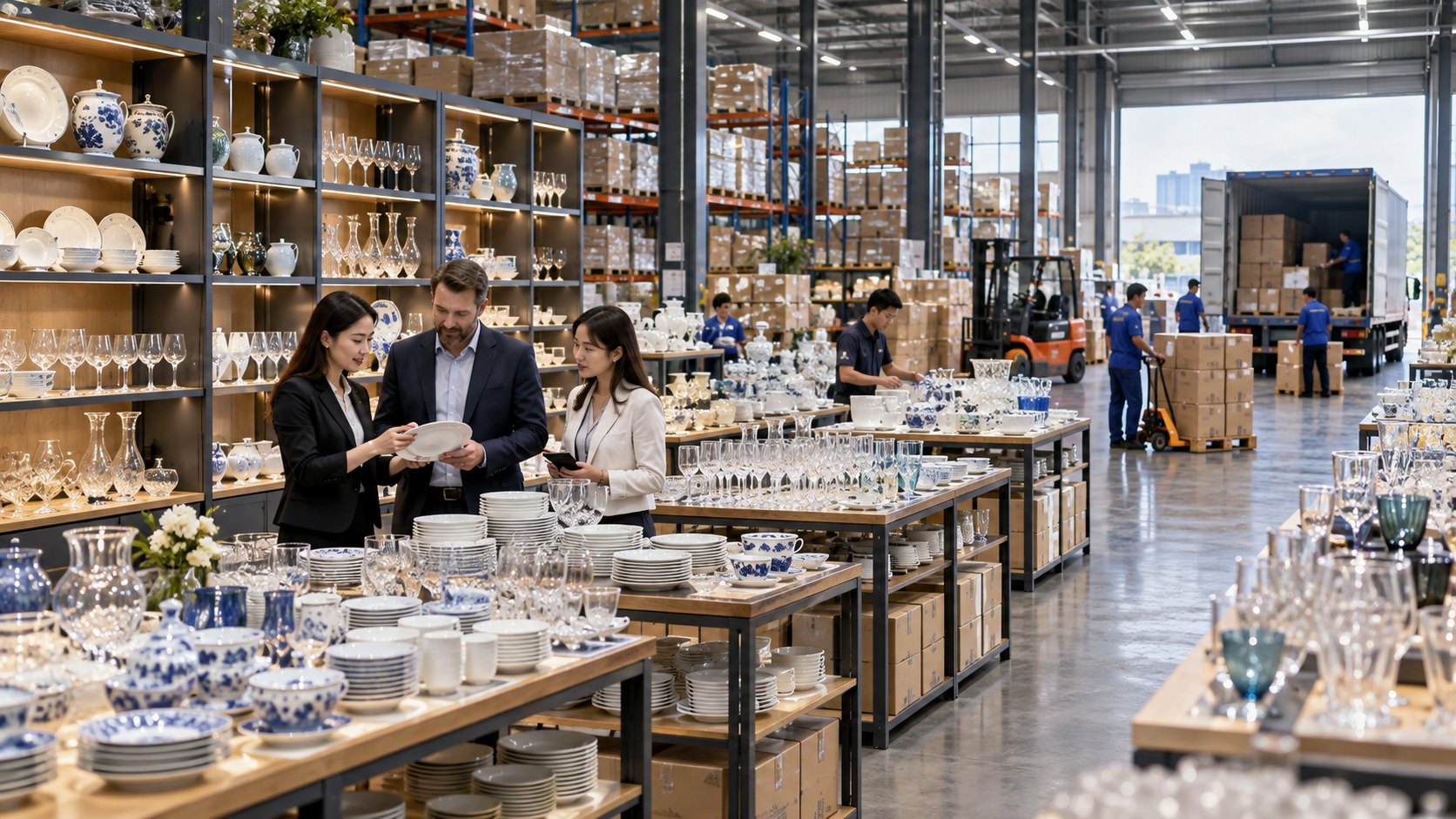
Hotels, restaurants, caterers, banqueting operations, airline and hospital catering. Volume is large, margin per piece is thin, and the decision is made on specification rather than on appearance. What actually wins this business is continuity: a hotel that has fitted out three hundred covers in one pattern needs to replace a broken plate in that same pattern three years from now, and the supplier who can do it keeps the account. That is a stockholding commitment more than it is a sale, and it is why a contract supplier's warehouse looks so much duller than a gifting importer's.
The importer sitting behind both
The third position supplies the other two: bringing containers in, holding the depth, and selling on in pallet and case lots to shops and caterers alike. It is the most capital-hungry version of the business and the one where breakage, obsolescence and warehouse cost all land on the same balance sheet.
Where this is the wrong purchase. If the plan is to make the pieces, a kiln or a glass furnace is an industrial activity and this trading line will not carry it. If the plan is a shop the public walks into to buy one mug, that is retail wording rather than wholesale wording, and the two are recorded differently on a licence.
A consignment's journey explains why so much of the value in this business is settled before anything is sold. Six stages separate a factory's packing line from a buyer's shelf, and only one of them belongs to a government body.
- Pattern, specification and pack detail agreed with the factoryFixes what will arrive, and how it is boxed
- Pieces interleaved, cartoned and palletised before the container is sealedDecides the breakage rate, and nothing downstream can undo it
- Sea freight, and the handling the container takes on the wayWhere drops, stacking and rough weather do their damage
- Customs entry against the declared goodsReleases the container for delivery
- Unpacking, counting and quantifying the lossTurns damage into a credit claim, or absorbs it in silence
- Repacking into retail lots or contract ordersPuts stock on a shelf or into a hotel's store
The marked row is the argument of the page. Everything after it is damage control and everything before it is negotiation. A supplier who will not discuss interleaving, carton strength and pallet height is a supplier whose price is lower than it looks, and the difference shows up in the count rather than on the invoice.
Where it sits between the mainland and a free zone
A mainland licence is the structure that matches selling into the UAE itself. Hospitality supply, retail accounts, banqueting contracts and tender work are all sales to UAE businesses on UAE soil, and buyers in this category expect a supplier who can invoice them directly, deliver locally and be visited. A showroom a chef or a purchasing manager can walk into with a sample case is worth more in this trade than in most, because plates get chosen by being handled.
A free zone licence matches the other half of the trade. Dubai's position as a consolidation and re-export point for the wider Gulf, East Africa and the subcontinent means a great deal of tableware passes through without ever entering the UAE market, and holding that stock without clearing it is exactly what a free zone structure is built for. Plenty of established operators end up holding both, for the plain reason that the two halves of this business need different things.
The premises question outranks the jurisdiction question here. What the trade needs is ground-level loading, racking rated for dense pallets, a floor that does not transmit shock, and a dedicated area where a container can be broken out and counted under decent light. A unit that fails on those points will cost more in breakage than any licence saves. Which approvals attach to the goods and to the site, and what the licence costs to hold, depends on the emirate, the premises and the activity mix — ConsultZone confirms those with the licensing authority for the specific case before a lease is committed.
References
- Dubai Municipality — food control in Dubai, including materials intended to come into contact with food, and premises suitability. Dubai Municipality
- Ministry of Industry and Advanced Technology — national standards and conformity marking applied to consumer goods. Ministry of Industry and Advanced Technology
- Dubai Customs — import and export, customs codes, and goods subject to restriction on entry. Dubai Customs
- UAE Government portal — federal law, general government information and licensing guidance. UAE Government portal
Elsewhere in Trading
Activities that sit beside this one
Most licences carry more than one activity. Adding a neighbouring line at the application stage costs a fraction of amending the licence afterwards.
Begin with a clear conversation
Tell us what you intend to build.
A consultant will map the structure, jurisdiction, approvals and likely cost against what you actually described — not against a package.
