

Activity CZ 153
How to Start a Lighting Equipment Wholesale Business in Dubai
Two trades share the word lighting. One is fashion sold from a showroom, the other is performance figures sold to contractors, and LED turned the second one into a components business.
ConsultZone licensing desk
- Activity code
- CZ 153
- Category
- Trading
- Reviewed
- Read
- 7 min
Listen instead
42 seconds
An audio summary of this guide.
Topic summary
How to Start a Lighting Equipment Wholesale Business in Dubai
Ask two lighting wholesalers what they sell and you get answers with almost nothing in common. One talks about finishes, glass, a new pendant range and which designer specified it for a villa in Jumeirah. The other talks about lumens per watt, colour rendering, ingress protection and how many units a contractor needs on site by the fourteenth. They hold the same activity line. They do not hold the same business.
The decorative half is fashion. The technical half is engineering procurement. A stock plan, a showroom, a sales team and a credit policy built for one of them will fail at the other, so the useful first decision on this line is which of the two is the actual plan — and, if the answer is both, to accept that they are run as two operations under one licence.
Two different trades share the word lighting
Interior designers, fit-out firms and the retail buyer
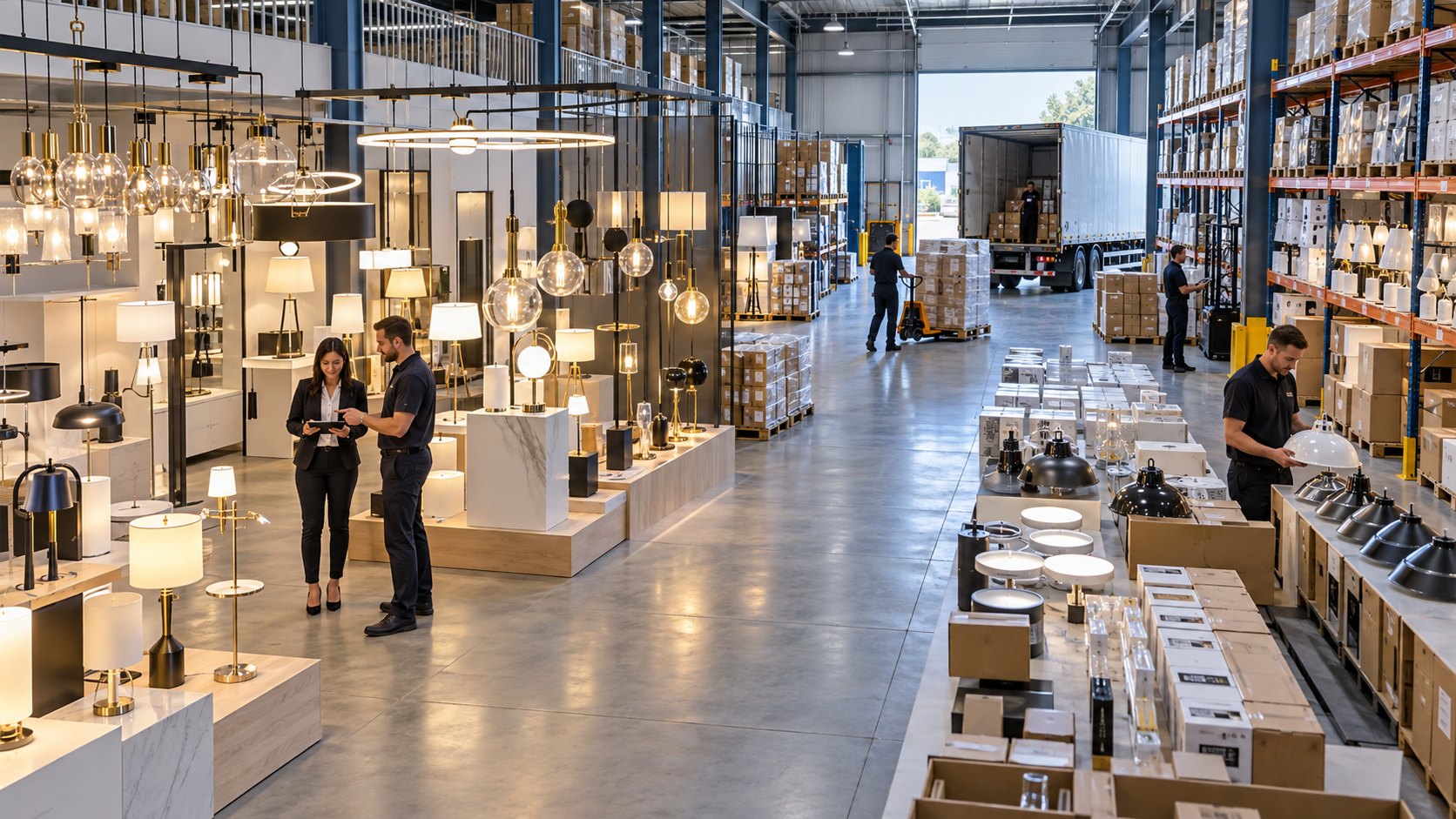
The decorative end: chandeliers, pendants, wall lights, table and floor lamps, exterior decorative fittings. The buyer is a designer specifying for a villa or a restaurant, a fit-out contractor working to that design, or a retailer selling to homeowners. The decision is visual and it is made in front of the lit fitting, which is why this half of the trade cannot really be run out of a warehouse. Margin per fitting is the best in the line. The cost of it is that ranges date — a pendant that was everywhere two seasons ago is a markdown, and nobody tells you the month it happens.
MEP consultants, who decide without ever buying
The technical end begins with a consultant who does not place orders. Consulting engineers write lighting into a building's design and name what it has to achieve: light levels, efficacy, colour temperature, colour rendering, glare control, protection ratings, emergency duration. A wholesaler whose products are named in that document has effectively won the job before anyone tenders it. One who is not named spends the project trying to get a substitution accepted.
Electrical contractors, who actually pay
The contractor buys against the consultant's schedule and against his own programme. Orders are large, they arrive in phases, and the money follows the main contract rather than your invoice terms. Contractors also buy off the counter continuously — a box of downlights, a driver, a replacement floodlight — and that trickle is steadier than the projects.
Facilities managers and the replacement cycle
Buildings already lit still need lighting. Facilities teams and maintenance contractors replace failed fittings, drivers and controls across portfolios, in small quantities, forever. It is the least exciting demand in the sector and the most reliable.
Municipal and infrastructure buyers
Street lighting, car parks, tunnels, sports and landscape lighting are bought by authorities and their contractors, specified tightly and tendered formally. Long, repeating and specified demand, with terms that a company in its first year will struggle to satisfy.
six ways in, weighed on the same two questions
What it givesWhat it costs
- Stocking decorative ranges for interiors and retailThe best margin per fitting, and a reason to hold a showroomRanges date, and last season becomes a markdown
- Supplying technical lighting to contractors on projectsVolume in a single order, and a place on the specificationPayment behind the main contract, and a claim if the figures are missed
- Holding a manufacturer's agencyProtected pricing, and a reason for a consultant to callVolume commitments, and stock carried on the brand's behalf
- Buying unbranded LED from open supplyThe lowest landed cost available anywhereYou own every failure, with nobody behind the warranty
- Carrying drivers, controls and dimmingThe part of a job nobody else wants to ownTechnical support you have to be able to give
- Supplying outdoor and infrastructure lightingLong, specified, repeating demandTender terms and a track record a new company lacks
What the line carries, and the four things it does not
The activity covers buying, importing, holding and selling lighting equipment: luminaires of every kind, lamps, drivers and control gear, dimmers, sensors and control systems, poles and brackets, track and profile, and the accessories that go with them.
LED changed what is actually being sold, and the change is worth stating plainly because it drives the commercial risk. In the older trade the light source was a consumable: the customer bought a fitting once and replaced the lamp himself for years, and your warranty exposure was small. In an integrated LED fitting the source is built in, so the whole luminaire is the product — and the component that fails first is usually the driver, not the diodes. That moved the warranty conversation from a cheap consumable to an entire fitting installed in a ceiling, and it is the reason a wholesaler who buys unbranded LED on price alone is taking on a liability he has not priced.
It does not let you install. Selling a luminaire is trading. Wiring it, fixing it into a ceiling or connecting it to a circuit is electrical installation work, which is a separate activity with separate licensing and separate qualified labour. Wholesalers who want to deliver a fitted result contract a licensed installer or add the activity; assuming the trade licence covers the fitting is a common and costly mistake.
It does not let you make or assemble. Putting an imported LED module, driver and housing together into a branded luminaire is manufacturing. That is an industrial activity, it needs industrial premises, and it answers to the ministry responsible for industry.
It does not let you repair. Maintaining and repairing electric lighting equipment is its own activity line. A wholesaler who takes failed fittings back from contractors, opens them and returns them working is running a repair operation, and that should be in the licence wording rather than discovered later.
It does not make you the specifier. Recommending a product is selling. Signing off a lighting design, a light-level calculation or an emergency-lighting layout as the responsible designer is engineering consultancy, and it is a professional activity with its own qualification requirements. Good technical wholesalers support the consultant; they do not replace him.
The premises question is really a showroom-or-racking question
Nothing exposes the split in this trade faster than looking for a unit.
A decorative business needs a showroom: floor area, height for a hanging chandelier, powered display so a customer sees the fitting lit, and a location a designer will actually visit. That is retail-grade space at retail-grade rent, and it is a marketing cost pretending to be a premises cost.
A technical business needs a warehouse: racking, long bays for linear luminaires and poles, which arrive in cartons that are awkward rather than heavy, and secure shelving for drivers and controls, which are small, valuable and easy to lose. It needs loading access for project deliveries and, more than most wholesale lines, it needs staging space — a project releases in phases, so material sits under your roof waiting for a floor to be ready, and that space is part of the working capital.
Two practical conditions sit on the goods rather than the building. Lamps and luminaires are energy-consuming products inside the national standards and conformity system, administered federally, and efficiency requirements on lighting are the reason the market moved decisively to LED in the first place; conformity documentation comes from the manufacturer and is far easier to obtain before a container is loaded than afterwards. And emergency and exit lighting is a life-safety product: what it has to satisfy is judged against the building by the civil defence authority, not against your stock list, so a contractor asking for emergency fittings is asking a question you should route rather than answer.
Which approvals attach to a given premises, what the licence costs to hold, and what a specific product needs before it can be imported all depend on the emirate, the site and the product mix. Those are confirmed case by case rather than quoted — and on this line the honest answer usually starts with whether the plan is a showroom or a warehouse.
References
- Ministry of Industry and Advanced Technology — national standards, conformity assessment and energy efficiency requirements on lighting products. Ministry of Industry and Advanced Technology
- Dubai Civil Defence — fire and life-safety requirements, including emergency and exit lighting in buildings. Dubai Civil Defence
- Dubai Municipality — premises suitability and warehouse conditions in Dubai. Dubai Municipality
- Dubai Customs — import and export, customs codes and clearance of consignments. Dubai Customs
- UAE Government portal — federal law, energy strategy and general government information. UAE Government portal
Elsewhere in Trading
Activities that sit beside this one
Most licences carry more than one activity. Adding a neighbouring line at the application stage costs a fraction of amending the licence afterwards.
Begin with a clear conversation
Tell us what you intend to build.
A consultant will map the structure, jurisdiction, approvals and likely cost against what you actually described — not against a package.
