

Activity CZ 149
How to Start a General Homeware Wholesale Business in Dubai
Homeware wholesale has a deliberate catch-all line, drawn for the importer whose range changes every season. What it holds, the product rules it cannot override, and who should hold it.
ConsultZone licensing desk
- Activity code
- CZ 149
- Category
- Trading
- Reviewed
- Read
- 7 min
Listen instead
48 seconds
An audio summary of this guide.
Topic summary
How to Start a Household Goods Wholesale Business in Dubai
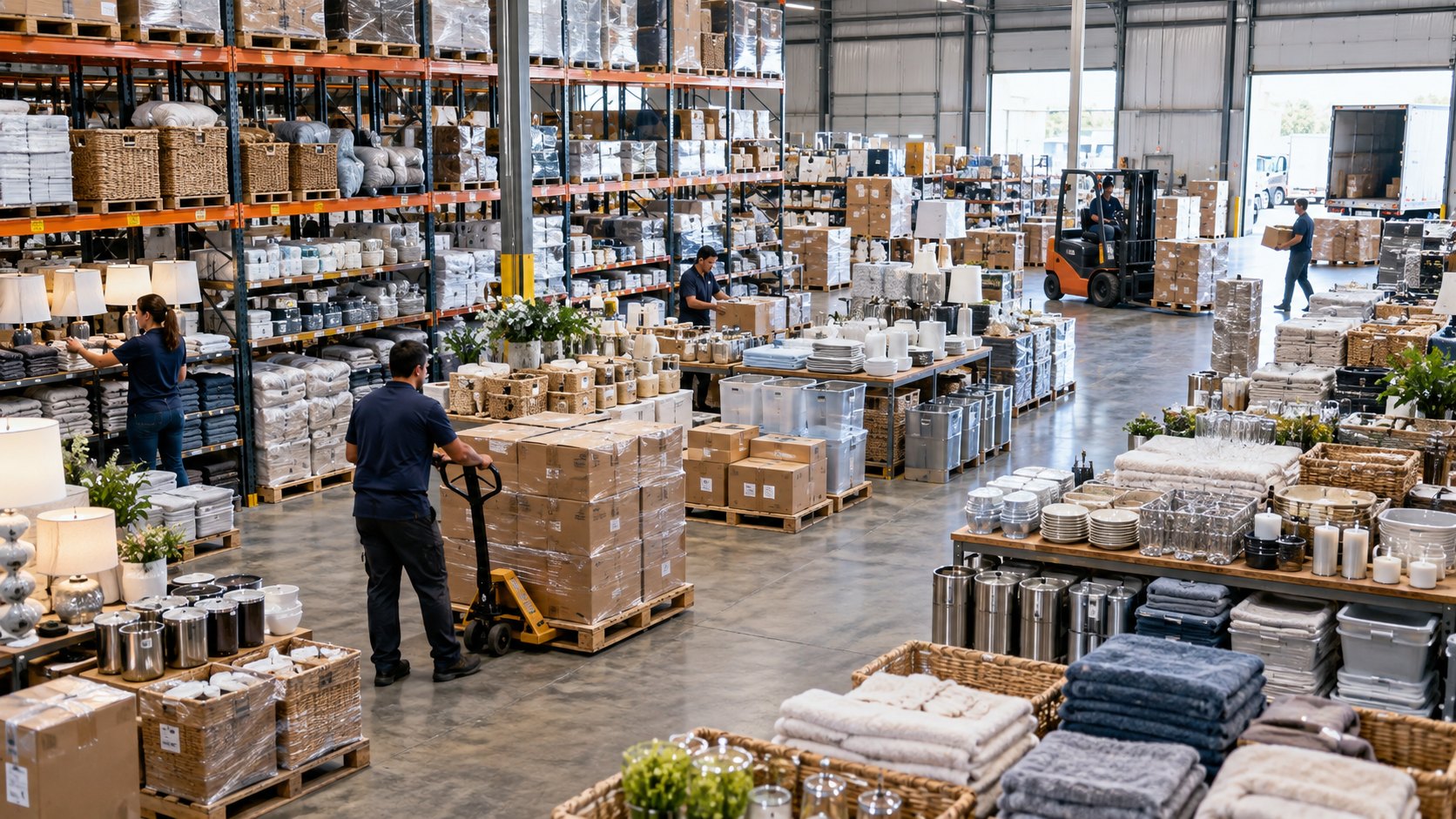
This activity is defined by what the lines around it have already taken. Read the catalogue in order and the shape of it becomes obvious: furniture has its own line, and so do household appliances, consumer electronics and lighting. What is left over — "other household goods" — is the remainder of a home once everything powered, everything you sit on and everything that lights a room has been claimed. Kitchenware, pots and pans, utensils, tableware, cutlery, glass and ceramics, plastic housewares and storage, brooms, brushes and cleaning implements, bathroom accessories, baskets, ironing boards, small decorative pieces.
It is a bucket. It was drawn as one on purpose, and that is the most useful thing to understand about it.
What a catch-all line is actually for
A general homeware importer does not sell a category. He sells whatever a container of shelf-ready product can be bought well and turned quickly, and the mix changes every season — copper-look serving dishes one quarter, food storage sets the next, then a run of glassware because a hypermarket ran a promotion. Describe that business with a product-specific activity and the licence needs amending every time the range moves. Describe it with the catch-all and the licence keeps up with the buying.
The trade-off is real, though, and it runs in both directions.
judged on the same five rows
| Judged on | One catch-all line | A named line per product family |
|---|---|---|
| Adding a new homeware range mid-season | No change to the licence | An amendment each time |
| How a buyer reads the trade licence | A general homeware supplier | A specialist in that category |
| How an invoice description is questioned at clearance | Broad wording, occasional queries | Exact match, fewer questions |
| A food-contact or electrical item inside the range | Still meets its own product rules | Still meets its own product rules |
| Cost of getting the range wrong | Low, the line already covers it | Re-opening the file |
The fourth row is the one to sit with, because both columns say the same thing. A catch-all licence widens what the company may trade; it does not override what a product itself requires. A stainless pan and a plastic lunch box are food-contact articles and are treated as food-contact articles regardless of how broadly the licence is worded.¹ An item with a plug is an appliance and belongs to the appliance line, not to this one. Anything with a lamp in it is lighting. The licence answers a question about the company, and the product rules answer a separate question about the goods, and no amount of breadth in the first collapses the second.
The edges that cause the most arguments
Four boundaries account for nearly every classification argument on this line, and two of them sit immediately next door in the same catalogue.
Anything powered leaves. A kettle, a blender, a fan or a vacuum cleaner is a household appliance under its own line, and the presence of a cable is the simplest test available. A lamp, a shade or a fitting is lighting equipment, again separately named.
Furniture leaves too. If it is sat on, slept on, eaten at or stored in as a piece of case goods, it is household furniture with its own activity and its own freight arithmetic. A cushion is a household good; the chair it sits on is not.
Umbrellas and parasols are named in their own right. Two parasols riding in a homeware container are covered here without ceremony; a company whose range is shading should hold the line that says so.
And food-contact goods are the edge that bites hardest, because they look like the most ordinary thing in the container. Cookware, drinkware, cutlery, food storage and anything that touches what people eat is handled under food control as well as under the general consumer-goods standards.¹ ² A range built around cookware is not a light-touch homeware range.
The breadth is free on the licence and expensive in the office
A specialist importer buys one product family deep. A company on this line buys shallow across all of them, and that difference is paid for somewhere other than the licence fee.
It is paid for per item. Every line added brings its own supplier, its own customs code, its own carton quantity, its own shelf price and its own conformity position, so a container holding forty mixed lines from four factories is forty sets of those facts travelling on one invoice. A packing list that describes the load as "household goods" is among the commonest reasons a consignment stops moving, and the delay lands on all forty lines rather than on the one that was written loosely. A specialist avoids that by accident. A general importer has to earn it, by making the supplier itemise before the container is loaded.
It is also paid for in what breadth conceals. A company with twenty lines knows which three are slow. A company with three hundred does not notice that forty of them stopped selling two seasons ago, because the shipment as a whole still covered its cost. Count stock by line rather than by consignment, fix a date each season for deciding what gets dropped, and treat "it still sells a little" as the sentence that keeps dead ranges alive.
Who should hold this line
The container importer with a rotating range
The original case for the activity, and still the best one. Buying capacity, a shelf-price sense and a willingness to drop a slow line are the skills; the licence is deliberately loose because the buying is.
The hospitality and accommodation supplier
Hotels, restaurants, catering companies, staff accommodation and serviced apartments buy homeware in identical repeats and on schedules, and the list they buy from spans a dozen product families at once. One line covers the list. This is also the buyer most likely to ask for conformity evidence on food-contact items, so the loose licence sits alongside tight product files.
The online seller who does not want to re-open the file
Marketplace and direct-to-consumer sellers test ranges constantly and abandon most of them. A broad activity matches that behaviour, and the jurisdiction decision below matters more to them than the activity wording does.
Where this is the wrong purchase. A company built on one product family with a deep range and a brand behind it — a cookware distributor, a glassware agency, a ceramics importer — is described better by the specific line. The specific line signals competence to a retail buyer and reads cleanly at clearance, and neither of those is a small advantage in a market where a trade licence is the first thing a new counterparty asks to see.
The jurisdiction question turns on who takes delivery
The structural choice here is the ordinary one, and homeware presents it in an unusually clean form because the goods themselves are not restricted.
Selling to UAE retailers, hotels and consumers, on UAE soil, in the company's own name, points to a mainland licence: the customer is here, the delivery is here, and the invoicing follows. Buying to move goods onward without their entering the local market sits comfortably in a free zone, where the value added is handling, consolidation and paperwork rather than local distribution. A company intending to do both either splits the flow deliberately or accepts a local distributor in the middle and gives away a share of the margin for the privilege.
One cost drives the decision harder than the licence does. Homeware is low value for the space it occupies — a pallet of plastic storage and a pallet of consumer electronics cost the same to store and are worth nothing like the same amount — so warehouse rent is a visible line in the margin rather than a rounding error, and the cheapest square metre is not always in the jurisdiction with the cheapest licence. Work the storage cost and the stock turn before the licence question, not after it.
What the licence costs to hold, which conformity and food-contact conditions attach to particular products, and how a mixed consignment is classified all depend on the emirate, the premises and the goods themselves.² ³ ConsultZone confirms those against the chosen jurisdiction and the real product list before anything is committed.
References
- Food control and the treatment of food-contact articles and premises in Dubai. Dubai Municipality
- National standards, conformity assessment and consumer-goods labelling. Ministry of Industry and Advanced Technology
- Import and export, customs codes, and restricted and prohibited goods. Dubai Customs
- General federal government information on trade and consumer protection. UAE Government portal
Elsewhere in Trading
Activities that sit beside this one
Most licences carry more than one activity. Adding a neighbouring line at the application stage costs a fraction of amending the licence afterwards.
Begin with a clear conversation
Tell us what you intend to build.
A consultant will map the structure, jurisdiction, approvals and likely cost against what you actually described — not against a package.
