

Activity CZ 59
How to Start an Off-Road Vehicle Trading Business in Dubai
Off-road vehicles here are bought for sand and for work sites, not for commuting, and most are modified before delivery. What the line covers, who buys, and where the trading licence sits.
ConsultZone licensing desk
- Activity code
- CZ 59
- Category
- Trading
- Reviewed
- Read
- 7 min
Listen instead
56 seconds
An audio summary of this guide.
Topic summary
How to Start an Off-Road Vehicle Trading Business in Dubai
A 4×4 sold in this market is usually sold twice. The first sale is the vehicle. The second is everything done to it afterwards — the suspension lift, the tyres, the underbody protection, the recovery points, the lower gearing — and for a large share of buyers here the second sale is the one that decides who they buy from. That is the fact separating this activity from selling cars generally. A dealer in saloons competes on price, stock and finance. A dealer in off-road vehicles competes on whether the vehicle arrives able to do the thing the buyer bought it for.
Demand for these vehicles is structural rather than fashionable. Desert tour operators work their fleets hard and replace them on a short cycle. Oilfield, survey, utility and municipal contractors need vehicles that reach places with no made road. Private owners here modify at a rate that would be unusual in most markets, and they buy on specification rather than on badge. Those three buyers want the same class of vehicle from the same class of supplier, which is why a specialist in this line can be small and still be the obvious place to go.
CZ 59 — Wholesale And Retail Sale Of Off-Road Motor Vehicles (Jeeps, Etc.)
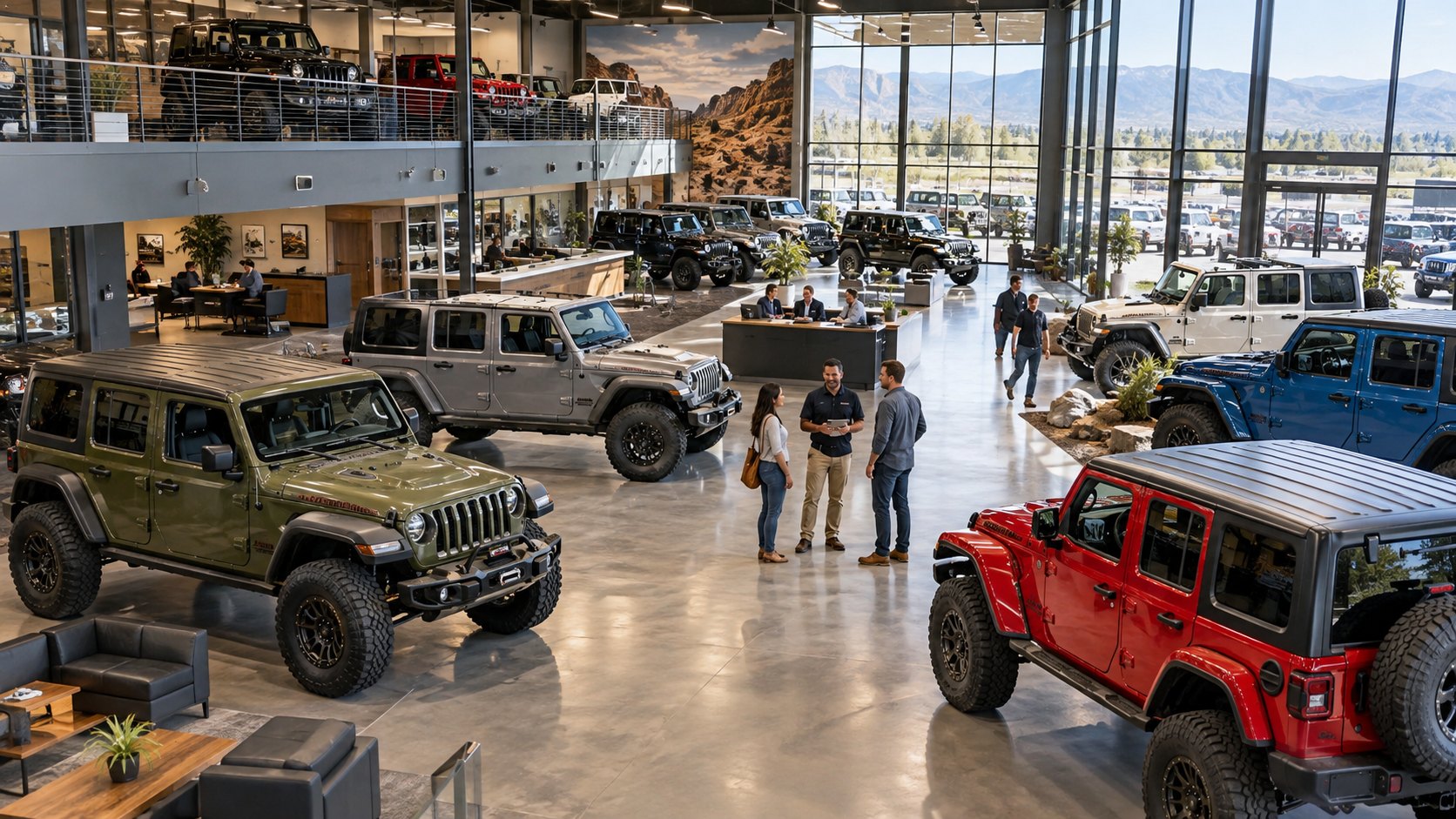
Under this line a company buys and sells off-road motor vehicles on its own account — in quantity to trade buyers, or one at a time to end users. Four things about that are worth knowing before a licence is applied for.
The category is capability, not body shape. What puts a vehicle in this line is that it is built to be driven off a road: low-range transfer, locking or limited-slip differentials, ground clearance, approach and departure angles, a chassis that tolerates being loaded and twisted. A soft-roader with the same silhouette and none of that hardware is an ordinary passenger car to anyone buying for desert or site use, and pricing it as an off-roader is the fastest way to lose a fleet customer permanently.
Wholesale and retail sit in one line, which is unusually useful here. The same stock genuinely serves both. A batch of ex-fleet 4x4s can be broken up between a tour operator taking six, a contractor taking two and a private buyer taking one, and the licence does not force a choice between those buyers. Few trading lines in this catalogue are that permissive about the size of a transaction, and it is what lets a small operation keep its stock turning.
Selling a modified vehicle and modifying it are different activities. This is where new entrants most often get the licence wrong. Fitting a lift kit, going up several sizes on wheels and tyres, re-gearing a differential, adding an auxiliary tank, a snorkel or a winch — that is workshop work, and it belongs to a vehicle modification or accessory-fitting line, not to a sales line. A trading company may buy and sell a vehicle somebody else has modified. It may not carry out the modification itself under a sales activity, and a customer promised a build before delivery has been promised something the licence does not permit.
A modified vehicle still has to be roadworthy and inspectable. Whatever is done to a vehicle, it has to pass the technical inspection the transport authority requires and it has to remain insurable. Changes that are not permitted, or that are permitted only with approval, surface at inspection rather than at the point of sale — and a vehicle that cannot pass is unsellable stock, not a discount. A dealer here who does not understand what the inspection regime will accept is carrying a risk a saloon dealer simply does not have.
five buyer types, three destinations
- Desert tour operators replacing safari fleetsThe customer is a UAE business working on UAE ground
- Rental and leasing companies refreshing their 4×4 stockBoth the supply and the disposal happen inside the local market
- Site contractors and municipal buyers on supply tendersTender conditions expect a supplier with a local trading history
Mainland licence
- Buyers who want the vehicle built before deliveryFitting is a separate activity from selling, so it needs its own permission
Mainland, with a workshop line beside it
- Consolidators shipping desert-specification 4x4s onwardThe vehicles never enter the UAE market at all
Free zone licence
Four of the five buyer types land in the same place, and that is the useful conclusion: for almost everyone in this line the mainland is the answer, because the customer is here. The one that separates is the buyer who wants a built vehicle, and it separates not because of where the sale happens but because a second activity has to sit alongside the first.
Four neighbouring lines, and where the edge falls
General vehicle sales. The broad new-and-used vehicle lines cover the same transaction for ordinary cars. A company expecting most of its turnover to be saloons, hatchbacks and crossovers should hold the general line and treat off-road as part of the mix; a company built around desert and site vehicles is better described by this one, and being accurately described is worth something to a fleet buyer reading a trade licence.
Parts and accessories. Selling the lift kit, the tyres, the roof rack and the recovery gear is its own activity. Most serious operators in this line hold it deliberately, because the accessory margin is better than the vehicle margin and the customer is already standing in front of them.
Vehicle modification and fitting. The workshop line described above. Held together with sales and parts, it produces the business most buyers in this market actually want to deal with. Assumed rather than applied for, it produces a customer complaint the licence cannot defend.
Rental. Putting 4x4s into the hands of paying users without selling them is a different activity again, with its own insurance position and its own relationship with the transport authority. It is a common adjacent business here and it is not this one.
Export. Sending used vehicles out of the country to a buyer abroad is a separate line, and the paperwork rather than the vehicle is what that buyer pays for. Where a dealer here sells to a consolidator who exports, the export file is the consolidator's problem; where the dealer wants to ship in its own name, that is the export activity and it should be held as such.
Who should take this line rather than the general one
Suppliers already inside the desert-use community
People who know which platforms survive a season of dune work and which do not, and who already know the tour operators and the clubs. In this line that knowledge is the product. It cannot be bought in, and it is why an outsider with more capital often does worse than an insider with less.
Fleet operators turning disposal into a margin
Companies whose real business is tours, logistics or contracting, and whose vehicles have to be sold at the end of a cycle. Adding this activity turns a cost into a revenue line and gives them a trade channel for buying the replacements.
Traders with a workshop already beside them
An existing garage or fitting shop adding sales, rather than the reverse. They start with the harder half — the technical competence and the understanding of what inspection will accept — and add the easy half.
Exporters who intend to specialise
Buyers sourcing desert-specification vehicles for markets that want exactly that. They should read the used-vehicle export line beside this one and decide which of the two describes the business, because the two are held for different reasons and the tax treatment of a domestic sale and an export sale is not the same.
What the licence costs to hold, what premises it demands and which approvals a particular vehicle category attracts are all decided by the emirate, by the jurisdiction and by the exact activity mix. A yard shared with two other traders and a standalone site with a workshop attached are the same words on a licence and nothing alike in cost. We confirm those figures against the specific plan before anything is filed.
References
- Roads and Transport Authority — vehicle technical inspection, ownership transfer and permitted modifications in Dubai. Roads and Transport Authority
- Dubai Customs — import clearance and export documentation for vehicles moving through Dubai. Dubai Customs
- Dubai Municipality — suitability of yards, showrooms and workshop premises. Dubai Municipality
- UAE Government portal — the general basis for commercial licensing and trade activity classification. UAE Government portal
Elsewhere in Trading
Activities that sit beside this one
Most licences carry more than one activity. Adding a neighbouring line at the application stage costs a fraction of amending the licence afterwards.
Begin with a clear conversation
Tell us what you intend to build.
A consultant will map the structure, jurisdiction, approvals and likely cost against what you actually described — not against a package.
