
Activity CZ 61
How to Start a Classic Car Trading Business in Dubai
In classic car trading the condition report is the price, nothing carries a warranty, and the buyer is a collector rather than a driver. The commercial case, and the conditions that attach.
ConsultZone licensing desk
- Activity code
- CZ 61
- Category
- Trading
- Reviewed
- Read
- 7 min
Listen instead
43 seconds
An audio summary of this guide.
Topic summary
How to Start a Classic Car Trading Business in Dubai
Two examples of the same model, the same year and the same colour can be worth a multiple of each other. Nothing about the specification explains the gap. What explains it is history: whether the engine is the one the car left the factory with, whether the bodywork has ever been cut, how many owners there have been and what they can prove, whether the service books survive, whether the paint is original or the third respray. In this trade the car is the smaller part of the asset. The evidence is the larger part, and a dealer who cannot read evidence is guessing with six figures of somebody's money.
That is what makes classic dealing a different business from used car dealing rather than a fancier version of it. A used car has a market price that a screen will tell you within a few per cent. A classic has a price that depends on a document you either have or do not have, and on a judgement about originality that two experts can disagree about. The skill being sold is appraisal.
The margin is in provenance, not in the metal
Value in this line is created in three ways, and none of them is volume.
The first is finding an under-documented car and documenting it. A vehicle whose history is unproven trades at a discount to an identical vehicle whose history is complete. Closing that gap — recovering build records from the manufacturer's archive, tracing owners, assembling the file — is genuine value creation, and it is work a dealer can do that a private seller usually cannot.
The second is buying in the wrong market and selling in the right one. Collector demand for a particular model is intensely local and it moves. A car that is ordinary in one country is scarce in another, and the Gulf has a collector base with appetite for cars that Europe undervalues and vice versa. That arbitrage is real, and it is why an operator here with international reach outperforms one who buys only what walks through the gate.
The third is being trusted. In a market with no warranties, the dealer's own reputation is the substitute for one. Buyers pay a premium to a dealer who has never sold them a bad car, and the premium is durable in a way that a price advantage never is.
Against that sit three costs that new entrants routinely underestimate. Stock turns slowly, so capital sits still for a long time. Storage has to be genuinely good — heat and humidity here are hostile to old paint, old rubber, old leather and old wiring, and a car stored badly for two summers loses more value than a year of margin. And when a car is wrong, it is very wrong: a chassis with a hidden history is not a discount, it is a write-off of the difference between what the file claimed and what the car is.
judged on the same six rows
| Judged on | Dealing on own account | Brokering for the owner | Storage and custody |
|---|---|---|---|
| Capital tied up in stock | Heavy | None | Light |
| Where the income comes from | The spread on resale | A fee on the sale | A recurring charge |
| Who holds a car that will not sell | You | The owner | The owner |
| Who is exposed if the provenance is wrong | You | Partly | No |
| Needs climate-controlled space | Yes | No | It is the product |
| How fast it can be started | Slowly, capital first | Immediately | Premises first |
Most established operations here end up doing all three, and the order they are added in matters. Custody and brokerage both generate income without stock risk, which is why they are the sensible first activities for someone entering the market, and they also produce the two things dealing needs most: a building full of cars whose owners trust you, and a live read on what is actually selling.
CZ 61 — Classic Cars Trading
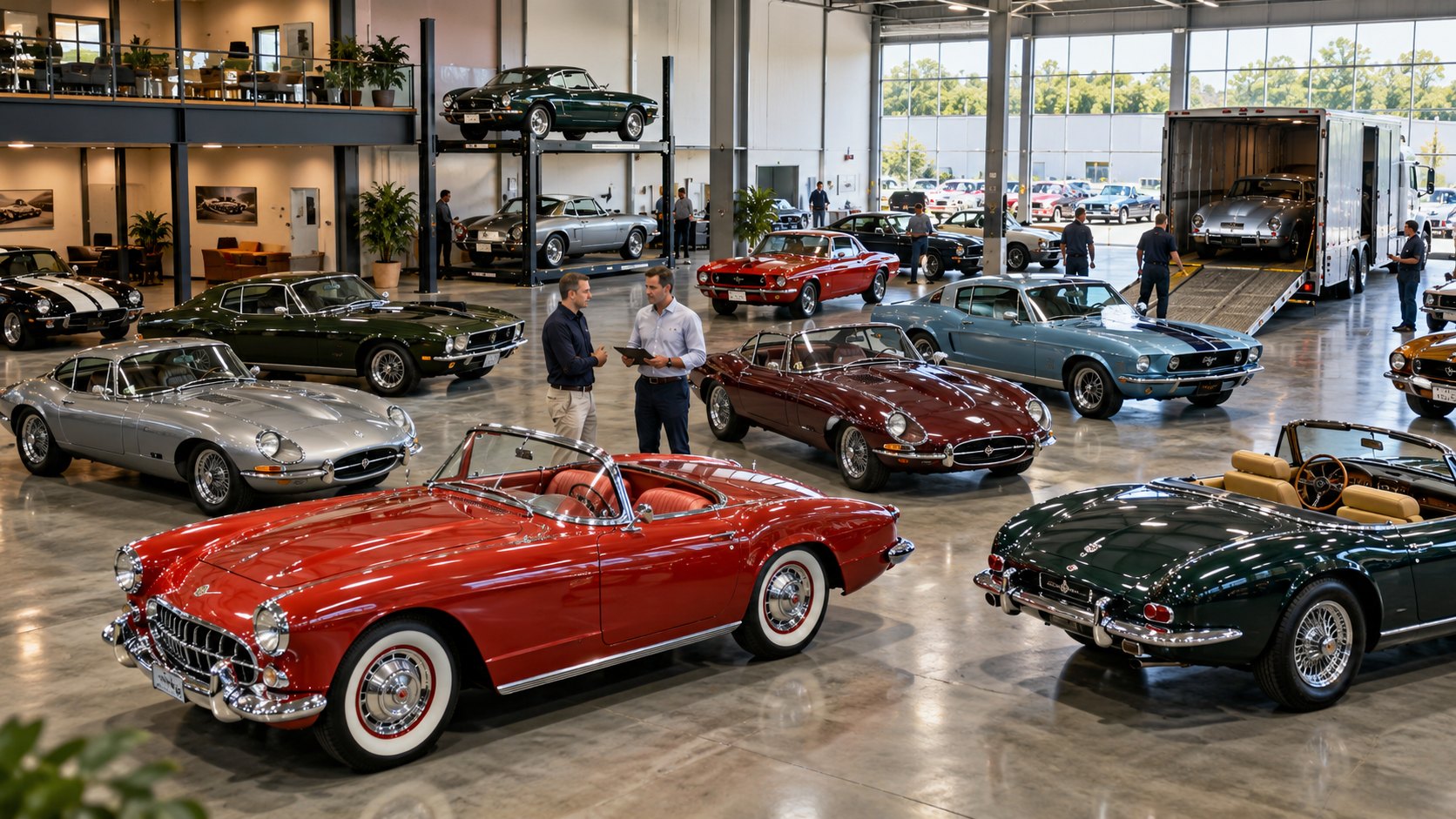
Under this line a company buys and sells classic motor vehicles. Four points define what that does and does not mean.
There is no warranty, and the sale document has to say what is being sold. A classic car is sold as it stands. What protects both sides is a description accurate enough to survive an argument — model, chassis and engine identity, what has been replaced, what has been repaired, what is known and what is merely believed. A vague description is the single most common source of dispute in this trade, and it is entirely avoidable.
Condition grading is the price, so it belongs in writing. Whatever scale a dealer uses, a buyer at a distance is buying the grade rather than the car. Photographs, an inspection report and an honest list of faults are not marketing material here; they are the substance of the transaction, and they are what allows a car to be sold to somebody who has never seen it.
Trading is not restoration. Stripping, repainting, re-trimming, rebuilding an engine or fabricating panels is workshop activity and belongs to a repair or restoration line rather than a trading one. A dealer may sell a restored car. A dealer who restores cars needs the activity that permits it, and most serious classic businesses hold both deliberately because restoration is where a large share of the value is added.
It is not the same line as used luxury cars. The boundary is age and motive, not price. A three-year-old supercar is an expensive used car: it has a warranty position, a known market price and a buyer who intends to drive it. A fifty-year-old saloon worth a tenth as much is a classic: it has provenance instead of a warranty and a buyer who intends to keep it. Where a business will trade mainly in recent high-value cars, the used luxury line describes it better, and describing it correctly matters because the two attract different buyers and different questions.
The conditions that attach to an old car rather than a new one
Road use is a separate question from ownership. Whether a particular older vehicle can be used on the road, and under what conditions, is a matter for the transport authority rather than for the seller — and a car that will live in a collection and appear at events is in a different position from one intended for regular use. That question is worth settling before a purchase, not after, because it changes who the car can be sold to.
Importing an old vehicle is not the same as importing a new one. Age, condition and the completeness of the foreign paperwork all bear on clearance, and the documentation that follows a car across a border is exactly the documentation the next buyer will want to see. Getting it assembled properly at the point of import is cheaper than reconstructing it later.
Storage is a premises approval, not just a cost. Cars hold fuel, and a building holding a quantity of fuel-bearing vehicles indoors is a fire-safety matter for the civil defence authority as well as a suitability matter for the municipality. An operator whose whole proposition is climate-controlled custody should establish what the building is permitted to hold before signing a lease on it.
Tax follows the transaction, not the sentiment. A domestic sale and an export sale are treated differently, and a car sold to an overseas collector is an export with its own documentary requirements. Where a business sits between the two, that is worth structuring rather than discovering.
What any of this costs — the licence, the building, the approvals a particular premises attracts — is decided by the emirate, the jurisdiction and the activity mix, and a shared unit in a warehouse complex and a purpose-built climate-controlled facility are not comparable numbers. We establish them against the actual plan before a file is opened.
References
- Roads and Transport Authority — technical inspection, ownership transfer and the conditions attaching to the road use of older vehicles in Dubai. Roads and Transport Authority
- Dubai Customs — import clearance and export documentation for vehicles, including the papers that must accompany a car across a border. Dubai Customs
- Dubai Civil Defence — fire safety approval for premises holding fuel-bearing vehicles indoors. Dubai Civil Defence
- Federal Tax Authority — value added tax treatment of a domestic sale against an export sale, and corporate tax filing. Federal Tax Authority
Elsewhere in Trading
Activities that sit beside this one
Most licences carry more than one activity. Adding a neighbouring line at the application stage costs a fraction of amending the licence afterwards.
Begin with a clear conversation
Tell us what you intend to build.
A consultant will map the structure, jurisdiction, approvals and likely cost against what you actually described — not against a package.
