
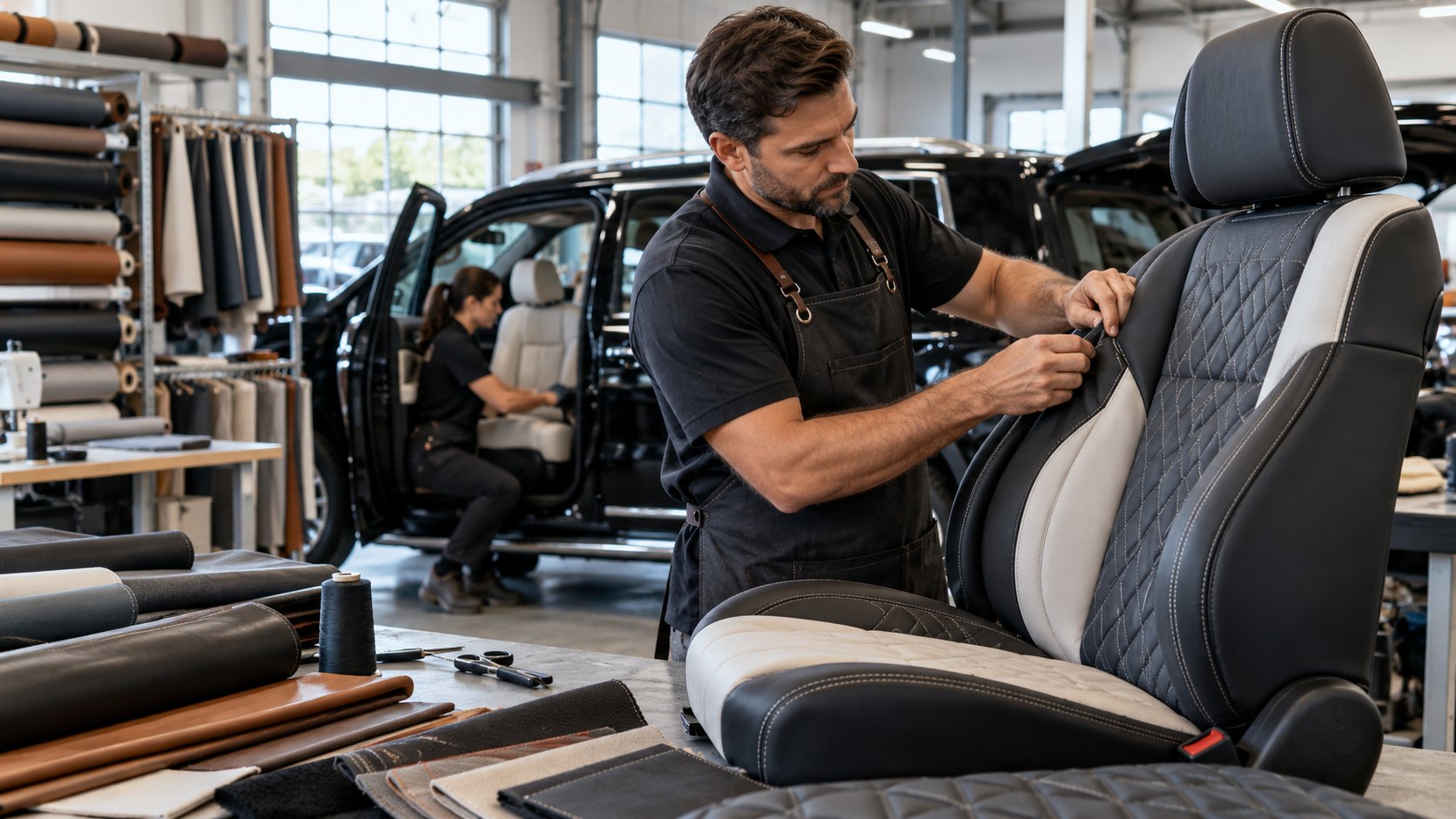
Activity CZ 81
How to Start a Vehicles Upholstery Services Business in Dubai
Vehicle upholstery is judged at arm's length in daylight. Three buyers want opposite things from the same trim shop: restorers, owners personalising a new car, and fleets refurbishing tired ones.
ConsultZone licensing desk
- Activity code
- CZ 81
- Category
- Trading
- Reviewed
- Read
- 8 min
Listen instead
45 seconds
An audio summary of this guide.
Topic summary
How to Start a Vehicles Upholstery Services Business in Dubai
The commonest job in a trim shop here is not a seat. It is a roof lining that has let go — the thin foam bonded behind the headlining fabric breaks down after enough summers, the adhesive gives up, and the cloth drops onto the heads of whoever is sitting underneath. It is a job that barely exists in temperate markets and arrives every week in this one, and it tells you something useful about the trade before you have priced anything: in this climate the workshop's best supplier is the weather.
Heat and ultraviolet light do the rest of the work. Dashboard tops crack and lift, leather dries and splits along the seams that take the most movement, the driver's outer bolster wears through first because of how a person gets in and out of a car, and fine sand grinds into carpet until the pile is gone. None of that is a fault in the vehicle. It is a consumable reaching the end of its life, which is the condition that sustains a repair trade.
What makes the business difficult is not the work; it is the standard the work is held to. A re-trimmed interior is inspected at arm's length, in daylight, by a customer comparing it against a memory of how the car looked when it was new. There is no tolerance table and no test certificate to hide behind. A seam that runs half a centimetre off, a panel that looks slightly fuller than its neighbour, a colour that is right indoors and wrong in the sun — each of those is a rejection, and a rejection in this trade means remaking the part at your own cost, because the material has already been cut.
A word on the neighbour that looks identical and is not. Aircraft seat trim uses the same machines, the same patterns and the same hands, and it is a completely different business: everything soft that goes into an aircraft cabin has to satisfy fire-behaviour requirements backed by test evidence, with an unbroken paper trail from the roll to the finished cover, and the work sits inside an airworthiness approval. A road-vehicle trim shop is judged on fit and finish. An aircraft trim shop is judged on documents. Anyone attracted by the second should not assume the first is a route into it.
The margin is in the hides and the hours, not the machines
The equipment bill is the smallest surprise in this trade. Two or three industrial walking-foot sewing machines, a cutting table, hog-ring pliers, a steamer, a compressor and a spray gun for contact adhesive will equip a serious workshop, and good machines are bought second-hand and outlast their owners. Nothing about the capital cost is a barrier, which is precisely why the barrier sits elsewhere.
It sits in material and labour, and both behave awkwardly. A hide is bought whole, in an area that varies, with natural marks that cannot be used in a visible position, so the yield on a job is a judgement made at the cutting table rather than a figure from a spreadsheet — and a job quoted on a good yield loses money on a bad one. Labour is the larger half of most invoices, and the trimmer who can pattern, cut, sew and fit to the standard described above is genuinely scarce and slow to train.
So no price list survives contact with the work. Every quote is an estimate made on the actual vehicle, and the operators who prosper strip a seat before they commit to a number rather than after. A deposit covering the material is the whole of the risk management, because a cut hide has no resale value.
The three customers pay for different things, and a shop serving all three with one process disappoints two of them. Restoration pays for accuracy: an original material, an original stitch pattern, an original grain, over a long lead time and few cars. Personalisation pays for finish and speed: an owner or a dealer wants a specified colour and stitch on a nearly new car, is unforgiving about the result, and wants the vehicle back. Fleet refurbishment pays for a repeatable unit price: taxis, buses, school transport and delivery vans, priced per seat, judged on durability and turnaround, and profitable only if the process is identical every time.
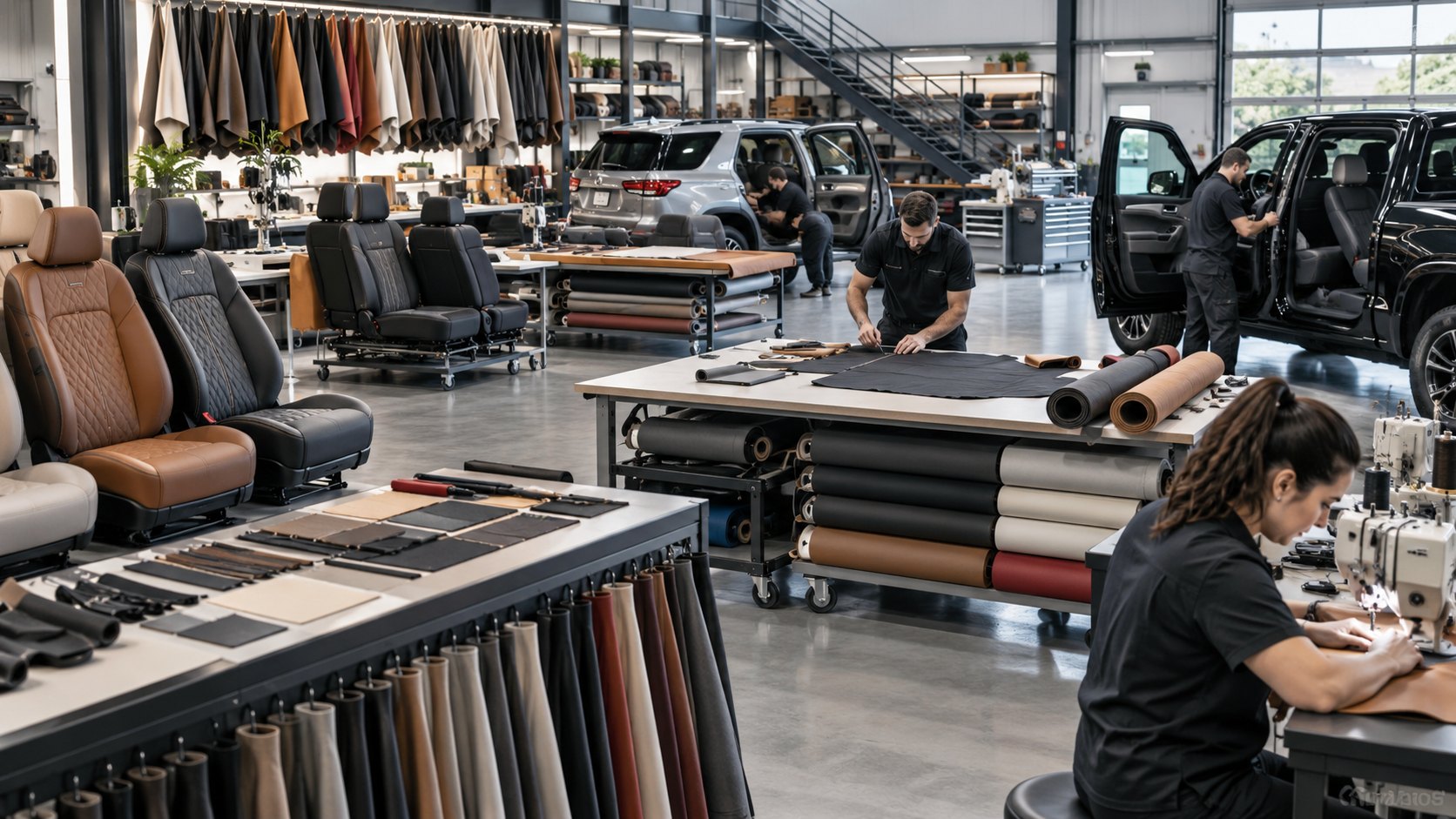
CZ 81 — Vehicles Upholstery Services
Read on its own terms, the line covers the soft interior of a road vehicle: seat covers and the foam under them, headlining and pillar trim, door cards and armrests, carpets, mats and boot linings, convertible soft tops and tonneau covers, steering-wheel and gear-lever wrapping, sun visors, and the repair of commercial and passenger-vehicle seating. It is the part of a vehicle's interior that wears out on a predictable cycle, which is what makes it a trade rather than an occasional job.
What it does not cover is everything the covering is stretched over. Seat frames, recline and slide mechanisms, seat belts and their anchorages are safety-related mechanical work on a structural assembly. Electrically adjusted and heated seats bring wiring and motors into it. Dashboard and hard-plastic repair is a related but separate craft with its own materials. Window tinting is a different line sold in the same breath. Furniture, marine and aircraft upholstery are different customers, different conditions and, in the aircraft case, a different regulatory world entirely.
One boundary inside the work itself is worth stating clearly because it is a safety matter rather than a question of scope. Many modern seats contain a side airbag, and the original cover is built with a seam designed to tear open so the airbag can deploy through it. A replacement cover that closes that seam with ordinary stitching, or that adds a layer over it, is not a cosmetic compromise — it is a fault in a restraint system. A trim shop taking on newer vehicles needs to know which seats those are and how the original was constructed before it cuts anything.
Getting a job through the shop is a sequence, and the order is not the one most owners assume. The irreversible decision comes second, not last.
- Strip and read the car itself, not the photographsTurns a guess into a price that survives the job
- Agree the material against a sample, in daylightThe one decision nothing later in the process can undo
- Take the pattern off the old coverSettles the fit before a single hide is committed
- Cut, sew and fit, panel by panelThe stage where the hours, and therefore the cost, actually go
- Hand it back at arm's length, in daylightWhere the job is accepted, or remade at your own expense
What attaches to the workshop rather than to the craft
The conditions on this business come from the materials and the premises, not from the sewing. Contact adhesives, spray cements, solvents and cleaners are flammable, and how much of them is held in a unit and how they are stored is a fire-safety question for the building rather than a matter of housekeeping.¹ The same materials give off solvent vapour in a space where people work all day, so real ventilation and extraction is a premises-suitability condition rather than a comfort measure, and foam offcuts, leather and vinyl scrap and solvent-soaked rags form a waste stream with municipal conditions attached.²
Space is the requirement most often underestimated. A trim shop needs a vehicle inside it, under light good enough to judge colour, and a vehicle takes the floor three sewing stations would. Add a cutting table long enough to lay out a hide unfolded, storage for rolls and foam that is bulky rather than heavy, and somewhere to keep finished panels clean, and the unit is larger than a first plan allows. It also belongs in an industrial area rather than a retail or residential one.
Almost every input is imported — hides, vinyl, suede-type cloths, foams, threads, adhesives and trim fittings — so the company wants a customs code in its own name.³ Trimmers are the business, and their permits run through the Ministry of Human Resources and Emiratisation.⁴
Fleet work brings one extra condition worth knowing before it is quoted. Taxis, buses and school transport are inspected as public-transport vehicles, and the condition of their interiors is part of what an inspector looks at, so that work is done to somebody else's standard and on somebody else's schedule.⁵ It is good repeatable revenue and it is not flexible revenue.
A mainland licence is the ordinary answer here, because the customers are vehicles owned and used in the UAE and the unit sits in a municipality's area with the approvals that attach to it. A free zone licence describes a different proposition: holding and re-exporting materials. Which activity name covers the intended scope, what approvals attach to a specific unit and what the licence costs depend on the emirate and the licensing authority, and ConsultZone establishes that before a lease is signed.
References
- Dubai Civil Defence — fire-safety requirements for premises storing and handling flammable adhesives, solvents and foam. Dubai Civil Defence
- Dubai Municipality — premises suitability, workshop ventilation and the conditions attaching to workshop waste streams. Dubai Municipality
- Dubai Customs — importing hides, textiles, foam and trim materials, and holding a customs code in the company's own name. Dubai Customs
- Ministry of Human Resources and Emiratisation — work permits and labour contracts for skilled trimmers and machinists. Ministry of Human Resources and Emiratisation
- Roads and Transport Authority — vehicle and transport permits in Dubai, and the condition requirements applying to public-transport vehicles. Roads and Transport Authority
Elsewhere in Trading
Activities that sit beside this one
Most licences carry more than one activity. Adding a neighbouring line at the application stage costs a fraction of amending the licence afterwards.
Begin with a clear conversation
Tell us what you intend to build.
A consultant will map the structure, jurisdiction, approvals and likely cost against what you actually described — not against a package.
