
Activity CZ 82
How to Start an Auto Air Conditioning Repair and Maintenance Business in Dubai
Nowhere is a car's air conditioning worked harder, or more likely to fail. The trade's real barrier is not diagnosis but refrigerant, which cannot simply be let out — so the recovery machine is the entry ticket.
ConsultZone licensing desk
- Activity code
- CZ 82
- Category
- Trading
- Reviewed
- Read
- 8 min
Listen instead
42 seconds
An audio summary of this guide.
Topic summary
How to Start an Auto Air Conditioning Repair and Maintenance Business in Dubai
A car's air conditioning is treated as a comfort feature in most of the world. Here it is the difference between a usable vehicle and an unusable one, it runs at high load for most of the year rather than for a season, and when it stops the vehicle stops being driven. Every workshop owner in the country already knows that the queue forms in May and does not clear until October.
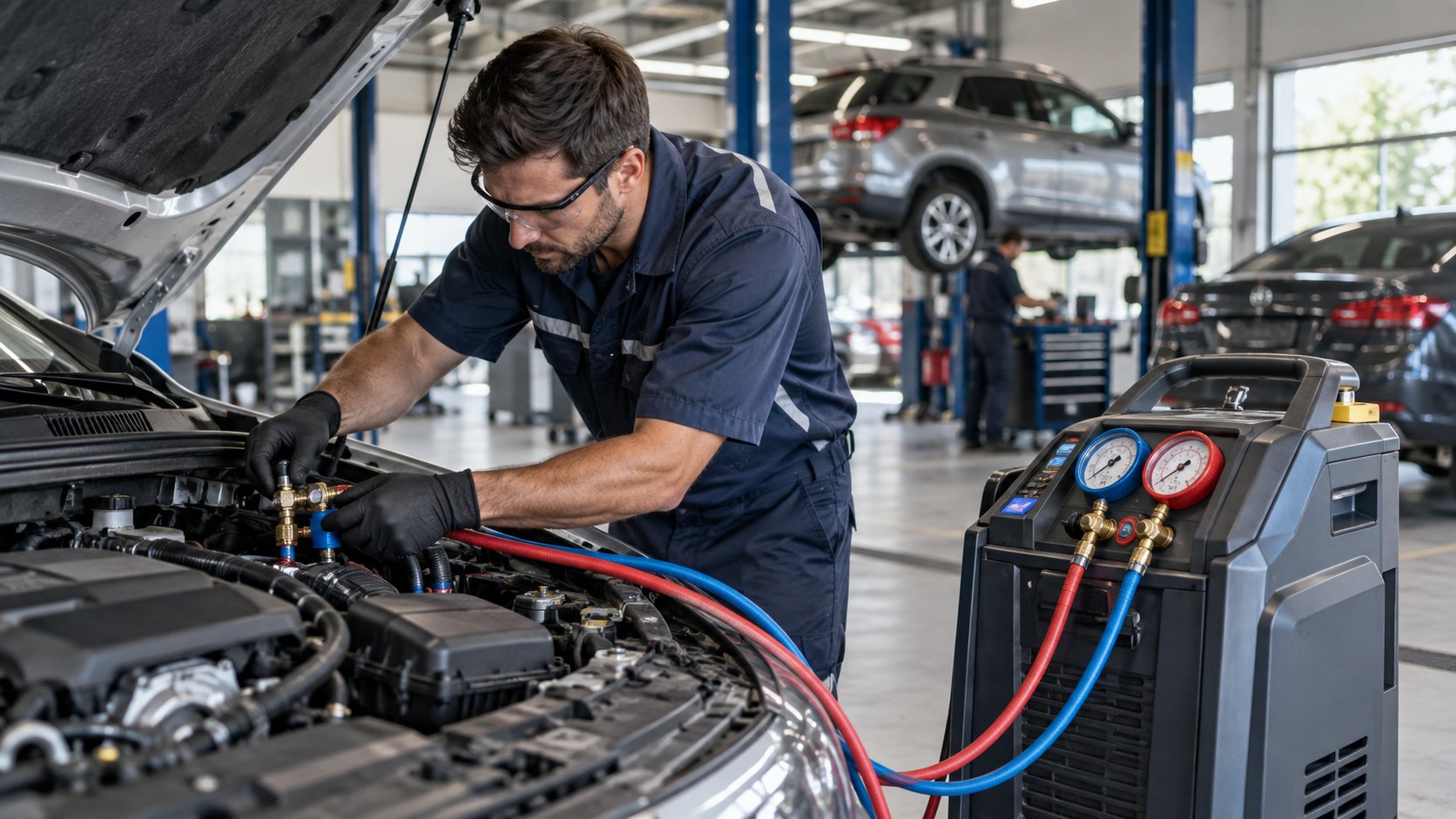
So the interesting question is not whether there is work. It is what a business must be able to do before it can take the work properly, and the answer is narrower than most entrants expect. The system is filled with refrigerant — a fluorinated gas held under pressure — and the defining fact of this trade is that the gas cannot simply be released into the air when a system is opened. It has to be drawn out, weighed, filtered and put back, or captured and sent for disposal. That means a recovery and recharge station rather than a can and a pair of gauges, and a vacuum pump good enough to boil the moisture out of a system before it is refilled.
That single requirement separates the trade from the rest of the automotive workshop family. The handling, recovery and disposal of refrigerant is an environmental control, and it belongs with the environment authorities and the municipality rather than with the body that cuts the trade licence.¹ ² Cylinders of refrigerant are pressurised gas in a workshop, which brings the premises inside the fire-safety approvals for gas storage.³ None of that is a formality settled at the counter, and none of it is answered by the trade licence alone — which is why the equipment and the premises are the real entry cost and the licence is the cheap part.
The second thing the trade punishes is guessing. Different vehicles take different refrigerants and different compressor oils, the newer gases are not interchangeable with the older ones, and a system charged with the wrong gas or oil is a destroyed system rather than a badly performing one. A refrigerant identifier — a machine that reads what is actually in a system before anything is connected to it — protects the shop's own recovery equipment from whatever the last workshop put in. It is capital a customer never sees and never pays for directly.
What the line covers, from a warm vent to a seized compressor
The activity covers diagnosing and repairing the vehicle's climate system, which is a wider set of jobs than the phrase suggests. The everyday work is a system that has stopped cooling: finding where the charge has gone, which is a leak-detection problem rather than a refill problem, then evacuating, pulling a vacuum and weighing in a fresh charge. The component work is the compressor, condenser, evaporator, expansion valve, receiver-drier, hoses, seals and pressure switches. The air-side work is the blower motor, cabin filter, blend doors and their actuators and the control panel. And a steady stream of complaints are not about temperature at all — a smell from a damp evaporator case, or water on the passenger floor from a blocked drain.
Two failure modes here are local rather than universal, and they shape the stock a shop holds. The condenser sits at the very front of the vehicle behind the grille, where it takes sand, dust and stone chips continuously; one that has been sandblasted for five years leaks at the seams and cools poorly long before it fails outright. And a system running almost continuously in high ambient heat wears its compressor and seals on a shorter cycle than the same car in a mild climate, which is why the parts that move slowly elsewhere move here.
What the line does not cover is a longer list than people expect. Fixed air conditioning in buildings is a separate trade with its own licence and approvals, and the fact that both involve refrigerant does not make them one activity. Refrigerated transport bodies and container units are adjacent, heavier, and usually a line of their own. Selling refrigerant in cylinders to other workshops is a trading proposition rather than a service one. And the engine cooling system — radiator, water pump, thermostat, coolant — is confused with air conditioning by customers almost daily and has nothing to do with it.
One newer boundary is becoming a real commercial question rather than a theoretical one. On an electric vehicle the same refrigerant circuit that cools the cabin also cools the traction battery, and the compressor is driven by high voltage rather than by a belt off the engine. Opening that circuit is high-voltage work on a safety-critical system, it needs different training and different equipment, and a conventional air-conditioning bay should not treat it as the same job with a different badge on the bonnet.
There are three genuinely different ways to sell the same repair, and the choice decides what work you can accept rather than merely how you are paid.
three ways to sell it, judged on the same six rows
| Judged on | A workshop bay of your own | A mobile recovery-and-recharge unit | A contract inside a fleet yard |
|---|---|---|---|
| Take a compressor, condenser or evaporator job | Yes | No | On the client's own ramp |
| Leak-test, evacuate and recharge a system | Yes | Yes | Yes |
| Reach a customer who cannot release the vehicle | No | Yes | Yes |
| Recover the charge rather than vent it | Required | Required | Required |
| Revenue arrives as a contract rather than a walk-in | No | Sometimes | Yes |
| Price gets argued against the workshop next door | Yes | No | Set in a tender instead |
The entrant who already owns the machine
A general workshop turning away the work it should keep
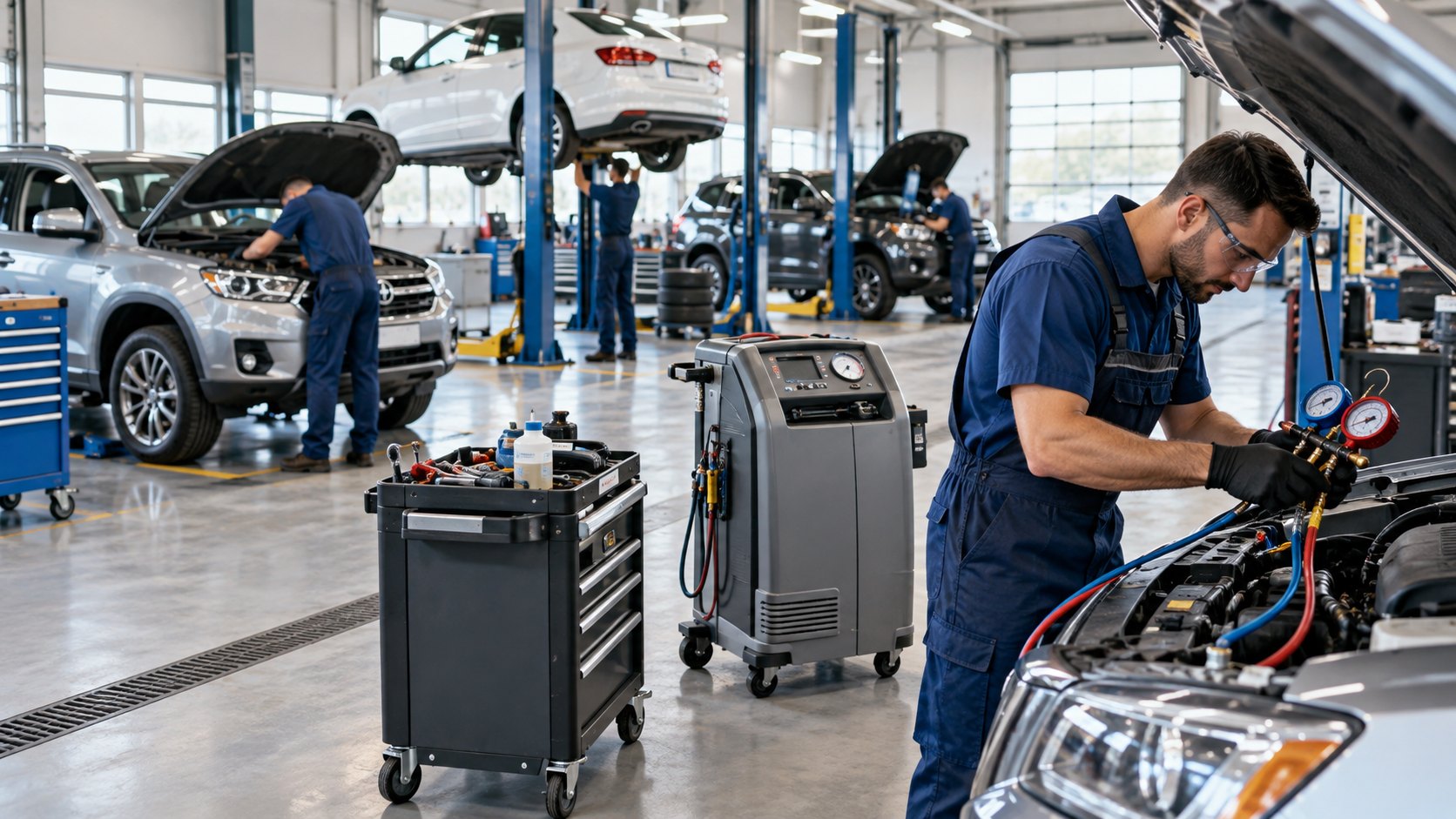
The most common and the most sensible route. The cars are already arriving, the air-conditioning jobs are being sent down the road, and with them goes the diagnostic work and the follow-on repair. A dedicated bay and a proper recovery station converts referrals into revenue at the busiest time of the year.
An auto electrician crossing over
A better fit than it looks. A modern climate system is sensor-driven, controlled by a module and diagnosed through data rather than by feel, so the failure-finding is closer to electrical work than to mechanical work. The refrigerant handling is what has to be added.
A fleet operator converting downtime into a service
Taxi, bus, rental and delivery fleets already lose money every time a vehicle comes off the road warm. An operator with the equipment and the bay to keep its own fleet cold has most of a business already, and the first external customers are usually competitors who have seen the vehicles.
A mobile operator with one van
The cheapest way in, and the one with the clearest ceiling. A recovery and recharge station fits a van, and leak tests and recharges can be done in a customer's parking bay. Anything requiring the dash out, the front end off or the vehicle on a ramp cannot, and a mobile business still needs licensed premises and a compliant gas store behind it.
Where this is the wrong purchase. If the intention is to service building air conditioning, this is the wrong line entirely and a different trade licence and competence applies. If the intention is to import and sell refrigerant, components or equipment without working on vehicles, a trading activity is cheaper to hold and needs no bay.
Why the customers decide the mainland question for you
The structural choice is usually made by the customer rather than by the owner, and in this trade it is made decisively. The work is performed on a vehicle standing on UAE soil, owned by a UAE resident or operated by a UAE-licensed fleet, and the vehicle has to be able to drive to you. A mainland licence is the straightforward answer to that, with the unit in a municipality's industrial area and the premises carrying the approvals that attach to gas storage, ventilation and workshop waste.
A free zone licence describes a different business built on the same skills. Holding air-conditioning components and equipment and re-exporting them without clearing into the local market, serving companies operating inside the zone, or running a regional service and supply operation are all real propositions, and none of them is a bay taking walk-in cars from the city.
What is worth being clear about is that the licence choice does not settle the things this business actually runs on. Neither a mainland nor a free zone licence gives you the refrigerant handling position, the recovery equipment or the approved gas store; those attach to the premises and to the environmental and fire-safety authorities whichever licence is on the wall.¹ ³ Staff permits run through the Ministry of Human Resources and Emiratisation in either case, and technicians competent on modern climate systems are a scarce and internationally mobile skill.⁴ Vehicles brought in under a fleet contract may carry their own permit conditions in the emirate where they operate.⁵
Which activity name fits the intended scope, which approvals attach to a particular unit, and what the licence costs all depend on the emirate, the premises and the activity mix. ConsultZone confirms that before equipment is ordered or a lease is signed.
References
- Ministry of Climate Change and Environment — environmental controls on refrigerant gases, and their handling, recovery and disposal. Ministry of Climate Change and Environment
- Dubai Municipality — premises suitability, workshop ventilation and the conditions attaching to workshop waste. Dubai Municipality
- Dubai Civil Defence — fire-safety requirements for storing and handling pressurised gas cylinders on a workshop premises. Dubai Civil Defence
- Ministry of Human Resources and Emiratisation — work permits and labour contracts for workshop technicians. Ministry of Human Resources and Emiratisation
- Roads and Transport Authority — vehicle and transport permits in Dubai. Roads and Transport Authority
Elsewhere in Trading
Activities that sit beside this one
Most licences carry more than one activity. Adding a neighbouring line at the application stage costs a fraction of amending the licence afterwards.
Begin with a clear conversation
Tell us what you intend to build.
A consultant will map the structure, jurisdiction, approvals and likely cost against what you actually described — not against a package.
