
Activity CZ 84
How to Setup a Refrigerated Trailers Repair and Maintenance Business in Dubai
A refrigerated trailer is a link in a cold chain, so a failure spoils a load worth more than the repair. What the work really is, who pays for it, and what the refrigerant demands.
ConsultZone licensing desk
- Activity code
- CZ 84
- Category
- Trading
- Reviewed
- Read
- 7 min
Listen instead
49 seconds
An audio summary of this guide.
Topic summary
How to Setup a Refrigerated Trailers Repair and Maintenance Business in Dubai
Everything in this line follows from the value of what is inside the box. A dry trailer that fails is a day of lost hire and an annoyed haulier. A refrigerated trailer that fails on a summer afternoon between Dubai and the border is a pallet of chilled poultry, a load of ice cream or a consignment of temperature-controlled medicines drifting out of specification while the driver looks for a phone number. The repair might be a fan motor. The loss is the cargo.
That asymmetry is the whole business proposition, and it is why this activity does not read like the workshop lines around it. The customer is not buying a repair. He is buying the probability that his load arrives at the stated temperature, because that is what his own customer audits him on. A workshop that understands it is selling temperature integrity prices differently, staffs differently and answers the telephone at two in the morning. A workshop that thinks it is fixing trailers will lose the contract to one that does.
Two trades share one bay: a refrigeration plant, and a box that has to stay cold
The refrigeration side
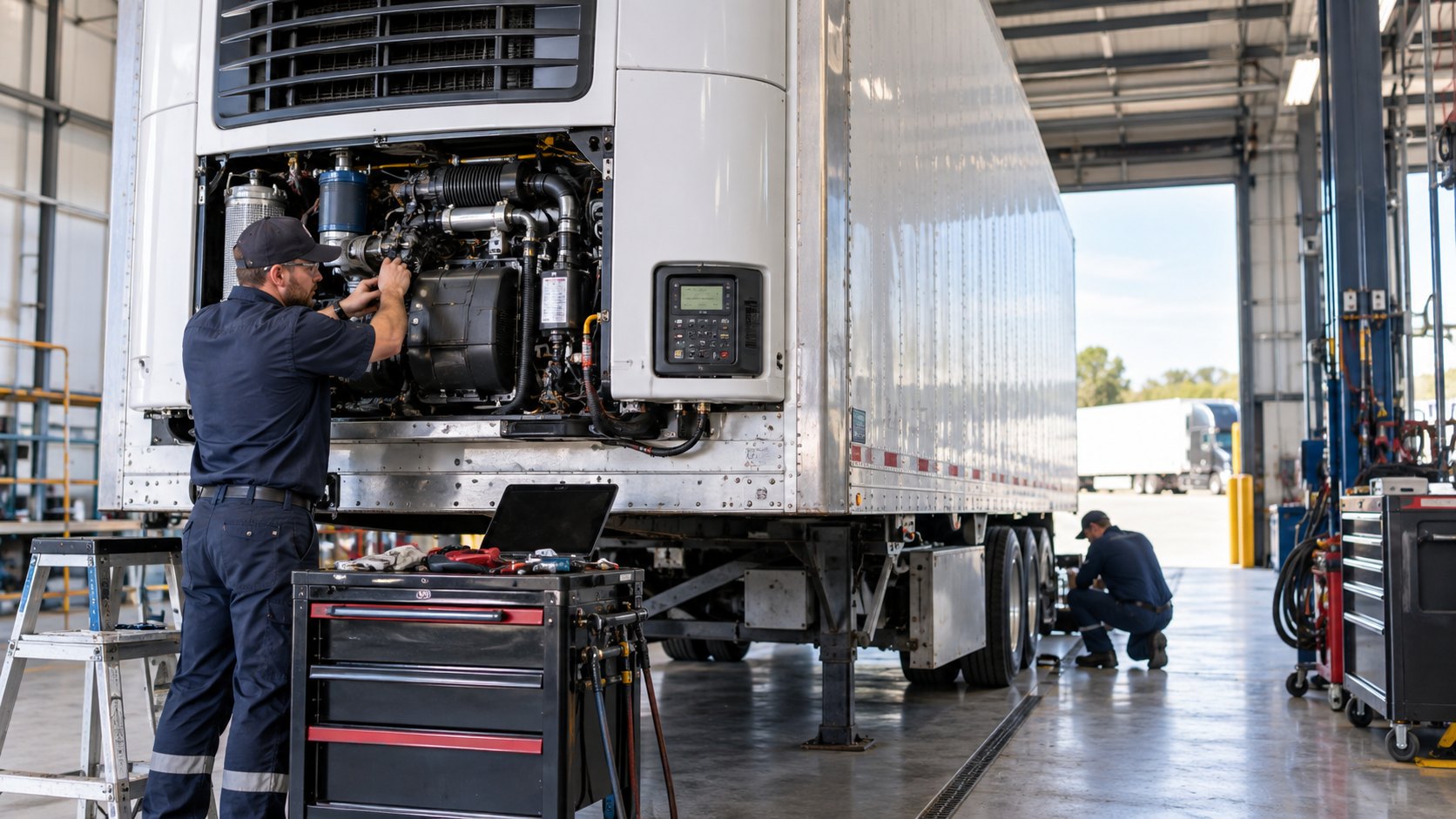
A transport refrigeration unit is a small, hard-working piece of engineering bolted to the front of a trailer and asked to run in Gulf ambient temperatures. It has a compressor, a condenser, an evaporator, a charge of refrigerant, a controller and, on most units, its own engine or a power take-off. The failures are refrigeration failures: a leaking charge, a blocked condenser coil, a defrost cycle that has stopped cycling, a controller reading a sensor that has drifted. Diagnosing those is refrigeration work, not motor-vehicle work, and it is the scarcer of the two skills.
The body side
The other half of the job is the insulated box, and it is quietly where most of the lost performance hides. Insulation that has taken water weighs more and cools worse. A door seal crushed by a forklift lets warm air in every time the trailer stops. Delamination, a punctured inner skin, a floor drain that no longer drains — none of it appears on a controller display, and all of it shows up as a unit running permanently at full duty and still missing the set point. A workshop that can only read the unit will keep replacing components on a trailer whose real problem is a seal.
The two halves together are what separates this line from the workshops a reader is most likely to confuse it with.
| Refrigerated trailer | General trailer repair | Car air-conditioning | |
|---|---|---|---|
| Who signs the order | A fleet or cold-chain operator | The trailer owner or haulier | The driver of the car |
| What actually fails | The cooling unit, its charge, its controls, and the insulated box | Brakes, axles, suspension, chassis, lights | A compressor, a hose, a cabin blower |
| What a failure costs | The cargo, which is usually worth more than the trailer | A day of the trailer earning nothing | An uncomfortable drive home |
| What the bench has to hold | Refrigeration skill plus insulated bodywork | Heavy-vehicle mechanical skill | Automotive air-conditioning skill |
| Why the customer telephones at night | A warm box is a load spoiling by the hour | A parked trailer can wait for morning | The car can wait for the weekend |
Read the marked row, because it is the commercial argument of the whole page. Two of these three trades can work office hours. This one cannot, and the premium it earns is paid for exactly that.
The buyer is a logistics operator, and he is calling with a load already on the road
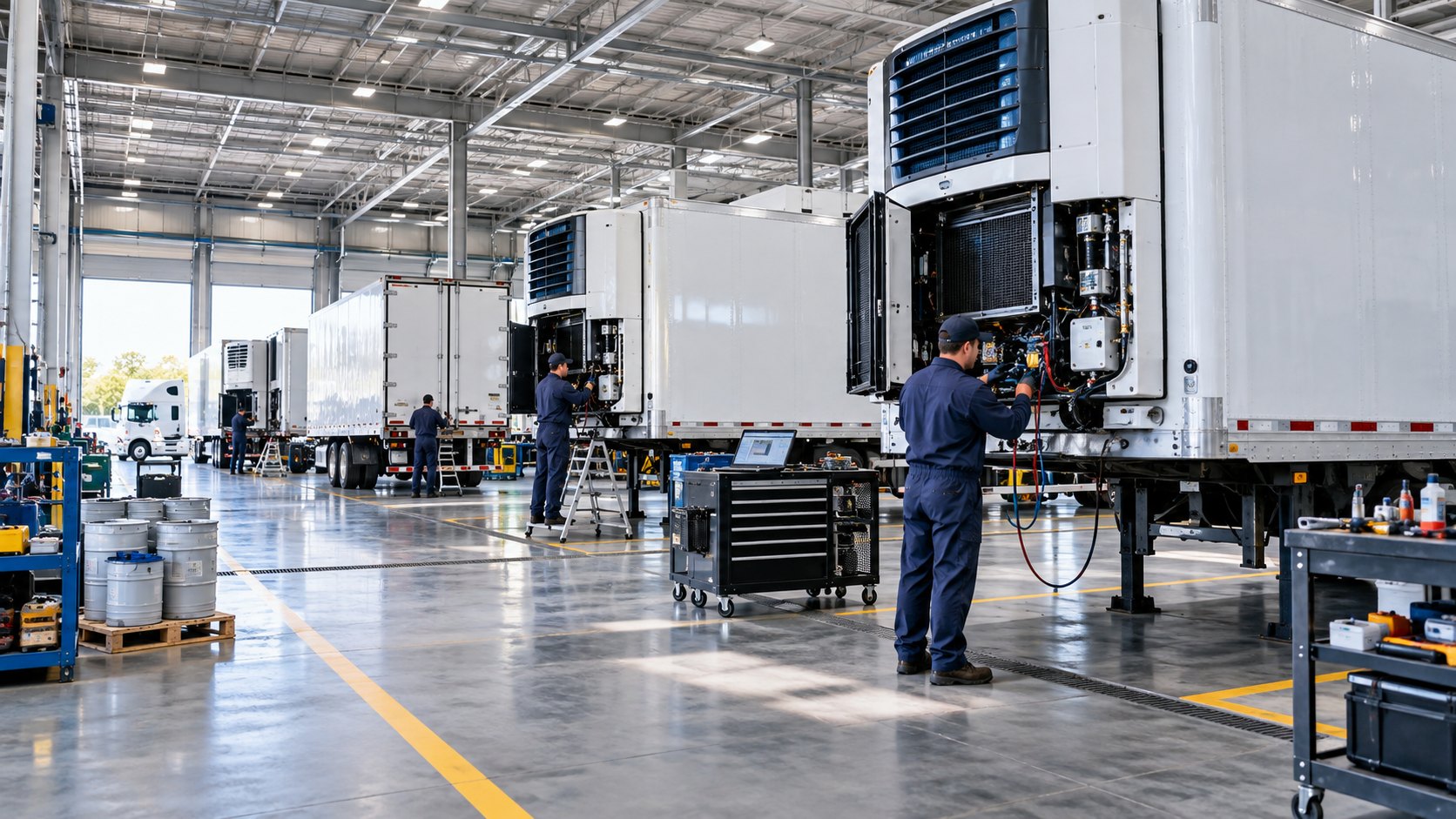
The customer base here is narrow, identifiable and almost entirely business to business. It is the chilled and frozen food distributors, the dairy and ice cream fleets, the fruit and vegetable importers running out of the wholesale markets, the catering and central-kitchen operators, the pharmaceutical and clinical logistics companies, the trailer rental and leasing fleets, and the contract hauliers moving other people's temperature-controlled freight. There are not thousands of them. There are dozens, and they all know each other.
That shapes how the work is won. Advertising to the public is close to worthless — a private individual does not own a reefer trailer. What wins the book is a maintenance schedule, because an operator with thirty units would far rather pay a predictable monthly figure for planned servicing than face an unplanned failure with a full box. Scheduled work is also the better business for the workshop: it fills the bays on your calendar rather than the customer's, it finds seals and coils before they cost somebody a cargo, and it converts a repair trade with unpredictable revenue into something closer to a subscription.
Two practical consequences are worth planning for from the first day. The first is mobility: a trailer that will not cool is frequently not driveable to you in any useful sense, so a road service capability — a van, a technician, a refrigerant set and a stock of the components that actually fail — is often the difference between winning a fleet contract and being a fallback. The second is parts. A reefer unit is made by a handful of manufacturers, the components are specific, and a workshop waiting a fortnight for a controller is a workshop that has already lost that customer. Working capital in this line sits in the parts shelf, and it is not optional.
The conditions attach to the refrigerant, the workshop and the record — not to the trailer
Three separate controls sit over this work, and it is worth being exact about which is which.
The refrigerant is a controlled substance. Refrigerant gases are subject to environmental control in essentially every market in the world and the UAE is no exception. That control is about handling, recovery and release rather than about your trade licence, and it belongs with the environment ministry and the relevant emirate-level environment body, not with the department that issued the licence. What that means concretely for one workshop — what has to be held, what has to be recorded, what equipment is expected — differs by emirate, so it is a question to settle for the specific premises rather than to assume from a template.
The premises is a vehicle workshop and is treated as one. A bay long enough to take an articulated trailer, hardstanding that can carry the weight, drainage, the handling of waste oil and recovered gas, ventilation, and the fire conditions attached to keeping fuel and compressed gas on site are municipal and civil defence matters. This line is premises-led: the unit determines what the licence can say, not the other way round.
The cargo is food or medicine, and that reaches back to you. The workshop is not licensed to handle food, and nothing here makes it a food business. But the operator it serves is audited on temperature, which means he will ask for something the ordinary trailer workshop is never asked for: evidence. Calibration of the sensors and data loggers, a written service record per unit, and a repair history that stands up when a consignee rejects a delivery. Building that paperwork properly is cheap, and it is the single most effective way to be the workshop a pharmaceutical or supermarket contract is allowed to use.
What none of this comes with is a number. The licence cost, the class of unit required, the approvals a particular activity mix attracts and the visa allocation that follows all depend on the emirate, the jurisdiction and the premises. We confirm the actual requirements for the specific case before anything is filed.
References
- Ministry of Climate Change and Environment — the environmental control of refrigerant gases, and food security policy behind the cold chain. Ministry of Climate Change and Environment
- Dubai Municipality — food control, premises suitability, drainage and waste handling for a vehicle workshop in Dubai. Dubai Municipality
- Abu Dhabi Agriculture and Food Safety Authority — food safety expectations that follow chilled and frozen cargo in Abu Dhabi. Abu Dhabi Agriculture and Food Safety Authority
- Roads and Transport Authority — trailer and heavy-vehicle permits, and road service in Dubai. Roads and Transport Authority
- Dubai Civil Defence — fire safety conditions where fuel and compressed gas are kept on a workshop site. Dubai Civil Defence
Elsewhere in Trading
Activities that sit beside this one
Most licences carry more than one activity. Adding a neighbouring line at the application stage costs a fraction of amending the licence afterwards.
Begin with a clear conversation
Tell us what you intend to build.
A consultant will map the structure, jurisdiction, approvals and likely cost against what you actually described — not against a package.
