
Activity CZ 361
How to Start a Swimming Pool Installation and Maintenance Business in Dubai
One licence name hides two unrelated businesses: building a pool is construction, keeping it running is a weekly route. What each half needs, and where the swimming pool line stops.
ConsultZone licensing desk
- Activity code
- CZ 361
- Category
- Maintenance
- Reviewed
- Read
- 6 min
Topic summary
How to Start a Swimming Pool Installation and Maintenance Business in Dubai
Building a pool is construction. Excavation, a reinforced shell, waterproofing, a plant room, pipework, tiling and commissioning, sold as a project to a builder or an owner and paid in milestones with money held back at the end. Keeping a pool running is a route business: a technician in a van, a weekly round of villas and buildings, chemicals and filters consumed continuously, invoiced monthly, and valued on how many addresses sit inside one driving hour. Swimming Pools Installation & Maintenance is a single activity covering both.
Different capital, different staff, different buyers, different seasons. A company can hold both and many do, but the two halves should be planned as separate businesses that happen to share a licence, because the mistake that costs most on this line is financing a construction book out of a maintenance cash flow, or pricing a maintenance round as though it were a small project.
Who is this for?
Pool contractors arriving from abroad
The technical work transfers almost unchanged; three local conditions do not. Evaporation in this climate is a running cost that clients abroad never see on a bill. Water has to be cooled in summer as well as heated in winter, which is a plant decision outsiders routinely get wrong. And ground conditions across the emirates — sabkha, high water table, salts — change what the shell and the waterproofing have to do.
Landscaping and villa fit-out companies
Firms already building gardens, terraces and outdoor kitchens, and subcontracting the wet works. The pool is usually the most expensive single element in the garden and the one the client talks about, so holding it in-house changes both the margin and the pitch.
Technicians building a round
The cheapest start in this family. A van, a test kit, a chemical store and twenty addresses is a real business with positive cash flow from the first month. It grows by density rather than by reach, and the discipline is refusing work that is too far from the existing route.
Facilities management companies
Firms holding the contract for a building whose pool is serviced by somebody else. Pool water in a shared or commercial building is a public-health item on their own inspection list, which makes it a risk they are already carrying without controlling.
CZ 361 — Swimming Pools Installation & Maintenance
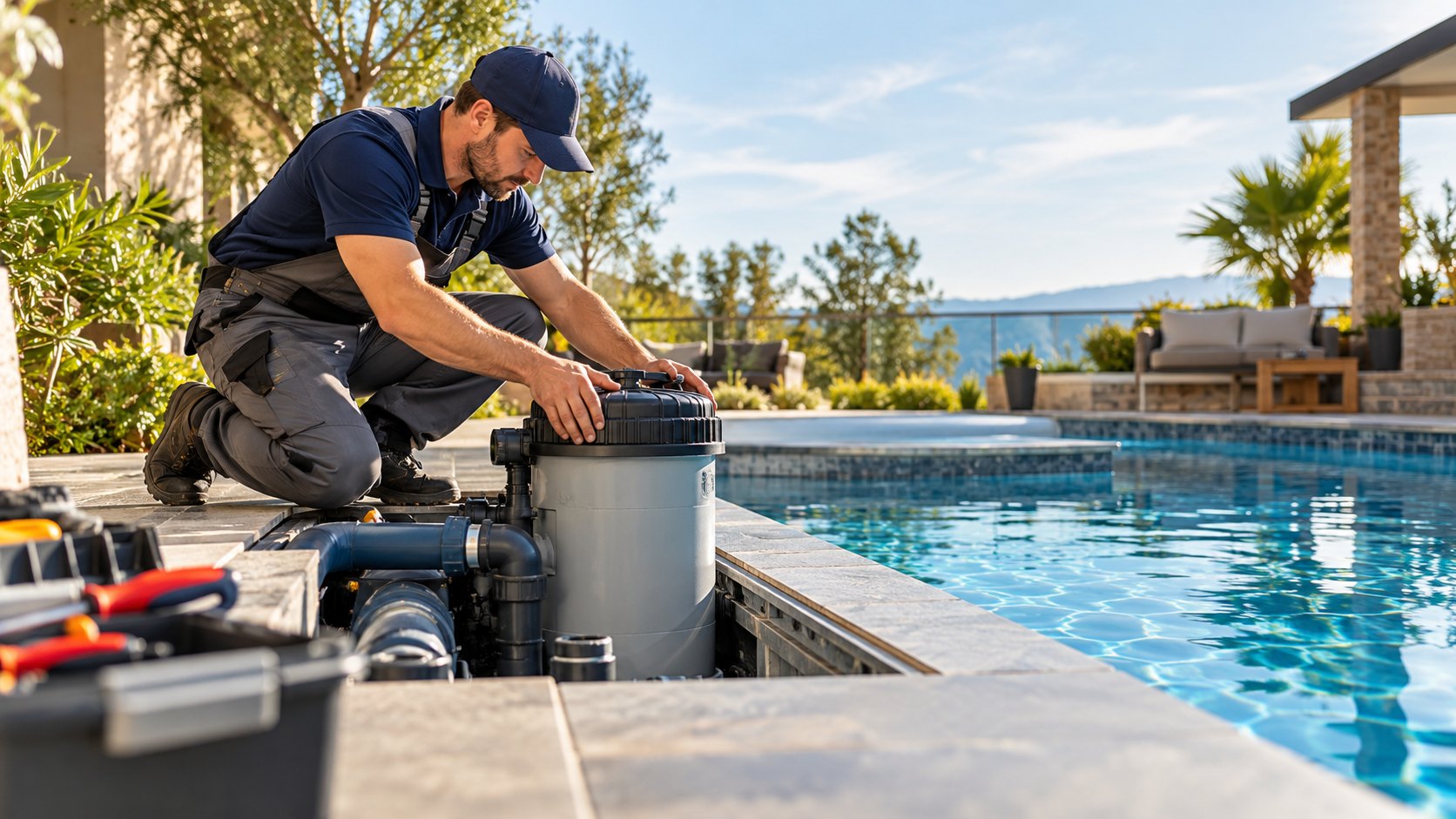
The construction half behaves like any other subcontract trade. The counterparty is a villa owner, a main contractor or a developer; the programme is somebody else's; and the money arrives against measured progress with a retention held until the defects period expires. What is specific to pools is that nearly every defect is a water defect. A shell that moves, waterproofing that fails, a pipe joint that weeps underground or a plant room that was never sized for the chilling load all show up as water loss or as water that will not hold its chemistry, and they show up after handover, during the period when the retention is still outstanding.
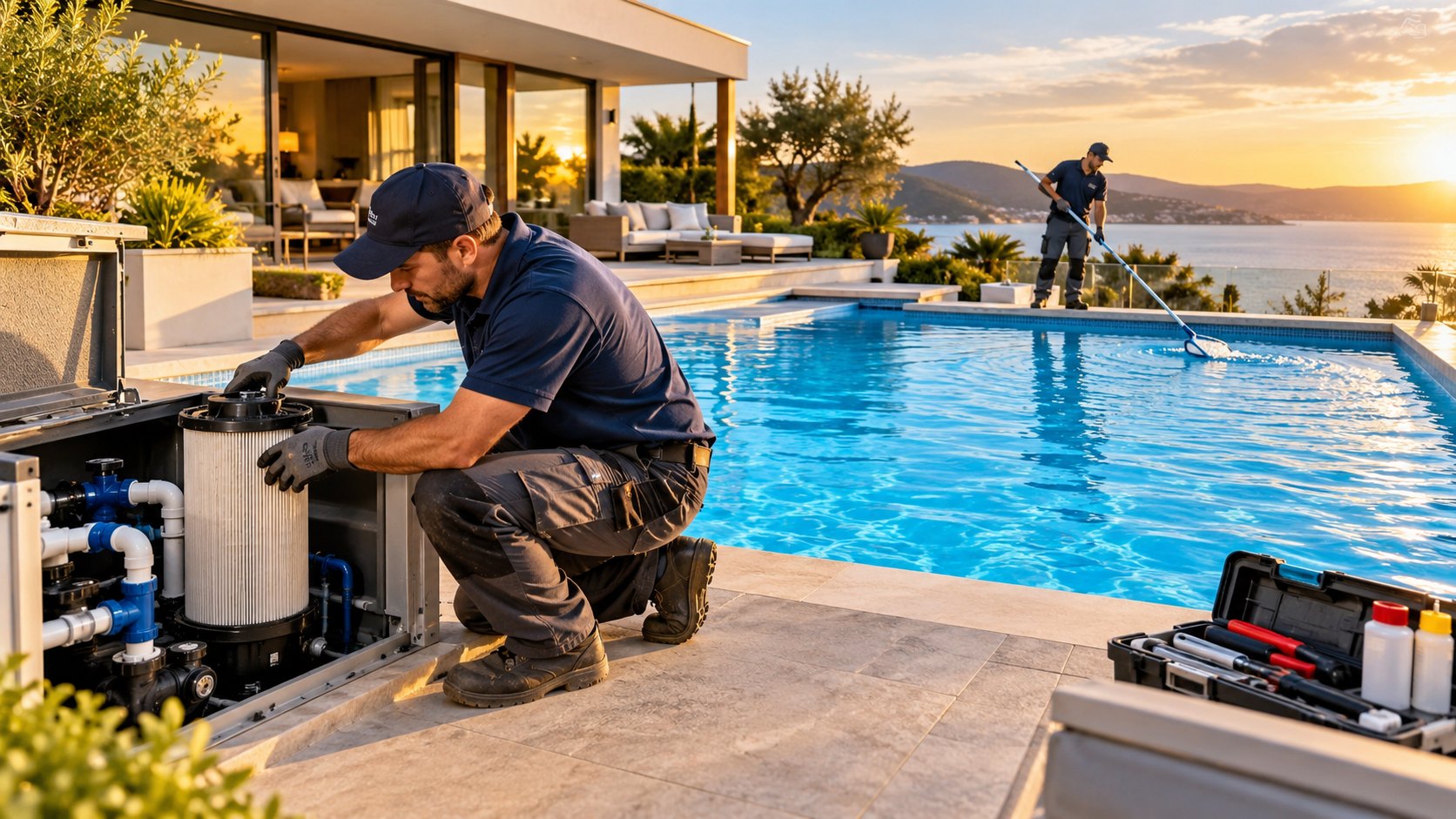
The maintenance half is the one most newcomers underestimate, because it looks like cleaning and is actually water treatment. The job is holding a body of water inside a chemical band — disinfection, pH, alkalinity, stabiliser, salts — in a climate that works against every one of those at once. Heat accelerates the chemistry and the biology, evaporation concentrates what is dissolved, dust and sand load the filters, and bathing in the cool months peaks exactly when the plant is being asked to heat rather than cool. A technician's weekly visit is testing, dosing, backwashing, emptying baskets and recording the result. The recording matters: where a pool serves a hotel, a school, a club or the residents of a building, the water is a public-health matter and the authority inspecting it — in Dubai, the municipality, which holds the public health remit — wants to see that it has been managed rather than merely cleaned.
That public dimension is the sharpest line inside this activity and it is not drawn where people expect. A private villa pool used by one household is a domestic installation. The same pool in a building shared by residents, or on a hotel roof, is a public facility, and public facilities carry conditions of a different order: water quality, barriers and access control, depth marking and signage, rescue equipment, and supervision arrangements where they apply. The conditions, and the authority that enforces them, differ by emirate and by the kind of premises, and they are confirmed against the specific site rather than assumed from the pool's size.
| Building it | Keeping it running | Selling the equipment | |
|---|---|---|---|
| Who signs | A villa owner, a builder or a developer | A building manager or a homeowner | A contractor or a retailer |
| What is actually sold | A finished structure | Compliant water, week after week | Pumps, filters, dosing kit, chemicals |
| How the cash arrives | Milestones, with retention held back | A fee that repeats monthly | On delivery, against stock bought first |
| What the premises has to hold | A yard for plant and material | A van, a chemical store and a route | A warehouse and a customs code |
| Where it usually sits | This licence | This licence | A trading line |
The marked row is the one that decides the shape of the company. A pool builder needs somewhere to keep pipe, tiles, pumps and spoil equipment and is effectively a contractor. A maintenance operator needs almost no space except a properly arranged chemical store, because pool chemicals are oxidisers and acids that must be separated, ventilated and kept away from each other — a storage condition the civil defence authorities take an interest in, and the single most common thing a new operator gets wrong.
What the licence does not cover
Trading in pool equipment and chemicals. Importing and selling pumps, filters, robotic cleaners or drums of chlorine as goods is wholesale or retail work on its own line. Supplying material as part of work you are performing is installation; supplying it to somebody else who will fit it is a sale.
Manufacturing. Moulding shells, assembling filtration units or blending chemicals is a manufacturing activity with an industrial premises question attached.
Water treatment beyond the pool. Drinking-water systems, irrigation treatment and industrial process water are different equipment with a different purpose and different control. A pool licence is not a general water-treatment licence, and the distinction is in what the water is for.
Landscaping and hardscaping. Decking, paving, planting, pergolas and outdoor lighting around the pool are a separate trade. Companies selling a whole garden carry both activities rather than stretching one.
Supplying lifeguards. Placing supervisory staff at a facility is manpower supply, which is licensed on its own terms and is not an extension of servicing the water.
Designing the pool as an engineering service. Structural and hydraulic design sold as a deliverable is consultancy. A contractor's own drawings for its own build are a different thing from selling a design to somebody else to build from.
References
- Dubai Municipality — public health conditions and water-quality requirements attaching to pools serving the public and shared buildings. Dubai Municipality
- Dubai Civil Defence — storage approvals for pool chemicals, which are oxidisers and acids requiring separated and ventilated storage. Dubai Civil Defence
- Dubai Sports Council — sport and recreation facilities in Dubai, where a pool is operated as part of a club or training venue. Dubai Sports Council
Elsewhere in Maintenance
Activities that sit beside this one
Most licences carry more than one activity. Adding a neighbouring line at the application stage costs a fraction of amending the licence afterwards.
Begin with a clear conversation
Tell us what you intend to build.
A consultant will map the structure, jurisdiction, approvals and likely cost against what you actually described — not against a package.
