

Activity CZ 360
How to Start a Sports Agent Business in Dubai
A sports agent owns no stock, no venue and no brand — only a mandate that one person can end in a phone call. How the commission actually arrives, what the line covers, and the gate the sport itself holds.
ConsultZone licensing desk
- Activity code
- CZ 360
- Category
- Arts, Events & Entertainment
- Reviewed
- Read
- 8 min
Topic summary
How to Start a Sports Agent Business in Dubai
A sports agency's whole asset is a piece of paper saying that one particular person has asked it to act for him. He can withdraw it at the end of its term, or sooner if it was drafted loosely. It cannot be sold to anybody, because what it describes is a relationship rather than a thing. And there is nothing behind it: no stock, no premises worth anything, no equipment, and no brand that means much separately from the names on the book.
That single fact sets the economics. The work on a young athlete begins years before any money moves — watching, travelling, advising, introducing, absorbing the cost of all of it — and the return, if it comes, arrives as a percentage of a contract signed when he is in his twenties. There is no steady curve. There are long stretches of expenditure punctuated by cliffs of commission, and the cliffs belong to a handful of clients rather than to a spread. An agency with four names on its book has not got a diversified business; it has four concentrated risks, each of which can be lost to a rival, an injury, or a father who has decided he would rather handle things himself.
The sensible response, and the one that distinguishes agencies that last, is a second product that does not depend on anybody moving clubs. Sponsorship, endorsement, appearances, image rights and media work are earned annually rather than at a transfer, they can be sold for an athlete who is staying exactly where he is, and they pay in a rhythm a payroll can be built on. Many of the agencies that look like talent businesses from outside are commercial representation businesses that also do transfers.
The commercial case, and where the money actually comes from
A sports agency is paid a share of what its client earns, which sounds simple and conceals three problems worth facing before a licence is applied for.
The first is that the costs are front-loaded and unrecoverable. Travel, hospitality, legal drafting, scouting and the time spent being present at the right tournaments are all spent on relationships that may never produce a mandate, and none of it can be invoiced to anybody. A new agency is funding a pipeline, not a project.
The second is that the client's interests and the buyer's money sit on the same table. Agents are frequently paid out of the transaction they negotiated, and in some arrangements by more than one party to it. That is precisely the conflict the sports' own rulebooks address, and an agency that has not decided in advance which side it acts for will eventually be asked by somebody who matters.
The third stops an agency growing. Scaling means scouts, lawyers, a commercial desk and someone answering the telephone at midnight in another time zone — a cost base that arrives long before the commission justifying it. This is why so many agencies remain one credible person with an assistant, and why those that grow attach themselves to something steadier: a commercial division, an academy relationship, or a club advisory line.
Dubai's version of this business is shaped by one more thing. The city is not a single-sport market; it is a place where athletes across football, cricket, tennis, golf, padel, motorsport, combat sports, equestrian disciplines and athletics live, train, compete in season or pass through, and where a great deal of the work is representing people whose actual competitions happen elsewhere. An agency here is frequently acting between a client in one country and a buyer in a third, which makes the drafting, the currency and the tax treatment of a commission a daily question rather than an annual one.
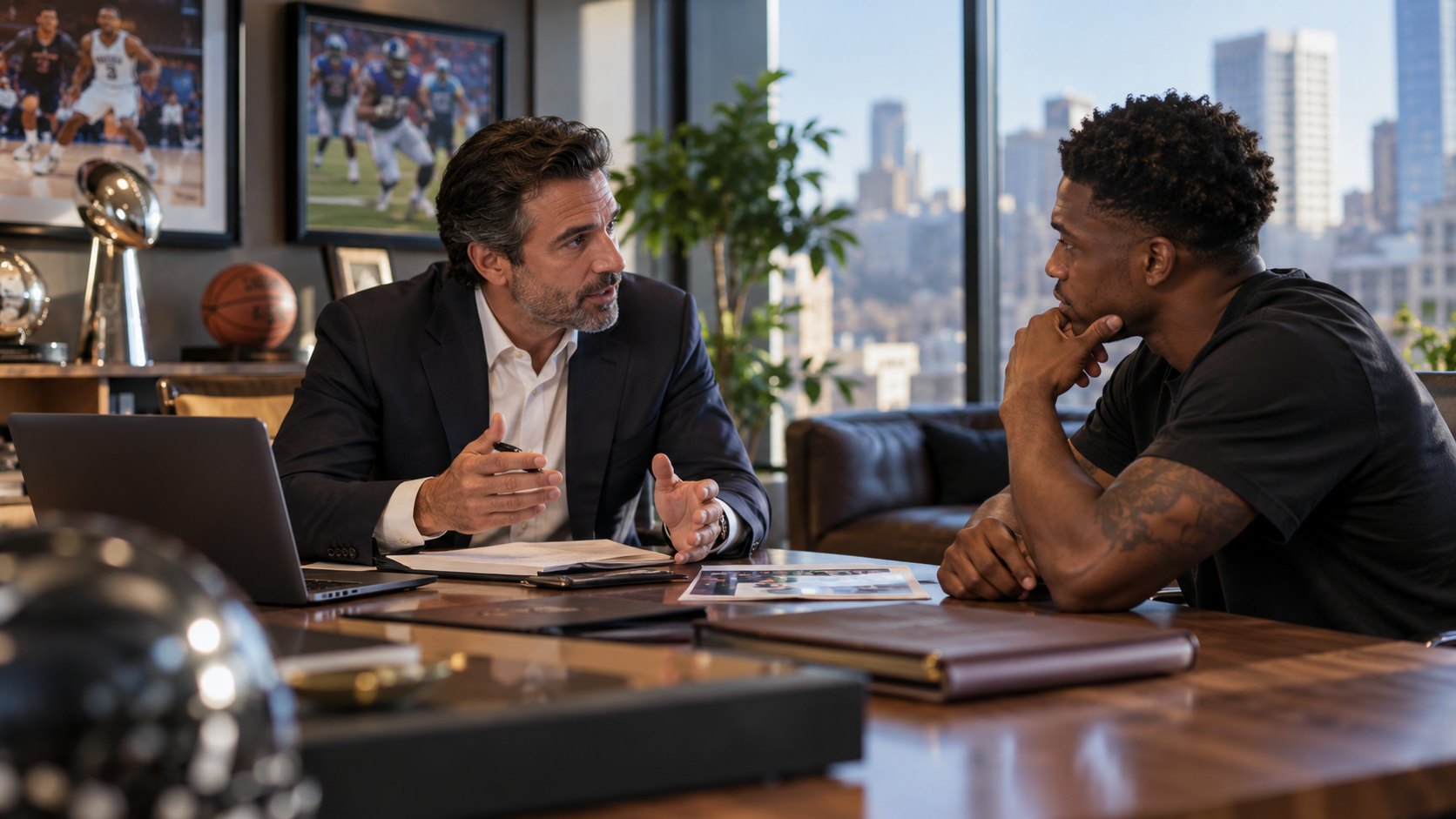
CZ 360 — Sports Agent
The line covers representing athletes, and sometimes coaches and other sporting staff, in their professional dealings: negotiating playing and coaching contracts, advising on and arranging moves between clubs, arranging sponsorship, endorsement and appearance agreements, handling image rights, managing media and public relations, planning a career across several seasons, and dealing with clubs, leagues and federations on the client's behalf.
The agent acts for the person, which is the boundary with booking
The nearest-looking line in the catalogue works the other way round. Artistic Talent Contracting (CZ 209) holds performers under agreement and supplies them to whoever is buying the evening — the firm's customer is the buyer. An agent's customer is the athlete, and the agent's job is to be across the table from the buyer rather than beside it. Representing a competitive gaming player under a mandate belongs here too, rather than with the e-sports line, for the same reason: the subject is one person's interests.
Placing coaching, medical or academy staff into jobs is recruitment rather than representation, and it carries the labour obligations that attach to employment. Running an event for a client — a testimonial, a tournament, a camp bearing his name — is event work with event permissions. And looking after what the client has earned is a different world again: advising on or managing somebody's money is a licensed financial activity in its own right and nothing a representation licence reaches.
seven kinds of work, four destinations
- Negotiating a player's move between clubsThe game decides who may act in its transfers
- Advising a club on a signing for a feeThe same transaction, represented from the other side
The sport's own authorisation, on top of the licence
- Arranging sponsorship and endorsement for an athleteCommercial representation with no sporting transfer in it
- Managing appearances, media and image rightsA representation service rather than a sporting transaction
The licence alone
- Placing a coach, physiotherapist or academy staffA person being employed rather than transferred
Recruitment, with the labour obligations of employment
- Running a tournament, camp or testimonial for the clientOwning or delivering an occasion, not representing a person
Events organising, with the event's own permissions
- Managing or advising on the client's moneyMoney advice is regulated on its own terms
A financial licence, which is a separate world
The gate that matters is held by the sport, not by a government
A trade licence lets the company exist, contract and invoice. It does not admit anybody to the transfer market. In several sports — football most visibly — a person may not act for a player or a club in a transfer unless he is authorised under the sport's own rules, and that authorisation is granted by the game through its international federation and the national body beneath it. It carries its own conditions, its own conduct obligations and its own disciplinary consequences, and it can be refused or taken away by a body that is not a government at all. Which sports require it, in what form, and what each one demands of the individual rather than the company is the first question to answer, because it decides whether there is a business at all.
Four further conditions attach to the work and are worth settling in advance.
The client may be a minor. Athletes become valuable young, which means a parent or guardian signs, and the sports themselves restrict how and when a young player may be approached and represented. This is the area where reputational damage is fastest and least recoverable.
The mandate is the business, so it has to be drafted like it. Scope, duration, exclusivity, the commission and how it is calculated, what survives termination and who is owed what on a deal signed after the agreement ends — an agency that is casual about this document is casual about its only asset.
A foreign athlete employed here is a worker. Playing or coaching for a UAE club on a salary brings work permits and labour contracts with the federal human-resources ministry, which is the club's obligation rather than the agent's but becomes the agent's problem when it is not in hand.
Image and endorsement rights are property. What a sponsor is buying is the right to use a person's name and likeness in defined ways, which is an intellectual property matter and the reason these agreements are longer than the playing contracts they sit beside. Medical and performance information about a client is personal data and belongs in the same category of care.
On structure, a free zone licence suits an agency whose clients and counterparties are abroad and whose UAE office is a desk rather than a shopfront, which describes much of this trade. A mainland licence suits one contracting with UAE clubs, leagues, academies and sponsors directly. Which wording covers representation as against recruitment, and what each authority will accept, depend on the emirate — and the sport's own authorisation sits on top of all of it. ConsultZone confirms both halves against the actual sport and client list.
References
- Dubai Sports Council — sports and recreation activities in Dubai, and the local sporting bodies an agency deals with. Dubai Sports Council
- Ministry of Human Resources and Emiratisation — work permits and labour contracts for athletes, coaches and support staff employed in the UAE. Ministry of Human Resources and Emiratisation
- Ministry of Economy — intellectual property, which is the basis of image, name and likeness rights in an endorsement agreement. Ministry of Economy
- UAE Government portal — federal law and general government information, including the handling of personal and medical data. UAE Government portal
- Federal Tax Authority — enrolment and filing on commission income, including fees earned on cross-border transactions. Federal Tax Authority
Elsewhere in Arts, Events & Entertainment
Activities that sit beside this one
Most licences carry more than one activity. Adding a neighbouring line at the application stage costs a fraction of amending the licence afterwards.
Begin with a clear conversation
Tell us what you intend to build.
A consultant will map the structure, jurisdiction, approvals and likely cost against what you actually described — not against a package.
