
Activity CZ 55
How to Start a Broadcast and Venue Equipment Installation Business in Dubai
Broadcast, cinema and theatre equipment installation is sold on the day the venue opens. What the activity covers, who buys it, and the conditions that attach to the kit itself.
ConsultZone licensing desk
- Activity code
- CZ 55
- Category
- Maintenance
- Reviewed
- Read
- 7 min
Listen instead
56 seconds
An audio summary of this guide.
Topic summary
How to Start a Broadcast and Venue Equipment Installation Business in Dubai
A studio, a cinema or a theatre has an opening date that was announced before the equipment was ordered. Everything about this licence line follows from that. The company that installs broadcast and venue systems is not selling boxes, and it is not really selling labour either — it is selling the certainty that the room will work on the night, and it is priced accordingly.
That makes it one of the better service businesses in the catalogue and one of the least forgiving. The work sits at the very end of a construction programme, after every delay upstream has already eaten the float, and it is the last thing anyone sees before the client's own deadline. The companies that survive in it are the ones that can mobilise quickly, commission under pressure, and be reached at eleven at night when a desk stops passing audio.
What the activity covers
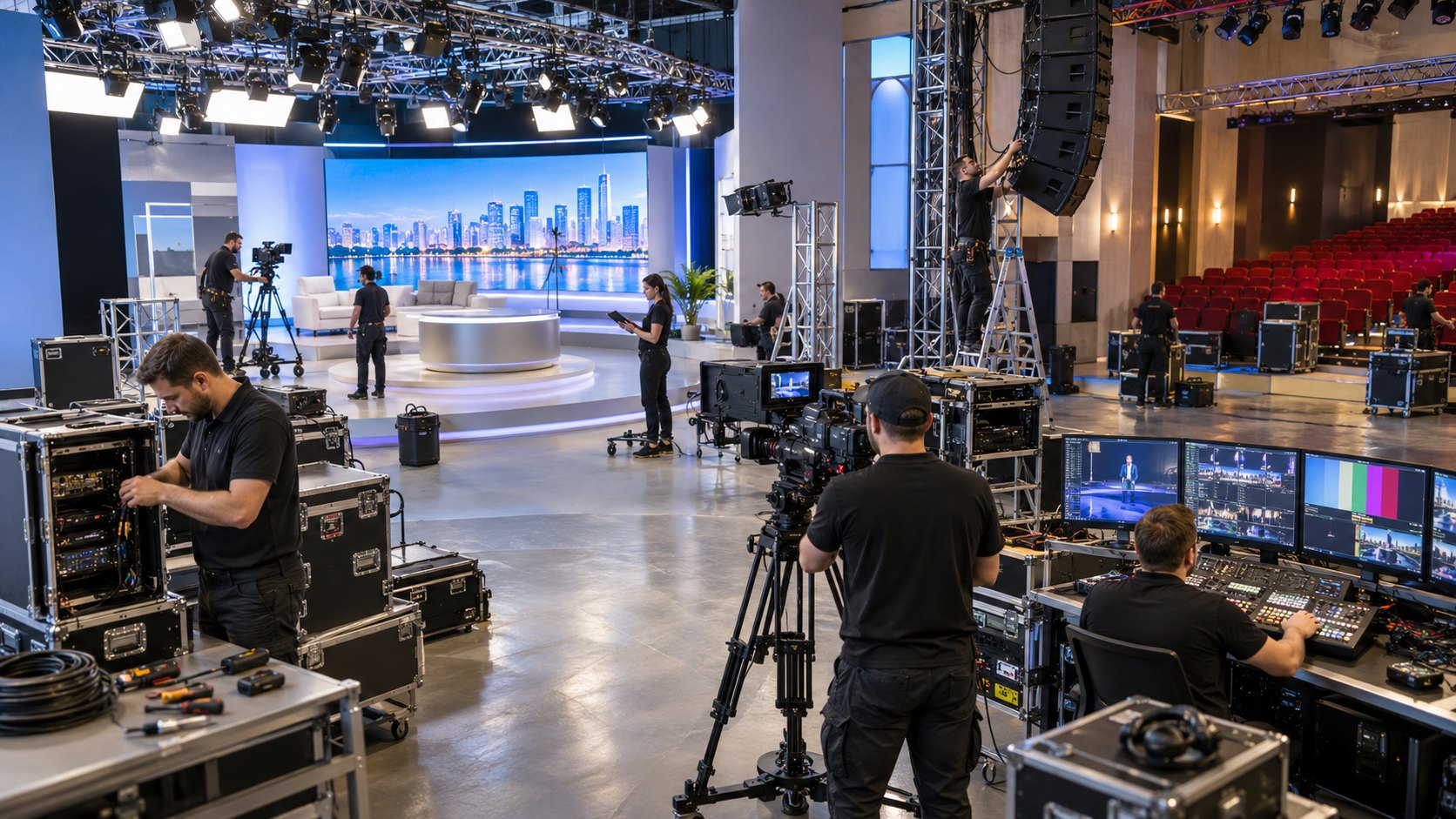
The name lists four settings — radio, television, cinema, theatre — and in practice they share a toolkit while behaving like four different customers.
Broadcast systems
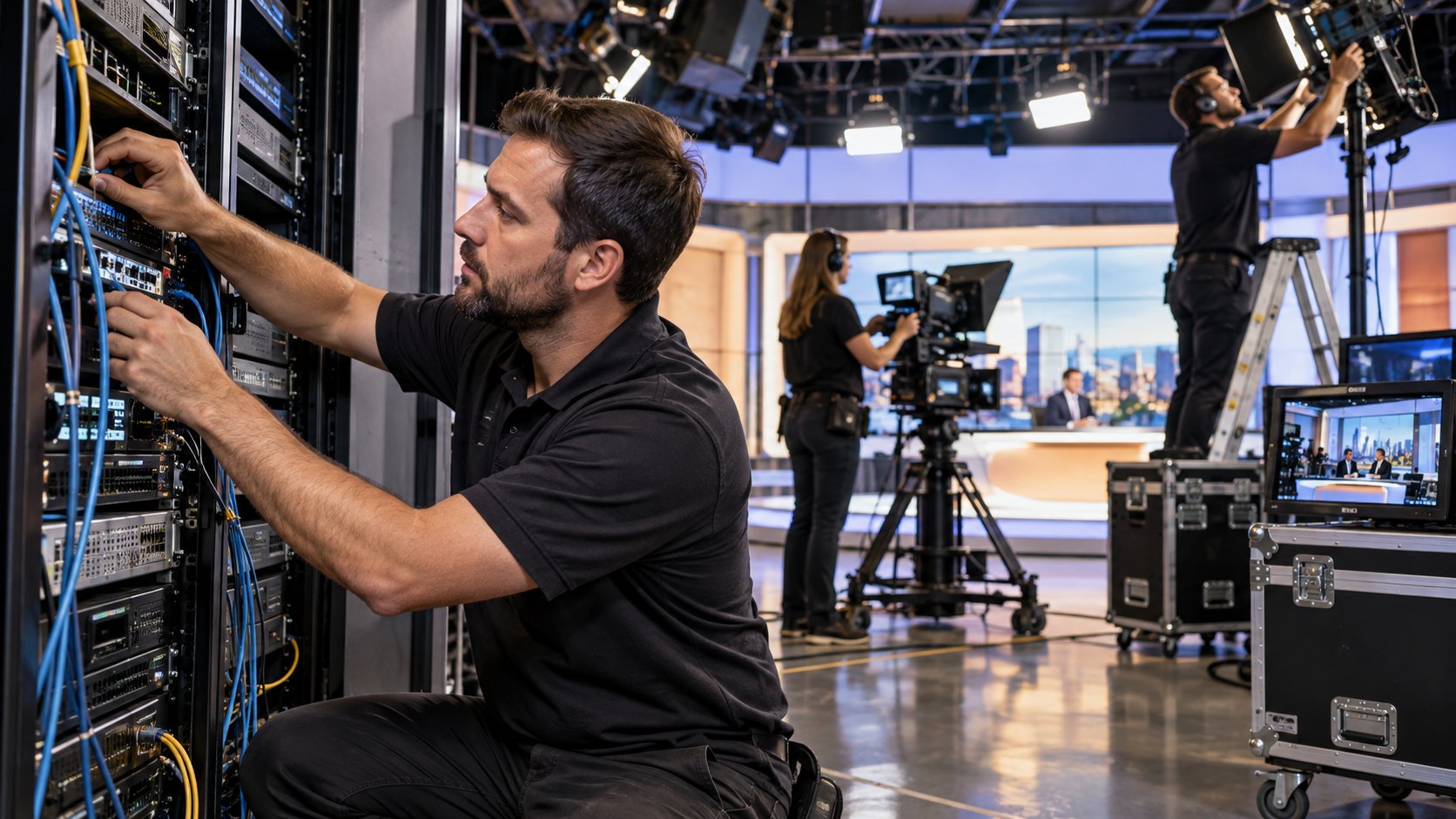
Cameras, vision and audio mixing, routing, intercom, lighting control, transmission chains, playout, and the racks that tie them together. The distinguishing feature is signal integrity: a broadcast installation is judged on whether it stays clean under load, and the commissioning is as much measurement as installation.
Cinema systems
Projection, immersive sound, screen and masking, and the automation that runs a session with nobody in the room. Cinema work is unusually standardised — the formats are licensed and the alignment tolerances are published by the format owner — which means competence is demonstrable and shortcuts are visible.
Live performance and venue systems
Stage lighting and control, line arrays, monitoring, rigging, and the motorised bars and hoists that move scenery and equipment above a stage. This is the part of the line where the work is physically consequential, because loads are suspended over performers and audiences.
Corporate and institutional rooms
Auditoria, lecture theatres, council chambers, houses of worship and hotel ballrooms. Technically the least demanding and commercially the most reliable, because the buildings exist in far greater numbers and they refurbish on a cycle.
The buyers, and the route to them
There are four buyers, and the route to each differs enough that most companies pick two and specialise.
Broadcasters and production facilities buy directly and technically. The conversation is with an engineer who knows more about the equipment than the salesperson does, the specification is written before tender, and the relationship survives on service rather than on price.
Cinema operators and their landlords buy per site, in rollouts, usually inside a main contractor's fit-out package. Winning one screen in a chain is how a company wins the chain.
Theatres, government venues and universities buy through procurement, against a consultant's specification, on published tender processes. Slow, documented, and the most durable revenue in the sector once a company is on the list.
Hotels, event companies and houses of worship buy the way commercial clients buy anything — on a recommendation, from somebody who answered the phone.
What it givesWhat it costs
- Broadcast and production facilitiesA technical reputation that travels, and service revenue outliving the installAn engineering payroll carried between projects
- Cinema rollouts through a main contractorRepeatable scope, and a programme somebody else managesTheir payment terms, and your place at the end of their float
- Government and institutional tendersThe most durable revenue in the sector once you are on the listA bid function, documentation, and patience to lose the first few
- Hotels, events and houses of worshipFast decisions, direct payment, no tenderSmall tickets, and a pipeline you rebuild constantly
Read that as a choice about working capital rather than about technology. The two routes at the top demand that a company carry specialist people between jobs; the two at the bottom let it grow out of cash flow, and cap how large it can get.
Conditions that attach to the goods
Three conditions attach to the equipment rather than to the company, and each is a reason the licence alone is not enough.
Anything that transmits needs type approval. Radio links, wireless microphones, in-ear monitoring, talkback and broadcast transmission all put energy into the spectrum, and equipment operating in the UAE has to be approved for use here. That is a telecommunications matter, decided by the national regulator rather than by the licensing authority, and it is the condition most often discovered late — by a company that has already shipped a wireless system in.
Anything suspended over people is a structural question. Motorised hoists, lighting bars, arrays flown above an audience and projection rigged above a rake are loads, and the people who care about them are the venue's engineers and the authority responsible for occupancy and safety. Competence there is not a matter of the licence either.
Anything in an occupied venue meets fire and life safety. Cable routes, penetrations, emergency lighting interfaces and the way a system behaves when an alarm sounds are governed by the building's own approvals, not by the audiovisual specification.
None of the three prevents a licence being issued. All three decide whether the installation can be handed over, which is a more expensive thing to find out afterwards.
What it costs to hold
It depends on the emirate, on whether the company sits on the mainland or in a free zone, and on the activity mix requested — a company that only installs is not the same filing as one that also imports and holds stock. We confirm the real figures for the specific case rather than quote an average that fits nobody.
Retrofit work happens in somebody else's gap
New-build is the easy half of this trade: an empty shell, a full working day, and nobody queueing behind the scaffold. The other half, and the one that never stops arriving, is replacement and upgrade work in venues that are already trading. There the scarce resource is neither labour nor equipment. It is access.
A cinema earns from its screens. A broadcaster is on air. A theatre has a run with a dated last night. So the work happens between the final screening and the first one of the next day, on a dark Monday, in the hours when a channel's audience is at its smallest, or in the short closure between one production striking the stage and the next loading in. The window is measured in hours, it was fixed before anybody looked at the drawings, and it does not move to suit a supplier.
Three habits follow, and they are what separate a company that does this from a competent installer who assumes it is the same work indoors.
Build it and prove it off site. Racks assembled, wired, configured and left running in your own workshop, so what arrives at the venue is a system that has already worked. The window is for installing, not for diagnosing.
Stay reversible until the house is dark again. The existing path stays live and patched around until the new one has survived a real show, and nothing is cut that cannot be put back before doors open. An over-run here is not a late job. It is a cancelled performance, and the loss is the night's takings rather than your invoice.
Carry the spares in the van. Ten minutes before doors, a courier is worth nothing, so whatever can fail inside the window travels with the crew.
The commercial consequence is the part newcomers get wrong. A price for the same equipment in an empty shell and a price for it in a working venue are not comparable numbers, and the second is higher for reasons that have little to do with the kit: night shifts, a crew sized for the window rather than for the hours of work inside it, two systems running in parallel for a period, and a fallback that has to exist and will probably never be used. Clients compare the two numbers anyway. The company that explains the difference before quoting usually keeps the job. The one that quietly matches the lower number finds out what it cost on the night.
References
- Telecommunications and Digital Government Regulatory Authority — type approval for radio, wireless and transmission equipment used in the UAE. Telecommunications and Digital Government Regulatory Authority
- Dubai Civil Defence — fire detection, emergency systems and life-safety approval in occupied venues. Dubai Civil Defence
- Dubai Municipality — building, fit-out and occupancy requirements that installed systems are tested against. Dubai Municipality
- UAE Government portal — the general framework for commercial licensing in the UAE. UAE Government portal
Elsewhere in Maintenance
Activities that sit beside this one
Most licences carry more than one activity. Adding a neighbouring line at the application stage costs a fraction of amending the licence afterwards.
Begin with a clear conversation
Tell us what you intend to build.
A consultant will map the structure, jurisdiction, approvals and likely cost against what you actually described — not against a package.
