
Activity CZ 205
How to Start an Agricultural Machinery Spare Parts Business in Dubai
The UAE machine fleet is small, so the first decision is which market you serve. What agricultural machinery spare parts trading covers, who buys it, and where the line stops.
ConsultZone licensing desk
- Activity code
- CZ 205
- Category
- Trading
- Reviewed
- Read
- 8 min
Listen instead
43 seconds
An audio summary of this guide.
Topic summary
How to Start an Agricultural Machinery Spare Parts Business in Dubai
A spare part for a tractor is one of the few goods whose value has almost nothing to do with its price. A hydraulic seal is cheap. The week of cutting it delays is not, and in a UAE summer an irrigation pump that stops in high summer does not cost a grower a repair bill — it costs him the field. That asymmetry is the entire commercial logic of this line. The customer is not shopping. He is stopping a loss, and what he pays for is availability rather than the component.
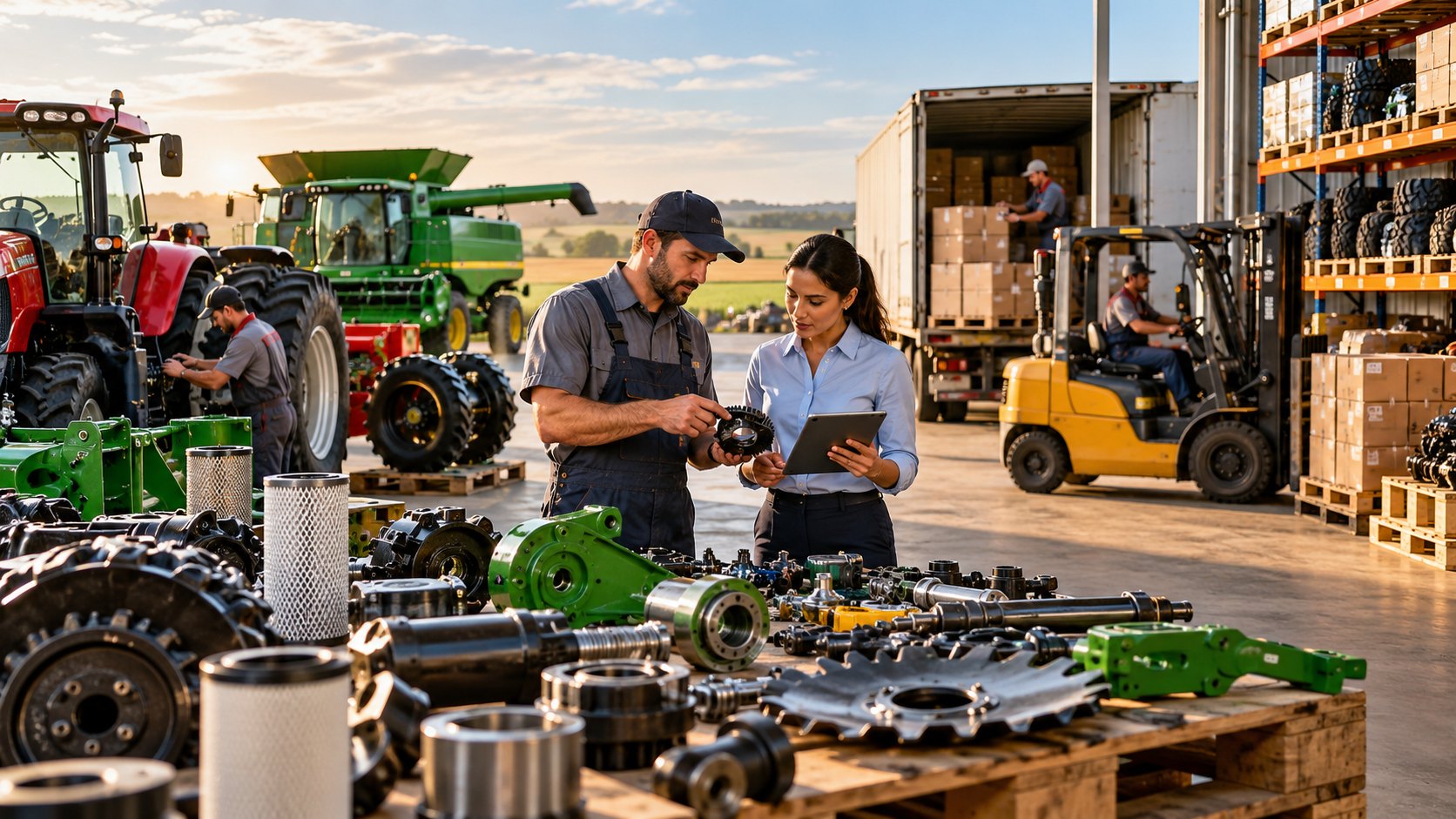
Agricultural Equipment & Machinery Spare Parts Trading is the licence line for exactly that transaction: supplying components for the machines that work land, water it, harvest it and handle what comes off it. Tractors and the implements behind them, irrigation pumps, filters and emitters, sprayers and spreaders, harvesting and handling equipment, and on livestock holdings the feed mills, milking plant and poultry-house machinery that run every day of the year.
Who this is for: the farm with a machine standing still
The second thing to understand is where the machines are, because it decides which business you are actually in. The UAE imports most of the food it eats and says so in its own food security strategy; a small cultivated area carries a correspondingly small number of machines. Domestic demand is therefore thin, concentrated in a handful of agricultural districts, and almost completely captive — there is no large field of competitors to shop against. The UAE's ports and re-export trade, meanwhile, reach farm economies whose fleets dwarf its own. Those are two different companies wearing one activity name, and the choice between them should be made before a lease is signed rather than after.
The grower with one platform and one season
The strongest domestic customer and the most demanding. He runs a short list of machines, knows their failure points, and will pay a premium for the item that is on your shelf today over the identical item that arrives next week. Win him once during a harvest and he stops calling anyone else.
The landscaping and grounds contractor
Easy to overlook and, in this country, a large share of the real demand. Municipal landscaping, hotel and resort grounds, golf courses and roadside planting all run mowers, blowers, trenchers, pumps and irrigation hardware in volume, under heat, with a maintenance budget that renews annually. The machines are smaller than a farm's and they are used far harder.
The dealer's parts counter, and the independent who undercuts it
An authorised dealer's parts department is supplied by the manufacturer and priced accordingly. The independent trader sits beside it offering original-equipment-equivalent components from the firms that actually make them for the brands, and that gap is where most of this trade lives. It is a legitimate business and it depends entirely on knowing which equivalent is genuinely equivalent.
The exporter serving a farm economy next door
Buys by the pallet, pays against documents, and cares about packing, part numbering and shipping dates rather than about your counter. The parts mix is different too, because the machines in those markets are older than the machines here.
Where this is the wrong licence. A founder whose real plan is to sell tractors, pumps or harvesters as machines is describing a machinery trading business, not a parts one. A founder whose plan is to send a technician out to a farm to fit what he sells is describing maintenance work. Both are separate activities with their own conditions, and discovering that after the licence is cut is an amendment nobody enjoys paying for.

CZ 205 — Agricultural Equipment & Machinery Spare Parts Trading
The line covers components, assemblies and consumable service items for agricultural and horticultural machinery: engine and transmission parts, hydraulics, filters and belts, bearings and seals, cutting and ground-engaging parts, irrigation components, and the electrical and control parts that newer equipment carries. New or reconditioned, supplied over a counter, delivered to a holding, or shipped onward.
Two realities sit inside that description and neither is visible from the activity name.
The money is in the long tail, and so is the loyalty. A handful of consumables — filters, belts, blades, seals, nozzles — turn over constantly and fund the operation. The awkward item for a twenty-year-old implement sells once a year and is the reason a customer rings you rather than a catalogue abroad. Carrying only the fast-moving lines produces a business with no defence; carrying the tail without discipline produces a warehouse of capital standing still. Which items belong in the tail is learned from the machines in your own district, not from a supplier's recommended stock list.
Fitment is settled by the machine, not by the model name. Agricultural equipment is sold into different markets in different specifications, rebuilt during its life, and routinely fitted with implements the original maker never supplied. The serial or data plate on the machine is the only reliable key to the correct component, and a trader who quotes from a verbal description will eat the returns. Getting the identification process right is a bigger operational decision than getting the supplier right.
The gates on a file like this are not where a newcomer expects them, and they are not clustered.
five gates, five different bodies, and no body holds two
The emirate's economic department
- Trade licence with the spare parts activity recorded on itFirst; nothing is quoted before it
The municipality
- Store or warehouse able to take long, heavy and awkward stockWith the tenancy, because the racking decides the catalogue
The emirate's customs authority
- An importer code held by the company itselfOnce the licence is cut, before a single order is placed abroad
The federal ministry responsible for agriculture and the environment
- Whether a line on the price list is an agricultural input rather than a machinery partWhen the catalogue is written, not when the container lands
The federal labour ministry
- Work permits for the warehouse and counter staffOnce the licence is cut
The shape of that drawing is the argument. Nothing concentrates: five gates, five deciding bodies, and the licensing authority holds exactly one of them. The gate that catches people is the fourth, and it is decided by a ministry that will never see your trade licence. A sprayer's pump, hoses and nozzles are machinery parts. The chemical that goes through them is not — it belongs to a controlled class with its own licensing, and the same split runs between a feed mill and the feed, between a milking line and the veterinary medicines used in the parlour. The decision point is the day somebody adds a line to the price list, which is why the catalogue is worth drafting before the licence application rather than afterwards.
What the licence does not cover
It does not cover the machines. Parts and whole equipment are different activities. Plenty of businesses hold both on purpose; none of them gets there by assuming the parts line includes the tractor.
It does not cover going out and fitting them. Repair, overhaul and field maintenance are their own activities with their own premises and manpower conditions. A trader who agrees to "just change it on site" for a good customer has stepped outside the licence for one job.
It does not cover the inputs that travel with the machine. Pesticides, fertilisers, seed and veterinary products are controlled classes in the UAE, licensed on their own terms and supervised federally by the authorities responsible for agriculture and the environment. The control attaches to the product, not to your shop, and it is assessed line by line.
It does not make you anybody's agent. Holding this activity confers no right to use a manufacturer's marks or to describe the business as an authorised distributor. That is granted commercially by the maker and sits inside the UAE's commercial agency framework.
It does not settle where you may sell. A mainland licence sells into the UAE market directly, to growers and contractors standing in front of you. A free zone licence is built for holding, consolidating and re-exporting stock that never enters the UAE market. A business serving UAE holdings belongs on the first; a regional distribution operation may well belong on the second. Which conditions attach, what the licence costs to hold and what a particular product class requires all depend on the emirate and the jurisdiction, and ConsultZone confirms them against the actual plan rather than in the abstract.
References
- Ministry of Climate Change and Environment — agriculture and animal health, and the treatment of agricultural inputs as a controlled class separate from machinery components. Ministry of Climate Change and Environment
- Dubai Customs — importer codes, tariff classification of machinery components and the clearance of each consignment through Dubai. Dubai Customs
- Abu Dhabi Agriculture and Food Safety Authority — agriculture and animal health in Abu Dhabi, where a large part of the UAE's farm machinery sits. Abu Dhabi Agriculture and Food Safety Authority
- Dubai Municipality — premises and storage suitability for a parts warehouse in Dubai. Dubai Municipality
- UAE Government portal — the National Food Security Strategy and the general basis on which trading activities are licensed. UAE Government portal
Elsewhere in Trading
Activities that sit beside this one
Most licences carry more than one activity. Adding a neighbouring line at the application stage costs a fraction of amending the licence afterwards.
Begin with a clear conversation
Tell us what you intend to build.
A consultant will map the structure, jurisdiction, approvals and likely cost against what you actually described — not against a package.
