
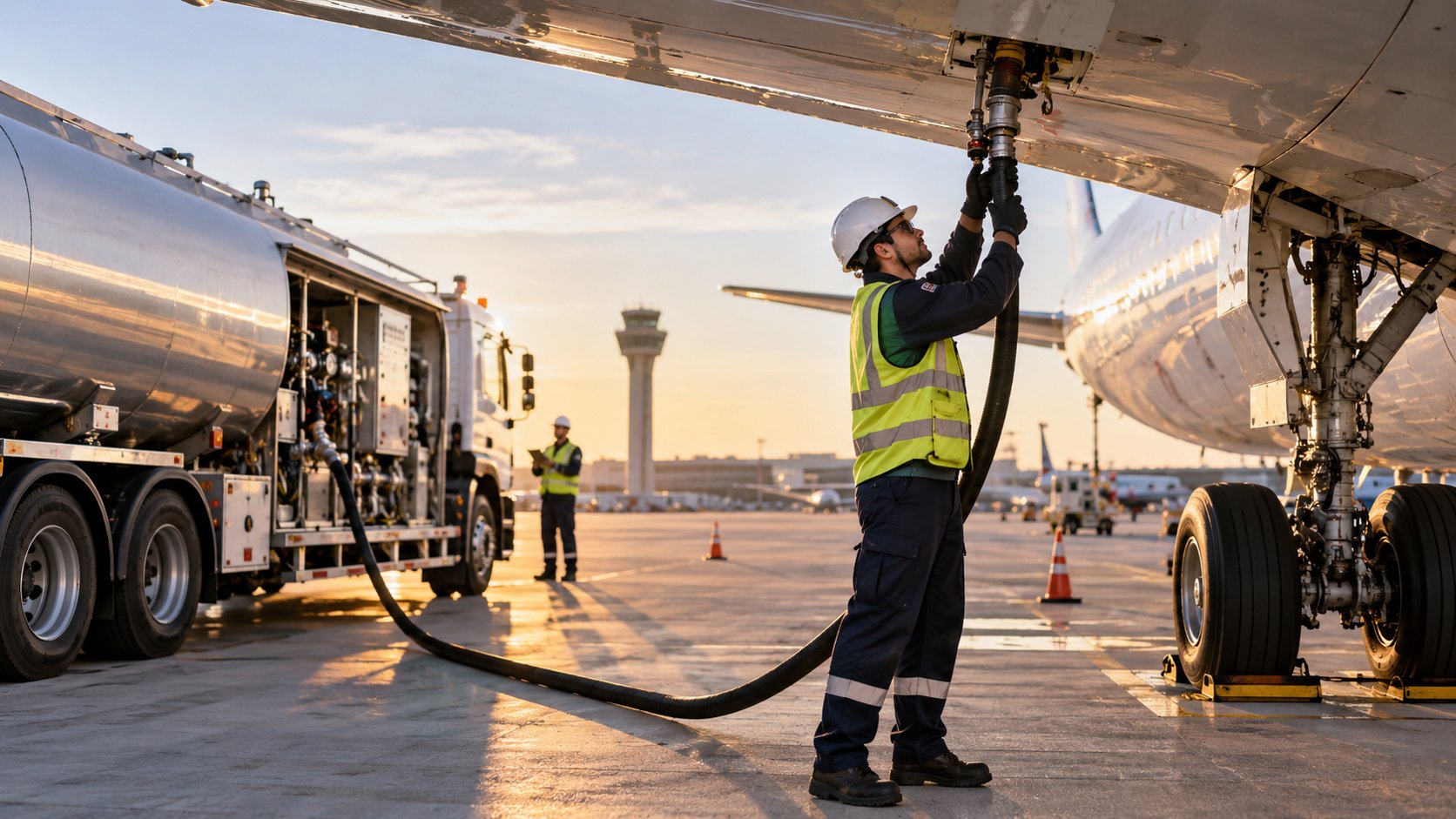
Activity CZ 200
How to Start a Jet Fuel Supply Business in Dubai
Jet fuel supply is an infrastructure business before it is a trading one. Where the money actually sits, what the activity covers, and the approvals that attach to the fuel itself.
ConsultZone licensing desk
- Activity code
- CZ 200
- Category
- Trading
- Reviewed
- Read
- 7 min
Listen instead
51 seconds
An audio summary of this guide.
Topic summary
How to Start a Jet Fuel Supply Business in Dubai
Aviation fuel looks like a commodity trade and behaves like an infrastructure business. The product is largely undifferentiated, the price is set somewhere else, and nobody chooses a supplier on the specification of the kerosene. What is bought and sold is access, certainty and quality assurance: the ability to put clean fuel into a specific aircraft at a specific airport within a specific window, and to prove afterwards that it was clean.
That is why this is one of the harder lines in the catalogue to enter and one of the most defensible once entered. A company cannot decide to fuel aircraft at an airport it has no agreement with, using equipment it does not have, operated by people nobody has approved. Every one of those is a separate permission held by a different party, and the trade licence is the least of them.
The UAE is nevertheless an unusually logical place to try. The country is a long-haul hub with enormous uplift volumes, a second hub in Abu Dhabi, a busy general-aviation and business-jet segment, and refining capacity in the region rather than across an ocean.
The commercial case
There are three distinct businesses inside this activity and they are not variations on each other — they are different companies with different balance sheets.
Into-plane fuelling is the physical operation: hydrant carts or refuellers, crews on the apron, and a contract with the airport operator that permits you to be there at all. Revenue is a fee per uplift. It is capital-heavy, operationally relentless, and the barrier to entry is the airport agreement rather than the money.
Bulk supply and storage sits behind that: bringing product into a fuel farm, holding it, and releasing it into the airport system. This is tankage, pipelines and quality control, and it is where the volume margin lives.
Supply arrangement and reselling is the asset-light version: contracting to supply an operator's fuel across multiple airports and buying the physical uplift from whoever holds the licence at each one. Business aviation runs largely on this model, because an operator flying to thirty airports wants one account rather than thirty.
judged on the same five rows
| Judged on | Into-plane fuelling | Bulk supply and storage | Supply arrangement and reselling |
|---|---|---|---|
| Who you must contract with | The airport operator | The terminal, the pipeline and the airport system | The aircraft operator, and a fuelling agent at each field |
| Capital required | Heavy — vehicles, crews, workshop | Heaviest — tankage and connection | Light — working capital and credit |
| Where the margin comes from | A fee per uplift | Volume through the tank | The spread, and the convenience of one account |
| Who can enter without an incumbent's permission | No | No | Yes |
| What a failure costs you | An aircraft delayed on your stand | Product quality across everyone downstream | A customer stranded at an airport you do not control |
The drawing marks the third route because it is the only one a new company can actually begin with. The other two are extensions bought later, usually after the customer relationships already exist.
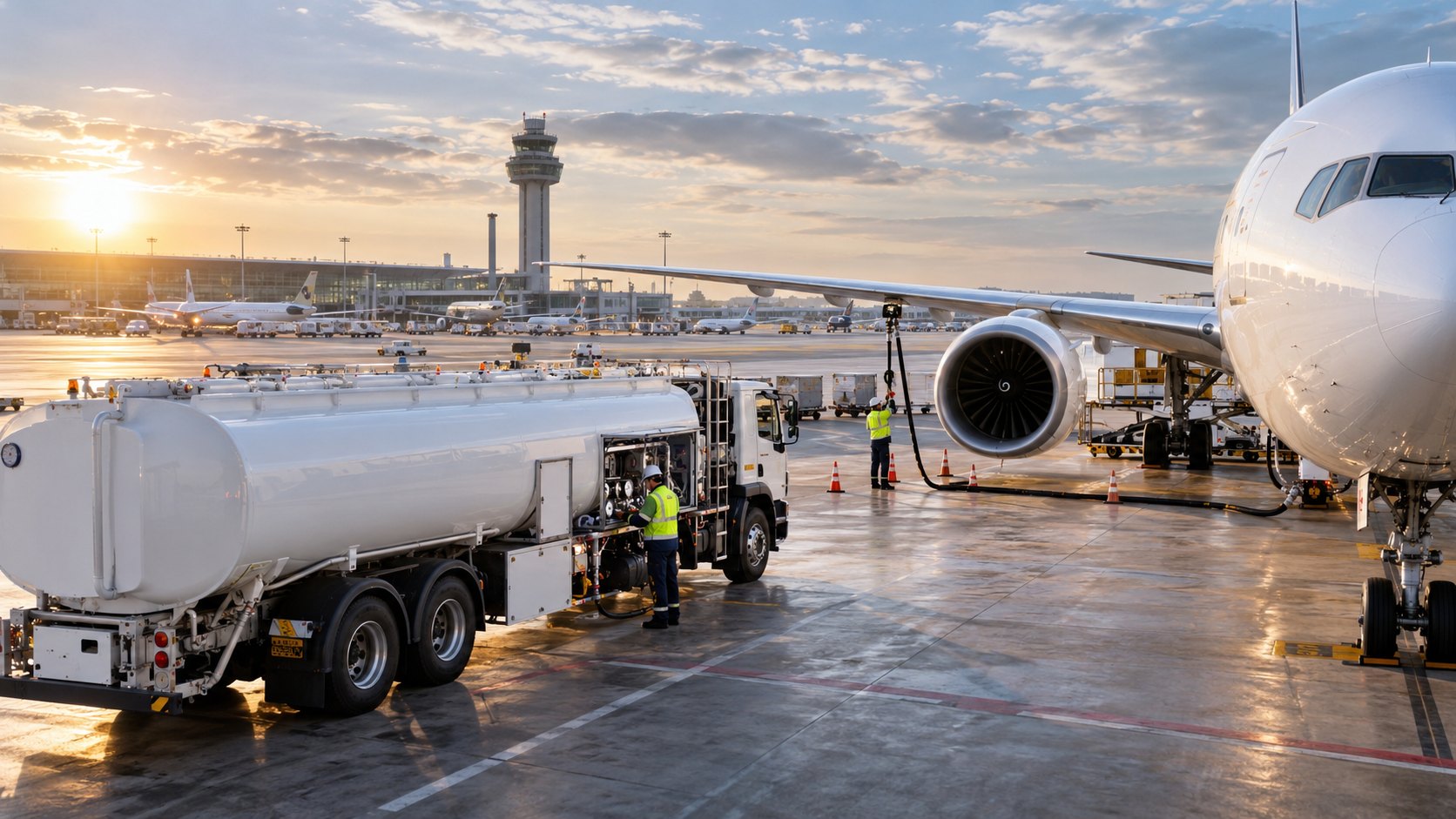
CZ 200 — Jet fuel supply services
Under this line you supply aviation fuel and the services that go with it. Four things are worth stating plainly about the scope.
Fuel quality is the product. Aviation kerosene is tested, filtered and documented at every transfer, and the record of that testing travels with the batch. A supplier's real deliverable is an unbroken chain of custody showing that what went into the wing met specification. Contamination is not a commercial problem; it is a flight-safety one.
Uplift happens on somebody else's property. An apron is controlled airside, so every vehicle, every driver and every pass is subject to the airport operator's own regime as well as to aviation oversight. Access is granted, not bought.
Measurement is where disputes live. Fuel is sold by mass, delivered by volume and affected by temperature. The conversion and the meter calibration are the commercial substance of an invoice, and they are the thing a serious customer audits.
Supplying fuel is not operating aircraft, and it is not refining. Handling fuel for a customer does not extend to maintenance, handling or ground services, each of which is its own activity and its own approval.
Approvals and conditions that attach to it
Almost everything constraining this business attaches to the fuel or the place rather than to the company.
Aviation oversight. Fuelling is part of aviation safety, so the national civil aviation authority has a view on procedures, training and quality systems, and the airport operator applies that view on its own site. A trade licence does not create airside access.
Flammable storage and handling. Bulk fuel is a major hazard: tank siting, bunding, firefighting provision, separation distances and emergency planning sit with the civil defence authority, and they are conditions on the premises rather than on the licence.
Environmental control. Vapour, spill containment, interceptors and contaminated water handling sit with the environmental authority, and a fuel farm is inspected as an industrial installation.
Customs and tax. Fuel moves under customs control, and the treatment of product supplied to international aviation is not the treatment of product sold domestically. Getting that classification right is a finance function, not an afterthought, and it materially changes the economics of a supply contract.
Insurance. No airport operator and no serious aircraft operator will contract without cover proportionate to the consequences, and the cost of that cover is a real barrier that is easy to leave out of a plan.
What it costs to hold
The licence fee is a small number inside a large one, and it depends on the emirate and the jurisdiction in the ordinary way. What actually determines the cost of entering this line is which of the three businesses above you intend to run, and none of that is decided by the licensing authority. We confirm the licensing position for the specific case and are straightforward about which parts of the plan sit elsewhere.
Sized for the peak, paid by the average
Fuel demand at a hub is not a flow, it is a series of waves. A long-haul connecting operation gathers aircraft into banks that land together, turn together and leave together, so uplift concentrates into a few hours and then very nearly stops. Business aviation is less predictable again, clustering around events, seasons and weather somewhere else. The number of refuellers, the number of crews and the shift pattern are all set by the busiest hour of the busiest day, and every one of those assets is then paid for out of a fee earned across the whole month. Average volume tells a plan almost nothing about what it has to own.
Inside the wave, the unit of time is a departure slot, and the slot is not yours. A turnaround runs to a published sequence, with fuelling alongside boarding, catering and baggage rather than ahead of them, so nothing downstream absorbs a late bowser. What lateness costs is not the minutes; it is the slot, and a slot lost at a congested airport is not won back by hurrying.
The figure is not final until shortly before the uplift. Payload, routing, the alternate and the weather all move the fuel requirement, so what a flight actually takes is frequently not what was ordered. A supplier who treats a revision as a new order is a supplier an operator replaces.
Unscheduled arrivals are part of the work, not an exception to it. Diversions, technical stops and delayed aircraft landing outside their window still expect to be served, and the capacity to serve them is the same capacity already sized for the peak.
So what customers punish is unreliability, and they punish it twice. An operator that loses a connection over fuel moves the account at renewal. The airport, watching a delay generated on its own apron, reopens the agreement that lets you be there at all. Before quoting a fee per uplift at any field, work out the shape of its day: the shape decides the equipment, and the equipment decides the fee.
References
- General Civil Aviation Authority — aviation safety oversight, including fuelling procedures, training and quality systems. General Civil Aviation Authority
- Dubai Civil Defence — flammable and bulk fuel storage, firefighting provision and emergency planning. Dubai Civil Defence
- Dubai Customs — customs control of fuel movements and the treatment of product supplied to international aviation. Dubai Customs
- Federal Tax Authority — the tax treatment of fuel supplied domestically against fuel supplied for international transport. Federal Tax Authority
- Environment Agency Abu Dhabi — environmental permitting for fuel storage installations in Abu Dhabi. Environment Agency Abu Dhabi
Elsewhere in Trading
Activities that sit beside this one
Most licences carry more than one activity. Adding a neighbouring line at the application stage costs a fraction of amending the licence afterwards.
Begin with a clear conversation
Tell us what you intend to build.
A consultant will map the structure, jurisdiction, approvals and likely cost against what you actually described — not against a package.
