

Activity CZ 64
How to Setup an Electric Cars Trading Business in Dubai
An electric car has no mileage worth quoting, only a battery. Trading them is a business about battery health, charging access and aftersales, not about novelty.
ConsultZone licensing desk
- Activity code
- CZ 64
- Category
- Trading
- Reviewed
- Read
- 6 min
Listen instead
46 seconds
An audio summary of this guide.
Topic summary
How to Setup an Electric Cars Trading Business in Dubai
Ask a buyer about a used petrol car and the first question back is the mileage. There is no honest equivalent question for an electric car. Two cars of the same model and the same year, with the same reading on the odometer, can be worth thousands apart because one of them has spent two years being fast-charged hard in Gulf summer heat and the other has not. Battery condition is to an electric car what mileage is to a combustion one, and almost every commercial decision in this trade comes back to that sentence.
The market here is real rather than aspirational. Federal policy openly favours electrified transport, charging has been built out across the main emirates faster than in most of the region, and the local fleet turns over quickly enough that a genuine second-hand supply now exists. What that produces is not a novelty trade. It is an ordinary vehicle business in which the single most valuable thing a dealer can offer is credible information about a component the buyer cannot see.
What you are trading is a battery with a car built around it
New stock and the maker's relationship
Selling new electric cars puts a company into the same position as any other new-vehicle seller. The maker's agency, its warranty and its allocation decide what can be sold and at what margin, and none of that is granted by a licence. Where a manufacturer supports its battery with a long warranty, that warranty is a large part of what the buyer is actually paying for, and it is worth understanding precisely rather than approximately before repeating it to anybody.
Used stock and the question nobody can answer by eye
This is where the interesting business is, and it is genuinely hard. A combustion car's history can be read from a service book and an odometer. An electric car's history is stored in the pack, and the useful measure is its state of health rather than its age. A trader who can produce a defensible reading of that, consistently, across every car in stock, is selling something the market does not yet reliably supply. A trader who cannot is guessing with their own capital.
What this line is not
Selling charging equipment is a trade in electrical goods, not in vehicles. Servicing, repair and anything involving opening a battery pack are workshop activities with their own lines in this catalogue. Reconditioning or re-celling packs is further still from a trading licence. None of these is forbidden; each is a separate activity, and a dealer who wants the aftersales income holds them deliberately.
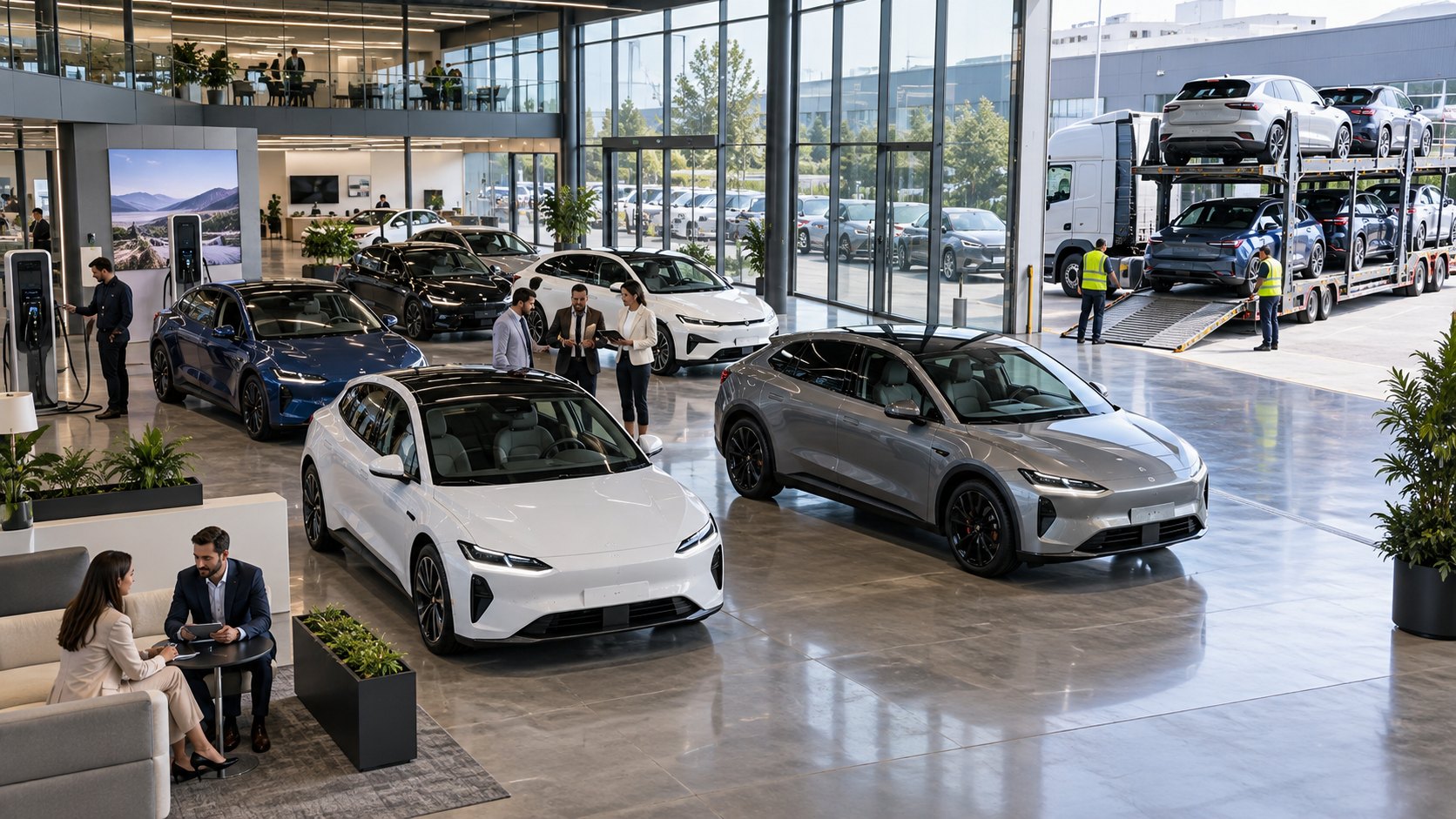
The buyer is doing arithmetic, not making a statement
Corporate and fleet buyers compare a cost per kilometre over a holding period, and they will do the sum properly. They are the most rational customers in the trade and the most demanding on residual value, because their whole case depends on what the car is worth when they hand it back.
Ride-hailing, limousine and taxi operators are where the running-cost argument is strongest, since they cover the distance that makes it work. They are also the hardest use a battery can have, which means the cars they retire are the ones a used trader must price most carefully.
Private buyers with somewhere to plug in — a villa, an allocated bay, a building that has installed charging. Their experience is straightforwardly good.
Private buyers without somewhere to plug in are the honest disqualifier in this business. A dealer who sells a car to somebody with no reliable charging has created a dissatisfied customer and a car that comes back onto the market early.
Export and regional buyers take stock into markets where charging exists. Demand is narrower than it is for combustion cars and it is concentrated in particular cities rather than whole countries, so it is a real channel and not the automatic clearing route the petrol trade enjoys.
They mostly arrive through the listing portals, through fleet tenders, and through repeat business from operators who already trust a supplier. Cars sell faster when the advertisement carries a battery report than when it carries adjectives.
The conditions that attach are mostly about high voltage
A pack is electrical work, not mechanical work. Anybody who opens a high-voltage system needs the competence and the equipment for it. A trading company that does not intend to hold a workshop activity needs a relationship with somebody who does, because a car with a suspected pack fault cannot simply be handed to a general garage.
Storing and charging indoors is a fire-safety question. Large lithium batteries are treated seriously everywhere, and the control a trader meets is the condition attaching to the premises: where cars may be charged, how many at once, what separation and what detection. That belongs in the conversation with the landlord and the civil defence authority at the point of taking the unit, not afterwards.
A large battery is controlled cargo when it moves. Shipping vehicles that contain them, and shipping a damaged pack in particular, is restricted in ways ordinary vehicle freight is not. It affects import planning and it affects what can be done with a car that has been in an accident.
Charging has to exist at both ends of the sale. The showroom needs enough electrical capacity to keep stock charged and to demonstrate a car; the buyer needs a plug they control. Neither is an approval in the licensing sense, and both have stopped deals that were otherwise agreed.
Those conditions do not all sit with the same body, which is the practical thing to understand about this file before starting it.
six gates, six different holders
The emirate's economic department
- Trade licence carrying the vehicle trading activityFirst, and nothing else moves until it exists
The emirate's traffic and transport authority
- Each car's ownership record and its transferPer vehicle, every time, and it is where a sale completes
The emirate's customs authority
- Clearance of the vehicle and the battery inside itBefore the first imported unit lands
The civil defence authority
- Fire-safety conditions on storing and charging indoorsWith the premises, not after taking them
The electricity utility and the building owner
- Charging capacity at the showroom and at the buyer's buildingBefore charging is promised to anybody
The federal tax authority
- Tax treatment of a domestic sale and of an exportContinuously, and the two are not the same
This is an unusually flat drawing, and that is the finding. In most trades the licensing authority dominates and everything else is incidental. Here six gates belong to six different bodies, so the work is coordination rather than paperwork, and the two most frequently underestimated are the last two — the ones that are not approvals at all.
The figures nobody can responsibly give you in advance
Licence cost, premises, electrical capacity, the charging installation, and any approval a particular vehicle category attracts all depend on the emirate, the jurisdiction and the specific building. A company importing a container of used cars and a company taking a franchised showroom hold comparable words on a licence and nothing else in common. We establish the actual numbers for the actual plan.
References
- UAE Government portal — federal energy and mobility strategy, and the policy environment behind electric vehicle adoption. UAE Government portal
- Roads and Transport Authority — vehicle records, ownership transfer and transport permits in Dubai. Roads and Transport Authority
- Dubai Customs — import clearance for vehicles and for the lithium batteries inside them, and the position on restricted goods. Dubai Customs
- Dubai Civil Defence — fire-safety conditions on storing and charging high-voltage batteries on commercial premises. Dubai Civil Defence
- Federal Tax Authority — value added tax on domestic sales and on exports, and corporate tax filing. Federal Tax Authority
Elsewhere in Trading
Activities that sit beside this one
Most licences carry more than one activity. Adding a neighbouring line at the application stage costs a fraction of amending the licence afterwards.
Begin with a clear conversation
Tell us what you intend to build.
A consultant will map the structure, jurisdiction, approvals and likely cost against what you actually described — not against a package.
