
Answered plainly
RAKEZ is two jurisdictions sharing one licence desk, and the cheaper side cannot sell to the UAE
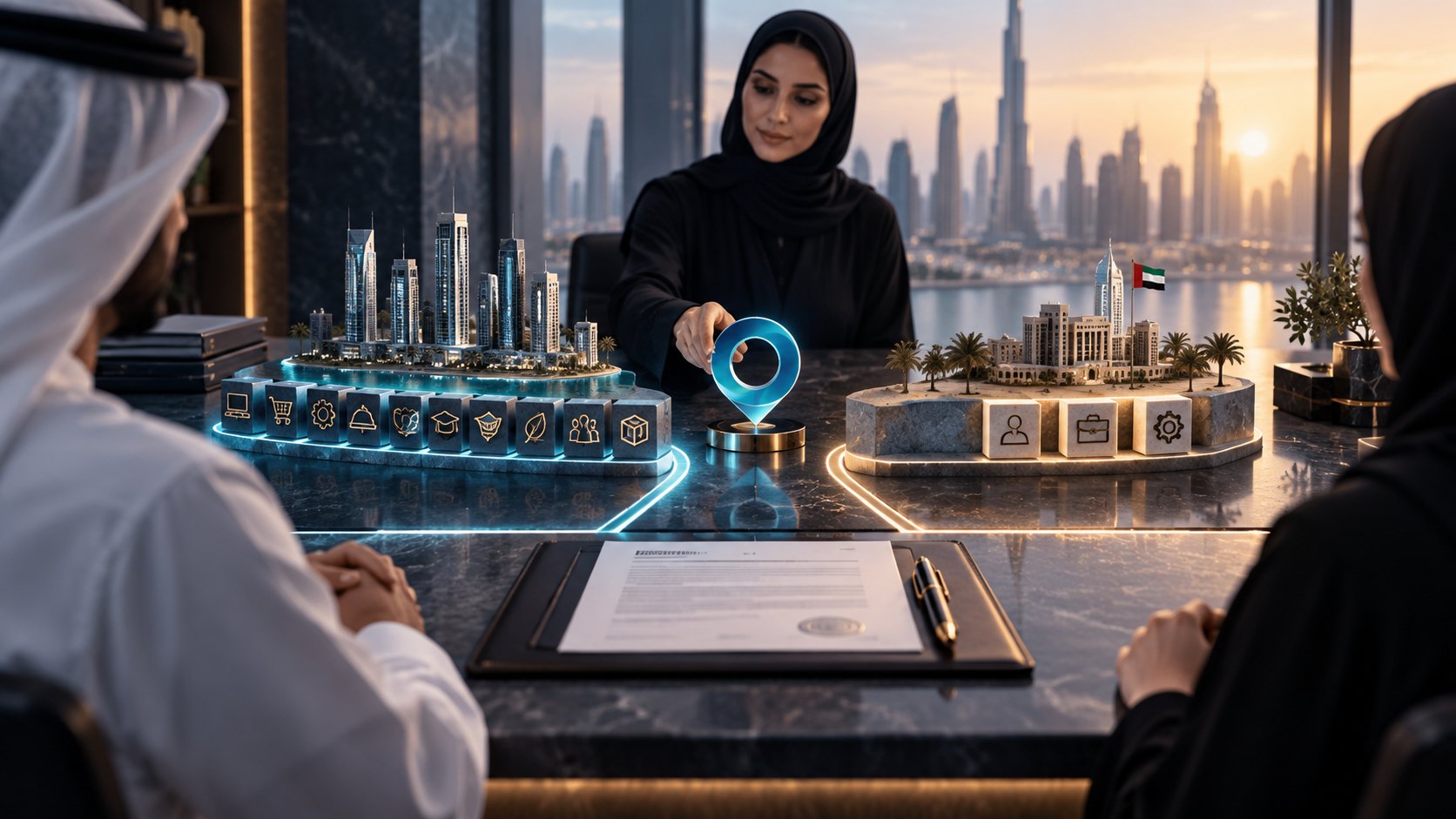
RAKEZ licenses on both sides of the free zone boundary, and the side you land on decides which licence categories exist for you, who you may invoice, and how many licences you carry.

The decision RAKEZ hands you before it hands you a price
Every quotation you will be sent for a Ras Al Khaimah company describes one product: a licence, a desk, a visa allocation, a number at the bottom. The authority issuing it does not work that way. RAKEZ licenses on both sides of the free zone boundary, and which side you land on decides more about the next three years than the number on the quotation does.
It decides which licence categories are available to you at all. It decides whether you hold one licence or two. It decides whether you may invoice a customer in Dubai directly or must place somebody between you and that revenue. And it is not a decision you can count on revisiting. The Commercial Companies Law now lets a company move from a free zone to the mainland authority, or back, keeping its legal personality — but only where the systems on both sides allow the move and both authorities approve it, and neither of those is in your hands. Where the move is not available or not approved, crossing from one side to the other means a new entity, a new licence, new permits and a new bank account.
Almost nobody puts this choice to a client, because the free zone side is quicker to sell. So put it to yourself. What follows is the choice, not the brochure. The zone itself — what it runs, what it charges, what compliance follows the licence — is set out in the RAKEZ free zone profile, and this page assumes you have read it or will.
One question decides the side, and it is not about cost
The two routes are usually compared on price. That is the wrong axis, because they are not two prices for the same thing. They are two different permissions.
The question that settles it is: who signs the invoice you most need to be able to raise?
If that counterparty sits outside the UAE — an overseas client, an overseas buyer of goods you hold in a RAKEZ warehouse, a group company abroad — the Free Zone Area answers it, and the non-free zone route buys you nothing you will use. If that counterparty is a UAE business outside the zone, the Free Zone Area does not answer it directly. The Operating Rules are explicit: a Free Zone Entity may sell elsewhere in the UAE only through an agent, representative, distributor or a parent company holding an appropriate UAE licence. Everything else follows from whether you can live with that sentence.
That last row is the one people resist, and it is why a cheap licence is sometimes written off in year two. If the plan depends on selling to Dubai's public sector, no licence from another emirate substitutes for one issued in Dubai.
the one question this page opens and closes on
- Write the activity as a bank would read itEverything downstream depends on it
- Find the licence category that activity falls intoNine exist inside the Free Zone Area, three outside it
- Check that category exists on your customers' sideSix of the nine have no non-free-zone counterpart
- Who signs the invoice you most need to be able to raise
- A counterparty outside the UAEThe Free Zone Area answers it, and the non-free-zone route buys nothing you will use
- A UAE business outside the zoneReachable only through an agent, distributor or a parent company holding UAE permission
- A Dubai public-sector buyerNo licence from another emirate substitutes for one issued in Dubai
- Which of the two RAKEZ sides you are licensed onTwo different permissions, not two prices for one thing
Nine categories on one side, three on the other — and the category outlasts the choice
This is the part of the RAKEZ decision that is almost never explained, and the part that cannot be fixed later.
Inside the Free Zone Area the Operating Rules make nine licence categories available: Industrial, Commercial, General Trading, Service, E-Commerce, Educational, Media, Individual or Professional, and a Freelance Permit for sole practitioners trading under their own name. In the Non-Free Zone Area the list narrows to three: Industrial, Commercial and Professional.
Read that as a constraint on the decision rather than a footnote to it. Six of the nine have no non-free-zone counterpart at RAKEZ. If your activity is naturally an e-commerce, media or educational one and your customers are UAE businesses outside the zone, RAKEZ does not offer you both things at once. You choose: the category that describes the business, or the permission to sell to the market.
licence categories
- Free Zone Area only6No non-free-zone counterpart at RAKEZ
- Both sides of the boundary3Industrial, Commercial and Professional
nine categories in the Free Zone Area9
Two consequences worth stating plainly. Categories do not blend: activities inside one of them can generally share a licence, and an activity from a second category generally needs a licence of its own — so a business that both consults and trades is a two-licence business before it has hired anybody. And the category sets the premises class, the premises class sets the visa arithmetic, and so a category chosen for price in month one becomes a lease renegotiation in month fourteen. The general form of that trap is in commercial, professional or industrial, and the wider set of one-way doors in the setup decisions you cannot undo later.
For the last row of that table the tax treatment decides it rather than the fee, and that comparison is in working alone in the UAE.

Who RAKEZ suits, tested by weight rather than by budget
The honest test is physical. What RAKEZ has that no low-cost Dubai zone has is room — built warehousing, plots you can develop, permanent power, on-site accommodation, and land at northern-emirate prices. That advantage is real in exact proportion to how much of it you occupy, and worth nothing at all to a business that occupies none.
If nothing in your plan has weight, the comparison that matters is not RAKEZ against Dubai. It is RAKEZ against the zones that are cheaper and closer, which is a comparison RAKEZ tends to lose. That comparison is worked in a free zone is a cluster before it is a price.
The distance is a recurring cost, so price it as one
The emirate sits roughly 100 km up the coast from Dubai, which in reasonable traffic is around seventy minutes in each direction and materially longer when the traffic is not reasonable. Quotations treat that as a lifestyle note. It behaves like a monthly operating expense, and it is the line item most often left out of the comparison that led someone here.
Price it in half-days, because that is the unit it consumes. A meeting in Dubai is not an hour; it is most of an afternoon. Count how many of those the plan needs each month, then ask whether the licence saving covers them.
Read the last two rows together. Distance is an advantage for things that arrive and a cost for things that leave, and your business is mostly one or the other. That is the arithmetic. The same calculation for a first licence anywhere outside Dubai and Abu Dhabi is in what the cheaper emirates charge you.
the trade-offs this page works through
What you gainWhat you give up
- Licence categoriesNine, from industrial through to a freelance permitSix of them have no non-free-zone counterpart here
- Who you may invoiceOverseas clients, and buyers of goods held in a RAKEZ warehouseA UAE customer outside the zone needs an agent, distributor or parent company
- RoomBuilt warehousing, plots to develop, permanent power, on-site accommodationWorth nothing at all to a business that occupies none of it
- DistanceAn advantage for everything that arrivesRoughly 100 km and about seventy minutes each way, counted in half-days
- Corporate taxA free zone company may qualify for a 0% rate on qualifying incomeCumulative conditions, including audited financial statements
- Leaving laterThe law lets a company move and keep its legal personalityOnly where both systems allow it and both authorities approve
If market access is the point, compare four routes and not two
Founders who discover the restriction late tend to be offered one fix. There are four, and they price very differently.
That last caution deserves its own sentence, because it is being repeated carelessly. Dubai opened a route in 2025 under which free zone establishments may apply to the Department of Economy and Tourism for a branch licence, or a permit to carry out specified activities for a limited period, outside their zone. The addressees are establishments licensed in Dubai's own free zones. A RAKEZ entity is not one of them. Until DET says otherwise in writing about your activity, plan on the ordinary branch route instead.
One ownership point runs underneath all four routes. On the free zone side, every share can be held by foreign individuals or foreign companies and no UAE partner is required at any stage. Outside the zone the federal position also removed the national majority requirement for most activities — but the permission to trade there is granted activity by activity by RAK Department of Economic Development, and RAKEZ's own published material has at times lagged the federal position. So get it in writing against your exact activity before anyone draws a cap table, because the same question costs a sentence beforehand and a reorganisation afterwards.
the gates this decision actually turns on
RAKEZ
- Which licence categories exist on each sideBefore a quotation means anything
- Whether a second category needs a licence of its ownThe month you add the second activity
- The premises class the category carriesIt then sets the visa arithmetic
RAK Department of Economic Development
- Whether foreign shareholders may be licensed outside the zoneActivity by activity, before anyone draws a cap table
Department of Economy and Tourism
- Whether the 2025 Dubai route reaches an entity licensed elsewhereIn writing, or plan on the ordinary branch route
Both authorities, one on each side
- Whether a move keeping legal personality is available at allCompany law gives no general free-zone-to-free-zone route
Where this is the wrong decision
There is a version of this decision in which the answer is somewhere else, and it is worth more to you than the licence fee is to us.
When cost is the only reason. If you need no warehouse, no plot and no industrial category, closer zones cost less and cost you fewer half-days. Room is what you are buying here, and a company that takes none of it has bought the penalty and left the benefit on the table.
When the zone is being chosen before the category. This is the most expensive version of a right answer in the wrong order. The category dictates the premises, the premises dictate the visa arithmetic, and the category is harder to change than the zone. Anyone who quotes you a zone before asking what the activity actually is has skipped the part that binds.
When the business needs a financial regulator. Banking, insurance, fund management, payment services and virtual asset activity are not in RAKEZ's gift, and no amount of licensing here substitutes for the authority that does hold them.
When credibility is load-bearing. Raising institutional money, selling to large corporates and opening a difficult bank account all get marginally harder on this licence than on one from a jurisdiction the counterparty already knows. Each instance is small. There are a great many instances.
When the plan quietly assumes you can move later. Company law gives no general route from one UAE free zone to another, so whether a company can move between two zones depends on both zones' own rules; a move between a free zone and the mainland needs the systems on both sides to allow it and both authorities to approve. The two sides of RAKEZ are two entity types rather than two settings on one. Where no move is available or approved, leaving means starting the entity again, with everything attached to it — moving between free zone and mainland after you have chosen sets out what that actually costs.
And where we are the wrong adviser. A firm that is a channel partner for one zone will recommend that zone. Ask whoever is advising you which other zones they can actually file in, and ask for the version of the recommendation in which RAKEZ is not the answer. If that version does not exist, you have learned something about the advice rather than about the zone.
What to settle before you pay anything
Three answers, in this order, and none of them is a price. First, the activity, written the way you would describe it to a bank rather than the way it appears on a package sheet. Second, the licence category that activity falls into, and whether that category exists on the side of the boundary your customers are on. Third, who signs the invoice you most need to raise — because that answer, not the quotation, decides which RAKEZ you are buying.
If you want that worked against your own numbers instead of against a package, put the question to us with the activity and the customer named, and we will tell you when the answer is somewhere else.
Frequently asked questions
Is a RAKEZ licence valid across the UAE?
No licence is. A Free Zone Entity's licence is valid inside the Free Zone Area, and reaching a customer elsewhere in the country needs an agent, distributor or parent company holding appropriate permission. The general shape of that problem is in your licence was issued by one emirate.
Can one company hold both a free zone and a non-free zone licence here?
They are different entity types rather than two permissions on one entity, so this is a question about holding two companies. Put the structure to RAKEZ before assuming it, and price the second set of annual costs before you like the idea.
Does a RAKEZ licence mean no corporate tax?
No. Corporate tax is federal and no zone can exempt you from it. A free zone company may qualify for a 0% rate on qualifying income, but the conditions are cumulative and include audited financial statements, which for a small consultancy can cost more than the rate saves. Are UAE free zone companies still tax free works through what survived.
Is RAKEZ the same as RAK ICC?
No, and the confusion costs money. RAK International Corporate Centre is a different authority altogether, forming offshore companies: no trade licence, no premises, no residence permits, and none of the decision described on this page. A quotation for a strikingly cheap "RAK company" is often for that product, so ask which authority is being named before anything is paid.
We only want the cheapest possible licence. Is that a reason to come here?
It is a reason to compare RAKEZ against the cheaper and closer zones rather than against Dubai, and to read what a low-cost UAE licence leaves out first. The licence is rarely where the money actually goes. The distance charges you every month you operate from here and sell into Dubai, and a licence category that cannot reach your customer is not cheap at any price. Settle the activity and the customer, then compare.
Begin with a clear conversation
Tell us what you intend to build.
A consultant will map the structure, jurisdiction, approvals and likely cost against what you actually described — not against a package.
