

Activity CZ 151
How to Start a Household Appliances Wholesale Business in Dubai
An appliance carries a warranty obligation, so a household appliances wholesaler sells a liability alongside every box. Retailers choose suppliers on how spares and claims get handled.
ConsultZone licensing desk
- Activity code
- CZ 151
- Category
- Trading
- Reviewed
- Read
- 6 min
Listen instead
51 seconds
An audio summary of this guide.
Topic summary
How to Start a Household Appliances Wholesale Business in Dubai
A washing machine leaves your warehouse once and comes back to you twice — once as a warranty claim, and once as a request for a part that the factory stopped making three model years ago. That is the shape of this trade, and it is what separates appliances from almost every other class of goods a wholesaler can carry. You are not moving a box. You are moving a box plus an obligation that somebody will repair what is inside it, and the retailer writing your purchase order knows perfectly well that he is the one who will take the customer's phone call.
Price wins the first order. What happens in the eighteen months after the sale wins the second one, and the second order is where this business actually lives.
What the line covers, and the split that runs straight through it
The activity carries the full domestic range: refrigerators, freezers, washing machines, dryers, dishwashers, cookers, ovens, extractors, water heaters, air conditioners, and the small end — kettles, toasters, blenders, food processors, irons, vacuum cleaners, microwaves, fans, air purifiers.
Written as one line, it reads as one trade. It is two, and the division is not by brand or by price but by weight and by what happens when the goods fail.
Large white goods are a freight and handling business. A container holds few units, each one is heavy, each one is easily damaged in transit, each one needs two people and a trolley to move, and each one has to be delivered to an address rather than handed over a counter. Damage in transit is a real and recurring cost line, not a rounding error. When one fails under warranty, somebody has to attend the customer's home, because a refrigerator does not get carried back to the shop.
Small domestic appliances are a stock-turn business. They arrive many to a carton, they sell in volume through retail and online, the unit margin is thin, and the buying is about getting the range and the price point right. When one fails it is replaced rather than repaired — a technician's hour is a large fraction of the product's value, so the honest commercial answer is a swap, and your warranty exposure is the replacement cost multiplied by a failure rate you should be able to estimate before you commit to a shipment.
Most established wholesalers carry both, because the retailer wants one supplier and one invoice. They should not be run as one stock plan.
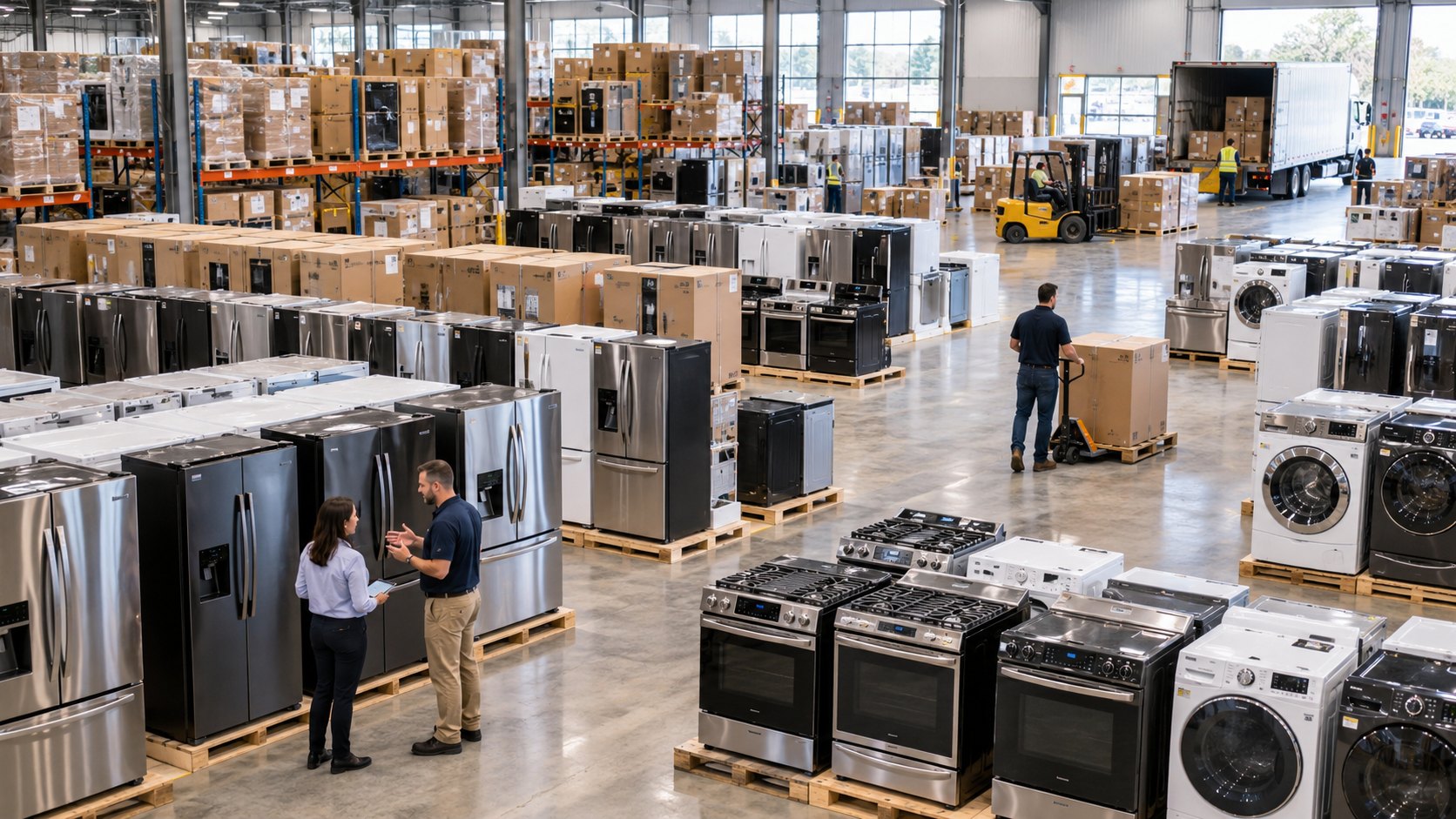
The retailer is buying your service department as much as your price list
The buyers divide more cleanly than the goods do.
Independent electrical and electronics retailers are the traditional core: small orders, frequent, delivered, credit expected. They are price-sensitive and supplier-loyal at the same time, which sounds contradictory until you watch one change supplier after a warranty claim goes badly. Hypermarket and chain buyers place large scheduled orders against a listing and a promotional calendar, they pay on their own terms, and they will hold you to a spares commitment in writing.
Then there are the buyers who are not retailers at all. Contractors and developers fitting out apartment blocks buy identical appliances in volume, once, and then vanish — profitable, lumpy, and no repeat. Hotels, serviced apartments and staff accommodation operators buy to a specification and come back on a replacement cycle, which is the most valuable pattern available in this trade. Facilities management companies buy for the buildings they run. Online sellers buy small appliances in quantity and hold almost no stock themselves, so they need you to ship fast and they will not carry your inventory risk.
The route to all of them runs through the same two things: what you hold on the shelf today, and what you do when something breaks. A wholesaler with a parts room and a technician on the payroll is selling something a container-flipper cannot match, and can price accordingly.
| Large white goods | Small appliances | Spares and service | |
|---|---|---|---|
| What one order looks like | Few units, heavy, delivered | Cartons, many to a box | One part, needed today |
| Where the freight cost lands | High per unit, damage is real | Low per unit | Negligible |
| Who attends a failure | A technician, at the address | Nobody, it is swapped | You, by courier |
| What a warranty claim costs you | A visit, a part and the time | The replacement unit | Nothing, it is the product |
| Where the margin actually sits | Volume orders and delivery | Range and price point | Highest of the three |
Spares earn the row they get in that drawing. It is the least glamorous stream, it moves the least money, and it is the reason a retailer keeps calling. A wholesaler who cannot supply a door seal or a drain pump for the machine he sold two years ago has taught his customer to buy the next one somewhere else.
What attaches to the goods before they reach a shelf
Appliances are consumer products that draw power, touch water and get handled by children, so they sit inside the national standards and conformity system rather than outside it. The shape of that control is worth understanding even where the detail belongs to the specific product.
Conformity with national standards, and the marking that evidences it, is administered federally by the ministry responsible for industry and standards. Energy-consuming household appliances additionally carry efficiency labelling — the label a shopper reads on the front of a refrigerator is a requirement on the goods, not a marketing choice, and it is one the importer has to be able to satisfy with documentation from the manufacturer. Consumer products sold in the UAE also carry Arabic labelling obligations. None of that is negotiable at the border, and all of it is far cheaper to settle with the factory before the container is loaded than to fix in a warehouse afterwards.
Two boundaries matter more than people expect. An appliance with a wireless connection — a smart oven, a connected air conditioner, anything that pairs with a phone — contains a radio, and radio-bearing equipment answers to the federal telecommunications regulator for type approval. That gate belongs properly to consumer electronics, CZ 152, but it reaches into this line the moment a range includes connected models, and it is the approval most often discovered late. Separately, delivering an appliance is trading; wiring it in, plumbing it, or mounting a split air conditioner is installation work, which is its own activity with its own licensing. Wholesalers who offer fitting either add that activity or contract a licensed installer, and the second is what most of them do.
What the licence costs to hold, which conformity route a particular product takes, and what a warehouse in a given emirate has to satisfy all depend on the emirate, the premises and the exact product mix. Those are confirmed case by case rather than quoted, because the answer moves between authorities and between product categories — and on this activity it is the product mix that decides it.
References
- Ministry of Industry and Advanced Technology — national standards, conformity assessment and the marking of consumer products. Ministry of Industry and Advanced Technology
- Telecommunications and Digital Government Regulatory Authority — type approval for connected appliances containing a radio. Telecommunications and Digital Government Regulatory Authority
- Dubai Customs — import and export, customs codes, and goods subject to restriction on entry. Dubai Customs
- Dubai Municipality — warehouse and premises suitability in Dubai. Dubai Municipality
- UAE Government portal — federal law, consumer protection and general government information. UAE Government portal
Elsewhere in Trading
Activities that sit beside this one
Most licences carry more than one activity. Adding a neighbouring line at the application stage costs a fraction of amending the licence afterwards.
Begin with a clear conversation
Tell us what you intend to build.
A consultant will map the structure, jurisdiction, approvals and likely cost against what you actually described — not against a package.
